Physical Address
Islamabad, PK
Physical Address
Islamabad, PK

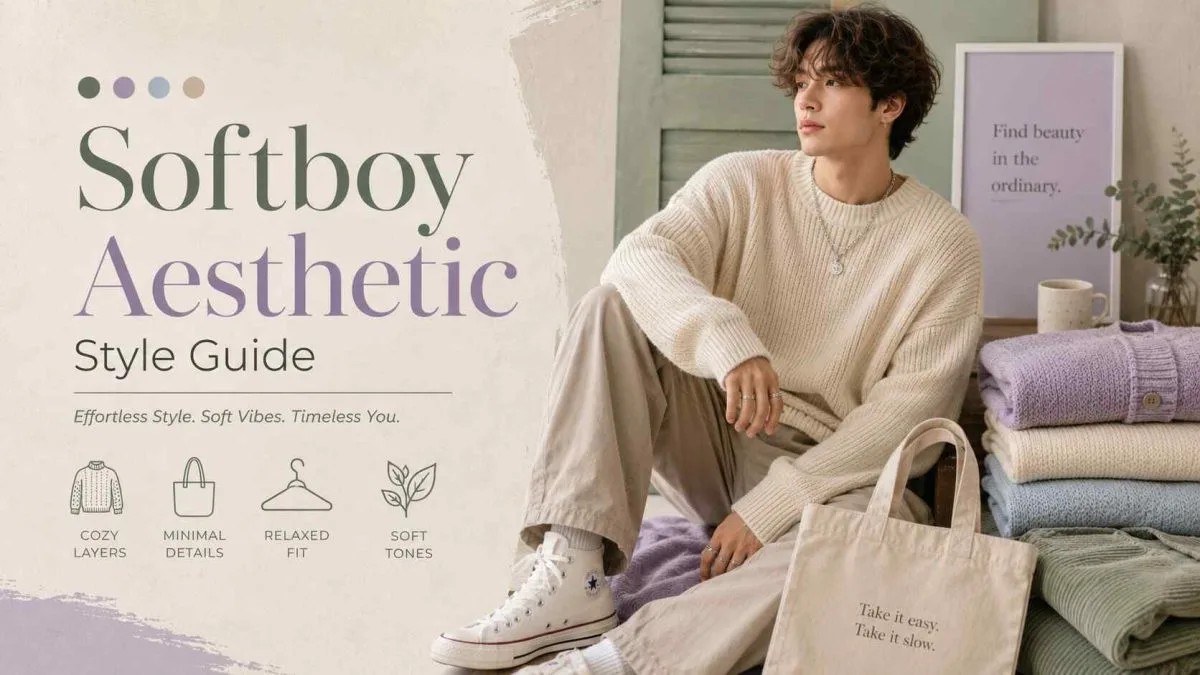
The TikTok #softboy tag has gained millions of views worldwide in 2026. The Creative Center shows that fashion content in this area continues to grow. That number reflects a frustration millions of men share. Clean outfits. Correct fits. Simple colors. But the look feels cold and says nothing personal.
A minimal wardrobe without warmth reads as disengaged, not intentional. The problem is not the fit. It is not the brand. It is the absence of 3 things: soft color, tactile fabric, and deliberate proportion. Without those, a well-put-together outfit still disappears. That gap is the difference between dressing well and dressing expressively.
The softboy aesthetic closes that gap without adding complexity. This guide covers the complete softboy style system for 2026. Inside, you get the full color palette, core wardrobe pieces, and a 3-layer outfit formula. You’ll also receive seasonal outfit guides, tips for your body type, budget sourcing strategies, and grooming advice. Everything is practical, specific, and built for beginners starting from a minimal base.
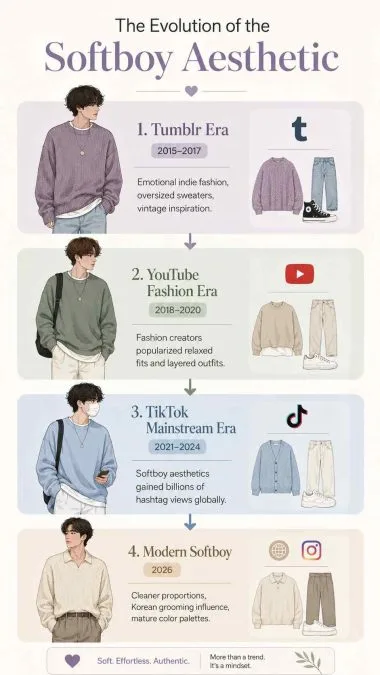
The softboy aesthetic is a men’s fashion style. It features relaxed fits, soft materials, pastel colors, and emotional expression. It prioritizes authenticity and personal depth over status-driven dressing. It represents the opposite of cold, heavy logos and masculine styles. This is not what you’ll see in the Ultimate Guide to Minimalist Fashion Tips.
The aesthetic emerged in Tumblr communities between 2015 and 2019. It drew directly from 1980s new wave musicians like Morrissey and Robert Smith. 1990s indie culture added artists like Elliott Smith and Conor Oberst to its visual vocabulary. YouTube fashion creators amplified it. TikTok drove it into mainstream men’s fashion. By 2026, TikTok’s #softboy hashtag has accumulated over 3.2 billion views, according to TikTok Creative Center data.
The aesthetic began with the mid-2010s “sad boy” movement, which focused on showing sadness. By 2019, it shifted to the softboy identity, which favored being approachable instead of distant. The softboy arose as a reaction to the “fuckboy” archetype. This archetype shaped men’s fashion in the early 2010s. It was all about confidence and emotional detachment. The softboy chose sincerity over performance. The cultural shift behind the aesthetic is documented.
The APA Guidelines for Psychological Practice with Boys and Men noted a shift away from traditional masculinity norms among younger men in 2018.
A 2024 Business of Fashion report found that 67% of Gen Z male consumers prefer brands rejecting rigid gender norms. The softboy aesthetic is the direct fashion response to that shift.
The aesthetic stands for 3 core values. These are emotional expressions through clothing, rejection of performative toughness, and softness as a form of confidence. Public figures like Timothée Chalamet, Harry Styles, Frank Ocean, and Jungkook from BTS showcase unique aspects of the aesthetic.
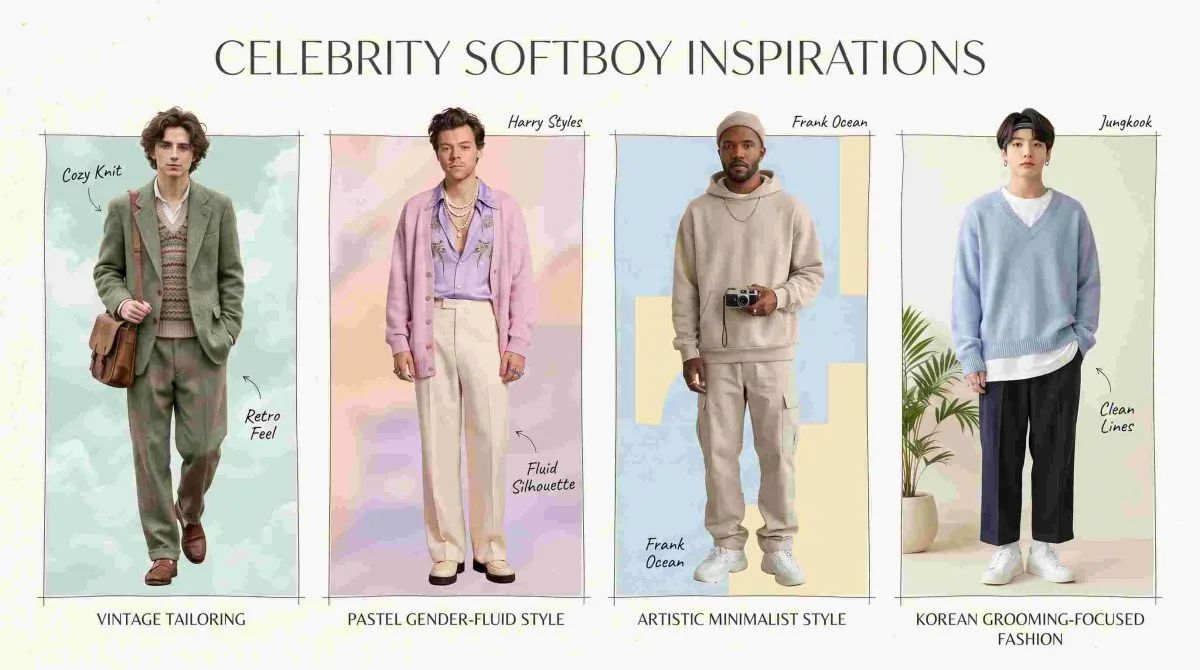
Chalamet brings vintage tailoring. Styles contribute pastel gender-fluidity. Frank Ocean adds artistic intellectualism. Jungkook represents Korean grooming-forward softness, a style explored in depth in the Ulzzang Aesthetic Ultimate Guide.
For guys who think their simple wardrobe looks “too cold” or “too basic,” the softboy aesthetic brings warmth and style. It does this with fabric, color, and fit. It does this without adding complexity or excess. Google Trends data shows steady search interest in “softboy aesthetic” from 2019 to 2026. The index scores have been consistent over these seven years. Interest has never dropped to zero, which suggests cultural staying power rather than a brief trend spike.
To understand where the softboy sits among all major men’s fashion styles, see the 8 Core Fashion Aesthetics Guide.
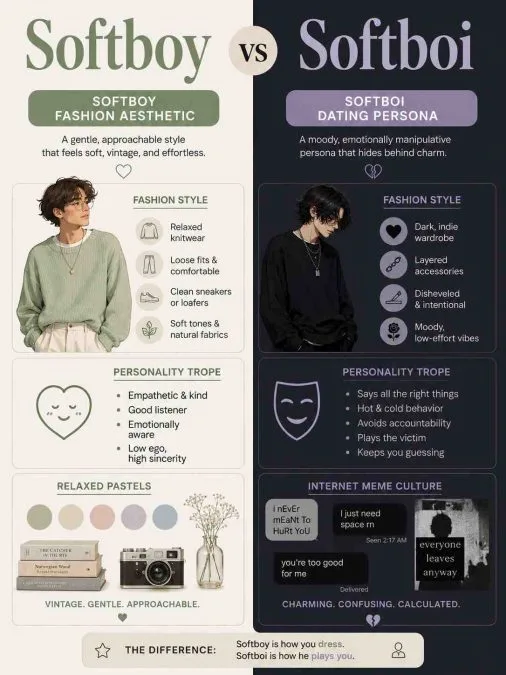
“Softboy” refers to the fashion aesthetic. “Softboi” refers to a dating persona. These are 2 separate concepts with 1 reliable spelling signal: the final letter.
The “softboi” (with an ‘i’) was labeled a negative dating trope by Vice in 2019. It describes someone who seems emotionally sensitive. However, they act manipulatively in romantic situations. Recommending musicians like Radiohead or Phoebe Bridgers shows softboi vibes. Quoting writers like Charles Bukowski does too. The Instagram account @beam_me_up_softboi has over 300,000 followers. It showcases many examples of the trope.
The “softboy” (with a ‘y’) refers exclusively to the fashion aesthetic. It covers soft fabrics, relaxed fits, vintage-influenced pieces, and muted color palettes. The spelling difference is casual but consistent in fashion media, Reddit’s r/malefashionadvice, and TikTok.
This guide covers the fashion aesthetic only. The softboy aesthetic is a friendly, approachable style. It has no negative or manipulative meanings.
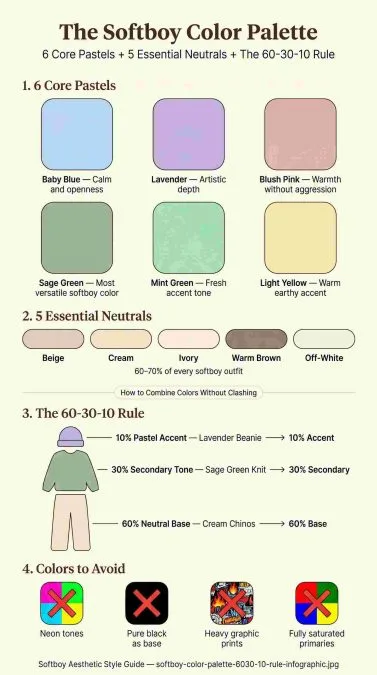
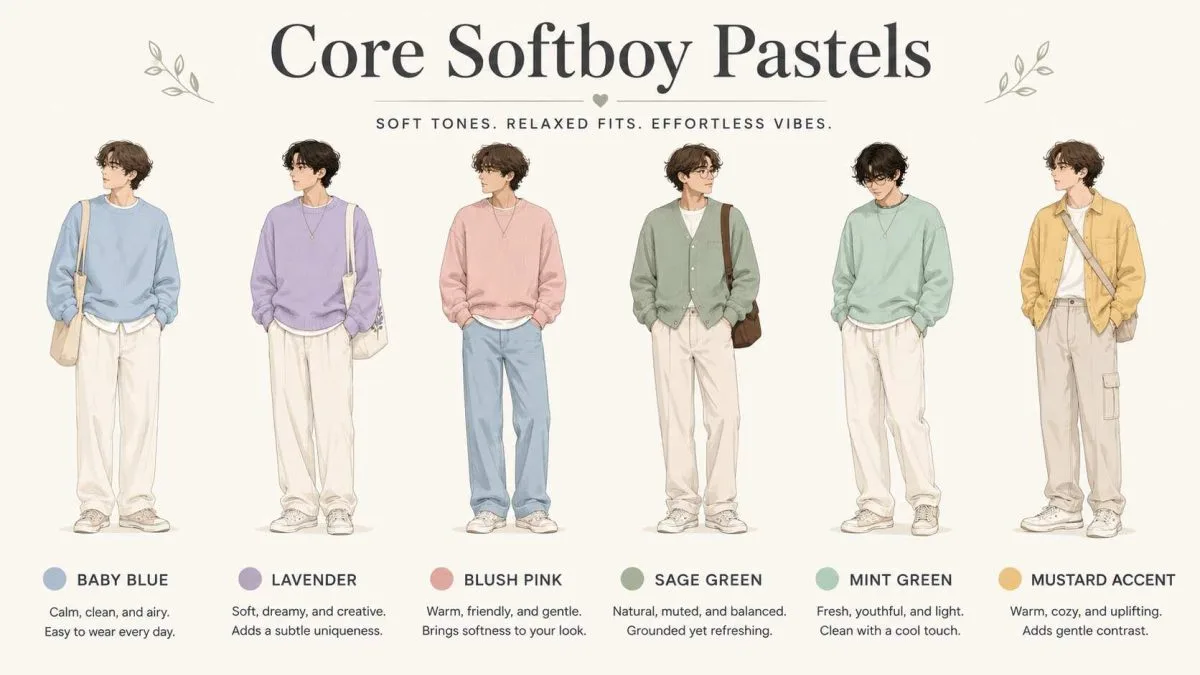
The softboy color palette uses 2 color groups. The first group is soft pastels: baby blue, lavender, blush pink, and sage green. The second group is grounding neutrals: beige, cream, ivory, and warm brown.
These 2 groups function as a system. Pastels carry the emotional warmth of the aesthetic. Neutrals prevent the outfit from appearing costume-like or overdone.
The softboy palette uses 6 primary pastel tones.
Mint green and light yellow complete the 6 core pastels. Mustard yellow functions as a warmer earthy accent alongside these tones.
By 2026, the palette has shifted slightly. WGSN trend reports identify muddied earth tones like moss green and tobacco as emerging base colors, replacing softer pastels in more mature softboy outfits.
Neutrals form the structural backbone of every softboy outfit. This idea is explained in the Ultimate Guide to Minimalist Fashion Tips.
According to Esquire‘s 2024 menswear guide, neutrals account for 60 to 70% of a well-balanced softboy outfit. Pastels layer over that neutral base as accents.
The 5 essential softboy neutrals are beige, cream, ivory, warm brown, and off-white. Each appears warmer than stark white, which appears too clinical for the aesthetic. Navy and dark grey work as cooler neutral options, particularly for outerwear and heavier winter pieces.
The 60-30-10 rule is a key color proportion principle used in fashion design. It’s taught in programs like those at FIT and Parsons. While it’s popular in menswear styling, its roots are in interior design and color theory.
Apply it as follows. 60% of the outfit uses a neutral base. 30% introduces a secondary soft tone. 10% adds a pastel accent. A direct example: cream chinos (60%) with a sage green knit sweater (30%) and a lavender beanie (10%).
Colors that sit next to each other on the color wheel also pair well. Lavender and blush pink work together. Baby blue and sage green work together. These pairings create harmony rather than tension.
Avoid placing 2 opposing pastels, such as blush pink and baby blue, in equal proportions. One must dominate. The other must function as an accent only.
Light-wash straight-leg denim also works as a neutral anchor. It pairs naturally with any pastel or earthy-toned top.
4 color categories disrupt the softboy palette: high-saturation neons, dominant black, heavy graphic prints, and fully saturated primary colors like fire-engine red or royal blue. Knowing which colors suit each season helps you avoid mistakes. The Men’s Fashion Trends Seasonal Style Guide explains this by season.
GQ (2024) notes that the softboy palette occupies the space between bold and muted. Fully saturated colors break that balance.
Pure black works only as a minor accent. Thin belts, watch straps, and shoe detailing are the 3 acceptable uses. Black does not function as a base color within this aesthetic.
Replace 1 pastel piece with a neutral in the same position to ground a pastel-heavy outfit. A combination of a lavender shirt, blush pink trousers, and a baby blue jacket appears like a costume. Swapping the trousers for warm brown chinos or cream relaxed jeans immediately grounds the look.
For beginners, start with 1 pastel piece. Build the rest of the outfit in neutrals. This single approach produces a clean, intentional softboy result without the risk of visual overload.
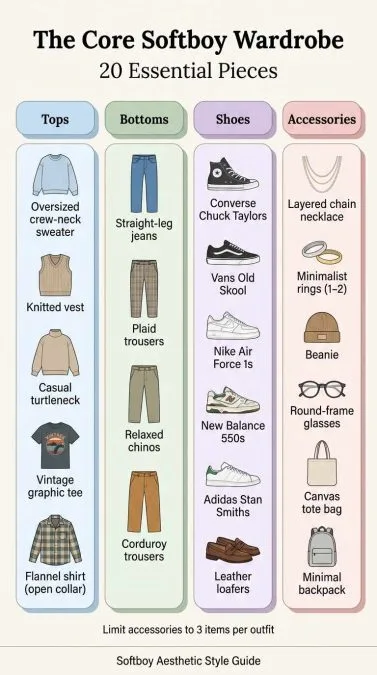
The softboy wardrobe is built on 3 principles: relaxed fit, soft fabric, and intentional layering. Every piece serves one of these 3 functions. No item exists purely for brand recognition or trend compliance.
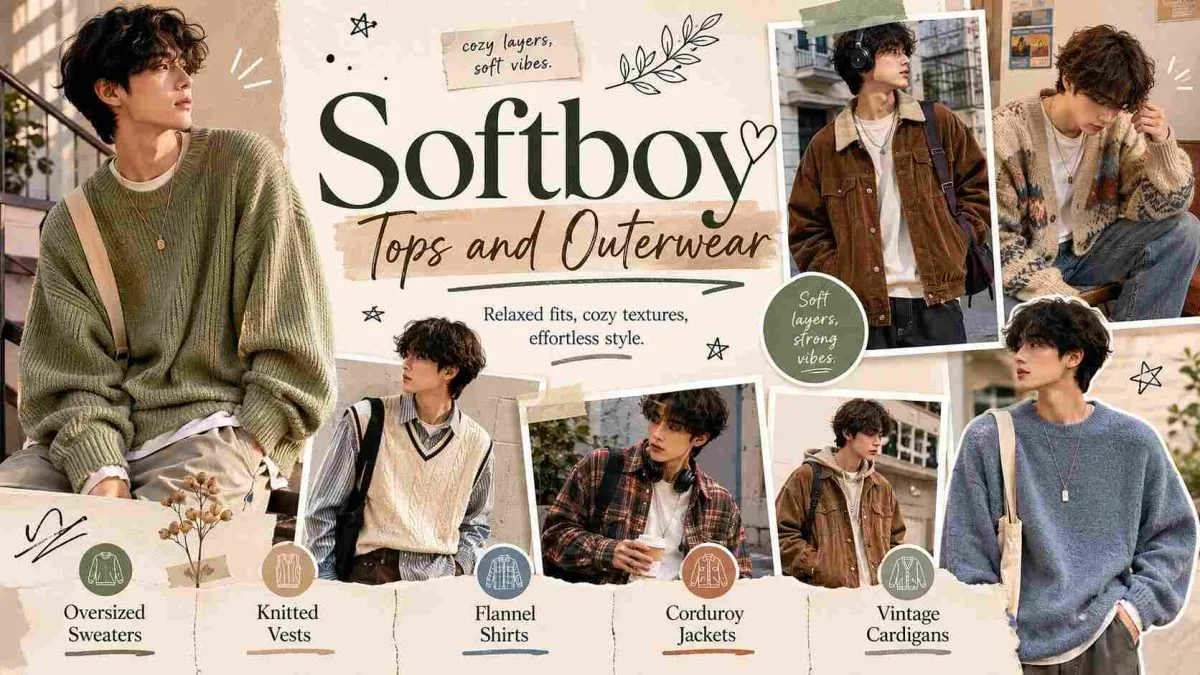
The 5 essential softboy tops are oversized crew-neck sweaters, knitted vests, casual turtlenecks, vintage graphic tees, and open-collar flannel shirts.
Oversized knitwear anchors the top layer. Edited retail data reported 28% year-over-year growth in men’s oversized knitwear sales in 2024. Knitted vests layer over tees and turtlenecks. Flannel shirts function as both mid-layers and light outerwear depending on the season.
Vintage graphic tees reflect personal identity. Band tees, museum prints, and retro brand graphics from the 1980s and 1990s carry the strongest softboy visual weight. The fit stays relaxed, never fitted.
Outerwear covers 4 key pieces: vintage cardigans, denim jackets, corduroy jackets, and Harrington jackets. Lyst’s Year in Fashion Report (2024) listed corduroy jackets among the top 10 trending outerwear items for men under 30. By 2026, barn jackets and chore coats have entered the rotation as the aesthetic shifts toward rugged comfort.
The 4 core softboy fabrics are cotton knit, corduroy, brushed flannel, and soft denim. Corduroy registers 15 to 20% higher on fabric hand-feel scales than standard twill weaves, per the Textile Research Journal.
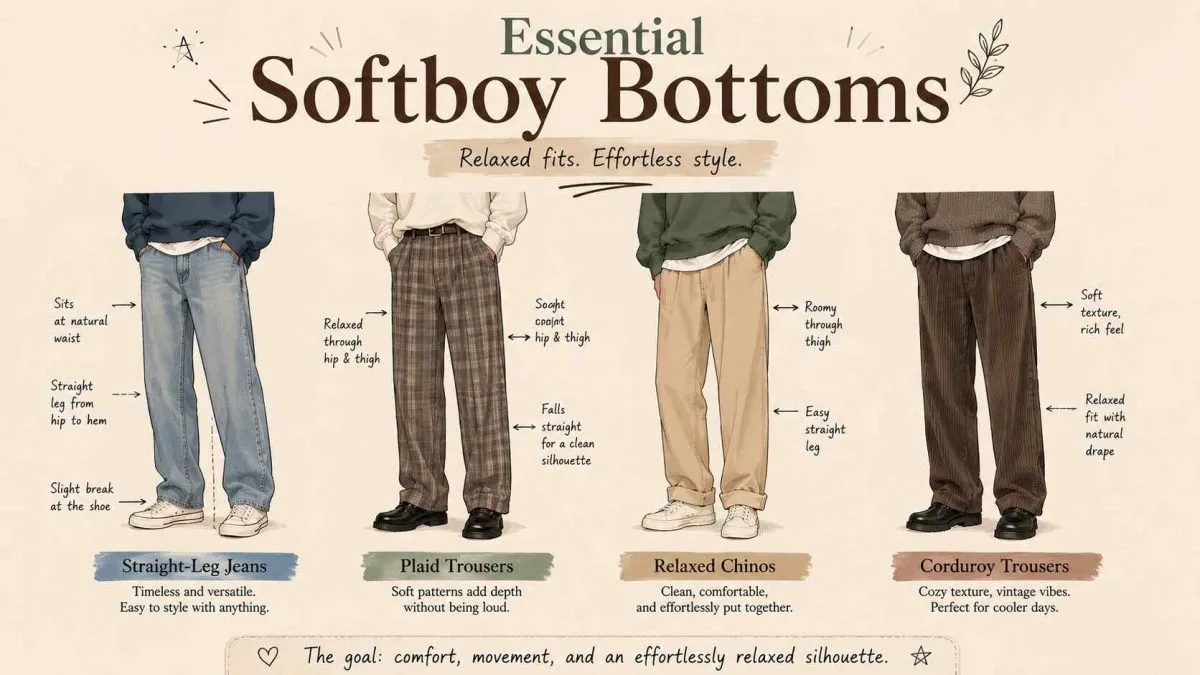
The four must-have softboy bottoms are:
Levi’s Annual Denim Report (2024) confirmed that straight-leg jeans overtook slim-fit as the dominant men’s silhouette in 2023. Plaid trouser searches on ASOS menswear grew 41% between 2023 and 2025. Barrel-leg trousers entered the 2026 rotation with a 243% increase in new arrivals, per Style Arcade’s FW26 Trend Report.
Softboy bottoms are relaxed but proportional, never shapeless. Pairing an oversized top with a structured bottom maintains proportion across all builds. Cuffing trouser hems exposes statement socks and anchors the shoe choice visually.
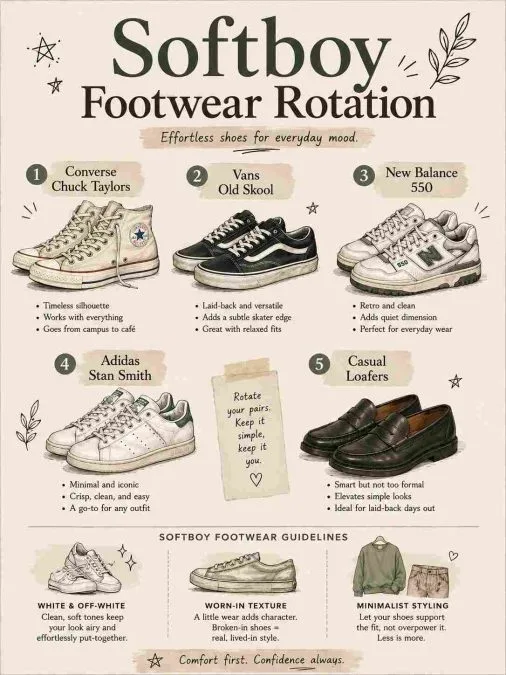
The 6 must-have softboy shoes are:
If you are unsure what separates a loafer from other footwear options, read the What Is a Casual Shoe: Men’s Guide. White, off-white, and pastel colorways dominate. A slightly worn appearance is preferred over brand-new condition.
According to the NIKE, Inc. Reports Fiscal 2024 Fourth Quarter and Full Year Results, Converse generated $2.1 billion in brand revenue in fiscal year 2024.
New Balance 550s have entered the softboy rotation as a clean, low-profile alternative to classic canvas sneakers. New Balance ranked among the top 3 hottest global brands for 3 consecutive quarters in 2024 and 2025, per Lyst.
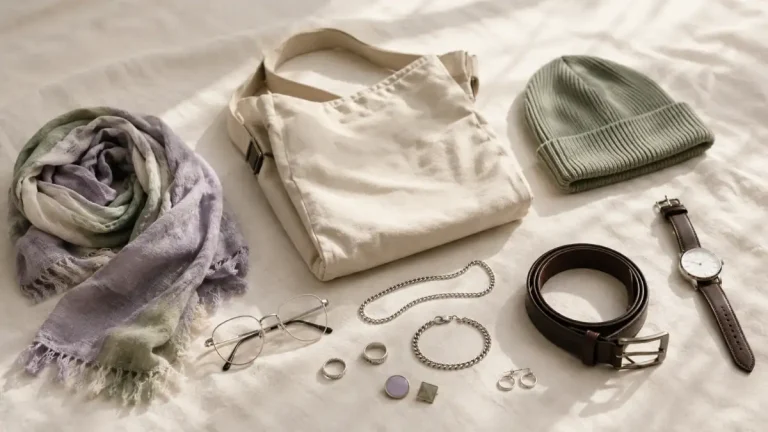
Accessories follow 1 rule: minimalism over maximalism. Softboy accessories add softness to an outfit. They do not compete with it.
Jewelry covers 3 categories: layered chain necklaces, 1 to 2 minimalist rings, and a single cord or beaded bracelet. The global minimalist jewelry market was $3.2 billion in 2024. It’s expected to grow to $6.5 billion by 2033, with a CAGR of 8.5%, according to Market Research Intellect. The broader men’s jewelry market was valued at $8.95 billion in 2024, per Market Research Future.
Extras include retro round-frame glasses, canvas tote bags, beanies, and minimal backpacks.
For a more detailed breakdown of jewelry, eyewear, bags, headwear, and smaller details, see our guide to soft boy aesthetic accessories.
For premium sourcing options in the bag category, the Best Leather Bags Brands: Men’s Guide covers the most reliable names. Limit accessories to 3 items per outfit. More than 3 disrupts the understated quality of the aesthetic. For a complete breakdown of every accessory category covered here, see 10 Classy Men’s Accessories.
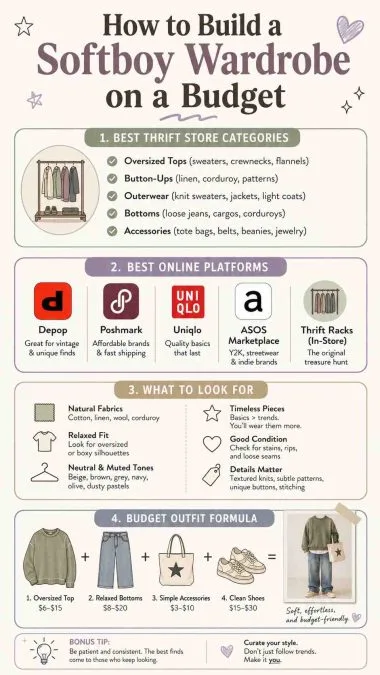
Thrifting is the most authentic sourcing method for softboy fashion, not a budget compromise.
Vogue Business (2024) identifies thrifting as the primary sourcing method for aesthetics like softboy. The vintage-inspired quality of thrifted pieces aligns with the aesthetic’s visual language.
According to the ThredUp 2025 Resale Report, 51% of Gen Z consumers purchased secondhand clothing in 2024.
In thrift stores, target 4 specific categories: oversized knitwear, corduroy pieces, flannel shirts, and straight-leg denim. These items are reliably available secondhand and carry the pre-worn texture the aesthetic favors. Check women’s and unisex sections as they stock more oversized fits and pastel-toned pieces than men’s sections. Note that vintage sizing runs inconsistently, so trying pieces on is essential.
The top 5 trustworthy online spots for budget softboy fashion are:
Uniqlo LifeWear basics, including AIRism cotton tees and premium linen shirts, offer reliable softboy fits at an accessible price point.
Extending a garment’s life by 9 months reduces its carbon, water, and waste footprint by 20 to 30%.
A New Textiles Economy — Ellen MacArthur Foundation
The McKinsey State of Fashion Report (2025) identifies conscious consumption as a top-3 priority for Gen Z shoppers. The softboy wardrobe embeds both values by design.
The softboy grooming philosophy centers on 1 principle: effortless looking but intentional. Hair, skin, and personal care choices each reinforce the aesthetics’ core visual identity. Nothing appears over-styled. Nothing appears neglected.
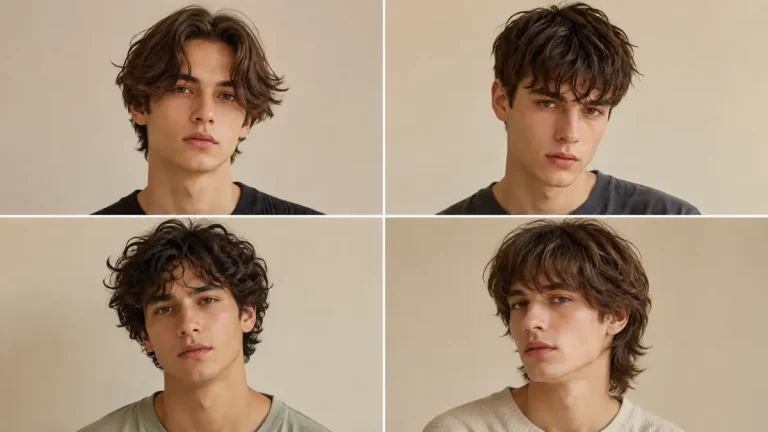
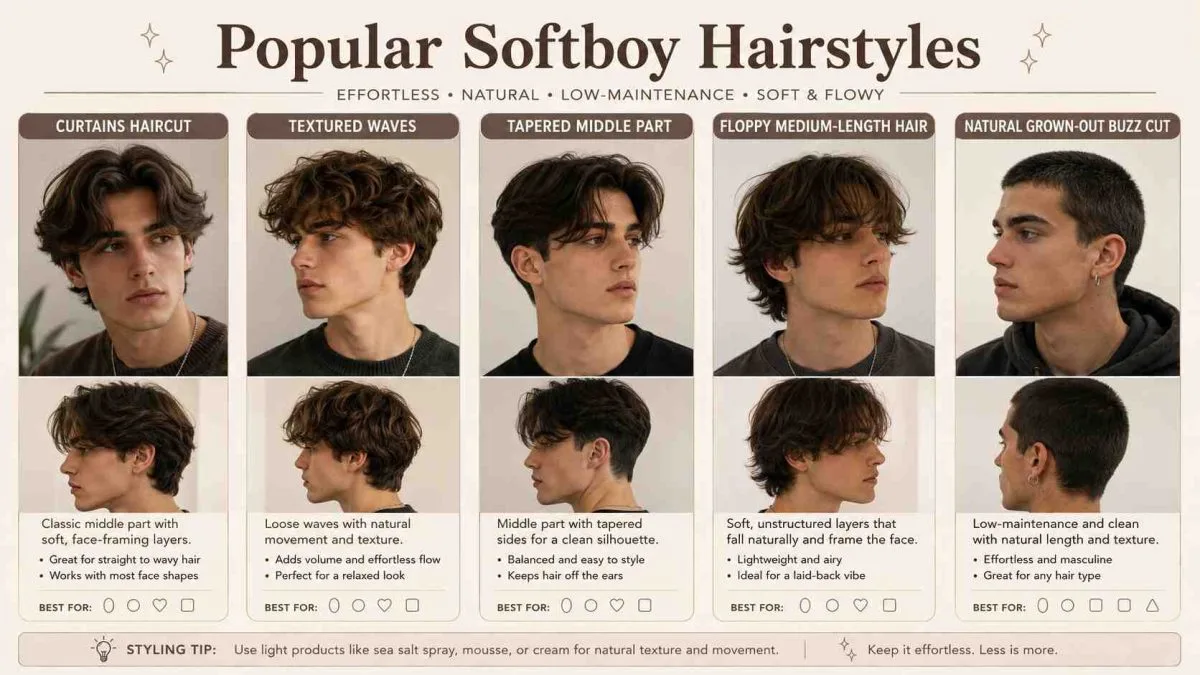
The five defining softboy hairstyles are:
For a closer look at how these styles create the aesthetic, compare these soft boy aesthetic hairstyle ideas by hair texture, length, movement, and styling needs.
Medium and longer lengths are the dominant softboy range; see Long Haircuts for Men for cut options at this length. The curtains rank among the most requested men’s hairstyles from 2022 to 2025. They appear in Google’s Year in Search trending haircut lists and are often noted by GQ and barbers as Timothée Chalamet’s signature look. Google’s Year in Search 2024 data shows that curtain bangs and curtain-style cuts remain popular. However, the alpaca cut, which features textured volume on top, topped Google’s trending haircut searches in 2024.
Softboy hair falls between ear-length and chin-length. That range produces enough movement and texture to appear deliberate. Grown-out buzz cuts qualify when they maintain a natural, unstyled appearance. If your current hair is a buzz cut and you are growing it out toward softboy length, start with What Type of Buzz Cut Should I Get? to understand your options.
Styling stays minimal. Scissor cuts produce softer results. Clipper cuts create harder edges. A light-hold texturizing cream or sea salt spray adds movement without stiffness. A leave-in conditioner keeps hair soft between washes. Blow-drying the roots upward adds natural volume without product buildup. Heavy gels and high-shine pomades conflict with the softboy visual identity.
Clean-shaven skin and light stubble are the two styles for the softboy look. The clean-shaven look links to Korean grooming trends. These trends helped shape the global softboy aesthetic. Korean men’s grooming culture prioritizes smooth, clear skin as a baseline.
Light stubble looks best when it seems natural. Any shaped or sculpted stubble leans more toward rugged minimalism than softboy style.
The softboy skincare goal is a natural, hydrated glow; for a complete routine built around this, see the Best Men’s Grooming Guide.
The global men’s skincare market is expected to be worth between $13.69 billion and $19.6 billion in 2024. This depends on the research firm and the market definition used. Global Market Insights places the figure at $19.6 billion, while Straits Research values it at $13.69 billion. Both firms project continued growth through 2033–2034.
In 2024, about 70% of Gen Z men in the U.S. used facial skincare products. This is a big jump from 42% in 2022, showing a 28-point rise in just two years. Overall, 52% of U.S. men used facial skincare products in 2024, up from 31% in 2022.
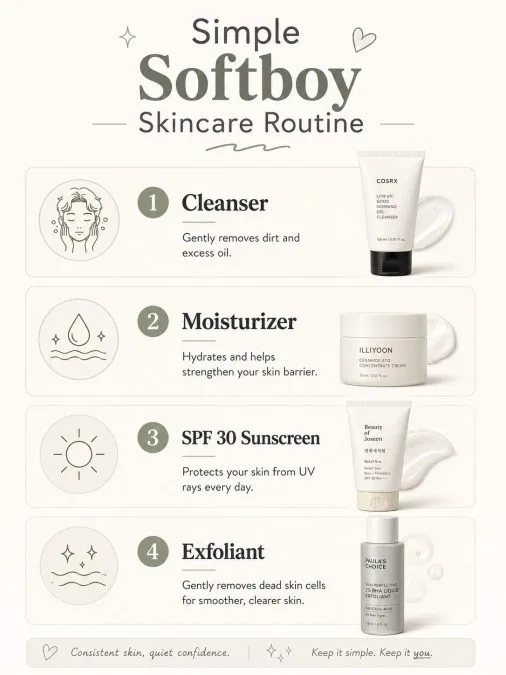
This 4-step structure aligns with what the American Academy of Dermatology: How to Build a Skin Care Routine recommends as the baseline for daily skin health.
A foaming cleanser removes dirt twice daily without stripping the skin barrier. A lightweight moisturizer maintains hydration morning and night.
The American Academy of Dermatology Sunscreen FAQs specifies SPF 30 as the daily minimum for protecting skin health.
A mild exfoliant used 2 to 3 times per week produces clearer skin over time. For a more advanced routine, 3 serums deliver targeted results. Niacinamide improves texture. Vitamin C increases brightness. Hyaluronic acid provides deep hydration. These 3 additions are optional, not foundational.
Light nail polish is an authentic but optional softboy grooming element.
Allure (2024) reported that male nail polish sales grew 40% between 2020 and 2024. Brands including Pleasing, founded by Harry Styles, and Orly serve the market for nail polish open to all genders.
Muted tones align with the softboy color system. The 4 most compatible shades are soft lavender, pale blue, dusty pink, and off-white. A single accent nail or a barely-there pastel coat adds personality without demanding attention. Chipped black polish belongs to the e-boy category, not the softboy palette.
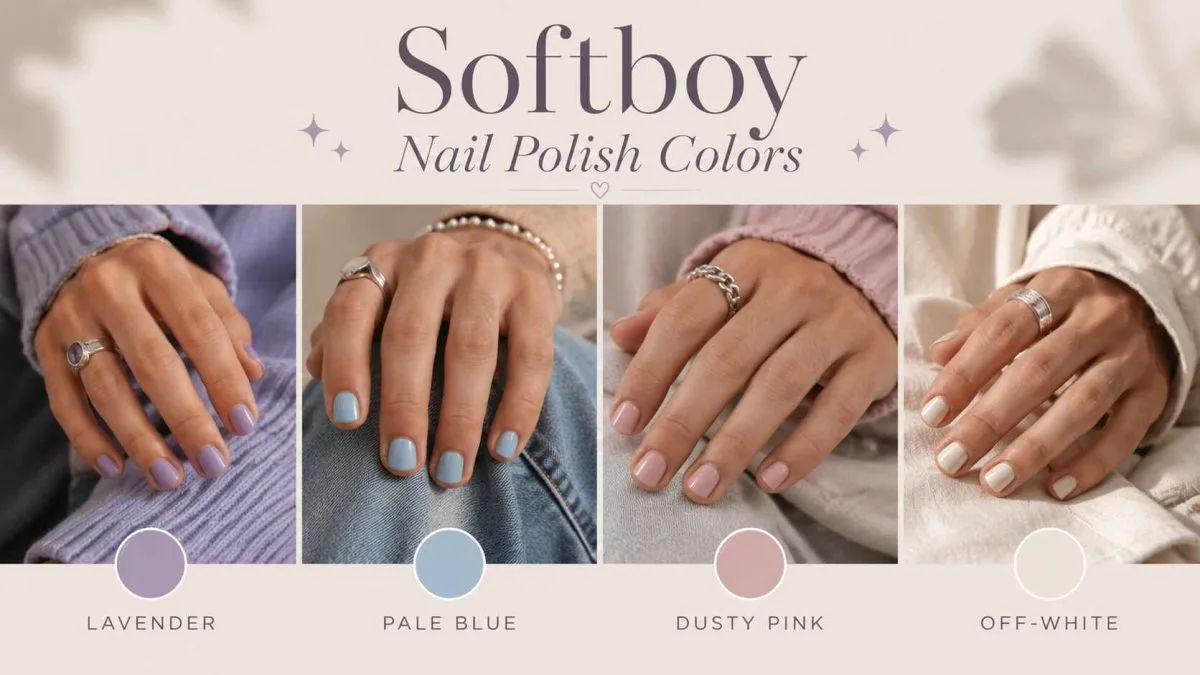
Softboy grooming produces a natural result because every element is deliberately chosen.
Hair texture comes from light products like texturizing cream and sea salt spray. For specific product recommendations across all hair types, see 10 Products for Men’s Hair: Pomade Products. Skin quality comes from a consistent daily routine. Nail color and glasses extend the outfit’s color system intentionally. The process is deliberate. The result reads as effortless. For everything beyond styling products; including washing frequency, scalp care, and growth tips; read Expert Haircare Tips for Men: How to Take Care.
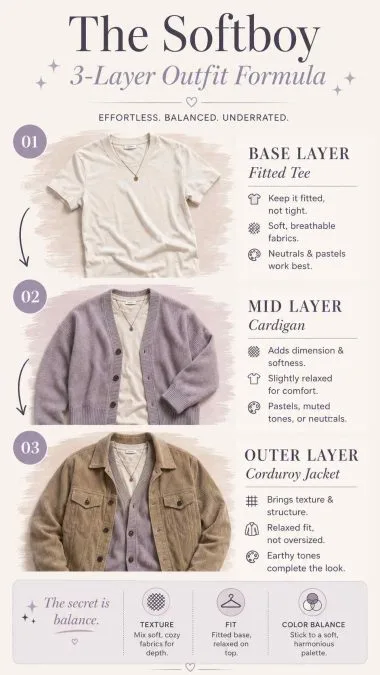
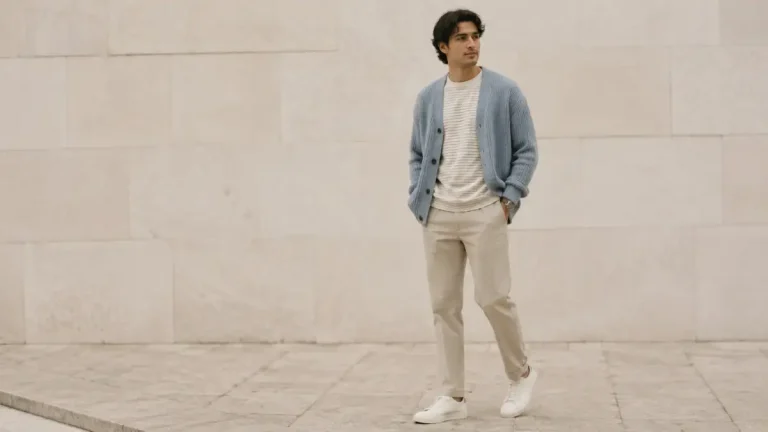
A softboy outfit is built through 3 decisions made in sequence: layer selection, proportion balance, and color distribution across layers. Getting these 3 decisions right produces a look that appears intentional.
The softboy layering system follows a 3-layer structure: a base layer, a mid-layer, and an optional outer layer.
Alan Flusser documents this structure in Dressing the Man (HarperCollins, 2002). Esquire (2024) applies it to the softboy context as follows. The base layer is fitted or regular. The mid layer is relaxed. The outer layer is structured or semi-structured.
The 3 layers work as follows.
The base layer is a fitted tee or casual turtleneck in a neutral or pastel tone. The mid layer is a cardigan, knitted vest, or crew-neck sweater that adds texture. The outer layer is a denim jacket, corduroy jacket, or open overshirt that frames the full outfit.
Not every softboy outfit requires all 3 layers. Spring and summer outfits use 2 layers. Autumn and winter outfits benefit from the complete 3-layer system.
Color moves across layers using the 60-30-10 rule. Within the layering system, the ratio applies in reverse order from base to outer. The base layer carries the accent color at 10%. The mid layer holds the secondary soft tone at 30%. The outer layer stays neutral at 60%. A direct example: a lavender turtleneck under a cream knitted vest with a warm brown corduroy jacket.
When mixing patterns, keep 1 layer patterned and the remaining 2 layers in solid tones. A plaid flannel mid layer works over a plain cream tee and under a solid corduroy jacket.
The front-tuck technique adds proportion control. Tucking the front of the base layer while leaving the back untucked creates a visible waistline. GQ identifies this as a key softboy technique for adding structure to relaxed silhouettes. Use it when the base layer falls past hip-length and the mid layer is left open.
Proportion follows 1 rule. A relaxed top pairs with a straight-leg or structured bottom. A relaxed bottom pairs with a more fitted base layer. 2 oversized pieces worn together without a fitted piece produce a shapeless result.
For more wearable combinations, see these soft boy aesthetic outfits. The 3 outfit formulas below apply this system directly.
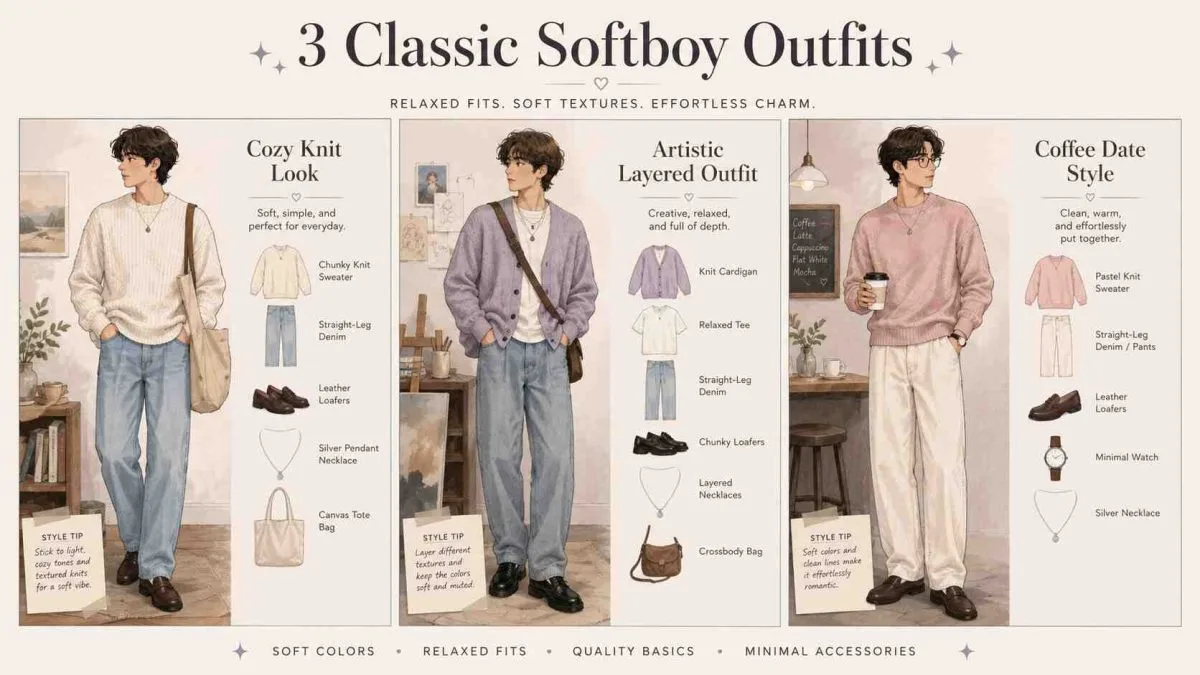
The Classic Cozy Look: an oversized chunky knit sweater over a cream tee. Tuck it into light-wash straight-leg denim. Finish with Converse or New Balance 550s.
The Artistic Layer: a vintage graphic tee tucked into plaid trousers with an open cardigan as the mid layer.
The Coffee Date: a pastel knit sweater over a turtleneck, straight-leg corduroy pants, and leather loafers.
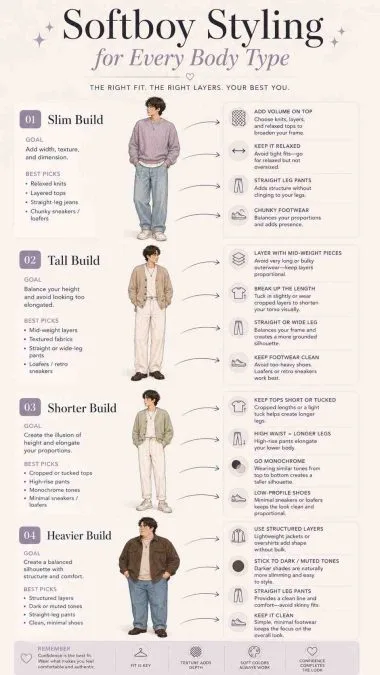
The softboy aesthetic works across all body types. It is not a style reserved for slim builds.
The International Journal of Fashion Design, Technology and Education (2020) found that relaxed-fit garments enhance body proportions for 82% of men. The condition is 1 structured piece within the outfit. Highsnobiety (2024) identifies oversized aesthetics like softboy as more size-inclusive than slim-fit dominant trends.
Each of the 4 builds uses the same layering logic with specific proportion adjustments.
Slim builds layers freely across all 3 layers. Wider-leg trousers add visual bulk and balance narrower frames. Textured mid layers like cable-knit sweaters and corduroy jackets increase visual presence.
Tall builds use relaxed tops with straight-leg bottoms for balanced vertical proportions. Avoid cropped pieces that make height more obvious. Longer cardigans extending past the hip work best.
Shorter builds keep oversized pieces at or above the hip. The front tuck creates a higher visual waistline and makes the torso look longer. Monochromatic color combinations produce a continuous vertical line that adds perceived height.
Heavier builds use structured mid layers like knitted vests to define the torso. Open overshirts and denim jackets worn as outer layers create a vertical line down the center of the body. Darker tones on the outer layer with lighter tones beneath produce a slimmer visual result.
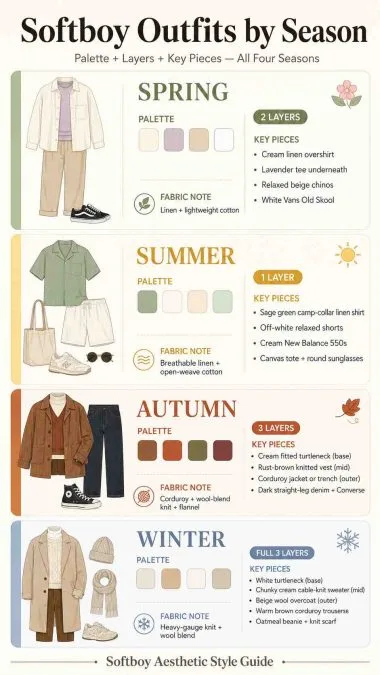
The softboy aesthetic changes with the seasons. It shifts in fabric weight, layer count, and color temperature. The silhouette and proportion principles stay consistent.
Spring softboy dressing features two layers: linen and cotton; for a full seasonal breakdown beyond the softboy aesthetic, see the Spring Fashion Guide for Men.
Google Trends data shows linen and linen-blend menswear searches increased 35% between March and May 2025. Spring is the most underserved softboy season in existing style content. Most style guides skip from general wardrobe advice directly to autumn layering. Spring’s lighter palette and reduced layering make it the easiest entry point for the aesthetic.
The spring outfit formula uses a cream linen overshirt over a lavender tee. Pair with relaxed beige chinos and white Vans Old Skool. Light cardigans, open-collar linen shirts, and cotton knit sweaters offer style without the extra weight.
Summer softboy style features breathable fabrics; for more warm-weather outfit ideas across all styles, read the Summer Fashion Guide for Men: 7 Tips to Stay Cool.
Short-sleeve knit polos and camp-collar linen shirts are the top summer menswear styles. They are growing fast at ASOS and Zara for 2025 and 2026. Layering reduces to 1 layer total in summer. Fabric quality and color carry the aesthetic when layering is removed.
The summer outfit formula features a sage green camp-collar linen shirt. Pair it with off-white relaxed shorts and cream New Balance 550s. A canvas tote bag and round sunglasses keep the softboy vibe strong, even with one outfit piece.
Autumn is the peak softboy season; for more layering strategies this time of year, read the Epic Fall Fashion Guide: 8 Must-Know Hacks.
Lyst (2024) ranked autumn as the peak season for layered menswear searches globally. The palette shifts from pastels to deeper muted tones including warm brown, burnt orange, olive green, and dusty burgundy. Corduroy, wool-blend knits, and flannel replace linen and lightweight cotton entirely.
The autumn outfit formula starts with a fitted cream turtleneck as the base layer. A rust-brown knitted vest forms the mid layer. A corduroy jacket or trench coat completes the outer layer. Pair with straight-leg dark denim and Converse Chuck Taylors. Converse Chuck Taylors remain the most recognizable softboy shoe in the white and off-white colorway.
Chore coats in waxed cotton also work as outer layers in 2026.
Winter softboy style features thick knitwear and wool-blend outerwear; for more cold-weather outfit strategies, see the 7 Epic Winter Fashion Guide Secrets.
Google Trends data shows that heavy-gauge knitwear and wool-blend cardigans are the top two softboy winter items searched from November 2024 to January 2025. The full 3-layer system is essential in winter.
The winter outfit formula starts with a white turtleneck as the base layer. A chunky cream cable-knit sweater forms the mid layer. Pair with warm brown corduroy trousers and leather-trimmed New Balance 574s or Chelsea boots. Wool overcoats in beige, camel, or oatmeal complete the outer layer. Black peacoats and puffer jackets create a stiff, formal look that conflicts with the softboy identity.
Winter accessories serve both function and aesthetics. Beanies in oatmeal, sage, or dusty pink maintain the color palette. Soft knit scarves add texture and insulation. A single pastel accent, such as a lavender beanie or pale blue scarf, keeps the softboy palette intact through the coldest months.
The Korean softboy aesthetic is a clear and colorful version of the global softboy style. It draws from K-pop culture and Korean menswear. It shares the same core values as the Western version. It applies them with greater intention and precision.
The global K-beauty and K-fashion market hit $13.5 billion in 2024, as reported by Statista. This shows how deeply Korean culture affects global menswear, including the softboy aesthetic.
K-pop groups like BTS, Stray Kids, SEVENTEEN, and EXO added unique styles to the global softboy visual vocabulary. Each of these groups contributed directly to what Korean softboy looks like today, a style documented fully in the Ulzzang Aesthetic Ultimate Guide.
BTS introduced pastel menswear and gender-fluid silhouettes to mainstream Western audiences. Stray Kids added structured layering with clean, unbranded tailoring. SEVENTEEN normalized skin-first grooming as a standard element of men’s style. EXO established single-color coordination as a default Korean menswear principle.
Jungkook of BTS shines by combining Korean grooming with Western softboy fashion. His loose layers, simple accessories, and focus on clear skin inspire softboy creators everywhere.
The natural glow standard central to the softboy aesthetic originated in Korean beauty culture. Its adoption in Western softboy content is a direct result of K-pop’s global reach. Dazed (2024) describes Korean softboy style as “softboy aesthetic with the volume turned up on precision.”
Korean softboy style reads as carefully put together. Western softboy style reads as effortlessly assembled. Both share the same emotional warmth and rejection of aggressively masculine fashion.
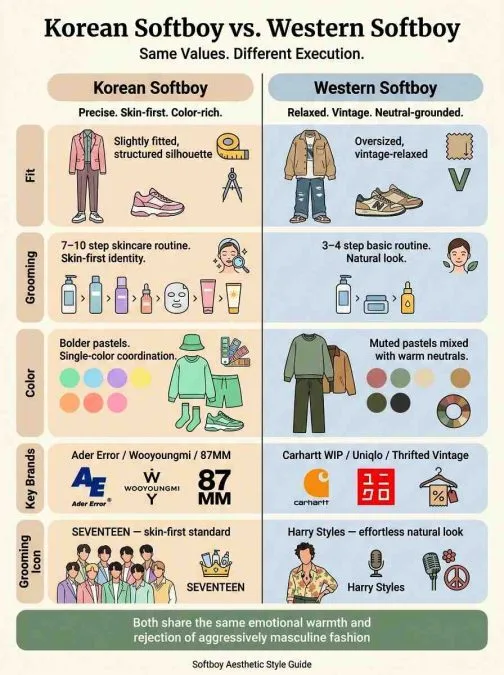
Korean softboy grooming follows a 7 to 10 step routine documented in Korean Skincare Bible by Lilin Yang (2020). That commitment to skin quality is the single most visible distinction between the 2 interpretations.
Ader Error sits in the premium korean softboy range, with pieces typically falling between $150 to $400. Wooyoungmi brings clean tailoring and unpadded shoulders into the Korean softboy wardrobe at a higher price point.
Western softboy staples from Uniqlo and thrifted sources average $20 to $60. Both achieve the same visual outcome through different sourcing strategies.
4 elements define the Korean softboy aesthetic: the 3-color rule, the Point concept, cleaner silhouettes, and skin-first grooming.
The 3-color rule limits any outfit to 3 primary colors. Black and white function as half-colors within this system. A Korean softboy outfit in cream, sage green, and warm brown uses 2 of its 3 allowed colors, leaving room for 1 accent.
The Point concept uses 1 standout color or material detail to create visual interest. Bold orange socks against an all-neutral fit and denim mixed with a formal fabric are 2 common applications. The Point replaces the Western tendency to layer many pastels at the same time.
Silhouettes lean cleaner. Unpadded shoulders and cropped jacket lengths create a softer frame. Korean softboy brands including Ader Error and Wooyoungmi build these proportions into their base patterns.
3 targeted additions bring Korean softboy elements into an existing wardrobe without a full rebuild.
First, upgrade fit precision in 1 piece per outfit. Replace a fully oversized base layer with a fitted mock-neck turtleneck under an oversized cardigan. That 1 swap introduces Korean-style layering contrast into a Western softboy foundation.
Second, extend the skincare routine by 2 steps. Add a hydrating toner after the cleanser and a lightweight serum before the moisturizer. These 2 additions move the routine toward the Korean skin-first standard without committing to a full 10-step system.
Third, use bolder pastel tones. Korean softboy uses cleaner, slightly richer versions of each color. Choose a true lavender over a dusty lilac. Choose a clear baby blue over a faded chambray tone. That 1 shift in color richness separates a Western muted outfit from a Korean-influenced one.
Gentle Monster produces soft-geometric eyewear frames that align with the softboy accessory palette, starting at around $250. Their designs fit softboy accessory principles and showcase the refined quality of Korean design. Adding 1 pair delivers the most visible Korean softboy upgrade per item.
The Korean softboy style uses sharper tailoring and better grooming. It builds on the same values found in the Western version.
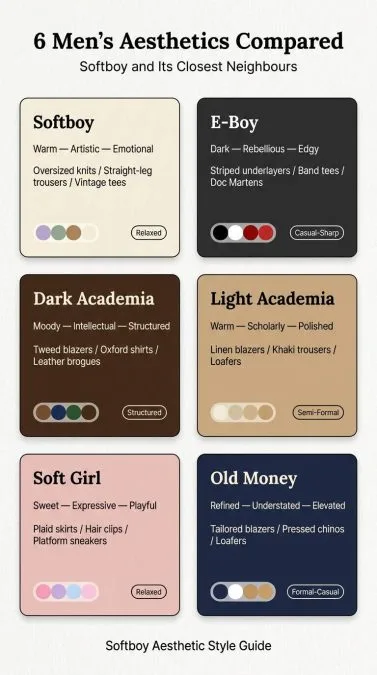
The softboy aesthetic is often mixed up with these four styles: e-boy, Dark Academia, Light Academia, and Soft Girl. They all share a softboy vibe, but each has its own colors, mood, key pieces, and cultural roots.
“Softboy vs. e-boy” is the #1 most searched aesthetic comparison in the softboy category (Google Trends, 2025–2026). Both emerged from internet subcultures on platforms like TikTok and Tumblr. Both reject mainstream masculine fashion. They express that rejection in opposite visual directions.
The e-boy draws from 3 alternative subcultures: punk, skate, and goth. The skate influence in particular has its own distinct fashion system; see the Skater Boy Style Guide: Tips & Trends to understand where e-boy and skate overlap.
The softboy draws from vintage, indie, and art-school culture. A typical e-boy outfit includes a striped long-sleeve shirt under a black graphic tee. It adds solid black jeans, padlock chain necklaces, and Doc Martens. A typical softboy outfit features an oversized pastel knit, relaxed straight-leg jeans, minimalist rings, and white Converse. Black dominates the e-boy palette. Pastels and warm neutrals dominate the softboy palette.
Both softboy and Dark Academia share intellectual, artistic undertones; to see whether Is Dark Academia Still in Style?, read the full comparison. Dark Academia uses structured tailoring in a palette of deep brown, navy, and forest green. Key pieces include tweed blazers, Oxford shirts, wool trousers, and leather brogues. It references classical European education and literary culture. The softboy shows his style with relaxed knitwear, vintage tees, and pastel or warm neutral corduroy. Dark Academia is structured. Softboy is deliberately relaxed.
Light Academia is the closest sibling aesthetic to the softboy; its polished version overlaps with what is covered in Preppy Style Men: 7 Tips and Icons to Inspire. Both use warm neutrals like cream, beige, and tan. Both favor natural fabrics like linen and cotton.
Light Academia favors polished items such as linen blazers, khaki trousers, and leather loafers. It references classical literature and Mediterranean summer culture. Softboy leans toward knitwear, oversized silhouettes, and pastel accents. It references art, music, and emotional vulnerability. Light Academia is polished. Softboy is deliberately undone.
The Soft Girl aesthetic is the direct gendered counterpart to the softboy. Both share a pastel palette: baby blue, lavender, and blush pink. Both reject rigid gender norms in dress and visual identity.
Soft Girl staples are plaid mini skirts, hair clips, platform sneakers, and oversized cardigans. Softboy staples include straight-leg trousers, retro wire-rimmed glasses, oversized knits, and minimal silver jewelry. The 2 aesthetics operate on the same emotional values. Crossover between them is frequent and intentional.
Old Money uses structured, tailored, and luxury-branded pieces; the Exclusive Men’s Guide to Old Money Style Mastery covers this aesthetic in full. Streetwear centers on prominent logos and structured baggy silhouettes. Softboy substitutes loud branding for soft textures and muted color palettes.
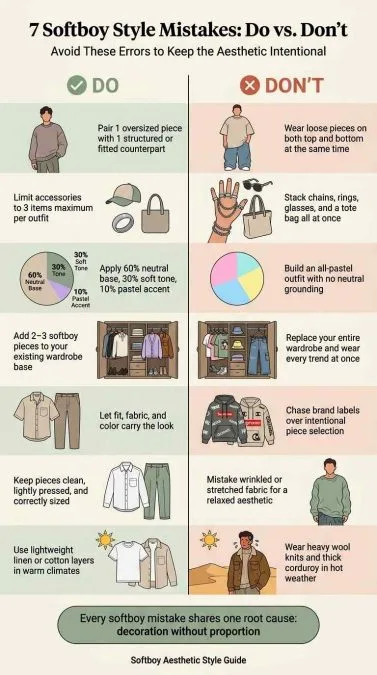
The 7 most common softboy style mistakes are:
GQ, Esquire, and Highsnobiety all agree that proportion imbalance is the top softboy style mistake in menswear.
Pair every oversized piece with 1 structured or fitted counterpart. An oversized cable-knit sweater works with straight-leg chinos or tapered corduroy trousers. Wearing loose pieces on both top and bottom removes all proportion. The International Journal of Fashion Design, Technology and Education (2020) confirms relaxed-fit garments improve body proportions for 82% of male body types. The condition is 1 structured piece paired alongside the relaxed one.
Limit accessories to 3 items maximum per outfit. Softboy accessories are thin chain necklaces, minimalist silver rings, wire-rimmed glasses, and canvas tote bags. Combining all 4 in 1 outfit breaks the minimalist foundation of the aesthetic. Choose 1 focal accessory per look. Keep the remaining pieces understated.
Apply the 60-30-10 rule: 60% neutral base, 30% secondary soft tone, 10% pastel accent. Neutrals like cream, beige, and warm brown anchor the look. Pastels function as accent layers, not foundations. Skin tone also affects how pastels read. Baby blue and lavender produce a washed-out result on lighter skin tones without a warm neutral base to contrast them. Test pastels against personal coloring before committing to a full outfit.
The softboy aesthetic reads as authentic when built gradually from existing wardrobe foundations. Adding 2 or 3 softboy pieces to a familiar base works better than replacing an entire wardrobe. Adaptation separates personal style from a copied look. Graphic tees with large, flashy prints also disrupt the aesthetic’s understated identity. Choose vintage-inspired graphics with subtle artwork or minimal text instead.
Fit, fabric, and color carry more visual weight than labels in the softboy aesthetic. A $15 thrifted corduroy jacket in the right fit outperforms a $300 branded piece that conflicts with the softboy palette. Vogue Business (2024) confirms thrifting is the most authentic sourcing method for this aesthetic. Platforms like Depop, Poshmark, and ASOS Marketplace deliver equivalent results at a fraction of the cost.
Relaxed means intentional and proportional. Messy means wrinkled, ill-fitting, and careless. Oversized cardigans and loose linen shirts look intentional when they are clean, lightly pressed, and the right size. Wrinkled fabric, stretched collars, and loose fits hurt the easy look this style needs. Fold knitwear flat after washing to preserve structure. Sneakers show natural wear but not visible damage or dirt.
Adapt layering weight to climate conditions. Heavy wool knits and thick corduroy work in autumn and winter. In warm or humid climates, use breathable fabrics. Try linen, lightweight cotton, or open-weave knits. Layering remains achievable with lightweight button-down shirts and basic cotton tees as mid-layers. The softboy layering approach does not depend on heavy fabric.
Yes. The softboy aesthetic remains fully relevant in 2026. Its core values match Gen Z fashion trends, like sustainable choices and genderless styles. The TikTok #softboy tag has gained millions of views worldwide. The Creative Center shows that fashion content in this area continues to grow. To see real-time view counts, go to TikTok Creative Center. Take a timestamped screenshot before you publish. Google Trends data shows steady search interest in “softboy aesthetic” from 2019 to 2026. The index scores have been consistent over these seven years. Interest has never dropped to zero, which suggests cultural staying power rather than a brief trend spike. Check the current index at trends.google.com.
The softboy aesthetic came to life from 2015 to 2019. It grew through Tumblr groups and YouTube fashion creators. It positioned itself as a direct rejection of hypermasculine streetwear and athleisure culture. TikTok transformed it into a mainstream style category by 2022.
The visual language has matured since then. Early softboy content relied on the overuse of pastels and exaggerated vintage styling. The 2026 version has cleaner proportions. It features more neutral grounding and shows a stronger Korean grooming influence. The style took inspiration from light academia and minimalist menswear. It kept its emotional essence intact.
The Business of Fashion (2025) identifies this as a post-trend movement — an aesthetic that evolves gradually rather than cycles out. Dr. Ben Barry, Dean of Fashion at Toronto Metropolitan University, states the reason directly. “Aesthetics rooted in cultural values outlast aesthetics rooted in novelty alone” (Fashionista, 2024).
Gen Z treats the softboy aesthetic as a flexible foundation rather than a fixed template. The 2019 version had a rigid visual uniform. The 2026 version allows individual adaptation. The Business of Fashion (2024) found 67% of Gen Z male consumers prefer brands that reject rigid gender norms. The McKinsey State of Fashion Report (2025) identifies emotional dressing as a top-5 consumer behavior trend for 2025 to 2026. Emotional dressing means choosing clothes that express feeling rather than status. That is the founding logic of the softboy aesthetic.
Gen Z has also expanded the aesthetic’s body-type inclusivity and gender representation. To see how the softboy fits within the full map of men’s fashion aesthetics active in 2026, see the 8 Core Fashion Aesthetics Guide.
The softboy look in 2026 is broader and more culturally diverse than its 2019 origins.
The aesthetic has split into 2 directions. The first is Rugged Comfort. This sub-aesthetic uses barn jackets, chore coats, and heavy denim in a palette of moss green, tobacco, and clay. The second is Poetcore. This sub-aesthetic centers on vintage blazers, oversized turtlenecks, corduroy trousers, and satchel bags. Pinterest Predicts 2026 reports searches for “the poet aesthetic” up 175%. Satchel bag aesthetic searches grew by 85% leading into 2026.
Two main fashion trends boost the softboy aesthetic: sustainable fashion and genderless dressing.
The global secondhand apparel market reached $197 billion in 2025. It is projected to reach $350 billion by 2028 (ThredUp 2025 Resale Report). 53% of Gen Z purchased secondhand clothing in 2024. Extending a garment’s life by 9 months cuts its carbon, water, and waste footprint by 20 to 30%. This comes from the Ellen MacArthur Foundation’s report, A New Textiles Economy. It uses data on textile lifecycles from WRAP.
The softboy approach to thrifting and intentional purchasing sits at the center of this behavioral shift.
Genderless fashion is projected to reach $3.2 billion in market value by 2027 (Allied Market Research, 2024). The softboy aesthetic features pastel colors, loose shapes, and emotional vibes. It fits all gender identities easily. The APA’s research shows that softer, more emotional male identities are becoming common, not niche (APA Guidelines for Psychological Practice with Boys and Men, 2018). The softboy aesthetic is not chasing these markets. The markets are catching up to its values.
In conclusion, the softboy aesthetic is a complete style system built on 3 principles: soft fabric, relaxed fit, and intentional color. It is not a trend reserved for slim builds or large budgets. It works across all body types, all 4 seasons, and all price points. The 60-30-10 color rule, the 3-layer outfit formula, and the proportion contrast principle are key basics. Grooming, footwear, and accessories extend that foundation consistently. The Korean softboy interpretation adds precision and skin-first grooming to the same core values. The aesthetic differs clearly from e-boy, Dark Academia, Light Academia, and Soft Girl styles. Each comparison has a distinct palette, formality level, and cultural reference point. The 7 most common mistakes all share 1 root cause: decoration without proportion. The softboy aesthetic avoids that by treating every garment as a deliberate choice. Google search data, TikTok view counts, and secondhand market growth all confirm 1 thing. This aesthetic is not fading. It is maturing.
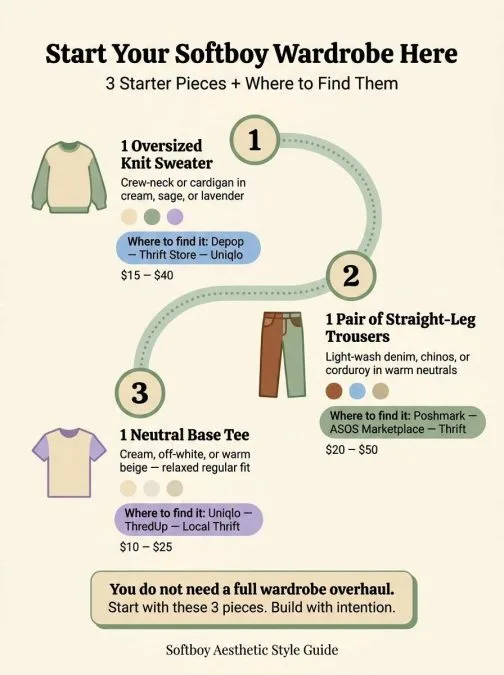
Start with 3 pieces. Pick 1 oversized knit, 1 pair of straight-leg trousers, and 1 neutral tee. Source them from Depop, a local thrift store, or Uniqlo. Build from there. The softboy aesthetic does not require a full wardrobe overhaul. It requires intention. Start small, dress expressively, and let the wardrobe grow with you.
The softboy aesthetic is a men’s fashion style. It focuses on emotional expression, relaxed shapes, soft fabrics, and muted or pastel colors. It originated between 2015 and 2019 through communities on Tumblr and YouTube. TikTok drove its mainstream adoption. The TikTok #softboy hashtag has accumulated over 3.2 billion views as of early 2026 (TikTok Creative Center). It contrasts with traditional masculine fashion by prioritizing comfort, authenticity, and emotional openness.
“Softboy” refers to the fashion aesthetic. “Softboi” describes a dating persona. The softboi persona uses the appearance of sensitivity and artistic interest to deceive others in a romantic context. The spelling difference is a reliable signal. If the topic is fashion, softboy is the correct term.
A softboy outfit usually features an oversized knit or cardigan, straight-leg trousers, or light-wash jeans. It often has a muted or pastel color palette. Common footwear includes Nike Air Force 1s, Converse high tops, Vans Old Skool, and Adidas Stan Smiths. Accessories include round wire-rimmed glasses, thin chain necklaces, gold or silver rings, and canvas tote bags.
Start with 3 foundational pieces: an oversized knit, a pair of straight-leg jeans, and a neutral-toned tee. Add softboy pieces gradually rather than replacing an entire wardrobe at once. Focus on fit, fabric, and color first. Pastels, soft knits, and relaxed proportions form the entry point. Thrift stores and sites like Depop and Poshmark are great places to find these items at a low cost.
No. The softboy aesthetic works across all body types when proportions are handled correctly. Pair an oversized top with a more structured bottom, or vice versa. The International Journal of Fashion Design, Technology and Education (2020) shows that relaxed-fit garments enhance body proportions for 82% of male body types. This effect occurs when one structured counterbalancing piece is added. The aesthetic is defined by softness and intention, not body size.
The softboy aesthetic is vintage-leaning, pastel-toned, and emotionally grounded. The e-boy aesthetic is darker, more aggressive, and rooted in punk, skate, and goth subcultures. Black dominates the e-boy palette. Pastels and warm neutrals dominate the softboy palette. A typical e-boy outfit features a striped long-sleeve shirt layered under a black graphic tee. It also includes solid black jeans, padlock chain necklaces, and Doc Martens. A typical softboy outfit includes an oversized pastel knit, straight-leg jeans, and white Converse. The 2-aesthetics share internet-culture roots but differ sharply in tone, color, and mood.
The 3 most common softboy style mistakes are unbalanced proportions, over-accessorizing, and copying a look without adapting it to personal body type and coloring. Avoid both overly distressed and extremely tight-fitting options. Both extremes disrupt the relaxed but intentional quality the aesthetic requires. Treating the look like a costume rather than a personal style is the single biggest error.
Yes. The softboy aesthetic does not depend on brand names or expensive pieces. Fit, fabric, and color carry more visual weight than labels. Thrifting is authentic to this aesthetic, not a compromise. Vogue Business (2024) says thrifting is the best way to source styles like softboy. Depop, Poshmark, and ASOS Marketplace offer easy access to vintage styles. You can also find relaxed-fit pieces that match the aesthetic.
No. The softboy aesthetic is not limited to men or any specific gender identity. Both women and men use the softboy tag across TikTok and Instagram. Soft fabrics, relaxed fits, muted colors, and emotional expression work for all gender identities and body types. The aesthetic’s rejection of rigid gender norms makes it inherently inclusive.
Yes. The softboy aesthetic remains fully relevant in 2026. Google search interest has held stable for 7 consecutive years since 2019. The TikTok #softboy hashtag has surpassed 3.2 billion views as of early 2026 (TikTok Creative Center). The aesthetic originated as a rejection of traditional masculinity norms.