Physical Address
Islamabad, PK
Physical Address
Islamabad, PK


This men’s watches guide breaks down six things that matter most when buying your first watch: movement quality, case material, crystal type, case size, water resistance, and strap fit. Once you understand these six areas, you can choose a watch with confidence instead of guessing.
Most first-time buyers make one of two mistakes and both are easy to avoid. They buy a fashion watch with a cheap movement inside a case that rusts, or they buy a watch that doesn’t fit their wrist. Either mistake usually leads to regret within the first year.
A stainless steel watch with a sapphire crystal, 100m water resistance, and a case between 38mm and 42mm works well for most daily situations. The Seiko 5 Sports ($150 to $250) checks all these boxes. If you have a bigger budget, the Tissot PRX Powermatic 80 ($625 to $695) adds a Swiss-made movement and a sapphire crystal.
This guide covers 11 core topics:
- Watch anatomy and terminology
- Movement types: quartz, automatic, and manual-wind
- Watch types and their purposes
- Sizing and wrist fit
- Case materials and crystal types
- Straps and bracelets
- Brand tiers and budget breakdowns
- Water resistance ratings
- Styling and occasion matching
- Common beginner mistakes
- Watch care and maintenance
Every term is defined at first use. Every recommendation includes specific models and
Yes. Traditional watches continue to sell alongside smartwatches, not in spite of them.
Swiss watch exports totaled CHF 26.0 billion in 2024, a decline of 2.8% compared with 2023, according to the Federation of the Swiss Watch Industry (FHS). That decline followed three consecutive years of growth. In 2025, exports declined a further 1.7% to CHF 25.6 billion (FHS, January 2026). The industry has posted export growth in the majority of the last ten years.
During the same period, smartwatch shipments continued to grow globally. Both markets expanded. Traditional watches serve different purposes than smartwatches, and neither is replacing the other.
Traditional watches serve five purposes beyond timekeeping: personal expression, craftsmanship, social signaling, generational value, and technology-free function. Watches are consistently cited as a style and self-expression purchase rather than a functional one. A phone stays in a pocket. A watch is visible at every handshake, meeting, and meal. It communicates taste without words.
In professional settings, a watch remains one of the few accepted accessories for men. No other accessory carries the same signal across casual, business, and formal dress codes.
Mechanical watchmaking carries cultural weight beyond fashion. In 2020, UNESCO added the craftsmanship of mechanical watchmaking and art mechanics in the Franco-Swiss Jura Arc to its Representative List of the Intangible Cultural Heritage of Humanity.
Traditional watches also function without charging, software updates, or signals. A mechanical watch from Seiko, Tissot, or Rolex can remain serviceable for decades with proper maintenance.
Smartwatches and traditional watches serve different purposes. They complement each other rather than compete.
The Apple Watch Ultra, Garmin Fenix, and Samsung Galaxy Watch handle health monitoring, fitness tracking, and notifications; though anyone using one for continuous tracking should check whether it’s safe to wear a smartwatch while sleeping. A traditional watch handles style, craftsmanship, and occasions where technology is inappropriate or unnecessary.
A 2023 Deloitte Swiss Watch Industry Study found that 60% of consumers see the two categories as complementary. Many men use a smartwatch for fitness and a traditional watch for business and formal events.
The 2026 watch market favors informed buyers over impulsive ones. After multiple quarters of declining secondary-market prices, the speculative premium on popular models has diminished. Beginners now enter a more rational market with less inflated pricing.
Four trends define what men are choosing:
Smaller case sizes. The dominant case size has shifted from 44–46mm (2010 to 2015) toward 38–42mm and smaller in recent years, with major brands including Omega, Tudor, and Longines releasing or expanding their 36–39mm lines in 2025 (Chrono24 Magazine, 2025 Recap; WWD, August 2024). 40 to 42mm remains the most popular purchase range on major platforms.
Rectangular revival. Rectangular watches, led by the Cartier Tank (first produced in 1917) and the Jaeger-LeCoultre Reverso (introduced in 1931), are gaining popularity among buyers seeking alternatives to round cases. Demand for rectangular case shapes on Chrono24 increased by 9.3% in 2025 compared to 2024, according to the Chrono24 2025 Market Review (February 2, 2026).
Bolder dial colors. While standard blue and black dials remained flat, green dials grew 9.5%, with champagne and gold tones also rising sharply in 2025 (Chrono24 2025 Market Review). Non-traditional colors have moved from niche to mainstream across all price tiers.
Dress watch resurgence. Smaller, more elegant proportions are gaining ground over oversized tool watches. Gen Z buyers on Chrono24 showed a strong shift toward slimmer, design-driven timepieces in H1 2025, contributing to a fourfold increase in Cartier’s popularity on the platform (Chrono24 Secondary Market Report H1 2025).
For beginners, these trends point toward a practical choice: a 38 to 42mm stainless steel watch with a clean dial. That profile matches market preferences, fits most wrist sizes, and works across dress codes.

In 2026, COSC introduced the Excellence Chronometer standard, first announced in February 2026 and presented publicly at Watches and Wonders. This tests the fully assembled watch; not just the movement; to −2/+4 seconds per day, with mandatory 200-gauss magnetic resistance and power reserve verification. The traditional COSC chronometer certification (−4/+6 seconds per day, movement-only testing) remains available alongside the new tier. Full deployment began in October 2026 (COSC).
A watch has 10 external components: the case, dial, bezel, crown, crystal, lugs, hands, caseback, pushers, and buckle or clasp. Every product listing uses these terms. Learning them before buying helps you evaluate fit, quality, and compatibility; not just appearance.

The case is the metal shell that protects the movement, dial, and crystal. Case diameter is measured in millimeters, excluding the crown. Men’s watches range from 36mm to 46mm. Case thickness ranges from 6mm to 15mm depending on the movement type.
Three case materials appear across most price tiers:
| Material | Mohs Hardness (approx.) | Pros | Cons | Common Price Range |
| 316L stainless steel | 5.5–6 | Corrosion-resistant, durable, affordable | Heavier than titanium; scratches with wear | $50–$10,000+ |
| Titanium (Grade 2/5) | ~6 | 40% lighter than steel, highly corrosion-resistant, hypoallergenic | Scratches more visibly; $200–$500 premium over steel | $300–$5,000+ |
| Ceramic | 8–8.5 | Extremely scratch-resistant, lightweight, fade-proof | Can crack under sharp impact; $500–$2,000 premium | $500–$10,000+ |
Avoid alloy or base-metal cases in watches under $50. Plated alloy cases may show corrosion or plating wear sooner than stainless steel, particularly at contact points like the caseback and bezel edges.
The dial is the face of the watch. It displays time through hands and hour markers.
Applied indices are metal hour markers physically attached to the dial surface. They cast a slight shadow and typically appear on watches above $200. Printed indices are painted directly onto the dial and are standard on entry-level watches.
The bezel is the ring surrounding the crystal. It can be fixed or rotating depending on the watch type.
Four bezel types appear on men’s watches:
| Bezel Type | Function | Found On |
| Fixed / plain | Aesthetic only | Dress watches, casual watches |
| Unidirectional rotating (60-min scale) | Tracks elapsed time; rotates counterclockwise only | Dive watches |
| Bidirectional rotating (GMT) | Tracks a second time zone | GMT watches |
| Tachymeter (fixed scale) | Measures speed over a known distance | Chronographs |
The unidirectional design on dive bezels prevents accidental extension of recorded time. ISO 6425 requires a timing device (typically a unidirectional bezel) on certified dive watches.
The crown is the knob on the side of the case. It winds the movement, sets the date, and sets the time.
Three crown positions are standard on most watches:
| Position | Function |
| Pushed in / screwed down | Normal wear; seals the crown |
| Pulled to first click | Sets the date |
| Pulled to second click | Sets the time |
Two crown types exist:
A crown left in an open position compromises water resistance regardless of the watch’s rating. Always push in or screw down the crown before any water contact.
The crystal is the transparent cover over the dial. Three crystal materials are used:
| Crystal Type | Mohs Hardness | Scratch Resistance | Impact Resistance | Typical Price Range |
| Sapphire | 9 | Very high | Can shatter under severe sharp impact | $200+ |
| Mineral glass | 5–6 | Moderate; fine scratches accumulate with daily wear | Moderate | $50–$200 |
| Acrylic | 3 | Low; scratches easily | High (flex, not shatter) | Under $100 |
Sapphire is the most scratch-resistant crystal used in watchmaking. It is standard on most watches above $300. One exception: the Omega Speedmaster Moonwatch uses acrylic intentionally to match its original 1969 Apollo 11 specification.
“Sapphire-coated” mineral glass is not solid sapphire. The coating provides limited scratch protection compared to a full sapphire crystal.
The lugs are the projections from the case that hold the strap or bracelet in place.
Three lug measurements matter:
The hands are the moving indicators that point to hours, minutes, and seconds.
Sport and dive watches include luminous coating for low-light visibility. The industry standard is Super-LumiNova, a non-radioactive compound used by most Swiss brands. Seiko uses its own equivalent, LumiBrite.
Polished, faceted hands indicate mid-range and luxury watches. Flat, painted hands are standard on entry-level models.
The caseback is the rear cover that seals the movement inside the case.
Pushers are buttons on the case side that control complications like a chronograph stopwatch. A standard chronograph uses two pushers at the 2 o’clock and 4 o’clock positions. The upper pusher starts and stops elapsed time. The lower pusher resets the display. Watches with no stopwatch function do not have pushers.
The buckle or clasp secures the strap or bracelet to the wrist.
| Clasp Type | Found On | Notes |
| Pin buckle | Leather and NATO straps | Simple, adjustable, easy to replace |
| Deployant / folding clasp | Metal bracelets | Opens and closes without removing the bracelet |
| Butterfly clasp | Leather and metal | Folds symmetrically for a flush look |
Some mid-range and luxury clasps include micro-adjustment systems that allow bracelet length changes in small increments without tools.
These terms appear on virtually every watch specification sheet:
| Term | Meaning |
| Caliber | The specific movement model inside the watch |
| Power reserve | How long the watch runs on a full charge or wind |
| ATM / bar | Units of water pressure; 1 ATM ≈ 10 meters of static water pressure |
| Complication | Any function beyond hours, minutes, and seconds |
| COSC | Swiss chronometer testing body; certifies accuracy |
| Lug width | Width of the strap attachment point in millimeters |
| Reference number | The manufacturer’s unique model identifier |
Four common complications appear across men’s watches: date display, chronograph, GMT (second time zone), and moon phase. Each adds mechanical parts, increases case thickness, and raises the price.

Three movement types power wristwatches. Each differs in power source, accuracy, maintenance cost, and case thickness.
| Feature | Quartz | Automatic | Manual-Wind |
| Power source | Battery or solar cell | Wrist motion via rotor | Hand-winding via crown |
| Typical accuracy | ±15 seconds/month | ±15 to ±25 seconds/day | ±15 to ±25 seconds/day |
| Maintenance | Battery every 2–5 years | Full service every 5–10 years | Full service every 5–10 years |
| Typical thickness | 6–10mm | 10–13mm | 8–11mm |
| Price range (entry) | Under $50 | $150+ | $400+ |
| Second-hand motion | Tick (one step/second) | Smooth sweep | Smooth sweep |
One clarification: an automatic movement is a type of mechanical movement. Both use a mainspring, gear train, escapement, and balance wheel. The only structural difference is the rotor. Knowing this prevents confusion when reading product listings.
A quartz movement uses a battery-powered quartz crystal to regulate time. It is the most accurate and lowest-maintenance movement type at every price point.
How it works: A battery sends electrical current to a quartz crystal, which vibrates at 32,768 times per second. An integrated circuit counts those vibrations and sends one pulse per second to a stepping motor, which advances the hands one tick at a time.
Many standard quartz watches keep time within approximately ±15 seconds per month. This outperforms most standard mechanical movements.
Three quartz variants appear across men’s watches:
An automatic movement is a self-winding mechanical watch powered by the natural motion of the wearer’s wrist.
How it works: A weighted rotor sits above the movement and spins as the wrist moves. That spinning winds the mainspring, which stores energy and releases it through a gear train, escapement, and balance wheel. The balance wheel swings at a fixed rate, dividing time into equal segments. The result is the smooth sweep of the second hand.
Accuracy varies by movement. Many standard automatics are specified within ±15 to ±25 seconds per day, though individual calibers differ. A COSC-certified chronometer movement achieves −4/+6 seconds per day, tested across 15 days, 5 positions, and 3 temperatures (COSC). COSC certifies over 2 million movements per year for more than 60 Swiss brands.
Power reserve is the most important automatic specification for beginners. Most standard automatics run for 38 to 42 hours when fully wound. A watch removed on Friday evening may stop by Sunday morning. Movements with approximately 80-hour reserves; such as the Tissot Powermatic 80, Hamilton H-10, and Rolex Calibre 3235; run through a full weekend. A watch taken off Friday still runs Monday morning.
A manual-wind movement stores energy through hand-winding via the crown. It uses no battery and no rotor.
How it works: Wind the crown approximately 20 to 40 turns per day, which takes under 60 seconds. Modern manual-wind movements include a slipping clutch that reduces the risk of overwinding.
The core components are identical to an automatic: mainspring, gear train, escapement, and balance wheel. The absence of a rotor allows a thinner case. The Hamilton Khaki Field Mechanical with the H-50 caliber measures 9.5mm thick, compared to 11.3mm for the automatic H-10 version. That 1.8mm difference can determine whether a watch fits flat under a shirt cuff.
Two examples across price tiers:
The right movement depends on three factors: daily lifestyle, budget, and maintenance tolerance.
| If You Value… | Choose… | Why | Budget Range |
| Accuracy and low maintenance | Quartz | Better timekeeping than mechanical; care limited to battery changes every 2–5 years | Under $300 |
| Mechanical craft and ownership ritual | Automatic | The sweep, the rotor, the winding; widely serviceable | $200–$600 |
| Slim profile and daily engagement | Manual-wind | Thinnest case possible with a mechanical movement | $400+ |
Under $300, quartz is the most practical first choice. The full budget goes toward case quality and design rather than movement complexity.
In the $200 to $600 range, reliable automatic options include the Tissot Powermatic 80 (approximately $625), Hamilton H-10 (approximately $525), and watches using the Miyota 9015 caliber (from approximately $200). Choose a model with an 80-hour power reserve to prevent the common beginner issue of a stopped watch.
Seven watch types cover the needs of most men: dress, dive, field, pilot, chronograph, everyday casual, and digital. Each was designed for a specific purpose and has a defined set of features suited to particular occasions.
| Type | Case Size | Thickness | Water Resistance | Best For | Not Ideal For |
| Dress | 36–40mm | Under 10mm | 30–50m | Formal, business | Swimming, sport |
| Dive | 38–44mm | 12–15mm | 200m+ | Daily wear, water sport | Black-tie formal |
| Field | 38–42mm | 9–12mm | 50–100m | Casual, outdoor, travel | Formal events |
| Pilot | 42–46mm | 12–15mm | 50–100m | Casual, statement | Small wrists, formal |
| Chronograph | 39–44mm | 12–16mm | 50–100m | Casual, timing tasks | Formal events |
| Everyday casual | 38–42mm | 10–13mm | 50–100m | All daily situations | Extreme sport, formal |
| Digital | 38–46mm | 10–14mm | 30–200m | Sport, outdoors | Business, formal |

A dress watch is a slim, minimal timepiece designed for formal and business settings. The defining rule is simplicity, the same principle covered in our guide to minimalist fashion.
Four characteristics define a dress watch: case thickness typically under 10mm, case diameter typically between 36mm and 40mm, a clean dial with simple hour markers, and a leather strap in black or dark brown. Water resistance is typically 30m to 50m; splash-proof only.
Examples:
A dive watch is a tool watch built for underwater use. ISO 6425 defines the international standard for diver’s watches, specifying a minimum water resistance of 100m along with requirements for a timing device (typically a unidirectional bezel), luminous readability at 25cm in darkness, and resistance to shock, magnetism, and saltwater. Most recreational dive watches are rated to 200m or 300m.
The Rolex Submariner, launched in 1953, set the template for modern dive watches.
Five features define a typical dive watch:
The unidirectional bezel rotates counterclockwise only. This prevents accidental bumps from adding time to the dive timer; a safety feature.
A dive watch is among the most versatile single-watch types for daily wear. On a metal bracelet, it pairs with casual outfits and business-casual settings. The only setting where it is generally inappropriate is black-tie formal.
Examples:
A field watch is a rugged, highly legible watch with military roots.
The field watch originated during World War I when soldiers needed a wristwatch readable instantly in combat conditions. Hamilton supplied a large number of watches to the U.S. military during World War II, establishing the field watch as a service tool.
Four design elements define a field watch: a high-contrast dial with large Arabic numerals, a matte or brushed case finish, a 24-hour inner track, and a canvas, NATO, or leather strap.
A field watch suits casual wear, outdoor activities, and travel. On a leather strap, it works in smart-casual settings.
Examples:
A pilot watch features a large, high-contrast dial designed for cockpit readability.
Louis Cartier made an early pilot watch in 1904 for aviator Alberto Santos-Dumont. During World War II, manufacturers including IWC, Laco, and Stowa produced B-Uhr observation watches for military pilots, and their design directly informs modern pilot watches.
Four elements define a pilot watch: an oversized crown for use with gloves, a high-contrast dial, a large case (typically 42mm to 46mm), and a Type A or Type B dial format.
Cases above 44mm can look visually large in professional settings. A pilot watch suits casual and business-casual environments.
Examples:
A chronograph is a standard timepiece with a built-in stopwatch function operated by two pushers on the case side.
How it works: The upper pusher at 2 o’clock starts and stops elapsed time. The lower pusher at 4 o’clock resets all sub-dials to zero. Two to three sub-dials on the face track elapsed seconds, minutes, and hours.
Chronograph cases typically run 12mm to 16mm thick. Multiple sub-dials create visual complexity that works well in casual and business-casual settings but competes with formal attire.
Examples:
An everyday casual watch is a versatile, mid-sized timepiece built for daily wear across multiple dress codes.
Four characteristics define a strong everyday watch: case diameter between 38mm and 42mm, water resistance of 50m to 100m, stainless steel case with an interchangeable strap, and a clean dial with three hands and a date window.
On a metal bracelet it reads as professional. On a NATO strap it reads as casual. On a leather strap it reads as smart-casual. One watch covers all three contexts through strap changes alone.
Examples:
A digital watch displays time through an LCD or LED numerical screen. Digital watches excel during physical activity, outdoor use, and in environments where an analog watch could get damaged. They are not appropriate in formal or business settings.
Examples:
A stainless steel dive watch or everyday casual watch between 38mm and 42mm is the best first watch for most men.
The watch community uses the term GADA (Go Anywhere, Do Anything) for a single watch capable of covering most everyday situations. Three models appear frequently as GADA choices:
| Model | Diameter | Approximate Price |
| Tissot PRX Powermatic 80 | 40mm | $625 to $695 |
| Longines Spirit | 40mm | $1,500 to $2,500 |
| Tudor Black Bay 58 | 39mm | $3,800 to $4,200 |
A genuinely versatile first watch meets five criteria:

First watch recommendations by budget:
| Budget | Model | Movement | Key Features |
| Under $100 | Casio Duro MDV106 | Quartz | 200m, rotating bezel, screw-down crown |
| $100–$250 | Seiko 5 Sports SRPD | Automatic (4R36) | 100m, steel case, exhibition caseback |
| $100–$250 | Orient Kamasu | Automatic (in-house) | 200m, sapphire crystal, screw-down crown |
| $250–$500 | Hamilton Khaki Field Auto | Automatic (H-10) | 100m, 80-hour power reserve, Swiss movement |
| $500–$700 | Tissot PRX Powermatic 80 | Automatic (Powermatic 80) | Sapphire crystal, 80-hour reserve, integrated bracelet |
Best single recommendation for a beginner: The Seiko 5 Sports at $150 to $250 meets all five criteria: automatic movement, 100m water resistance, stainless steel case, 20mm lug width, and a clean dial.
Three measurements determine whether a watch fits: case diameter, lug-to-lug distance, and case thickness. Case diameter alone is not enough.
Poor case fit is one of the most common beginner regrets. Most first-time buyers check only diameter. Checking all three measurements before buying prevents this mistake.
Wrap a flexible tape measure snugly around the wrist above the wrist bone (the ulna; the small bone that protrudes on the outer wrist) and record the measurement in inches or centimeters. This is where a watch naturally rests during wear.
Without a tape measure, wrap a strip of paper around the wrist at the same position. Mark where it overlaps. Lay the strip flat against a ruler and read the distance.
General sizing guide:
| Wrist Circumference | Suggested Case Diameter |
| Under 6.5 inches | 36–38mm |
| 6.5 to 7.5 inches | 38–42mm |
| Over 7.5 inches | 42–46mm |
These ranges are guidelines, not rules. Lug-to-lug distance and lug shape affect perceived size more than diameter alone.

Case diameter is the width of the watch face in millimeters, excluding the crown. It is the most cited measurement in watch listings but the least reliable predictor of fit when used alone. Two 42mm watches can look and feel very different on the same wrist because of differences in lug-to-lug distance and case thickness.
Lug-to-lug distance is the vertical measurement from the tip of the upper lug to the tip of the lower lug. This is the most important measurement for actual wrist fit.
The lugs should not extend past the flat width of the wrist when viewed from above. When they do, the watch appears disproportionate and may feel uncomfortable. A smaller case diameter does not always produce a shorter lug-to-lug. Always check the lug-to-lug figure on the specification sheet.
📌 Lug shape matters: downward-curved lugs follow the wrist contour and reduce overhang. Straight lugs create a longer visual footprint. A curved-lug 42mm watch may fit a smaller wrist better than a straight-lug 40mm watch.
Case thickness is the measurement from the caseback to the top of the crystal. It determines how high the watch sits above the wrist and whether it fits under a shirt cuff.
| Thickness Range | Wear Context |
| 6–9mm | Dress; fits under any cuff |
| 9–12mm | Most daily wear; fits under most cuffs |
| 12–15mm | Sport and casual; may not fit under a standard cuff |
When uncertain between two sizes, choose the smaller one. A slightly smaller watch looks proportionate. A slightly larger watch looks oversized. The sizing error is not symmetrical.
Measure and compare. Find the lug-to-lug distance on the specification sheet. Compare it against the flat width of your wrist. The lug-to-lug should not exceed your wrist width.
Try in person. Authorized dealers for brands like Tissot, Hamilton, Seiko, and Longines allow in-store try-ons without purchase obligation. Testing takes under five minutes.
Find wrist reference photos. Search the watch model name with “wrist shot” on YouTube or Reddit’s r/Watches. Find reviewers with a similar wrist size. A real wrist photo shows more than any product image.
Case material, crystal type, and strap quality determine how long a watch lasts. A $200 watch with a steel case and sapphire crystal can outlast a more expensive watch built with weaker materials.
316L stainless steel is the standard case material for long-term watch ownership. It resists corrosion, handles daily impacts, and is used across watches from $100 to $10,000+.
904L stainless steel provides greater resistance to saltwater, chlorine, and acids. Rolex adopted 904L in 1985. For most buyers, 316L delivers adequate durability. 904L is a premium upgrade, not a baseline need.
Titanium weighs approximately 40% less than stainless steel and is highly corrosion-resistant. Grade 2 and Grade 5 titanium are hypoallergenic. Titanium scratches more visibly than polished steel. Some brands apply surface-hardening treatments to reduce visible wear.
Ceramic offers extreme scratch resistance. It resists fading and stays lightweight. Omega, Hublot, and Rado use ceramic for bezels and full cases. Ceramic can crack under sharp impact.
Bronze develops a unique patina from natural oxidation over time. It resists seawater corrosion and is used mainly in dive watches. Bronze weighs more than steel, and oxidation can cause harmless green skin staining on some wearers. Most bronze watches use steel or titanium casebacks.
Plated alloy and base-metal cases may show corrosion or plating wear sooner than stainless steel, particularly at the caseback, bezel edges, and bracelet links. Some fashion brands in the $50 to $150 range use these materials. Gold plating on budget watches is typically thin (3 to 5 microns) and wears through at contact points.
A stainless steel Casio at $30 can outlast a plated alloy fashion watch at three times the price. When reading a product listing, verify that the case material states “stainless steel” rather than “alloy,” “zinc alloy,” or “metal alloy.”
Hollow-link bracelets rattle, flex, and degrade faster than solid-link bracelets. Budget watches under $100 often use hollow links to reduce material costs.
How to identify solid links: squeeze a link between two fingers. Hollow links compress slightly. Solid links stay rigid.
Sapphire is the most scratch-resistant watch crystal, measuring 9 on the Mohs hardness scale. Under normal use, only diamond can scratch it. Sapphire appears on most watches above $200 to $300. It can shatter under severe sharp impact. Most sapphire crystals include anti-reflective coating on one or both sides, which can wear with abrasive cleaning.
Mineral glass offers moderate scratch resistance at 5 to 6 on the Mohs scale. Fine scratches accumulate within months of daily wear. Seiko Hardlex is an enhanced mineral glass with improved hardness over standard mineral options.
Acrylic scratches easily but resists shattering. Light scratches can often be removed with a suitable plastic polish.
Five strap types serve different needs:
| Strap Type | Typical Lifespan | Best For | Water Safe? | Replacement Cost |
| Metal bracelet | 10+ years | Daily wear, professional settings | Yes (rinse after salt) | $50–$300+ |
| Leather | 1–3 years | Formal, smart-casual | No | $20–$100+ |
| NATO fabric | 2–4 years | Casual, outdoor | Yes | $10–$40 |
| FKM rubber | 3–5 years | Sport, water activities | Yes | $20–$80 |
| Mesh | 5+ years | Smart-casual, vintage styles | Yes (rinse after salt) | $25–$100 |
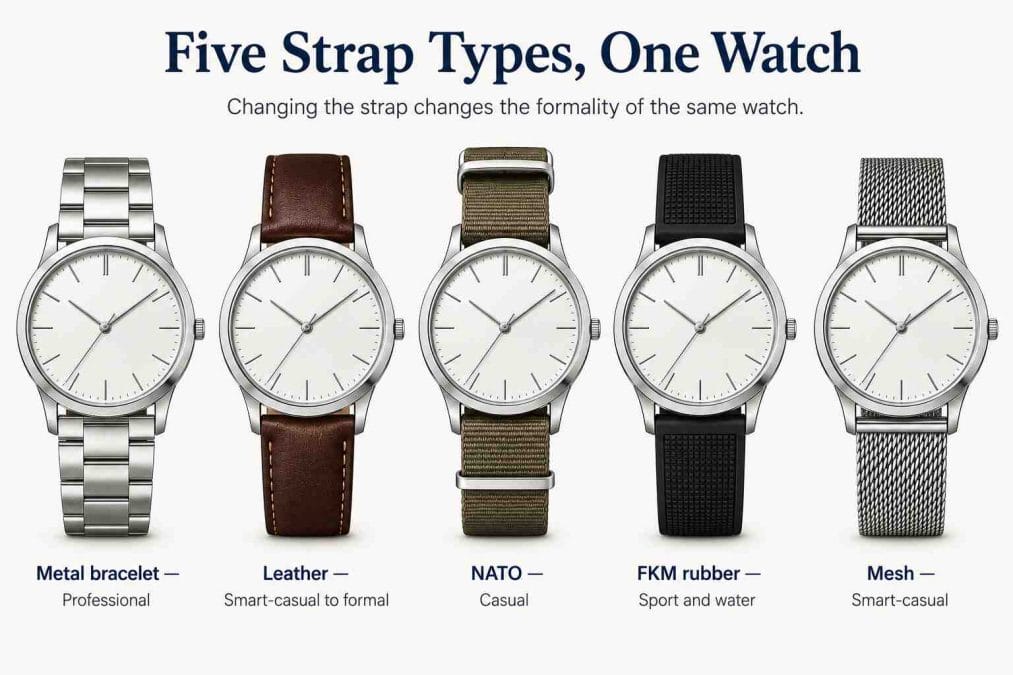
Metal bracelets are the most durable option. Solid links with screw pins outlast pin-and-collar construction.
Leather straps require the most maintenance. Full-grain calfskin and shell cordovan last longest. Apply leather conditioner every 3 to 6 months. Do not submerge leather in water.
NATO straps secure the watch even if one spring bar fails. They can be hand-washed with mild soap and are UV-resistant.
FKM rubber (fluoroelastomer) handles the harshest conditions. It resists UV, sweat, saltwater, and dust.
| Occasion | Recommended Strap Types |
| Formal / black-tie | Black or dark brown leather; alligator or calfskin |
| Business | Dark leather or metal bracelet |
| Smart-casual | Metal, mesh, or quality leather |
| Weekend / casual | NATO, rubber, or metal |
| Sport / water | Rubber or metal only |
A three-strap rotation covers most weekly occasions with one watch: a metal bracelet, a leather strap, and a NATO. Quick-release spring bars, standard on most watches above $200, enable tool-free strap swaps in under 30 seconds.
Price determines three things in order: movement quality, material grade, and finishing level. The quality improvement from $200 to $600 is proportionally larger than the improvement from $600 to $3,000. Above $1,500, each additional dollar increasingly pays for refinement, heritage, and brand prestige rather than measurably better timekeeping.
Seiko, Casio, Citizen, and Orient deliver the strongest quality under $200. These four Japanese brands manufacture their own movements and control much of their production process.
Seiko is one of the world’s most vertically integrated watch companies. Within its corporate group, Seiko has the capability to design and manufacture nearly all watch components, including movements, cases, dials, crystals, and lubricants. The Seiko 5 SRPD series offers an in-house automatic movement, 316L stainless steel, and 100m water resistance at $150 to $250. Note: some entry-level Seiko 5 models are assembled outside Japan.
Casio introduced the G-Shock collection in 1983. It has since surpassed 100 million units sold, built around an engineering requirement for extreme shock resistance.
Best-value Casio models:
| Model | Type | Water Resistance | Approx. Price |
| Casio F-91W | Digital quartz | 30m | $10–$15 |
| Casio G-Shock DW5600 | Digital quartz | 200m | $50–$70 |
| Casio Duro MDV106 | Dive-style quartz | 200m | $40–$55 |
Citizen offers Eco-Drive, a solar-powered movement that converts light into stored energy. A full charge can run for approximately 6 months in complete darkness. Routine battery replacement is not needed, though the rechargeable cell can eventually require service.
Best-value Citizen models:
| Model | Movement | Crystal | Water Resistance | Approx. Price |
| Promaster Diver BN0151 | Eco-Drive | Mineral | 200m | $180–$220 |
| Corso BM7100 | Eco-Drive | Sapphire | 100m | $150–$200 |
Orient produces its own automatic calibers in-house. Most competitors at this price rely on outside suppliers.
Best-value Orient models:
| Model | Type | Caliber | Approx. Price |
| Bambino V2 | Dress, 40.5mm | In-house automatic | $120–$180 |
| Kamasu | Dive, 41.8mm | In-house automatic, sapphire crystal | $180–$280 |
The $200 to $1,000 range delivers the largest measurable quality improvement in watchmaking. This tier introduces Swiss automatic movements, 80-hour power reserves, sapphire crystals with anti-reflective coating, and improved case finishing.
Tissot delivers Swiss automatic movements with 80-hour power reserves below $700. The Tissot PRX Powermatic 80 offers a silicon hairspring (which resists magnetism), sapphire crystal, and 100m water resistance at approximately $625 to $695.
Hamilton combines U.S. military heritage with Swiss movement quality at approximately $495 to $595. Hamilton supplied a large number of watches to the U.S. military during World War II.
Longines has operated continuously from Saint-Imier in the Swiss Jura since 1832.
Other strong mid-range options include Mido, Certina, Oris, and Christopher Ward. Tissot, Hamilton, Longines, Mido, and Certina all belong to Swatch Group. Oris and Christopher Ward are independent.
Luxury watches above $1,000 typically feature in-house movement production, hand-finishing, and significant brand heritage.
Patek Philippe, Audemars Piguet, and Vacheron Constantin are widely recognized as the pinnacle of mechanical watchmaking, a status reflected in our roundup of rarest classic watches ever made. Vacheron Constantin is one of the oldest continuously operating Swiss watch manufacturers, founded in 1755.
Rolex, Omega, and Cartier dominate global watch sales and cultural visibility. Rolex movements carry both COSC certification and Rolex’s own Superlative Chronometer standard (−2/+2 seconds per day). The Omega Speedmaster Professional was the first watch worn on the moon during Apollo 11 in 1969.
Tudor is owned by the Rolex Group and uses in-house MT5600-series calibers with 70-hour power reserves. The Tudor Black Bay 58 retails at approximately $3,250 versus the Rolex Submariner at approximately $10,250+. Tudor, along with Tissot and Steinhart, is often described by collectors as offering Swiss quality at a fraction of Rolex pricing.
A beginner does not need to start with luxury. A solid mid-range watch from Tissot or Hamilton provides years of reliable use, and our guide to entry-level luxury watches covers the best next step once preferences are established.
“Swiss Made” confirms where a watch was manufactured. It does not automatically guarantee superior quality compared to Japanese alternatives.
Swiss federal legislation (the Swissness Act, enacted in 2017) requires that a watch labeled “Swiss Made” meet several conditions, including: the movement is assembled and inspected in Switzerland, the movement is cased up in Switzerland, final inspection occurs in Switzerland, and at least 60% of manufacturing costs are generated in Switzerland.
Grand Seiko, produced in Shizukuishi, Iwate, Japan, is widely praised for finishing, movement decoration, and dial quality that competes with or exceeds many Swiss watches at higher price points. “Swiss Made” carries prestige and a resale premium, but it is not an automatic indicator of superior watchmaking.
Key distinction: “Swiss Made” confirms geographic origin. COSC certifies movement accuracy. These are two separate standards.
Water resistance ratings reflect the static water pressure a watch survived in a laboratory test. “Static” means still water with no arm movement, no impact, and no temperature change. Real-world conditions can exceed lab conditions. Every rating should be interpreted conservatively and in combination with the manufacturer’s guidance.
Water resistance for non-diving watches follows ISO 22810 (Horology: Water-Resistant Watches).
The rating appears on the dial or caseback in meters (30m, 100m, 200m), atmospheres (3 ATM, 10 ATM, 20 ATM), or both. 1 ATM equals approximately 10 meters of static water pressure.
No watch is waterproof. In the United States, FTC guidance from 1968 restricted the use of “waterproof” in watch advertising as misleading. The preferred industry term is “water-resistant” followed by a specific rating.
Water resistance depends on three sealing components: rubber gaskets at the caseback, gaskets around the crystal, and gaskets inside the crown tube. All three degrade from UV radiation, temperature changes, chemical contact, and natural aging. Chlorine, soap, and sunscreen accelerate gasket breakdown.
The crown is the most common point of water entry. A crown left open bypasses all seals. Water entry through an open crown can destroy a movement. Always confirm the crown is fully seated or screwed down before any water contact.
| Rating | What It Covers | What It Does Not Cover |
| 30m / 3 ATM | Splash resistance: rain, hand washing | Swimming, showering |
| 50m / 5 ATM | Light water contact; brief accidental exposure | Swimming is not recommended unless the manufacturer specifically permits it |
| 100m / 10 ATM | Recreational swimming, snorkeling (when watch is in good condition and crown is secured) | Scuba diving |
| 200m / 20 ATM | Swimming, snorkeling, water sports; combined with ISO 6425, qualifies as a dive watch | Saturation diving |
| 300m+ / 30 ATM+ | All recreational water activities; professional diving territory | — |
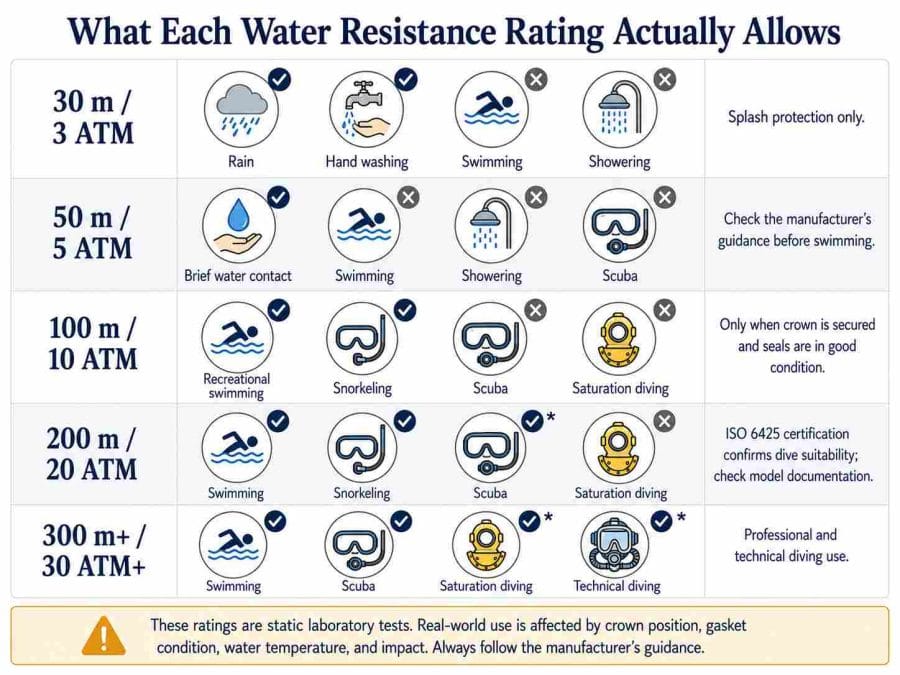
30m and 50m are more restricted than most buyers expect. Showering is generally not recommended below 100m because soap and shampoo degrade gaskets, and temperature changes can affect seals.
100m is the practical minimum for an active lifestyle. Three beginner-friendly watches rated to 100m:
200m combined with ISO 6425 defines a dive watch. ISO 6425 requires a minimum of 100m water resistance, a timing device, luminous readability, magnetic resistance, and shock resistance. Most consumer dive watches meet the standard at 200m or above.
Strap note: a 200m-rated watch on a leather strap should not be submerged. The water resistance rating applies to the case, not the strap. Switch to rubber, NATO, or metal before water activity.
Water resistance degrades without maintenance. Four habits preserve seals between service intervals:
Opening the caseback for a battery change does not automatically restore water resistance. Have the watch pressure-tested and gaskets confirmed before resuming water use.
Recommended maintenance schedule:
| Task | Frequency | Cost |
| Annual pressure test | Every 12 months (if worn in water) | $20–$50 |
| Gasket replacement | Every 2–3 years | $30–$80 |
| Full service (mechanical) | Every 5–10 years per manufacturer guidance | $200–$800+ |
Gasket replacement at $30 to $80 is the lowest-cost preventive measure in watch ownership.
Watch styling follows two core principles: match the watch’s formality level to the occasion, and match the metal tone to the outfit’s color temperature.
Color temperature means whether colors read as warm or cool. Warm colors include brown, tan, olive, and burgundy. Cool colors include navy, grey, black, and white.
Black-tie formal: A dress watch with a case under 10mm thick. It must sit flat under a French cuff. Models like the Jaeger-LeCoultre Master Ultra Thin, Cartier Tank, and Patek Philippe Calatrava meet this standard.
Business: A clean, uncluttered dial. A dive watch on a steel bracelet or a dark leather strap works in most professional offices.
Smart-casual: The most flexible setting. A Tudor Black Bay 58, Tissot PRX, or Hamilton Khaki Field works without a strap change.
Casual: Most watch types and strap combinations work.
Chronographs suit smart-casual and casual settings. Sub-dials add visual complexity that competes with formal attire.
Stainless steel works across the widest range of outfits. It functions as a neutral metal and pairs with both warm and cool palettes.
Yellow gold requires more intentional coordination. It pairs naturally with brown shoes, olive trousers, and tan blazers. The same gold case against a charcoal suit can create visual mismatch.
Three metal-tone guidelines for beginners:
Match leather strap color to shoes and belt. Brown straps pair with brown casual shoes and belts. Black straps pair with black shoes and belts.
Strap choice adjusts formality independently of the case. A metal bracelet reads professional, a NATO reads casual, a dark leather strap reads smart-casual. One watch covers all three contexts through strap changes alone. Strap width should match lug width; check the specification sheet.
Wear the watch on the non-dominant wrist. Right-handed men wear it on the left. Left-handed men wear it on the right. This reduces impact risk and places the crown away from the dominant hand.
Position the watch directly above the wrist bone, with the face sitting flat on the top of the wrist. One finger should fit between the bracelet and skin. Looser causes shifting. Tighter restricts circulation.
Eight mistakes appear consistently among first-time buyers. Most are preventable with the information already covered in this guide.
1. Buying the wrong case size. Most beginners choose watches from product photos, which do not show how a case sits on a wrist. Check the lug-to-lug distance and compare it to your wrist width. Try watches in person at an authorized dealer when possible.
2. Treating water-resistant as waterproof. A 30m rating covers splashes, not swimming. A crown left open bypasses all seals. Chlorine and soap degrade gaskets over time. Annual pressure testing costs $20 to $50 and prevents the most common seal failure.
3. Prioritizing looks over movement quality. Some fashion watches at $100 to $200 use basic quartz movements inside plated alloy cases. The case may corrode. The movement may not be economically serviceable. Check the case material and movement type before the design.
4. Confusing chronograph with chronometer. A chronograph is a stopwatch complication. A chronometer is a precision accuracy certification (COSC). The two terms are unrelated despite the shared Greek root “chronos.”
5. Ignoring strap options. The original factory strap limits versatility. A second strap in a different material transforms the same watch for a different occasion. Match the strap width to the lug width listed on the spec sheet.
6. Buying for hype over personal taste. Popular models on Reddit and Instagram are genuinely strong watches, but they may not suit the occasions you actually attend or the style you actually wear. Try a watch at an authorized dealer for 15 to 30 minutes before buying.
7. Skipping maintenance. Mechanical movements contain 100 to 300 components requiring lubrication. Internal lubricants break down over time, regardless of use. Follow the manufacturer’s recommended service interval. A service at the recommended time prevents more expensive repairs later.
8. Buying from unapproved sellers. Unauthorized sellers may sell counterfeits, grey-market pieces without warranty, or watches with undisclosed repairs. Buy new watches from authorized dealers (check each brand’s official website for dealer lists). Buy pre-owned from established platforms like Chrono24 or Watchfinder, which offer buyer protection and authenticity programs.
Four counterfeit indicators visible without tools: incorrect or inconsistent font on dial text, a loose or wobbly crown, case weight noticeably lighter than published specifications, and misspelled text anywhere on the watch.
A watch can last decades with daily habits, regular cleaning, and scheduled servicing. Care is divided into three levels: daily habits that cost nothing, periodic cleaning that takes under ten minutes, and professional servicing at manufacturer-recommended intervals.

Wipe the case after each wear. A dry microfiber cloth removes sweat salts from bracelet links, the caseback, and the crown tube. Sweat is mildly acidic and accelerates gasket and finish wear.
Avoid chemical contact. Apply cologne, sunscreen, and hand sanitizer before putting on the watch. These products degrade gaskets and can stain leather straps.
Keep the watch away from strong magnetic fields. Common sources include smartphone speakers, laptop magnets, and magnetic bag clasps. A magnetized movement gains or loses time suddenly. A demagnetizer (approximately $15 to $30) can correct this without opening the case.
Store correctly. Place the watch on a soft surface in a watch box or pouch. Avoid chemically treated wood surfaces. Maintain storage humidity between 40% and 50%. A silica gel packet inside a closed watch box helps.
Handle the crown carefully. Screw the crown fully down before any water exposure. Pull gently without forcing. Avoid changing the date during the movement’s date-change cycle; check the manual for the specific time window to avoid.
Avoid high-impact activities with a mechanical watch. Golf swings, power tool use, and similar activities transmit shock into the movement. Use a Casio G-Shock for high-impact situations.
Stainless steel with sapphire crystal (100m or higher): Confirm the crown is sealed. Submerge briefly in warm water with a drop of mild soap. Scrub bracelet links and caseback with a soft toothbrush. Rinse and air dry completely. Do not polish the case at home; polishing removes metal and can round edges permanently.
Leather straps: Clean without water. Apply leather conditioner (such as Saphir Renovateur) every 3 to 6 months. A leather strap worn daily in warm climates may need replacement within 1 to 2 years.
NATO and rubber straps: Remove before washing. Hand-wash with mild soap and lukewarm water. Air dry completely before reattaching.
Follow the manufacturer’s recommended service interval, which typically ranges from 5 to 10 years depending on the caliber and use. A full service includes disassembly, ultrasonic cleaning, parts and gasket replacement, re-lubrication, and a pressure test.
Internal lubricants degrade over time even without heavy use. A service at the recommended interval prevents more expensive repairs from accumulated wear.
Five warning signs that a service may be overdue:
Condensation inside the crystal confirms a seal has failed. Remove the watch from use immediately and take it to a watchmaker.
Quartz watches require less maintenance than mechanical watches but are not maintenance-free.
Replace a dead battery promptly. A dead battery left inside a quartz movement risks leaking acid onto the circuit board, which can destroy the movement.
Request a pressure test after every battery change if the watch will be used in water. Opening the caseback does not automatically restore water resistance.
Citizen Eco-Drive watches do not require routine battery changes. The rechargeable cell is rated for many years under normal light exposure, though it can eventually require service.
A chronograph is a watch with a built-in stopwatch. A chronometer is a watch whose movement has passed COSC accuracy testing (−4/+6 seconds per day). They are separate designations. A watch can be one, both, or neither.
The Seiko 5 series offers a reliable automatic movement, steel construction, and 100m water resistance at $150 to $250. The Casio Duro MDV106 and Orient Bambino are also strong choices depending on budget and style preference.
An automatic watch winds itself using wrist movement. A weighted rotor inside the watch spins as you move, storing energy in the mainspring. No battery is needed, but the watch stops if unworn for a day or two (depending on the power reserve).
For watches under $200, buying new is simpler and safer. For mid-range and luxury watches, pre-owned prices are often lower than retail and the watch may have already passed its steepest depreciation. Use established platforms like Chrono24 or certified dealer programs.
A stainless steel watch between 38mm and 42mm with a clean dial covers casual, business, and smart-casual settings. Adding a second strap (leather or NATO) extends its range. It will not suit extreme sports or black-tie events, but it handles most daily situations.
Measure your wrist circumference and use the sizing table in this guide as a starting point. Then check the lug-to-lug distance on the specification sheet; the lugs should not extend past the edges of your wrist.
Quartz is more accurate and easier to maintain. Automatic watches offer mechanical craft and a tactile ownership experience but need servicing every 5 to 10 years. Choose quartz for practicality or automatic if you value the mechanical ritual.
Accuracy gradually decreases as internal lubricants dry out, and parts can experience increased wear. Follow the manufacturer’s service interval. Delayed service increases the risk and cost of future repairs.
Decades, with proper care. Quartz watches last as long as electronic components remain functional. Mechanical watches can be repaired and serviced indefinitely. A well-maintained Seiko or Tissot bought today could last a lifetime.
You may receive a counterfeit, a watch without warranty, or one with undisclosed repairs. For watches above $300, buy from authorized dealers or platforms with buyer protection.
For most models, no. Only a small number of specific references from brands like Rolex, Patek Philippe, and Audemars Piguet have historically held or increased in value. Most watches; including expensive ones; depreciate after purchase. Buy a watch because you want to wear it.
Not for a single watch. Setting the time and date on a stopped automatic takes under 30 seconds. A winder becomes practical with three or more automatics in regular rotation, or watches with complex complications like perpetual calendars. For a beginner with one watch, a storage roll or box is sufficient.


