Physical Address
Islamabad, PK
Physical Address
Islamabad, PK


Backpacks for men have become essential accessories that combine practicality with personal style. A well-chosen backpack pulls together your daily outfit while keeping your gear organized. Whether you need a polished leather option for the office, a lightweight nylon pack for the gym, or a rugged canvas bag for weekend trips, the right choice depends on your lifestyle, style, and what you carry.
This guide walks through 10 essential backpack types, compares materials (leather, canvas, and nylon), explains sizing and comfort features, and shows you how to match your backpack to your aesthetic; from old money polish to minimalist restraint to streetwear edge. If you are building a complete kit, see our men’s accessories guide for what else completes the look.
TL;DR: Quick-Selection Summary
The right backpack matches your use case, body, and style. Here is what to focus on first:
- Materials: Leather often reads more formal. Canvas feels casual and heritage-inspired. Nylon suits travel, gym, and wet-weather commutes.
- Key types: Everyday (15–25L, slim profile), office/laptop (padded sleeve, structured shape), travel (30–45L, clamshell opening).
- Style match: Old money pairs well with structured leather. Minimalist outfits work with sleek, logo-free nylon. Streetwear leans toward canvas or heavy-duty fabrics.
- Fit first: The pack should sit high on your back, close to your body, with no sag below the waist.
- Check before buying: Padded adjustable straps, water resistance for your climate, laptop-sleeve dimensions that match your device, and a warranty you can trust.
| Quick Cue | What to Look For |
| Fit | Sits between shoulder blades and lower back; straps adjusted snugly |
| Material | Full-grain leather, waxed canvas, or coated nylon; matched to your use case |
| Structure | Keeps its shape when partially loaded |
| Function | Padded straps, organized pockets, reliable zippers |
A great men’s backpack balances clean design, durable materials, and comfortable carry. It should hold your daily gear without bulging, sit flat against your back, and complement your outfit rather than clash with it.
More precisely, look for:
This guide walks through materials, types, sizing, comfort, styling, care, and brand evaluation so you can narrow your choice with confidence.

Material choice shapes a backpack’s look, weight, weather performance, and care needs. No single material is best for every situation. The right pick depends on where you carry it, how often, and what you wear.
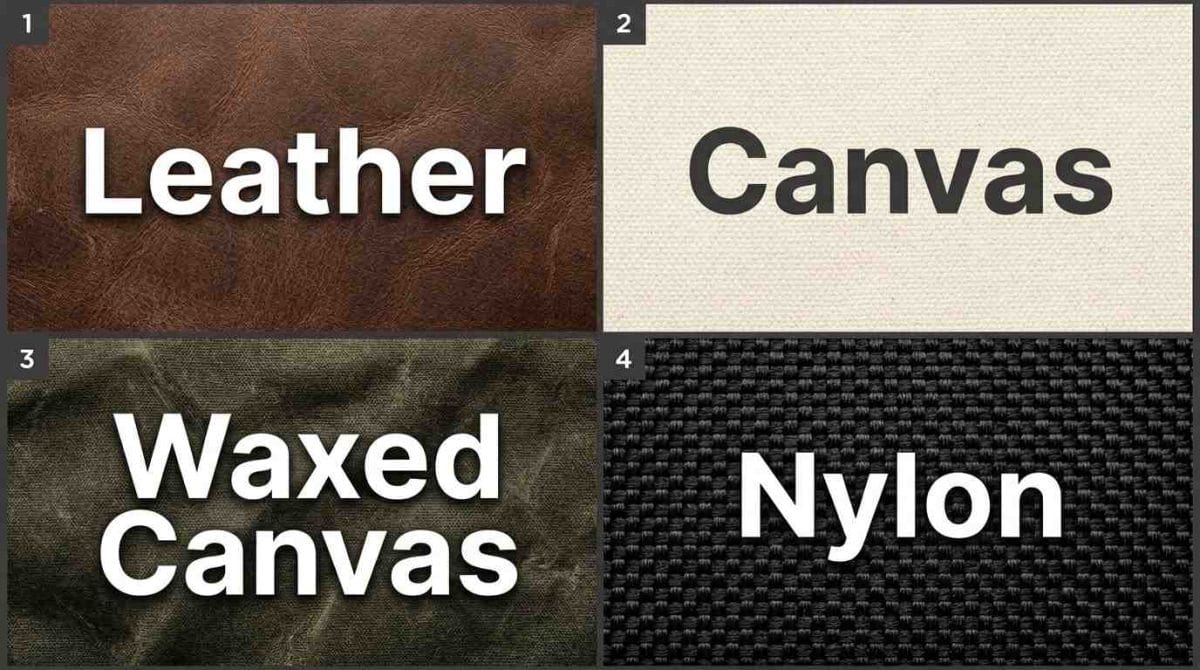
| Factor | Leather | Canvas | Waxed Canvas | Nylon (Coated) |
| Formality | High — suits office and smart-casual | Low to medium — casual and heritage | Medium — rugged-refined | Low to medium — sporty and technical |
| Weight | Heavier than synthetics | Light to moderate | Moderate | Light |
| Weather resistance | Low unless treated or protected | Low (absorbs moisture) | Moderate (resists light rain) | Moderate to high (depends on coating, seams, zippers) |
| Durability | High with proper care | Moderate; softens over time | Moderate to high | High; abrasion-resistant |
| Maintenance | Regular conditioning required | Low; spot clean | Low; re-wax periodically | Low; spot clean |
| Typical price range | $$$ to $$$$ | $ to $$ | $$ to $$$ | $ to $$$ |
| Best for | Office, business travel, polished style | Casual outings, college, weekend | Heritage-casual, light outdoor use | Commuting, gym, travel, wet climates |
Leather usually reads more formal and polished than canvas or nylon; for a deeper look at leather quality, construction, and top picks, see our leather bags guide. A well-built leather backpack can develop a patina over time, meaning the surface gains character with use instead of looking worn out. Full-grain leather uses the hide’s complete outer surface and tends to be the most durable. Top-grain leather is sanded for a smoother, more uniform finish (full-grain vs. top-grain leather).
Pros:
Cons:
Pack Hacker’s travel backpack guide notes that leather works well for stylish daypacks but adds weight and requires more care than synthetics.
Canvas gives a casual, rugged look that pairs naturally with jeans, chinos, and chore coats. Plain canvas allows some airflow, but waxed canvas trades breathability for better water resistance. The wax coating sheds light rain and develops its own patina.
Pros:
Cons:
Care note: Avoid machine washing waxed canvas. The heat and agitation can strip the wax coating.
Nylon is a common choice for commuter, gym, and travel backpacks because of its low weight and abrasion resistance. Coated nylon can resist light rain, but water protection depends on the coating, seam construction, and zipper design; the Pack Hacker travel backpack guide explains how to evaluate this before buying. Not all nylon backpacks are water-resistant.
Pros:
Cons:
Each backpack type serves a different use case, outfit style, and capacity need. The table below gives you a fast comparison. Detailed breakdowns follow.
| Type | Best For | Typical Capacity | Primary Material | Style Lean | Avoid If… |
| Leather | Office, business travel | 18–25L | Full-grain or top-grain leather | Old money, smart casual | You commute in heavy rain without a cover |
| Minimalist | Daily carry, tech protection | 15–22L | Matte nylon or technical fabric | Minimalist, modern | You need to carry bulky or heavy loads |
| Canvas | Weekend, college, casual days | 18–28L | Cotton or waxed canvas | Heritage, casual | You need consistent rain protection |
| Nylon / Tech | Gym, commute, travel | 20–30L | Coated nylon, ripstop | Sporty, urban | You want a polished office look |
| Commuter / Laptop | Work commute, meetings | 20–28L | Nylon, polyester, leather | Professional, clean | You carry a laptop larger than the sleeve fits |
| Carry-on / Travel | Air travel, 2–5-day trips | 30–45L | Nylon, polyester | Functional, streamlined | You don’t check airline carry-on dimensions first |
| Roll-top | Bike commute, variable loads | 18–30L (expandable) | Coated nylon, waxed canvas | Urban, techwear | You need guaranteed waterproofing without checking construction |
| Gym + Work hybrid | Office + gym in one bag | 25–35L | Nylon, polyester | Practical, restrained | You want a slim, polished profile |
| Vintage leather | Heritage outfits, casual days | 18–25L | Aged or distressed leather | Rugged, Americana | You need light weight or water resistance |
| Street / Skater | All-day casual, rough use | 25–35L | Heavy-duty nylon, cordura | Streetwear, skate culture | You dress business casual or formal |

A structured leather backpack signals polish and pairs naturally with suits, chinos, and smart-casual outfits. Look for full-grain or top-grain leather with reinforced stitching and quality hardware.
A minimalist backpack uses clean panels, matte fabric, and little or no visible branding. The result is a sleek profile that protects tech gear without visual noise.
Canvas backpacks are light, easygoing, and well suited for casual days, college, and weekend outings. Waxed canvas adds water resistance and develops character over time.
Nylon and tech-fabric backpacks are lightweight, abrasion-resistant, and often partially water-resistant when coated. They handle gym sessions, commutes, and travel well.
A commuter backpack is built around a padded laptop sleeve, organized pockets, and a slim enough profile for transit and meetings. The laptop sleeve is the most important feature and the most common source of fit mistakes.
A carry-on travel backpack is designed for air travel: it opens like a suitcase, compresses clothing, and is sized to fit in overhead bins when packed within the airline’s limits. Many use a clamshell (full-zip) opening for easier packing, but not all do; confirm the opening style before buying.
A roll-top backpack uses a fold-down closure that expands or compresses volume and can reduce water entry at the opening. The sleek, vertical profile suits urban commutes and bike rides.
A gym-work hybrid separates gym clothes and shoes from your work gear using dedicated compartments. This keeps odors contained and your meeting-day outfit clean.
A vintage-style leather backpack features heritage hardware, distressed or naturally aged leather, and a rugged silhouette. It is distinct from a standard leather backpack in shape, hardware, and patina character.
A street or skater backpack is built for all-day carry and rough use, with heavy-duty fabric, reinforced bases, large front pockets, and sometimes external board straps. It offers bigger capacity than most minimalist or office bags.
Start with your primary use case, then match size, comfort features, and laptop compatibility. A backpack that fits your routine and your body will feel better and last longer than one chosen for looks alone.

Capacity is measured in liters (L). A larger number means more space inside. Here is a general guide:
| Use Case | Suggested Capacity | What It Fits |
| Light daily carry | 15–20L | Laptop, wallet, keys, phone, light jacket |
| Work + lunch + extras | 20–28L | Laptop, charger, lunch, water bottle, notebook |
| Gym + work | 25–35L | Everything above, plus gym clothes and shoes |
| 2–5-day travel | 30–45L | Clothing layers, toiletries, shoes, laptop, accessories |

These are ranges, not rules. Your ideal capacity depends on what you carry and how tightly you pack.

A properly fitted backpack can reduce shoulder and back discomfort. Keeping total pack weight under about 10–15% of your body weight can help reduce strain, a guideline supported by ergonomics research on backpack loads and widely cited by health organizations including the American Chiropractic Association.
Use this checklist when trying on or evaluating a backpack:
Medical note: If you experience persistent back, shoulder, or neck pain while carrying a backpack, consult a healthcare professional. This guide provides general comfort advice, not medical recommendations.

Laptop sleeves vary by backpack model. Some fit up to 17-inch laptops. Many fit only 13–16 inches. A few are designed specifically for 14-inch ultrabooks.
Before buying:
Do not assume a backpack’s laptop sleeve fits your device based on the backpack’s overall size. A 30L travel pack may have a smaller sleeve than a 22L commuter pack.

A travel backpack only counts as a carry-on if its packed dimensions fit within your airline’s limits. US airlines commonly allow approximately 22 × 14 × 9 inches for carry-on bags, but rules vary by carrier.
Before flying:
Overpacked backpacks are the most common carry-on rejection. Leave room or use compression straps.

Your backpack should match your outfit’s level of formality and your personal style. A mismatched bag; too sporty with tailoring, or too polished with streetwear; breaks the outfit’s visual logic. Here are three common aesthetics and how to pair a backpack with each.
Pair a structured leather backpack with chinos, a tucked Oxford shirt, and loafers; see our old money style guide for a full breakdown of the aesthetic. Keep hardware muted; brushed metal or tonal finishes. This works for business travel, networking events, and polished weekend outings.
Choose a slim, matte nylon or technical-fabric backpack in black, charcoal, or navy; our minimalist fashion guide covers the full wardrobe system this aesthetic requires. Pair it with monochrome outfits, clean sneakers, and simple accessories. Avoid logos and loud patterns. The backpack’s clean lines should amplify the simplicity of the outfit.
Canvas or heavy-duty nylon suits this aesthetic; for the full outfit breakdown, see our skater style guide. Sling it over hoodies, graphic tees, and cargo pants. Skate sneakers and relaxed fits complete the look. Board straps and large front pockets are functional details that also read as style cues.
Outfit comparison photos showing the backpack in old money, minimalist, and skater looks.
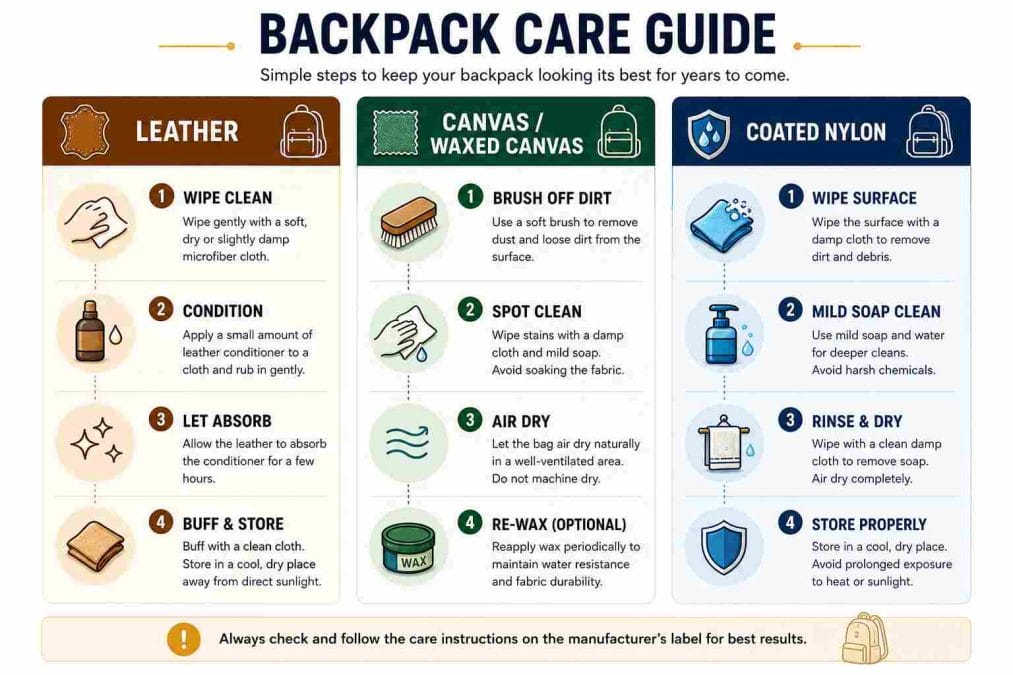
Proper care extends a backpack’s lifespan and keeps it looking sharp. Maintenance steps differ by material.
Focus on construction, comfort, warranty, and sourcing rather than brand name alone. A well-built backpack from a lesser-known maker can outperform a name-brand bag with weak stitching and poor hardware. For a curated list of leather-specific bag brands that meet these criteria, see our leather bag brands guide.
Evaluate across these criteria:
Some brands release limited-edition colorways or materials. Evaluate whether the difference improves durability, usability, or wardrobe fit before paying extra.
Full-grain leather and high-denier coated nylon are both long-lasting with proper care. Canvas is durable but softens over time; waxed finishes add water resistance and extend its lifespan. Longevity also depends on stitching, hardware, and how often you carry heavy loads.
A slim backpack in neutral nylon or canvas with clean lines, no visible logos, and organized interior pockets. Stick to black, gray, navy, or olive for easy outfit pairing.
They can be, if you value a polished look, long-term patina, and structured design. The tradeoffs are higher weight, higher cost, and regular conditioning. A leather backpack suits office and business-casual settings better than gyms or rainy commutes.
Around 15–25L for light daily carry (laptop, keys, wallet, light jacket). If you also carry gym clothes, lunch, or bulkier items, 20–28L gives more room without excess bulk.
Structured leather and sleek minimalist nylon tend to elevate outfits across jeans, chinos, and even suits. The key factors are clean lines, quality materials, and neutral or muted colors.
No single brand is best for everyone. Focus on build quality (reinforced stitching, reliable zippers), comfort (padded straps, ventilated back panel), warranty coverage, and ethical sourcing. A backpack that fits your body, your use case, and your style will outperform a famous name with poor construction.
Disclaimer: This article provides general fashion and buying guidance. Consult a healthcare professional for concerns about back or shoulder pain related to carrying a backpack. Consult the manufacturer for specific product care and warranty questions.


