Physical Address
Islamabad, PK
Physical Address
Islamabad, PK


Types of Vintage Clothing can confuse most men at first. They pick up a vintage piece and have no idea what they hold. Is it authentic or a modern reproduction? Is the sizing accurate, or has it shrunk by 2 full sizes? The global vintage apparel market reached $47.2 billion in 2024, per Market Intelo. Most buyers enter it without the knowledge to identify, size, or value what they purchase.
The consequences are costly. Reproductions of Levi’s Big E jeans and vintage band tees flood resale platforms. Vintage sizing runs 1 to 2 sizes smaller than modern equivalents. Without knowledge, buyers overpay for retro pieces and damage valuable garments.
This guide covers every type of vintage clothing for men across 11 categories. It classifies pieces by 7 collectible eras, 6 garment types, and 5 major subcultures. Readers learn to read union labels, authenticate construction details, and navigate vintage sizing. Value ranges, brand rankings, care guidelines, and 2026 market trends are all included.
Vintage clothing refers to garments manufactured between 20 and 99 years ago. These pieces reflect the authentic construction, fabric, and design of their production era. Age alone does not qualify a piece as vintage. The garment must have period-accurate features. This includes original labels and era-specific stitching. It should also use fabrics that match its production decade.
Vintage differs from simply old clothing in its verifiable construction details. These include bound seams, hand-finished hems, and metal zippers. Natural fiber textiles like dense wool, heavy cotton, and genuine silk are standard. Readers who prefer building a wardrobe around quality construction and fewer, better pieces will find the same principles applied in the 11 Minimalist Fashion Tips for Men – Ultimate Guide 2026.
The global secondhand apparel market hit $197 billion in 2023, based on the ThredUp 13th Annual Resale Report from GlobalData.
Vintage garments represent approximately 15–20% of that total by value. The London College of Fashion at the University of the Arts London lists 4 key factors that affect vintage value. These are age, authenticity, condition, and cultural significance.
Vintage, retro, and antique are 3 distinct classifications based on age and origin, not style. These terms carry different meanings in pricing, authentication, and collector value. For a clear view of modern style categories, see the 8 Core Fashion Aesthetics: Ultimate Guide 2026.

Retro pieces carry no collector value. Vintage pieces appreciate based on brand, condition, rarity, and cultural significance.
A garment qualifies as vintage at 20 years old. Professional collectors and auction houses reserve “true vintage” for pieces at least 50 years old. The 20-year threshold is the standard used by the Vintage Fashion Guild, Grailed, Depop, Christie’s, and Heritage Auctions. In 2026, true vintage menswear covers garments produced in 1976 or earlier.
Y2K clothing from 2000 to 2006 is now considered vintage. This includes logo-heavy sportswear and low-rise baggy denim. A 1955 denim jacket meets the true vintage threshold. It features unique mid-century construction methods and has over 70 years of production history.
Deadstock refers to vintage garments manufactured decades ago but never sold or worn. These pieces frequently retain their original store price tags. Deadstock has the highest resale prices in vintage. This is because the fabric, construction, and coloring stay completely unaltered.
Men’s vintage fashion evolved across 8 distinct decades, each shaped by economic conditions, cultural movements, and manufacturing advances. Fashion historian Christopher Breward from Edinburgh College of Art said that the years 1945 to 1965 were key. This time marked the biggest change in men’s fashion. Youth culture first separated from mainstream adult fashion during those 20 years. This knowledge helps collectors understand how garments are made. It also helps them check if items are real and figure out their value before buying.

| Decade | Cultural Force | Defining Garments | Collectibility |
| 1920s–1930s | Jazz Age, Hollywood icons Cary Grant and Clark Gable | Double-breasted suits, Oxford bag trousers, fedoras | High: extremely rare in wearable condition |
| 1940s | WWII rationing, War Production Board | Victory suits, A-2 flight jackets, peacoats, M-43 field jackets | Very high: genuine military pieces sell for $500–$5,000 |
| 1950s | Post-war prosperity, James Dean and Marlon Brando drive youth rebellion | Selvedge denim, leather jackets, chino trousers | Very high: 1950s Levi’s 501XX reached $100,000 at auction in 2018 |
| 1960s | Mod movement, British Invasion | Slim suits, Harrington jackets, Chelsea boots | High: original Baracuta G9 jackets sell for $200–$600 |
| 1970s | Disco culture, counterculture | Bell-bottoms, polyester suits, wide-lapel shirts | Medium: polyester disco shirts range from $20–$80 |
| 1980s | Corporate culture, MTV era | Power suits, Patagonia fleeces, varsity jackets | Medium to high: Patagonia Snap-T fleeces sell for $80–$300 |
| 1990s | Grunge, hip-hop culture | Graphic tees, baggy denim, Champion crewnecks | Growing: Wu-Tang tour tees sell for $200–$1,500 |
The War Production Board issued Limitation Order L-85 in 1942. This order restricted civilian suit fabric to 3.5 yards per garment. It eliminated double-breasted designs, trouser cuffs, and patch pockets entirely. After 1945, millions of military surplus garments entered civilian wardrobes. These construction changes are now key dating markers for authenticating 1940s menswear.
Certain eras command higher prices for 3 reasons: rarity of surviving garments, cultural significance, and quality of original construction. Before the 1970s, items featured heavier natural fibers like wool and cotton. They also had hand-guided stitching and sturdier seams. Earlier materials are stronger. They are also more collectible than later mass-produced items.
Men’s vintage clothing spans 7 distinct eras. Each era produced garments with unique silhouettes, fabrics, and construction details. Collectors use these details to date and value pieces accurately.
The 1920s and 1930s produced structured formal menswear defined by wide-leg silhouettes and heavy natural fabrics. Hollywood icons like Cary Grant and Clark Gable established the dominant aesthetic. Suits featured the “drape cut”: wide peak lapels, padded shoulders, and double-breasted closures. The tailoring principles from this era form the basis of heritage dressing today. You can find more details in the Exclusive Men’s Guide To Old Money Style Mastery [2026].
High-waisted Oxford bag trousers measured 22 to 40 inches at the ankle cuff. Standard fabrics included heavyweight wool, tweed, and flannel at 12 to 16 ounces. Key accessories included fedoras, flat caps, suspenders, and pocket squares. Surviving wearable pieces from this decade are extremely rare. Most authenticated examples are in museum collections. This includes the archives at the Victoria and Albert Museum in London.
The 1940s produced 2 distinct categories of men’s vintage clothing: civilian Victory Suits and functional military surplus outerwear. The War Production Board’s Limitation Order L-85 (1942) restricted civilian suit fabric to 3.5 yards per garment. This eliminated double-breasted cuts, trouser cuffs, and patch pockets from mainstream menswear. The Victory Suit featured a single-breasted jacket, straight-leg trousers, and narrow lapels. After 1945, military surplus garments entered civilian wardrobes. These included A-2 flight jackets, N-1 deck jackets, wool peacoats, and M-43 field jackets.
According to the Smithsonian National Museum of American History, these surplus items became everyday American clothing. Authentic WWII-era military pieces sell for $500 to $5,000 depending on condition and branch markings.
The 1950s produced the most collected category in men’s vintage fashion: selvedge denim, leather motorcycle jackets, and casual workwear. James Dean in “Rebel Without a Cause” (1955) and Marlon Brando in “The Wild One” (1953) made 3 garments iconic. Those garments were Levi’s 501XX jeans, white crew-neck T-shirts, and the Schott Perfecto leather jacket. Mainstream menswear favored the Ivy League look. Key pieces included boxy wool sack suits, Oxford cloth button-down shirts, rep ties, and leather penny loafers. This collegiate look has heavy wool and structured tailoring. It also features muted earth tones. This style fits well in the modern wardrobe shown in Dark Academia 2026: 15 Essential Pieces, Colors & Outfits (Still In Style?).
A pair of 1950s Levi’s 501XX jeans sold for $100,000 at auction in 2018, according to Levi Strauss Archives. Key construction markers include selvedge (shuttle-loom woven) outseams, chain-stitch hems, and the capital “E” red tab on pre-1971 Levi’s garments.

The 1960s shifted men’s vintage clothing toward slim tailored silhouettes. The British Mod movement, originating in London between 1958 and 1966, drove this change. Standard garments included slim 2-button and 3-button suits with narrow lapels measuring 2 to 2.5 inches. Fitted turtlenecks and Chelsea boots completed the look. Key brands included Ben Sherman (established 1963), Fred Perry, and Baracuta. Original 1960s Baracuta G9 Harrington jackets sell for $200 to $600.
The parallel American Ivy League look originated on campuses at Harvard, Yale, and Princeton. Its key pieces were button-down Oxford shirts, penny loafers by G.H. Bass, and crewneck sweaters. Teruyoshi Hayashida documented this style in the 1965 photographic study “Take Ivy.” The direct line from this collegiate wardrobe to modern dress codes is covered in the Preppy Style For Men 2026: 7 Tips & Icons To Inspire.
The 1970s produced men’s vintage clothing defined by dramatic proportions, synthetic fabrics, and wide lapels measuring 4 to 5 inches. Disco culture, fueled by “Saturday Night Fever” (1977), raised the need for 3-piece polyester suits and bell-bottom pants. These pants featured flares ranging from 24 to 32 inches. Synthetic fabrics like polyester, nylon, and rayon led mass-market production for the first time. This is reported by the Textile Research Journal. Punk emerged in 1976 and 1977 with an opposing style of DIY-altered garments, torn knitwear, and safety-pinned outerwear. Polyester disco shirts from this era range from $20 to $80. Leather jackets from the same decade range from $100 to $400.
The 1980s produced 2 parallel categories of men’s vintage clothing: the structured Power Suit and branded athletic casualwear. Giorgio Armani’s designs for “American Gigolo” (1980) defined the Power Suit. Key features included oversized double-breasted tailoring. Also, shoulder pads added 1 to 2 inches beyond the natural shoulder line. Athletic brands including Nike, Adidas, and Champion crossed into everyday fashion. Neon nylon windbreakers, acid-wash denim, and Members Only jackets became standard casual pieces. Patagonia Snap-T fleeces from 1985 to 1995 sell for $80 to $300 on Grailed. The MA-1 bomber jacket by Alpha Industries became the defining outerwear piece of the decade.
The 1990s defined men’s vintage through 3 cultural movements: Pacific Northwest grunge, hip-hop logo sportswear, and the founding of streetwear brands. Grunge, led by Nirvana and Pearl Jam, made oversized plaid flannel shirts, distressed denim, and worn-in work boots popular. These items still form the basis of a subcultural wardrobe today. You can find more in the Skater Boy Style Guide 2026: Tips and Trends. Hip-hop culture, driven by Wu-Tang Clan, Tupac, and Biggie, made baggy denim with 32 to 40-inch leg openings essential. Key sportswear pieces included nylon track jackets from Nike, Adidas, and FILA, plus satin Starter team jackets. Streetwear brands founded in this decade include Supreme (established 1994), FUBU (established 1992), and Karl Kani (established 1989). A 1990s Wu-Tang Clan tour tee sells for $200 to $1,500, according to Grailed sold listings from 2024 and 2025. Single-stitch hems on graphic tees confirm pre-1993 production.
Men’s vintage clothing has 6 main categories. Each one has unique construction features, brand rankings, and price ranges.
Vintage outerwear tops the list in men’s vintage fashion. There are 7 main jacket types that collectors seek today.
| Jacket Type | Era of Origin | Typical Vintage Price | Key Brands |
| A-2 Flight Jacket | 1930s–1940s | $300–$3,000 | Aero Leather, Rough Wear |
| MA-1 Bomber | 1950s–present | $80–$400 | Alpha Industries |
| Harrington G9 | 1937 (popularized 1960s) | $100–$600 | Baracuta, Grenfell |
| Chore Coat | 1920s–1960s | $60–$300 | Le Mont Saint Michel, Carhartt |
| Trucker Jacket (Type III) | 1962–present | $80–$2,000+ | Levi’s |
| Schott Perfecto | 1928–present | $200–$1,500 | Schott NYC |
| M-65 Field Jacket | 1965–2005 | $60–$250 | U.S. Military issue |

Schott NYC introduced the Perfecto motorcycle jacket in 1928 at a retail price of $5.50. Authentic vintage examples now sell for $200 to $1,500 depending on model number and condition. The Harrington G9’s scalloped back flap channels rainwater away from the body. Pre-1966 M-65 versions were produced without shoulder patches.
Vintage men’s trousers come in 6 distinct styles. You can tell them apart by waistband design, pleat direction, and leg shape.
| Trouser Style | Primary Era | Key Structural Features |
| Bag Trousers | 1920s–1950s | High waist, 22–40 inch ankle cuff, inward-facing pleats, button-fly |
| Fishtail Back | 1930s–1940s | V-notch rear waistband, suspender buttons, outward pleats, cuffed hem |
| Peg Trousers | 1930s–1940s | Roomy hips tapering sharply to a narrow ankle opening |
| High-Waisted | 1930s–1950s | Sits above the hips, tab-and-buckle side adjusters, vertical side pockets |
| Flat-Front Chinos | 1940s–present | Military origin; U.S. Army officer’s khakis issued from the 1940s onward |
| Cargo Pants | 1942–present | Cargo pockets added to U.S. paratrooper trousers in 1942, per U.S. Army Quartermaster Corps records; mainstream from 1990s |
Pleat direction is a key dating marker. Inward-facing pleats confirm pre-1960s production. Outward-facing pleats became the modern standard from the 1960s onward.
Vintage men’s shirts divide into 4 collected categories, each defined by collar construction, fabric weight, and decade of origin.
The Bowling Shirt peaked in popularity between the 1950s and 1960s. Its 3 defining features are two-tone panels, loop collars, and back pleats. The Camp Collar Shirt is also called the Cuban collar or resort shirt. It features a flat open collar, straight hem, and lightweight fabric. It originated between the 1940s and 1960s. It is worn unbuttoned at the collar.
The Oxford Cloth Button-Down (OCBD) was introduced by Brooks Brothers in 1896. Brooks Brothers archives confirm the design was inspired by English polo players’ collar buttons. It became the foundational Ivy League garment of the 1950s and 1960s. Original examples are identified by their locker loop and rear box pleat.
Flannel shirts from heritage mills like Pendleton (since 1863) and L.L. Bean became popular American workwear in the 1850s. Heavy wool and cotton plaid flannels from the 1960s and 1970s range from $20 to $80.
Vintage men’s knitwear divides into 3 primary types: Aran fisherman sweaters, collegiate sweater vests, and Champion Reverse Weave sweatshirts.
Aran fisherman sweaters originate from the Aran Islands, Ireland. Each garment weighs 800 to 1000 grams. They are knitted from unwashed wool containing natural lanolin for water resistance. Commercial Aran patterns date to the 1930s, according to the Knitting and Crochet Guild archives.
Champion Reverse Weave sweatshirts started in 1934. They’re knit horizontally, which helps stop vertical shrinkage. Authentic 1980s and 1990s examples feature ribbed side panels and a horizontal “C” logo on the sleeve. All original examples carry “Made in USA” tags. Standard examples sell for $40 to $200. Rare university-branded prints command $500 or more.
V-neck and crewneck sweater vests in Fair Isle, argyle, or solid colors were standard layering pieces from the 1930s through the 1950s. Shetland wool sweaters from Scottish mills were a staple of the 1960s Ivy League wardrobe.
Vintage denim is the most collected category in men’s vintage fashion. It is anchored by the Levi’s jacket Type system and the 501XX jean. Grailed’s 2024 market data shows that denim tops all vintage menswear categories in transaction volume.
3 technical terms define vintage denim authentication:
Selvedge (self-edge): Denim woven on shuttle looms, identifiable by a finished colored edge on the inseam. Red indicates Levi’s production. Most denim manufactured before 1980 is selvedge.
Chain stitch: A looping stitch pattern produced by Union Special sewing machines. It creates a distinctive “roping” fade pattern on denim hems over time.
Single stitch: A hem finished with one row of stitching. On Levi’s garments, single-stitch construction confirms pre-1986 production.

The 3 dominant brands in vintage denim are Levi’s (established 1853), Lee (established 1889), and Wrangler (established 1947). A pair of Levi’s 501 jeans from the 1880s sold for $87,000 in 2005, according to Levi Strauss Archives. Pre-1971 Levi’s 501 jeans sell for $500 to over $10,000.
Levi’s produced 3 distinct denim jacket types:
Type I (Lot 506XX, 1905–1952): Single left chest pocket, cinch-back buckle, double front knife pleats, and back box pleats. Pre-1936 models lacked pocket flaps. The cinch-back was removed in the Type II.
Type II (Lot 507XX, 1953–early 1960s): Two symmetrical chest pockets and button-adjuster tabs at the waist. Bar-tack stitching replaced copper rivets at stress points.
Type III (Lot 557XX, 1962–present): No front pleats, V-shaped tapered silhouette, and pointed pocket flaps. A capital “E” red tab dates the piece to 1962 to 1971. Hand-warmer pockets confirm post-1984 production. Lemon-yellow bar-tack thread beneath pocket flaps confirms an original Type III.
Vintage men’s suits fall into 4 unique silhouettes. Each silhouette links to a specific decade, subculture, and construction standard.
The Zoot Suit originated in Harlem’s African American jazz communities in the mid-to-late 1930s. Its jacket is thigh-length with padded shoulders and wide lapels. Its trousers are balloon-leg, tapering to a pegged cuff. The Los Angeles County Museum of Art purchased an authentic 1940s example in 2011 for $80,000. The Fashion Institute of Technology says the zoot suit is the first American men’s suit that isn’t based on European styles.
The Teddy Boy Drape Jacket appeared in 1950s Britain. It reimagined Edwardian tailoring for the working class. It features a long boxy coat with a contrasting velvet collar and slim drainpipe trousers. The Mod Suit of the 1960s features slim tapered trousers and a high 3-button closure. Lapels measure 2 to 2.5 inches. Common patterns include Glen plaid and bold checkers.
The Power Suit of the 1980s features double-breasted tailoring and peak lapels. Shoulder pads add 1 to 2 inches beyond the natural shoulder line.
Five key subcultures shape men’s vintage fashion:
Each produced distinct garment types, construction standards, and brand associations still collected today.
Heritage workwear centers on functional, American-made garments built from heavy 12 oz. cotton duck canvas and denim. Key brands are Carhartt (est. 1889, Detroit), Dickies (est. 1922, Texas), Ben Davis (est. 1935, San Francisco), and OshKosh B’Gosh (est. 1895, Wisconsin). Core pieces include chore coats, canvas duck jackets, denim coveralls, and hickory-stripe overalls. Pre-2000 Carhartt Detroit jackets with union-made tags sell for $80–$400. Blanket-lined versions in unique colors like forest green and burgundy cost the most.
The rockabilly look features five key pieces:
Cultural icons Elvis Presley, Gene Vincent, and Eddie Cochran defined this look. Schott NYC introduced the Perfecto motorcycle jacket in 1928 at $5.50 retail. Marlon Brando wore it in The Wild One (1953), cementing its permanent place in rebellious menswear culture. Authentic cuffed Levi’s 501s show a white selvedge line along the outseam. Perfecto models 618 and 613 from the 1950s–1970s sell for $400–$1,500.
The mod and Ivy League styles show two different mid-century looks. One is the slim British mod suit. The other is the structured American collegiate style. The Mod movement originated in London between 1958 and 1966. Key mod garments include slim 3-button suits, Fred Perry polo shirts, Clarks desert boots, and M-51 fishtail parkas. Mods wore the parkas over expensive suits while riding Vespa and Lambretta scooters. The Ivy League look comes from Harvard, Yale, and Princeton. It includes Oxford button-down shirts, Shetland crew-neck sweaters, and G.H. Bass Weejuns penny loafers (since 1936). “Take Ivy” (1965, Teruyoshi Hayashida) is the key photo record of Ivy League style. You can see how these garments are used today in the Ultimate Preppy Style For Men 2026: 7 Tips & Icons To Inspire.
Punk and glam rock vintage came from London and New York between 1976 and 1983. It focuses on four key garment types:
Glam rock was led by David Bowie and T. Rex. It brought velvet blazers, satin shirts, and platform boots to collectors. The punk hub was Vivienne Westwood and Malcolm McLaren’s shop, SEX, located at 430 King’s Road, London. Original band tees from the Sex Pistols, The Clash, and the Ramones can sell for $200 to $3,000. This is based on data from Grailed and Heritage Auctions. Single-stitch construction on sleeve and hem cuffs confirms pre-1993 production.
1990s hip-hop streetwear includes 5 main garment types:
Key founding brands include FUBU (est. 1992), Karl Kani (est. 1989), Cross Colours (est. 1989), and Phat Farm (est. 1992). The “Lo Heads” collector community targets rare Ralph Lauren Polo Sport pieces from the 1990s. Vintage Starter NBA and NFL satin jackets sell for $150–$800. FIT professor Elena Romero (Free Stylin’, 2012) said hip-hop started the first fashion subculture for men. This led to billion-dollar brand licensing deals.
| Subculture | Key Outerwear | Primary Trouser | Signature Footwear |
| Greaser | Schott Perfecto leather jacket | Cuffed raw selvedge denim | Engineer boots |
| Mod | M-51 fishtail parka | Slim-cut suit trousers | Clarks desert boots |
| Ivy League | Navy blazer | Pleated khaki chinos | G.H. Bass Weejuns |
| Punk | Studded leather jacket | Bondage trousers | Dr. Martens 1460 |
| Hip-Hop | Satin Starter jacket | Baggy wide-leg denim | Timberland boots |

Each subculture uniform pairs vintage outerwear, key trousers, and unique shoes. To enhance these looks with modern accessories, check out 10 Stylish Classy Mens Accessories: Elevate Your Style. Just make sure the vintage piece stays the main focus.
Three ways to authenticate vintage men’s clothing are:
Each method narrows a garment’s production date to a specific decade.
Labels have 6 key dating markers:
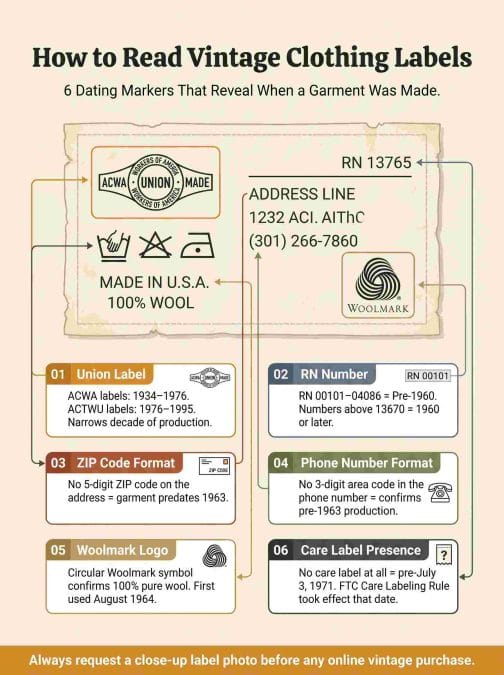
The Amalgamated Clothing Workers of America (ACWA), founded in 1914, is the primary union for American menswear. ACWA labels ran from 1934 to 1976. ACTWU labels followed from 1976 to 1995. RN numbers between 00101 and 04086 confirm pre-1960 production. Numbers above 13670 confirm 1960 or later. A U.S. address without a 5-digit ZIP code dates the garment before 1963. Phone numbers without 3-digit area codes confirm the same pre-1963 window. Labels reading “Made in British Hong Kong” or “Made in West Germany” place production before 1997 and 1990 respectively. The Woolmark logo, introduced August 1964, certifies 100% pure wool. The FTC Care Labeling Rule (16 CFR Part 423) took effect July 3, 1971. Garments without a care label predate it.
4 construction markers identify a garment’s era: seam finish, zipper material, stitch type, and button composition.

French seams confirm 1900s–1940s production. Pinked seams, cut with zigzag shears, are typical of the 1950s. Serged seams became standard from the 1960s onward. Metal zippers from brands like Talon, Conmar, and Scovill confirm pre-mid-1960s production. Talon introduced its blue-jean zipper in the 1920s. Plastic coil zippers entered the market in 1963. YKK became the dominant zipper brand from the 1970s onward. Bakelite (an early hard plastic) buttons confirm 1930s–1940s production. Cat-eye buttons indicate 1940s–1950s origin. Vintage leather jackets like the Schott Perfecto use metal hardware. Post-1963 models transitioned to plastic closures. Single-stitch hems on T-shirts confirm production before 1993.
Vintage denim and vintage band tees are the 2 most counterfeited categories in men’s vintage, per Real Authentication. On Levi’s, a capital “E” on the red tab confirms pre-1971 production. Verify further using 3 markers: a chain-stitch hem, hidden copper rivets (present pre-1966), and a red-line selvedge on the outseam. Chain-stitch hems produce a distinctive roping fade pattern on authentic denim. On band tees, authentic pre-1993 examples use blanks from Screen Stars, Anvil, or Giant. All 3 feature single-stitch sleeve and hem construction. A care label with international wash symbols confirms post-1971 production on any garment.
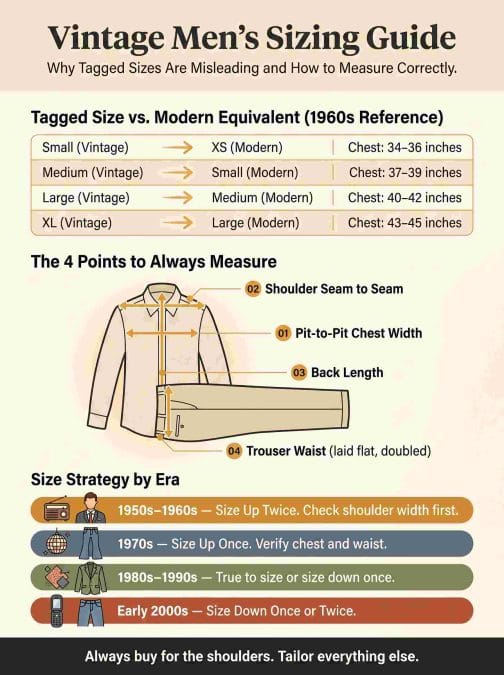
Vintage men’s sizing runs 1 to 2 sizes smaller than modern equivalents. 4 factors drive this: vanity sizing, sizing drift, thermal contraction (permanent shrinkage from heat washing), and lack of stretch fabric. A University of Warwick study found men’s clothing sizes inflated by 1–2 inches at the waist since the 1970s. A vintage trouser labeled “32-inch waist” measures a true 32 inches. A modern trouser labeled “32-inch waist” often measures 34–35 inches actual. In 1970, a standard Large shirt measured 22 inches pit-to-pit. By 2026, the same size expanded to 24.5 inches. Average American male height increased from 5’8″ in 1960 to 5’9.5″ in 2020, per CDC National Health Statistics. Vintage sleeve lengths run 1–2 inches shorter than modern garments. Deadstock pieces retain era-accurate sizing but still run 1 to 2 sizes smaller than modern equivalents. Vintage garments also lack elastane or spandex (stretch fiber). Size up 2 inches beyond actual chest measurement for comfortable movement.
Measure 4 points on any flat garment before buying. These are pit-to-pit chest width (armpit to armpit), shoulder seam to shoulder seam, back length from collar base to hem, and trouser waist laid flat and doubled. Platforms like Grailed, Depop, and eBay list flat measurements as standard. Buy for the shoulders and tailor the remaining dimensions. Never rely on the tagged size alone.
| Tagged Size (Vintage 1960s) | Modern Equivalent | Chest Measurement |
| Small | XS | 34–36 inches |
| Medium | Small | 37–39 inches |
| Large | Medium | 40–42 inches |
| XL | Large | 43–45 inches |
| Garment Era | Sizing Shift | Recommended Strategy |
| 1950s–1960s | Very small; short length, narrow armholes | Size up twice; check shoulder width first |
| 1970s | Slim; narrow chest, tapered waist | Size up once; verify chest and waist |
| 1980s–1990s | Large; boxy, drop-shoulder | True-to-size or size down once |
| Early 2000s | Very large; baggy, long length | Size down once or twice |
4 factors determine value in men’s vintage clothing: brand, condition, rarity, and label authenticity. The vintage menswear secondary market is projected to grow at 4.7% per year from 2025 to 2030.
Pre-1971 Levi’s selvedge denim holds the highest value floor, with authentic pairs selling for $500 to $150,000.
Pre-1970s garments fetch high prices for three main reasons:
Deadstock pieces reach 2x to 5x the price of equivalent worn examples in any category. Condition grades, from mint to poor, create big price differences in all categories.
A pair of 1880s Levi’s 501 jeans sold for $87,000 in 2005, per Levi Strauss Archives. Vintage rock concert tees from bands like Nirvana, Led Zeppelin, and the Rolling Stones sell for $500 to $2,000. An unreleased 1968 Beatles design sold for $400,000 in 2024. WWII-era A-2 flight jackets sell for $500 to $5,000. One documented example sold for $44,100 at Heritage Auctions. Wartime Sukajan jackets are reversible silk or satin bombers made for U.S. servicemen in Japan and Korea. Originals sell for $800 to $5,000. The Los Angeles County Museum of Art purchased a 1940s zoot suit for $80,000 in 2011.
| Category | Typical Price Range | Record Sale |
| Pre-1971 Selvedge Denim (Levi’s 501XX) | $500–$150,000 | $87,000 (1880s pair, 2005) |
| WWII Flight Jackets (A-2, B-3) | $500–$5,000 | $44,100 (Heritage Auctions) |
| Vintage Band Tees (1970s–1980s) | $200–$10,000 | $400,000 (1968 Beatles design, 2024) |
| Wartime Sukajan Jackets | $800–$5,000 | $6,000+ (hand-embroidered dragon/map originals) |
| Military Surplus (M-65, N-1 Deck Jacket) | $60–$800 | $2,500+ (named, dated pieces) |
| Hawaiian Shirts (1940s–1950s rayon) | $100–$4,000 | $3,000+ (Shaheen, Kamehameha) |
| Champion Reverse Weave (pre-1990s) | $40–$300 | $500+ (rare university prints) |
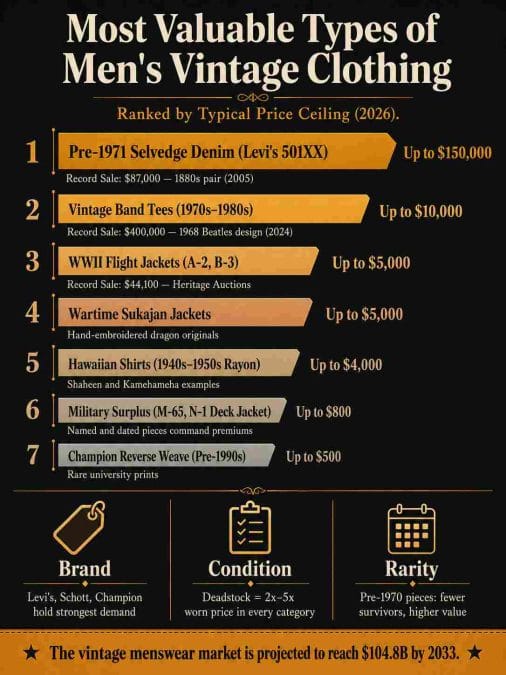
Levi’s, Champion, Carhartt, and Nike are the 4 most-searched vintage brands on Grailed, per the platform’s 2024 Year in Review.
Collector demand focuses on three key signals:
| Brand | Collectible Era | Key Authentication Marker | Value Range |
| Levi’s | Pre-1971 | Capital “E” red tab, red-line selvedge outseam | $40–$150,000+ |
| Champion | 1980s–1990s | “Made in USA,” horizontal “C” sleeve logo | $40–$500+ |
| Carhartt | Pre-2000 | Union-made tag, “Made in USA,” script logo | $80–$400 |
| Schott NYC | 1950s–1970s | Metal hardware, model numbers 618 or 613 | $400–$1,500 |
| Pendleton | 1960s–1980s | “Made in USA,” wool content tag, Board Shirt label | $30–$150+ |
| Alpha Industries | 1960s–1980s | Military contract label, MA-1 or N-3B model | $80–$400 |
| Nike | Pre-1995 | Silver or orange neck tag, block letter logo | $25–$200+ |
| Gucci (Tom Ford era) | 1994–2004 | Serif font label, “Made in Italy” | $50–$1,500+ |
| Burberry | Pre-2000 | “Burberrys” label with “s,” “Made in England” | $100–$600+ |
| Versace (Gianni era) | Pre-1997 | “Gianni Versace” script label, baroque silk print | $200–$3,000+ |
| Patagonia | 1985–1995 | Oval mountain logo, “Made in USA,” Snap-T | $80–$300 |
A functional men’s vintage wardrobe begins with six durable, versatile pieces. These items layer easily with modern clothes and need no special skills to wear. This idea aligns with the 11 Minimalist Fashion Tips for Men – Ultimate Guide 2026. It emphasizes quality over quantity when creating a complete modern wardrobe.
6 garments form the foundation of a functional men’s vintage wardrobe, each offering high versatility and an accessible entry price.
| Piece | Typical Price | Versatility | Best Use |
| Levi’s Type III trucker jacket (1990s) | $40–$100 | High | Layers over any outfit |
| Champion Reverse Weave crewneck | $30–$80 | High | Pairs with any trouser |
| Pendleton or Woolrich plaid flannel | $20–$80 | High | Shirt or light jacket |
| High-waisted neutral chinos (1960s–1970s) | $20–$60 | High | Pairs with modern and vintage tops |
| 1990s graphic tee (band or brand) | $15–$60 | Medium | Casual anchor piece |
| Military surplus M-65 field jacket | $50–$150 | High | Fits over knitwear and shirts |
Prioritize shoulder fit above all other measurements on any piece. Tailoring corrects waist, sleeve, and hem dimensions at low cost. Platforms like Grailed, Depop, and eBay list flat garment measurements as standard practice.
The best way is the 1-vintage-piece rule: base each outfit on 1 standout vintage item and keep the rest modern and neutral, according to GQ Style (2024). Michael Hill, creative director of Drake’s London, says: “The best-dressed men treat vintage as seasoning, not the whole meal.”
Apply the 70/30 principle: devote 70% of the wardrobe budget to neutral modern basics and 30% to vintage statement pieces. Modern anchor pieces include plain T-shirts, dark wash denim, and tailored chinos. For seasonal tips, read the 7 Epic Winter Fashion Guide Secrets Men Ignore [2026]. It covers how to layer vintage outerwear with knitwear. Add minimalist footwear like white leather sneakers or Chelsea boots. The Summer Fashion Guide For Men 2026: 7 Tips offers easy style ideas for warm weather. Pair vintage camp collar shirts, graphic tees, and Harrington jackets with modern summer basics for a fresh look.
5 online platforms and 4 physical sourcing channels provide reliable access to authentic men’s vintage clothing. Depop reported 30 million registered users in 2023, with menswear representing 35% of sales. The number of vintage and secondhand stores in the U.S. grew 12% between 2021 and 2023, per IBISWorld.
| Platform | Best For | Key Advantage |
| eBay | All eras and budgets | Completed auction pricing data, advanced search filters |
| Grailed | Designer and archival menswear | Curated seller knowledge, premium brand sections |
| Depop | 1990s and Y2K streetwear | Mobile-first, active offer culture |
| Etsy | Pre-1970s tailoring and accessories | Organized listings with detailed seller measurements |
| The RealReal | Authenticated luxury vintage | In-house authentication, standardized condition grading |
Physical channels include vintage shops, estate sales, military surplus stores, and flea markets. At these locations, inspect the zipper material, seam finish, and label text before you buy. These same sources often offer vintage leather bags and briefcases. Use the same authentication methods discussed in the 10 Best Leather Bags Brands For Men: 2026 Guide.
Correct care for vintage clothing requires matching the washing method, drying, and storage to the specific fabric type. The Smithsonian Museum Conservation Institute found that textiles stored at 65 to 70°F and a moisture level of 30 to 50% last up to 10 times longer. Wash vintage garments only when necessary. Each wash degrades natural fibers, fades dyes, and weakens original stitching.
| Fabric | Washing Method | Drying Method |
| Cotton | Cold wash, gentle cycle, inside-out | Air dry or low-heat tumble |
| Wool | Cold hand wash, gentle wool wash | Flat dry on towel; never hang |
| Silk | Cool hand wash, pH-neutral soap | Roll in dry towel; lay flat |
| Leather | Wipe with damp cloth and saddle soap | Air dry; condition twice yearly |
| Polyester | Cold machine wash, mild detergent | Air dry to prevent fiber damage |
| Rayon | Careful cold hand wash only | Lay flat; never wring |
| Selvedge denim | Cold soak, no detergent, infrequent | Air dry flat |
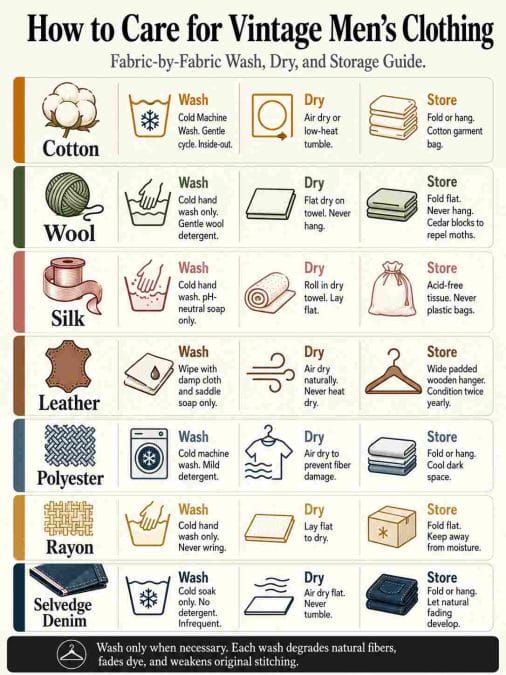
For musty storage odors, mix 90% water with 10% distilled white vinegar in a spray bottle. Lightly mist the garment and air dry flat indoors. Avoid aluminum-based deodorants when wearing vintage garments. These permanently stain natural fibers.
Store garments in a cool, dark environment away from basements and attics. Both produce damaging temperature and moisture shifts. Use breathable cotton garment bags or acid-free tissue paper. The American Institute for Conservation confirms acid-free storage prevents yellowing in cotton and linen. Avoid plastic dry-cleaning bags. These trap moisture and cause mildew. Hang structured coats and jackets on wide padded wooden hangers. Wire hangers distort shoulder seams permanently. Fold heavy knitwear, sweaters, and silks flat. Inspect all garments twice a year and refold flat items along new creases to prevent fiber fatigue. Use cedar blocks or lavender sachets to repel moths.
Lubricate stiff vintage metal zippers with a small amount of natural beeswax or Vaseline. Apply directly to the teeth to prevent rust and ensure smooth operation.
Repairs fall into two categories: functional and cosmetic. Functional repairs include simple tasks. You might replace a broken zipper. You could also reattach a missing button with a matching vintage one. These repairs keep the item wearable while maintaining its authenticity. Cosmetic restoration means fixing items to make them look better. This includes re-dyeing faded denim. It also involves patching holes in band tees and military jackets. These can lower resale value for collector-grade items.
Collectors seek natural chain-stitch roping on denim hems and honest fading patterns. If wear adds value, leave the pieces as they are. Restore only if damage affects usability.
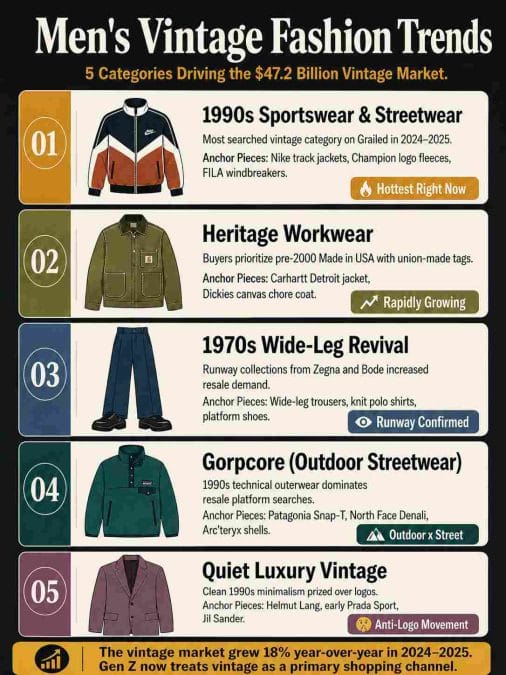
Five trends shaping men’s vintage fashion in 2026 are:
The global secondhand apparel market grew 18% year-over-year in 2024 and 2025, according to the ThredUp Resale Report. Within that total, the vintage-specific market reached $47.2 billion in 2024 and is projected to reach $104.8 billion by 2033, per Market Intelo.
Gen Z drives the largest share of vintage market growth. According to the ThredUp Resale Report 2024, Gen Z consumers treat vintage as a primary shopping channel rather than a niche interest. The clean and vintage-inspired look defines this group’s style. You can find more in the Ulzzang Aesthetic 2025: The Ultimate Style & Outfit Guide. Depop, their primary resale platform, has 30 million registered users. Grailed reported 40% growth in vintage menswear transactions between 2022 and 2024.
The 5 trending style categories in 2026 are:
1990s Sportswear and Streetwear: Track jackets from Nike, Adidas, and FILA are popular. Logo fleeces from Champion are also in demand. These are the top vintage searches on Grailed. Highsnobiety’s 2025 trend report identifies archival 1990s menswear as one of the top 5 fashion trends.
Heritage Workwear: Chore coats come from Carhartt. Canvas Detroit jackets and utility vests are from Dickies. These items drive workwear demand. Buyers prioritize pre-2000 Made in USA examples with union-made tags.
1970s Wide-Leg Revival: Wide-leg trousers and knit polo shirts from the 1970s are in active demand. Runway collections from Zegna, Bode, and Wales Bonner have increased resale demand for 1970s vintage pieces.
Gorpcore (Outdoor-Inspired Streetwear): Resale sites have popular 1990s gear. You can find Patagonia Snap-T fleeces, The North Face Denali jackets, and Arc’teryx Gore-Tex shells.
Quiet Luxury Vintage: Clean lines from 1990s minimalism catch attention. Helmut Lang, early Prada Sport, and Jil Sander offer subtle, collector-grade pieces that buyers love. This mindset values quality, restraint, and heritage more than logos. It reflects the foundation found in the Exclusive Men’s Guide To Old Money Style Mastery [2026].
The sustainability factor reinforces all 5 trends. The United Nations Environment Programme identified fashion as responsible for 8 to 10% of global carbon emissions in 2023. Buying vintage extends garment lifespan and avoids new production entirely.
In summary, men’s vintage clothing includes 7 collectible eras, 6 garment types, and 5 key subcultures. Each has unique construction markers, price ranges, and authentication standards. A garment qualifies as vintage at 20 years old. True vintage status requires at least 50 years of documented production history. Deadstock commands the highest prices in every category.
Authentication uses four key markers. These are metal zippers, union labels, seam construction, and country-of-origin text. Vintage sizing runs 1 to 2 sizes smaller than modern equivalents. Measure every garment flat before purchasing. Never rely on the tagged size alone.
Value concentrates in 4 categories: pre-1971 selvedge denim, WWII-era military outerwear, USA-made heritage workwear, and rare graphic tees. Brands like Levi’s, Carhartt, Champion, and Schott NYC hold the strongest collector demand. The global vintage apparel market is projected to reach $104.8 billion by 2033, per Market Intelo. Correct care, fabric-matched washing, and climate-controlled storage preserve both condition and resale value. The 5 trends driving the market in 2026 are 1990s sportswear, heritage workwear, the 1970s wide-leg revival, gorpcore, and quiet luxury minimalism.
Start your vintage wardrobe with 1 authenticated piece. Browse Grailed, Depop, or eBay using flat measurements rather than tagged sizes. Check the label, verify the zipper, and confirm the seam finish before every purchase. Every piece worth buying carries the evidence of its era in its construction.
Vintage clothing includes items that are 20 to 99 years old. These garments feature designs, fabrics, and construction methods that reflect their era. Age alone does not qualify a piece. A garment must show verifiable construction details from its production era. These have original labels, stitching from the era, and fabrics that match the decade when they were made.
Vintage, retro, and antique are 3 distinct classifications based on age and origin, not style. Vintage describes original garments made 20 to 99 years ago. Retro describes modern items designed to imitate a past era’s aesthetic. Antique describes garments over 100 years old.
A garment must be at least 20 years old to qualify as vintage. In 2026, any garment produced in 2006 or earlier qualifies. The Vintage Fashion Guild, Christie’s, and Heritage Auctions all use this 20-year threshold as the standard.
Yes. Y2K garments from 2000 to 2005 now exceed the 20-year threshold and qualify as vintage. Branded sportswear, logo-heavy casualwear, and low-rise baggy denim are in high demand. Collectors are seeking these items on sites like Grailed and Depop.
The 4 most valuable men’s vintage categories are pre-1971 selvedge denim, WWII-era military surplus, USA-made heritage workwear, and rare graphic tees. Brand, condition, rarity, and label authenticity are the 4 primary value drivers. Pre-1971 Levi’s 501 jeans sell for $500 to over $10,000.
Deadstock refers to vintage garments manufactured decades ago but never sold or worn. These pieces retain their original store price tags. Deadstock commands the highest resale prices in any vintage category. Fabric, construction, and coloring remain completely unaltered.
Authentic vintage pieces carry 4 verifiable markers: metal zippers, union labels, construction details, and country-of-origin text. Metal zippers from Talon, Conmar, or Scovill confirm pre-mid-1960s production. Plastic coil zippers entered the market in 1963. A “Made in USA” label suggests pre-1994 production. Single-stitch hems on T-shirts confirm pre-1993 production. Union labels narrow the decade but do not confirm vintage status alone.
Incorrect washing permanently damages or destroys vintage garments. Wool shrinks and felts under heat and agitation. Vintage graphic tees crack under hot machine washing. Natural fibers including cotton, wool, and rayon require cold-water hand washing. Leather and structured wool pieces require specialist dry cleaning.
Vintage men’s sizing runs 1 to 2 sizes smaller than modern equivalents. A shirt labeled “Large” from the 1960s fits like a modern Medium. A University of Warwick study confirmed men’s clothing sizes inflated by 1 to 2 inches at the waist since the 1970s. Measure the garment flat rather than relying on the tagged size.
Yes. A functional vintage wardrobe is achievable at low cost by focusing on durable, accessible pieces. Flannel shirts, chore coats, crewneck sweatshirts, and generic denim are easy to find. Everyday workwear and 1990s sportswear remain affordable. Rare deadstock and designer pieces command the highest prices.
Grailed, Depop, eBay, and Etsy are the 4 most reliable platforms for men’s vintage clothing. Depop has 30 million registered users, with menswear representing 35% of sales. Request close-up photos of labels, stitching, and zippers before any online purchase.
Four key garments are great for new men’s vintage buyers. They are a denim jacket, a flannel shirt, a Harrington jacket, and a crewneck sweatshirt. All 4 blend naturally with modern basics. None require full period-accurate styling to wear effectively.
High-quality vintage items from brands like Levi’s, Burberry, and Carhartt are valuable. As their supply goes down, their worth often goes up. Investment potential depends on brand, condition, rarity, and collector demand. Buying pieces that are also wearable reduces financial risk.
Skipping label checks increases the risk of overpaying for a reproduction or misidentifying an era. Labels reveal the production decade through 6 markers: union label design, RN numbers, ZIP codes, phone number format, Woolmark certification, and country of origin text. Request close-up label photos before any online purchase.
Yes. The global secondhand apparel market grew 18% year-over-year in 2024 and 2025, according to the ThredUp Resale Report. Gen Z’s preference for individual style and the expansion of platforms like Grailed and Depop are the primary growth drivers.
Vintage denim jackets, Harrington jackets, flannel shirts, and crewneck sweatshirts are perfect for daily wear. They are easy to style and comfortable. All 4 blend naturally with modern trousers, plain T-shirts, and clean sneakers. None require full period-accurate styling.