Physical Address
Islamabad, PK
Physical Address
Islamabad, PK


Curly hair does not need to be tamed. It needs a cut that was built for curls. Too many curly cuts fail for a simple reason: they are straight-hair cuts with curls left in them. The barber cuts wet hair, the hair dries, the curls spring up shorter than planned, and the shape that looked neat in the chair turns into a shape no one planned. This guide to curly haircuts for men is about avoiding that. It covers eight cuts that work with curl, not against it, how to pick one for your curl type and face shape, and the exact words to use in the barber’s chair.
Straight hair already has its own guide on this site, and so does wavy hair. For the broader picture of cuts, see our men’s haircuts guide. For straight hair, see our straight hair guide. For wavy hair, see our wavy hairstyles guide. What follows is the curly side only. It does not repeat those guides, and it does not borrow their advice and paste it onto curls.
A curly cut works when three things are right: the length is judged dry, the shape is planned, and the weight is controlled with layers. Get those three right, and most cuts in this guide will behave. Get one wrong, and even a good cut can disappoint.
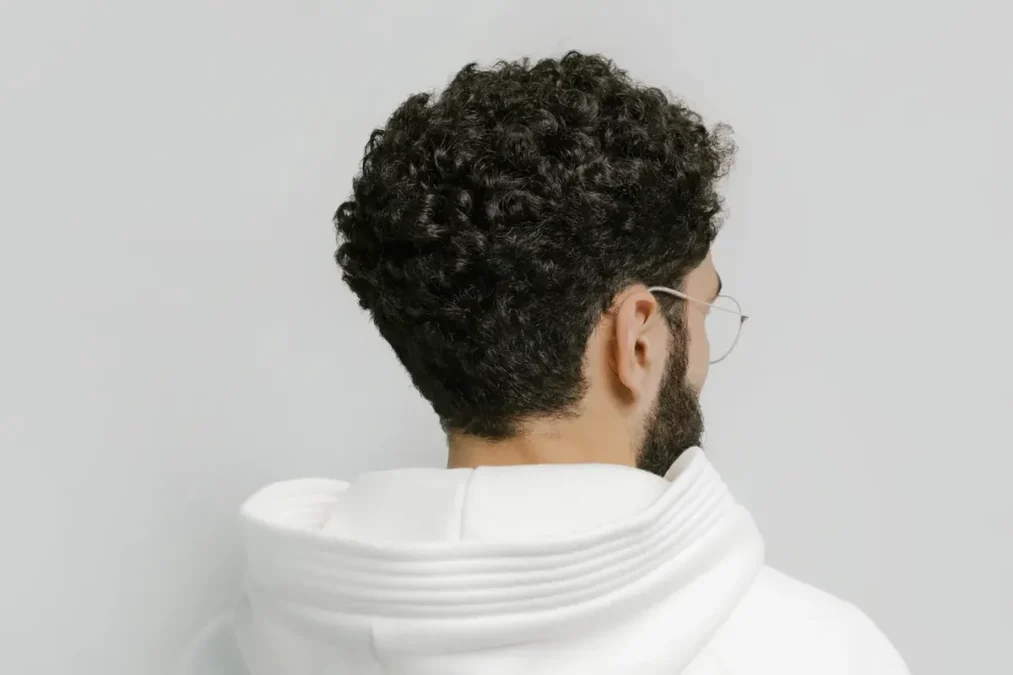
A curl looks longer wet than it does dry. Wet, the curl hangs down. Dry, it coils back up. Loose curls shrink a little. Tight coils shrink a lot. That is normal, and it is not a flaw in your hair. It is a fact the cut must allow for. If a barber cuts wet hair to the length you want to see dry, the dry result will be shorter than you asked for. The fix is simple: judge the length dry, or leave extra length and shape it once it dries. The barber section later in this guide turns this into words you can say in the chair.
On straight hair, length is easy to talk about: short, medium, or long, and everyone knows what it means. On curly hair, length alone tells you very little. Two men with the same length can have very different hair, because one man’s curls sit flat and the other’s stand out in volume. What you see from across the room is the outline — the shape. A good curly cut starts with the shape: round on top, tapered at the sides, even all round, or layered so it falls in steps. The length then serves the shape, not the other way round.
Without layers, curly hair can build into a heavy shape: flat on top, wide at the bottom, like a triangle. Layers fix that. A layer is a shorter section cut into the hair so weight comes out of the middle and the curl can sit where it was planned to sit. Layers are a shaping tool. They are not the same as heavy thinning, which cuts lots of short hairs all through the hair and can break curls apart and add frizz. The article says this in “can” language, because every head is different — but as a rule of thumb, ask for layers that shape, not thinning that shreds.
Many barbers cut curly hair dry, or mostly dry, so they can see the curl as it will actually sit. That is common practice, not a law, and not every barber works that way. What matters is that you ask. “Do you cut curls dry?” is a fair question, and the answer tells you a lot about whether the barber is used to curls. A barber who never cuts curls dry can still do a good job, as long as he leaves extra length and checks the shape dry before he finishes. A barber who cuts wet and short, with no dry check, is the risk this guide warns about.
A straight cut is planned around lines: a clean part, a flat top, an even edge. Curls do not hold lines the same way. They move, they spring, and they change shape as the day goes on. A cut that depends on a sharp line will lose that line by lunch. A curly cut depends on a shape instead. That is the whole difference, and it is why the straight and wavy guides on this site are siblings, not substitutes. If your hair is curly, start here, not there.
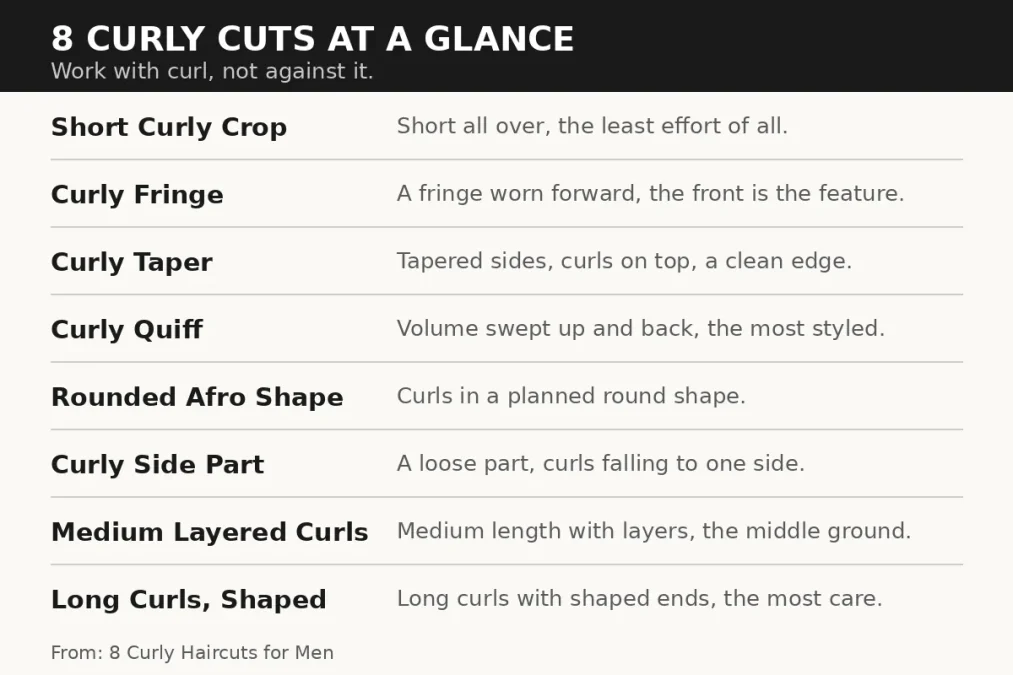
Read the eight in full below, or use the choosing sections to narrow them first: curl type, then face shape, then the barber script.
If you want to stop thinking about your curls every morning, start here. The crop is the simplest curly cut there is, and it is honest about what it gives up.
Short all over, with the curls kept close to the head. The shape is compact. There is no fringe to keep neat, no part to place, no volume to manage. The curls still show — this is not a shave — but they are short enough that they behave without much help.
It suits men who want the lowest possible daily effort, and men who are new to wearing their curls and want a safe first step. It suits loose, springy, and tight curls, because short length removes most of the problems curls cause: there is not enough length to go triangular, and not enough weight to drag the curls flat. It suits most face shapes, because it adds little and takes little away — but that is also its limit, covered below.
Two costs, both plain. First, choice: the crop looks like a crop every day. There is no restyle for a smart occasion and no longer version for the weekend. Second, upkeep in general terms: a short outline shows growth sooner than a long one, so the shape needs a tidy-up more often than a longer cut does. No fixed interval is given here, because none is established — the schedule system is covered in a separate guide, linked in the keeping section.
The fringe is the only cut in this guide where the front does most of the work. That makes it striking, and it makes the front the part you must keep neat.
A fringe worn forward across the forehead, with curls on top and shorter sides. The fringe is not combed flat — it is curls, falling forward in their own shape. The sides are kept shorter so the eye goes to the front, not to bulk at the sides.
It suits loose and springy curls best, because those curls fall forward in a soft shape without much help. It suits men who want a visible feature without a lot of styling: the fringe is the style, and the rest of the cut just frames it. It suits faces where a fringe softens the forehead, and it is a good pick for younger men, though age alone should never decide a cut.
The fringe line. As the fringe grows, it loses its clean edge first — it starts to fall unevenly, and the cut stops looking planned. That means the fringe shows its age sooner than the crop does, and visits need to come before the front turns scruffy. Daily, it costs almost nothing: wash, let the curls fall forward, and leave them alone.
The taper is the cut for a man who wants a neat edge without a loud fade. It is the most useful curly cut for work and smart settings, because it looks tidy from every side.
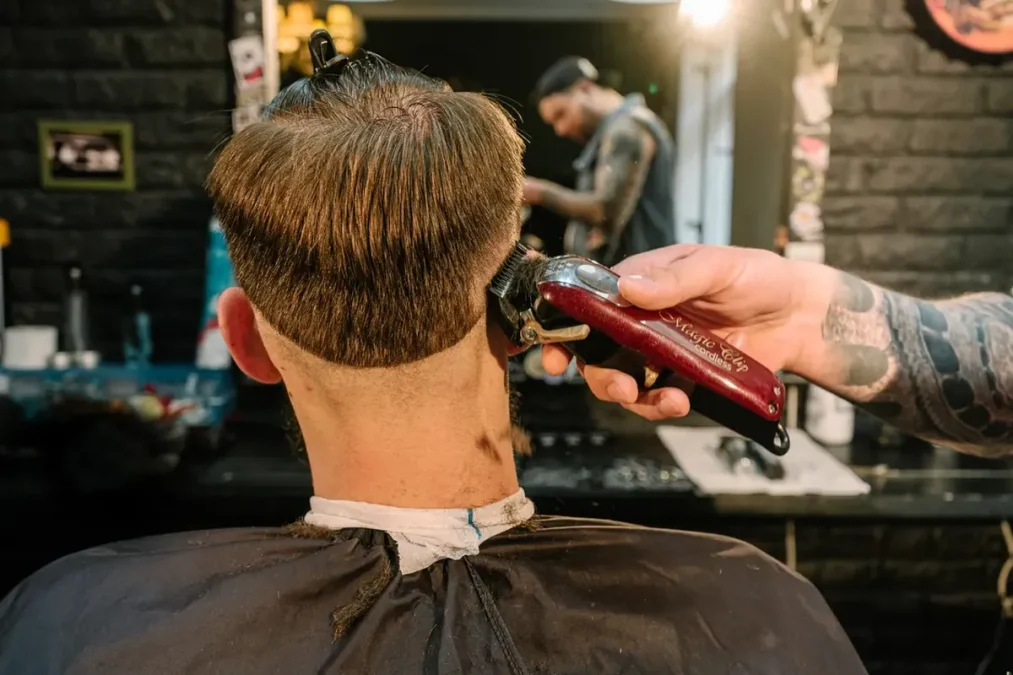
The sides and the nape are tapered — cut gradually shorter towards the edges — while the curls on top are left longer. The taper is gradual, not stepped, and it does not climb high up the head. That is what separates it from a skin fade: a skin fade is designed to be noticed, with shaved skin next to longer hair. A taper is designed to look neat without shouting, which is why it belongs in this guide and a skin fade does not.
It suits most curl types, and it suits thick, dense curls particularly well, because the taper removes bulk exactly where thick curls tend to push out — at the sides and the nape — while the top keeps its natural curl. It suits men who want the neatest possible edge, and it pairs cleanly with a short or medium top. For the product side of thick hair, see our guide to products for thick hair.
The edge. A taper’s clean edge is the first thing to blur as it grows out, so the cut looks less sharp sooner than the crop does, even though the top still looks fine. The daily cost is nothing — the taper needs no styling — but keeping that edge clean is what keeps the cut reading as planned.
The quiff is the only cut in this guide that asks something of you every morning, and this section does not hide that. In return, it gives the most height and the most presence.
Volume swept up and back on top, with the sides kept shorter. On curly hair, the volume comes from the curl itself, not from combing straight hair up — the curls are lifted and left to hold their own shape, with a little help from product. The sides stay short so the height on top reads as a shape, not as bulk all over.
It suits springy curls best, because those curls hold height on their own. It suits loose curls too, though loose curls may drop during the day and need a refresh. It suits men who want a cut with presence, and faces where a little height on top helps the proportions — the face-shape section covers this as a tendency, not a rule.
Morning effort, every day. The quiff does not fall into place on its own the way a crop does: the top has to be lifted, and the curls have to be placed. That is a small cost — a few minutes — but it is a daily cost, and it is the reason this cut sits at the higher-effort end of this guide. On tight coils, a quiff is harder to hold, because tight coils spring back to their own shape rather than the swept shape — another tendency, not a ban.
The rounded shape is the boldest cut in this guide, and also the most misunderstood. It is not “letting it grow.” It is a shape, planned and kept, like any other cut here.
Curls grown into a planned round shape, even all round. There is no part and no fringe. The outline is the style: a full, round silhouette that frames the face. The work is in the shaping — the barber cuts the outline so the volume sits evenly, not heavier on one side or flat on top.
It suits springy curls and tight coils best, because those curls hold volume on their own and fill a round shape well. It suits men who want their curls to be the look, not a detail of it, and men with the patience for a longer cut — this shape takes time to grow into, and it takes regular shaping to stay round rather than drifting into a block.
Care and shaping. A round shape shows uneven growth clearly: one side fuller than the other, or the top flattening, breaks the outline. Washing, drying, and detangling take longer at this length, and the cut needs shaping visits to stay round. That is the honest price of volume, and it is worth paying only if volume is what you actually want.
The side part on curly hair is a different animal from the side part on straight hair. On straight hair, the part is a line. On curly hair, the part is a suggestion, and the curl does the rest.
A loose part with curls falling to one side. The part is not a sharp line combed into place — it is a soft division, and the curls fall where the part points them. The sides are kept shorter than the top, so the part reads clearly without needing a comb line to hold it.
It suits loose and springy curls best, because those curls fall to one side without fighting. It suits men who want a smarter look without the daily combing a straight side part demands. It suits faces where a part adds structure, and it is a good middle step for a man moving from a short crop to a longer cut.
A little morning guidance: the part has to be placed, and the curls have to be nudged to fall to one side. That is less work than a straight side part, but more than a crop. On tight coils, a side part is harder to hold, because tight coils spring back to their own shape — the part may vanish by midday. Again, a tendency, not a ban.
The layered medium cut is the most forgiving cut in this guide. It is long enough to show curl, short enough to stay manageable, and layered so it falls in a shape instead of a block.
Medium length with layers cut through it. The layers take weight out of the middle, so the curls fall in steps rather than in one heavy mass. The outline is soft, not sharp, and the curls keep their own pattern — the cut shapes the curls, it does not replace them.
It suits loose, springy, and tight curls, because layers help every curl type: they stop the triangle shape on loose curls, they give springy curls room to bounce, and they keep tight coils from building into a block. It suits most face shapes, because the medium length can be adjusted — more height, less height, more width at the sides — to fit the face. If you are unsure where to start with curly cuts, this is the safest middle step.
More care than a short cut, less than a long one. Washing and drying take a little longer, and the layers need a shaping visit to stay in steps rather than growing into one length. The daily cost is small: wash, let the curls fall, and leave them alone, with a refresh if they flatten overnight (covered in the keeping section).
Long curls are the most care of the eight, and this section says so first, not last. If you want long curls, you should know the price before you grow them.
Long curls with shaped ends and layers through the length, so weight does not drag the curls flat. The ends are shaped, not cut straight across, because a straight cut across long curls can leave a heavy, blunt edge that pulls the curls down. The layers keep movement in the length, so the curls spring instead of hanging.
It suits loose and springy curls best, because those curls hold a long shape without too much weight. It suits men who are willing to spend time on washing, drying, and detangling, and men who want length as the look itself. On tight coils, long length is possible, but the weight and the shrinkage make the shape harder to plan — a barber who knows coils should be part of the decision.
Time, every wash day and every morning. Long curls take longer to wash, longer to dry, and longer to detangle, and they need shaping visits so the ends stay shaped rather than splitting into a blunt, heavy edge. They also need more care between visits: a refresh, a little product, and patience. If that sounds like a chore, pick a shorter cut. Long curls reward care, and they punish neglect, and both facts should be plain before the growing starts.
Curl type changes the choice as much as face shape does, and in one way more: face shape is a tendency, but curl type is a daily fact. A cut that fights your curl type will cost you effort every single morning. A cut that works with it will cost you almost none. The three descriptions below use plain words on purpose. No numbered code system is used in this guide, because a code would need a source to cite, and plain words serve the reader better.
Loose curls are wide, soft curls that turn from waves into curls. They hold a shape with the least fight, and most of the eight work on them. The crop, the fringe, the taper, the side part, and the layered medium cut all suit loose curls well. The quiff and the long shaped cut can work too, though loose curls may drop during the day and need a refresh. The risk with loose curls is the curl dropping out into a wave if the cut is too long and heavy — layers fix that, by taking weight out so the curl can spring back.
Springy curls are clear, bouncy curls that hold their own shape. They suit the crop, the taper, the quiff, and the layered medium cut, and they suit the rounded shape too, because springy curls fill a round outline well. Springy curls show shrinkage clearly — the barber must allow for it, or the dry result will be shorter than planned. The side part can work on springy curls, but the bounce may push the part out of place during the day, so it costs a little more attention than it does on loose curls.
Tight coils are small, dense curls that coil close to the head. They shrink the most, so length must be judged dry — this is the curl type where the dry-cut question matters most. They suit the crop, the rounded shape, and the taper, where the shape is planned and the coil is not fought. The layered medium cut can work too, with layers that keep the coils from building into a block. The quiff and the side part are harder on tight coils, because tight coils spring back to their own shape rather than holding a swept or parted shape. Harder is not impossible — it is a cost, stated honestly, not a ban.
Sometimes another fact matters more than curl type. Density is one: how much hair there is, not just how it curls. Thick, dense curls need layers and a planned shape to stop the triangle outline, whatever the curl type — for the thick-hair cut side, see our guide to haircuts for thick hair. Fine curls need the opposite care: length can make fine curls look thinner, so shorter lengths and layers that add the look of fullness are the safer picks — see our guide to haircuts for fine hair. Head shape matters too: a head shape that is very flat at the back or uneven at the crown can change which shape works, whatever the curl type. And preference matters outright: a cut you like and will keep is better than a cut a chart prefers and you will grow out in frustration.
Face shape guidance is tendencies, not rules. A tendency says a cut can flatter a shape; it does not promise it will, and head shape, hairline, density, and personal preference can override any tendency below. Treat this section as a starting point for the barber conversation, not a verdict. For the full guide, see our haircuts by face shape.
Round faces often suit cuts with a little height on top and shorter sides — the taper, the quiff, or the crop — because the height can lengthen the look of the face and the short sides keep the outline narrow. Square faces often suit most of the eight, since the jaw already gives structure and the cut’s job is mainly not to fight it: the taper, the crop, and the side part all work, and the choice becomes a matter of effort and length rather than shape. Oval faces often suit the widest range, since proportions are already balanced; if your face is oval, pick by curl type and effort instead of by shape, because shape narrows almost nothing down.
Longer faces often suit cuts that avoid adding much height on top, keeping the outline compact: the crop, the fringe, or the layered medium cut, rather than a high quiff or a tall rounded shape. Heart-shaped faces often suit cuts with some width at the sides rather than everything pulled tight and high — a layered medium cut or a rounded shape, rather than a severe tight taper that narrows the sides and stresses the forehead. In both cases, “often” is doing real work: these are starting tendencies, and a barber who can see your head will beat a paragraph that cannot.
Ignore the tendency whenever it conflicts with something you know about your own hair or your own taste. A receding hairline can matter more than face shape for a fringe. Very thick curls can matter more than face shape for a taper. A scar or an uneven crown can matter more than face shape for a crop. And preference matters outright: a cut you like and will keep is better than a cut a chart prefers and you will grow out in frustration. The barber script in the next sections exists so that this conversation happens in words, not just in a chart.
A curly cut is only a good cut if it stays that way between visits. This section is about what happens after the barber, in general terms: no fixed schedule is given, because exact trim intervals per cut are not established, and the schedule system itself belongs to a separate guide.
Curly hair can be drier than straight hair, because the natural oils have further to travel down a coiled strand. That is a tendency, not a measured fact, and this guide does not prescribe a wash schedule in days — no such number is established here. The practical point is gentler: wash when the hair needs it, not out of habit, and handle curls gently when wet, because wet curls stretch and can snap if pulled hard. What “when it needs it” means in days is a question for your own hair, not a number this guide invents. For general hair-care guidance, see the American Academy of Dermatology’s tips for healthy hair.
Rubbing curls hard with a towel can rough them up and add frizz, because friction breaks the curl pattern apart. Pressing the water out gently, or letting curls air-dry, keeps the pattern calmer. That is common practice, stated in “can” language. A diffuser — a dryer attachment that spreads the air out instead of blowing it in one hard stream — is named here as a category only, with no product name and no heat setting given. The point is not a drying system. The point is: dry curls gently, and the curls will repay you by holding their shape.
Most of the eight need a little product, not a shelf of it. Three categories cover almost everything in this guide: a leave-in conditioner category, for moisture that stays in after washing; a curl cream category, for soft hold and shape; and a light gel category, for hold that keeps curls in place without stiffness. Which category fits depends on the cut and the curl type — the crop may need none, the quiff may need a cream, the long shaped cut may need a leave-in and a light gel. No product name or cost is named here. For the full product comparison, see our comparison of pomade vs clay vs wax vs paste — this section gives only the curly verdict, not the full comparison.
Curls flatten overnight. That is normal, and it does not mean the cut has failed. A refresh — lightly dampening the curls with water and reshaping them by hand — can bring back the shape without a full wash. No product is required for a refresh, though a small amount of a curl cream can help if the curls are dry. If a cut needs a full wash and restyle every single morning to look right, the cut or the routine is wrong, not the curls.
Book when the planned shape grows out of shape, not on a date someone else chose. The signs are plain: the outline loses its planned shape, the layers grow into one length, the taper’s edge blurs, the fringe falls unevenly, or the rounded shape stops being round. Short outlines show this sooner than long ones, because a little growth changes a short shape more than it changes a long one. No fixed interval is stated here, because none is established. For the schedule system itself — trim intervals by cut family and finish — see our guide to haircut maintenance schedules. For the low-effort picks and how they hold up between visits, see our guide to low-maintenance haircuts.
A good curly cut starts with good words. The script below is written to be spoken, not memorised: use the parts that fit your cut, and leave the rest.
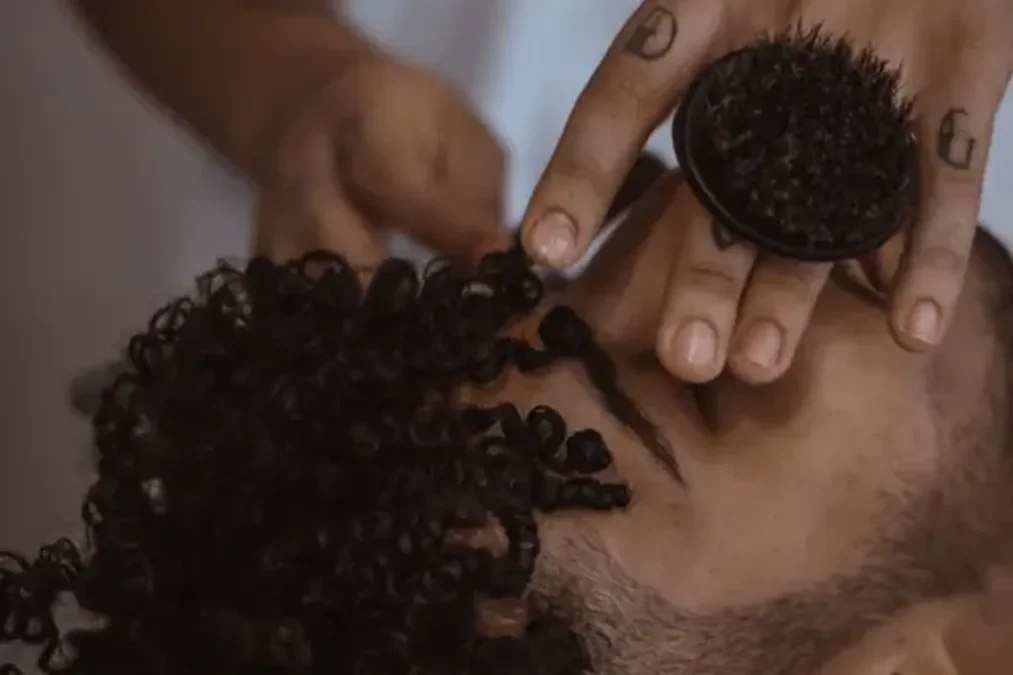
Start with the cut name — “a curly taper,” “a layered medium cut,” “a short curly crop” — then describe the shape in words, not numbers: “round on top, tapered at the sides, not flat,” or “layers through it, so it falls in a shape, not a block.” Length in words beats clipper numbers for most men, because a number means different things on different heads and in different barbers’ hands, and stating a number as a universal recipe would be false precision.
Ask the question plainly: “Do you cut curls dry?” If the answer is yes, good — the barber will see the curl as it will sit. If the answer is no, ask the follow-up: “Will you leave extra length and check the shape dry before you finish?” A barber who agrees to that check is a barber who understands shrinkage. A barber who cuts wet and short, with no dry check, is a barber to be careful with — not because he is a bad barber, but because his method does not fit curls.
The exclusions matter as much as the request, because they prevent the commonest curly failures. Say them plainly: “no heavy thinning, no straight cut across wet curls that will shrink up short, no skin fade unless I ask for it.” A barber who hears the exclusion will not add the detail to be helpful, and you will not discover it in the mirror at home.
A reference photo helps, but the photo’s curl type must match your own. Show the photo, then say what you like about it in the words above — the shape, the length dry, the way the curls sit — so the barber is cutting your description, not copying a stranger’s head onto yours. If the photo’s curl type is very different from yours — loose curls in the photo, tight coils on your head — say that too, and ask what will change. A good barber will tell you before cutting, not after.
Five errors cause most curly haircut disappointments, and all five are avoidable before the barber starts.
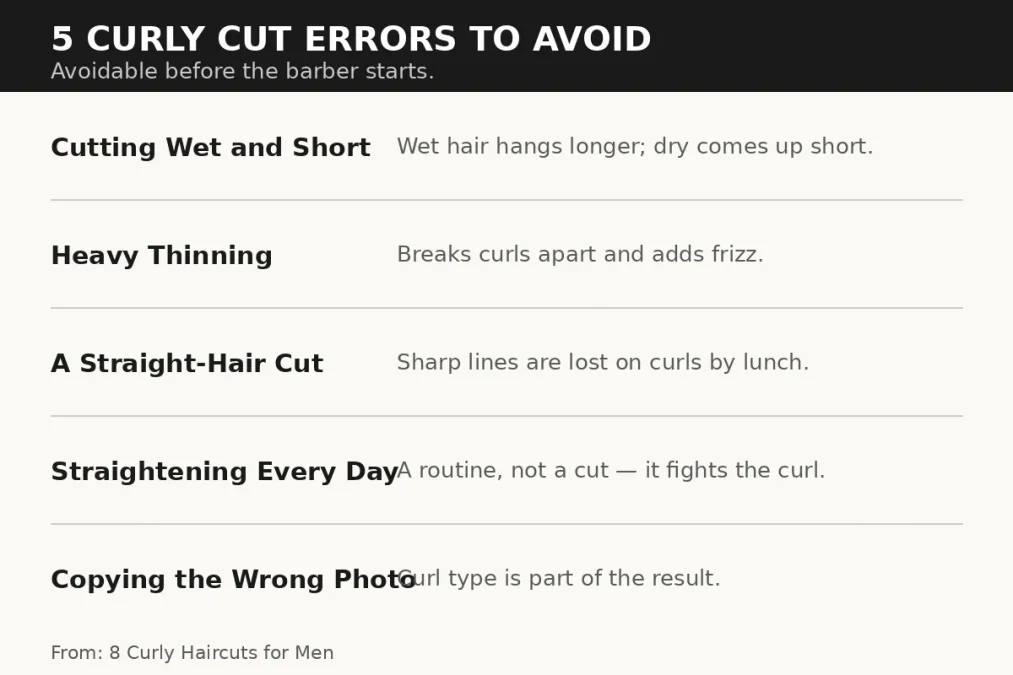
This is the commonest curly error, and it is also the most avoidable. Wet hair hangs longer than dry hair. Cut wet hair to the length you want dry, and the dry result comes up short. The fix is in the barber script: judge length dry, or leave extra length and shape it dry. If your barber will not do either, find a barber who will.
Thinning can sound like a fix for thick curls, but heavy thinning cuts lots of short hairs all through the hair, and those short hairs can break the curl pattern apart and add frizz. Layers shape; heavy thinning shreds. If bulk is the problem, ask for layers that take weight out in a planned shape, not thinning all through. Stated in “can” language, because every head is different — but if your curls got frizzier after a thinning, this is likely why.
A cut planned around sharp lines — a clean part, a flat top, an even edge — will lose those lines on curls by lunch, because curls move and spring. If your cut depends on a line holding all day, it is the wrong cut for curls. Pick a cut planned around a shape instead: the shape survives the day, because the shape is what the curls already do.
Straightening curls every day is a routine, not a cut, and it costs time, heat, and patience every single morning. It also fights the very thing this guide is about: wearing curls as curls. If you straighten every day, the question is not which curly cut to pick — it is whether you want curls at all. This guide assumes you do, and it does not cover straightened styles as an option, because that is a different node with its own routine.
A cut that looks perfect on loose curls can look ordinary on tight coils, because the curl type is part of the cut’s result. The choosing sections exist for this reason: check curl type before copying, and use the barber script to translate the cut into your own version rather than a replica. A photo is a starting point for a conversation, not a promise of a result.
The point of a curly cut, in one line: the best one is the one that works with your curl, not against it — in a shape someone planned, at a length judged dry, with layers that shape instead of shred.
For the broader picture of cuts, see our men’s haircuts guide. For the straight and wavy siblings, see our straight hair guide and our wavy hairstyles guide. For the product side, the full comparison is our pomade vs clay vs wax vs paste guide, and thick-hair product detail is in our products for thick hair guide. For keeping the cut on schedule, see our haircut maintenance schedules guide.
A curly haircut is not a straight cut with curls left in it — it is a shape planned for curls, judged dry, and kept with layers.
A curly cut is not a straight cut with curls left in it. It is a shape planned for curls, judged dry, and kept with layers. Do not pick by the loudest photo. Let your curl type narrow it down, let your face shape narrow it more, and let the effort you will spend each morning finish the job. Ask your barber about dry cutting, say what you do not want, and judge the result dry before you leave the chair.
There is no universal winner, and any article that names one is selling a preference as a fact. The best of the eight depends on your curl type, your face shape, the length you want, and how much daily effort you will accept. The eight cuts plus the choosing sections above are the answer, not one cut.
The dry length is the real length, because curls shrink as they dry. Many barbers cut curls dry or mostly dry, so they can see the curl as it will actually sit. Ask your barber how he handles it, and make sure the shape is checked dry before he finishes. No fixed shrinkage percentage is claimed here, because shrinkage depends on how tight the curl is — loose curls shrink less, tight coils shrink more.
The short curly crop, then the curly taper. The crop needs almost nothing in the morning, and the taper needs nothing daily beyond the edge staying neat. The trade-off is named in their sections: the least styling choice, and a short outline shows growth sooner, so tidy-ups come more often in general terms. No fixed interval is stated, because none is established.
Yes. The crop, the rounded shape, and the taper are planned shapes for tight coils, and the layered medium cut can work too. The key is judging length dry, because tight coils shrink the most. No cut is promised to suit all coil types, and density and head shape can change the choice — check those before you decide.
Tendencies only, not a promise: cuts with a little height on top and shorter sides — the taper, the quiff, or the crop — can lengthen the look of a round face, because the height adds a vertical line and the short sides keep the outline narrow. Head shape, hairline, density, and personal preference can override any tendency, so use this as a starting point for the barber conversation, not a verdict.
In general terms only: a curly cut needs a trim when its planned shape grows out of shape, not on a fixed date. Short outlines show growth sooner than long ones, because a little growth changes a short shape more than it changes a long one. No fixed interval is stated here, because none is established. For the schedule system itself, see our guide to haircut maintenance schedules.
Say the cut name, then the shape in words — “round on top, tapered at the sides, not flat” — then ask about dry cutting, and then say what you do not want: “no heavy thinning, no straight cut across wet curls that will shrink up short, no skin fade unless I ask for it.” Length in words beats clipper numbers for most men, because a number means different things on different heads. A reference photo helps only if its curl type matches your own.
Most of the eight need a little, not a shelf: a leave-in conditioner category, a curl cream category, or a light gel category, depending on the cut and the curl type. The crop may need none; the quiff may need a cream; the long shaped cut may need a leave-in and a light gel. No product name or cost is named here. For the full product comparison, see our pomade vs clay vs wax vs paste guide. If a cut needs a shelf of products every morning, the cut or the routine is wrong, not the curls.