Physical Address
Islamabad, PK
Physical Address
Islamabad, PK


Fine hair can look full after washing, then fall flat within hours. Long lengths, heavy products, and harsh fades can increase scalp visibility. Good haircuts for men with fine hair use controlled length, light texture, and balanced side volume. These features create a fuller appearance without claiming to increase actual hair density.
The best choice depends on texture, density, thinning location, growth direction, and styling effort. This guide compares 17 cuts and explains barber instructions, styling methods, and maintenance ranges.
- Fine hair looks fuller with controlled length, light texture, and balanced sides.
- Suitable cuts include textured crops, crew cuts, French crops, buzz cuts, low tapers, and short quiffs.
- Choose by density and thinning area before considering texture or face shape.
- Use lightweight products, avoid heavy thinning, and trim short cuts every 2 to 6 weeks.
Fine hair describes individual strand diameter, while thin hair describes low overall density. Fine strands can still grow closely together and provide full scalp coverage.
Low density leaves more scalp visible between strands. This difference matters because a man can have fine, dense hair or fine, low-density hair. Men with visible density loss can compare haircuts for thinning hair.
A 2022 scalp-hair study of 120 healthy Arab adults recorded 147.1 hairs per cm². The average strand diameter was 87 micrometers.
The study measured density and diameter as separate characteristics. These figures describe one population, not universal thresholds.

A suitable haircut controls length, retains visible coverage, adds light texture, and limits harsh side contrast. Balanced length can reduce the weight that pulls fine hair flat.
Retaining weight means keeping enough hair around areas like the fringe, crown, and upper sides. Blunt edges can form a stronger visual line around a fringe or perimeter.
Shallow point cutting can soften the ends while removing less hair than deeper texturizing. Professional point-cutting guidance explains that deeper cuts remove more weight than shallow cuts.
Directional styling can place strands across localized gaps near the temples, crown, or part line. Low tapers keep more length above the ears and temples.
This shape can help when a sparse top would look isolated above a high skin fade.


Choose a haircut by matching density, thinning area, styling effort, and desired maintenance.
| Haircut Need | Suitable Options | Main Reason |
| Fine, dense hair | Ivy League, side part, short pompadour | Supports controlled length and styling movement |
| Fine, low-density hair | Caesar cut, textured crop, buzz cut | Reduces separation and strong density contrast |
| Receding temples | French crop, textured fringe, side-swept crop | Directs hair toward the frontal corners |
| Thinning crown | Crew cut, textured crop, buzz cut | Keeps the crown compact and controlled |
| Low styling effort | Buzz cut, burr cut, crew cut | Requires limited daily shaping |
| More front height | Short quiff, brush-up, short pompadour | Uses longer frontal length for lift |
For broader comparisons across short, medium, long, fade, and taper styles, use the men’s haircuts guide.
These 17 cuts use length, direction, and side balance to create a fuller appearance. The listed measurements are practical starting points rather than fixed rules.

The textured crop creates fullness through short, separated movement across the top. A typical top length is 1.5 to 2.5 inches.
It suits fine hair with mild temple recession, visible parts, or moderate crown separation. Deep texturizing can remove too much visual mass from low-density hair.

The French crop directs a short fringe forward across the hairline. About 2 inches on top usually provides enough length for controlled coverage.
This cut suits receding temples or a high hairline. A blunt or lightly textured fringe retains a stronger edge than a wispy fringe.
Compare French crop variations for different fringes, fades, textures, and face shapes.

The Caesar cut uses a compact top and short forward fringe to reduce visible separation. A typical top length is 1 to 1.5 inches.
It suits low-density hair, mild frontal recession, and men wanting limited styling. A strong cowlick can make the fringe harder to control.

The classic crew cut reduces the amount of hair that can fall flat. The front commonly remains near 1.5 inches and shortens toward the crown.
This shape suits straight or slightly wavy fine hair. A softer taper often creates less contrast than a high skin fade.
Compare crew cut variations with classic, textured, tapered, and faded finishes.

The textured crew cut adds controlled movement to the compact crew-cut shape. Shallow texture separates the surface without deeply removing internal weight.
It suits fine hair with moderate density. Heavy texturizing can expose the scalp when density is already low.

The Ivy League provides enough front length for a soft side sweep. A typical frontal length is 1.5 to 2 inches.
It works best with medium-density or high-density fine hair. Styling effort is moderate because the part and direction require daily control.

The buzz cut keeps the hair uniformly short and can reduce contrast between density zones. Common choices include #1, #2, or #3 guards.
The Wahl guard-size chart lists #1, #2, and #3 as ⅛, ¼, and ⅜ inch. Confirm the expected finished length with the barber.
This cut suits diffuse thinning, advanced recession, or minimal-styling preferences. Compare buzz cut styles and guards before choosing the finished length.

The burr cut leaves more visible hair than a shorter induction-style buzz cut. Wahl #3 and #4 guards leave approximately ⅜ to ½ inch.
The even length creates a soft scalp shadow and suits men wanting simple daily maintenance.

The short side-swept crop directs nearby strands across a temple or visible part. About 2 inches across the front usually supports a diagonal sweep.
It suits localized recession better than advanced diffuse thinning. Excessive length can turn the style into an obvious comb-over.

The short textured fringe adds movement around the hairline while covering frontal corners. Keep the fringe compact and lightly separated.
This cut suits mild frontal recession and straight or wavy hair. Deep thinning can create wide gaps between sections.

The short quiff creates front height with less weight than a traditional quiff. A common range is 2 to 3 inches near the hairline.
It requires enough frontal density to hold a connected shape. Styling effort is medium because blow-drying and light products are usually required.

The brush-up uses upward styling across the full top. A typical top length is 2 to 2.5 inches above tapered sides.
Straight or slightly wavy fine hair responds best. Strong crown patterns or very low density can limit the finished height.

The classic taper keeps gradual length around the sides, ears, and neckline. The top often remains between 2 and 3 inches.
This shape suits professional settings and medium-density fine hair. It requires less contrast than a high fade but more styling than a buzz cut.

The low taper fade confines the shortest blend near the sideburns and neckline. More length remains above the ears and temples.
This placement can support a sparse top by reducing side contrast. It does not automatically suit every density or face shape.
Compare fade types before choosing a low, mid, high, skin, or taper finish.

The low fade with a textured top combines clean lower edges with controlled movement above. About 2 inches on top provides a practical starting point.
It suits straight or wavy fine hair with moderate density. Retaining length around the crown can reduce visible separation.

The short side part directs hair across the scalp while maintaining a structured outline. A typical top length is 2 to 2.5 inches.
A natural part usually exposes less scalp than a shaved hard part. This cut works best when the top has medium density.

The short pompadour creates controlled front height without the length of a traditional pompadour. The front commonly measures 2.5 to 3 inches.
It requires moderate density and dependable frontal growth. Styling effort is high because the shape needs blow-drying and product support.
Choose the haircut by prioritizing density and thinning location before texture and face shape. These factors control coverage, side contrast, length, and styling direction.
Match the cut to straight, wavy, curly, or coily fine hair. Straight hair suits crops, crew cuts, side parts, and brush-ups.
The straight-hair haircut guide compares crops, tapers, quiffs, and side parts.
Wavy hair suits short quiffs, side-swept crops, and textured fringes. The wavy hairstyle guide covers crops, low fades, quiffs, and side parts.
Curly or coily fine hair suits compact curls, short rounded tops, and low tapers that preserve upper-side length.
Use more styling length for dense fine hair and compact shapes for low-density fine hair. Dense hair can support Ivy League cuts, side parts, and short pompadours.
Low-density hair often suits Caesar cuts, buzz cuts, and textured crops. Visible scalp under normal indoor light indicates that aggressive thinning or deep texture may remove too much coverage.
Direct the haircut toward the area requiring visual coverage. French crops and Caesar cuts can cover receding temples or frontal thinning.
Crew cuts and textured crops can keep a separating crown compact. Buzz cuts can reduce contrast across diffuse thinning, which means reduced density across most of the top.
A visible part line can suit a short side sweep when enough nearby density remains.
Use face shape to adjust height, fringe direction, and side volume after choosing for density. Round faces can use controlled front height from quiffs or brush-ups.
Oblong faces often suit forward or side-swept fringes. Oval and square faces support crew cuts, tapers, and Ivy League cuts.
Soft fringes and retained temple width can balance heart-shaped or diamond-shaped faces. These are visual guidelines, not fixed rules.
Use haircuts by face shape to refine height, fringe placement, and temple fullness.
Long, flat, over-textured, glossy, or high-contrast styles can expose more scalp. Each feature affects visibility through a different mechanism.
Long flat hair can become weighed down. Deep layers and aggressive razor cutting can remove visible mass. Wet products can group fine strands into narrow sections.
High skin fades can increase contrast when the top has low density. Centre parts, wet slick backs, flat comb-overs, and wispy fringes may also expose sparse areas.

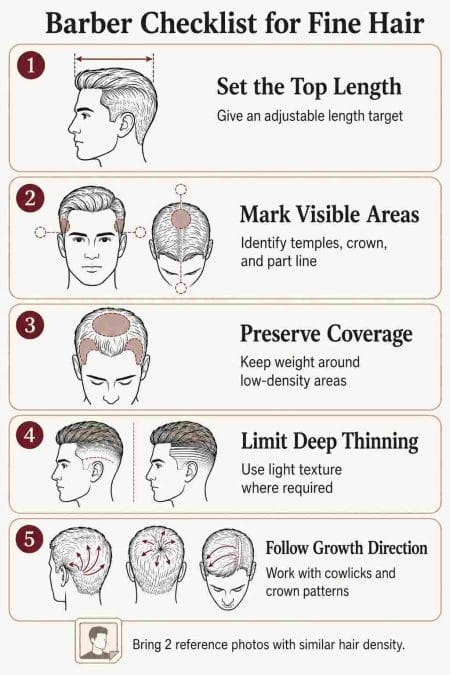
Ask for controlled top length, retained coverage, light texture, and side blending that matches your density. Identify concerns around the temples, crown, hairline, or part before cutting begins.
Ask the barber to follow growth patterns such as cowlicks, crown spirals, and natural part direction.

Style fine hair with lightweight products, root-focused blow-drying, and a low-shine finish. These methods can add grip and shape without excessive weight.
The men’s hair styling techniques guide explains drying, product application, and finishing methods.
Use small amounts of volumizing mousse, sea salt spray, or texture powder. Apply mousse or spray to towel-dried hair.
Add texture powder to fully dry roots. Too much product can cause clumping, stiffness, or visible separation.
Compare men’s hair products by hold, finish, weight, and intended style.
Blow-dry the roots upward or against their natural fall before shaping the final style. Use fingers or a vent brush for controlled lift.
Keep the dryer moving and avoid close, high heat. A hair-dryer study found less damage at 15 centimeters with continuous movement under its test conditions.
The study evaluated hair-shaft damage. It did not test volume improvement or hair-loss treatment.
Heavy or glossy products can group fine strands and increase scalp visibility. Examples include oily waxes, wet gels, and high-shine pomades.
Use a pea-sized amount of matte clay or paste when stronger control is required. Product weight and finish vary by formula.
Short fine-hair cuts are commonly refreshed every 2 to 6 weeks, depending on shape and desired sharpness. These ranges describe appearance maintenance rather than hair health.
Buzz cuts and skin fades often need 2 to 4 weeks. Crew cuts and textured crops commonly need 3 to 5 weeks.
Ivy League cuts, classic tapers, and side parts often hold their shape for 4 to 6 weeks. Book a trim when the sides expand, fringe becomes heavy, or crown separation increases.
A head-hair growth review calculated a 1.06-centimetre monthly average with substantial individual variation.
Fine hair has a small strand diameter, while thin hair has low overall density. Fine hair can still provide complete coverage when enough strands grow closely together.
Short hair often creates a more controlled shape because less length can fall flat. Crops, crew cuts, and short quiffs are common options. Medium styles also suit dense fine hair.
A fade can suit fine hair when its height matches the top density. Low fades retain more upper-side length. High skin fades can increase contrast with a sparse top.
Light layering can add movement, while excessive layering can remove visible mass. The result depends on strand density, cutting depth, and the intended shape.
Men with fine, dense hair can wear medium or long styles. Soft layers and side-swept direction can create movement. Long flat hair can expose more scalp when density is low.
Textured crops, crew cuts, French crops, and short side parts can create a fuller appearance. The best option depends on density, texture, thinning area, and growth direction.
Heavy thinning-shear use can increase separation in low-density fine hair. Limited use can reduce bulk when the hair has fine strands but high density.
Lightweight mousse, texture powder, sea salt spray, and matte clay can add grip or control. Apply small amounts because product buildup can flatten fine strands.
Seek medical assessment for sudden or patchy hair loss, or loss with burning, intense itching, tenderness, redness, or scaly patches. These symptoms appear among the AAD hair-loss signs.
A dermatologist uses examination, medical history, and testing for an accurate hair-loss diagnosis. A haircut can change appearance but cannot treat the cause of hair loss.
Good haircuts for men with fine hair create a fuller appearance through controlled length, retained coverage, light texture, and balanced sides. Density and thinning location determine the best starting point.
Texture, face shape, growth direction, styling effort, and maintenance refine the final choice. Heavy thinning, glossy finishes, and strong fade contrast can expose more scalp when density is low.
Select one preferred cut and one backup option. Show both references to your barber and discuss length, texture, taper height, and visible areas.


