Physical Address
Islamabad, PK
Physical Address
Islamabad, PK


Thick hair can become wide, heavy, or uneven soon after a haircut. Shorter sides or heavy thinning may create frizz, harsh contrast, or difficult grow-out.
The best haircuts for men with thick hair manage weight without flattening natural texture. The right cut accounts for density, strand size, growth direction, face shape, and maintenance.
This guide compares 20 haircuts for straight, wavy, curly, and coily hair. It also explains layering, barber requests, products, trim timing, and common mistakes.
TL;DR Summary
- Choose a haircut that reduces side bulk without removing useful density.
- Structured cuts suit straight hair, layered cuts suit wavy hair, and tapers suit curly or coily hair.
- Internal layering and point cutting reduce hidden weight while preserving the outer shape.
- Avoid excessive thinning, heavy product buildup, and cuts that ignore crown growth.
- Bring 2–3 matching reference photos and discuss length, taper height, and grow-out with your barber.
A suitable thick-hair haircut redistributes weight, reduces unwanted width, and follows the hair’s natural growth direction.
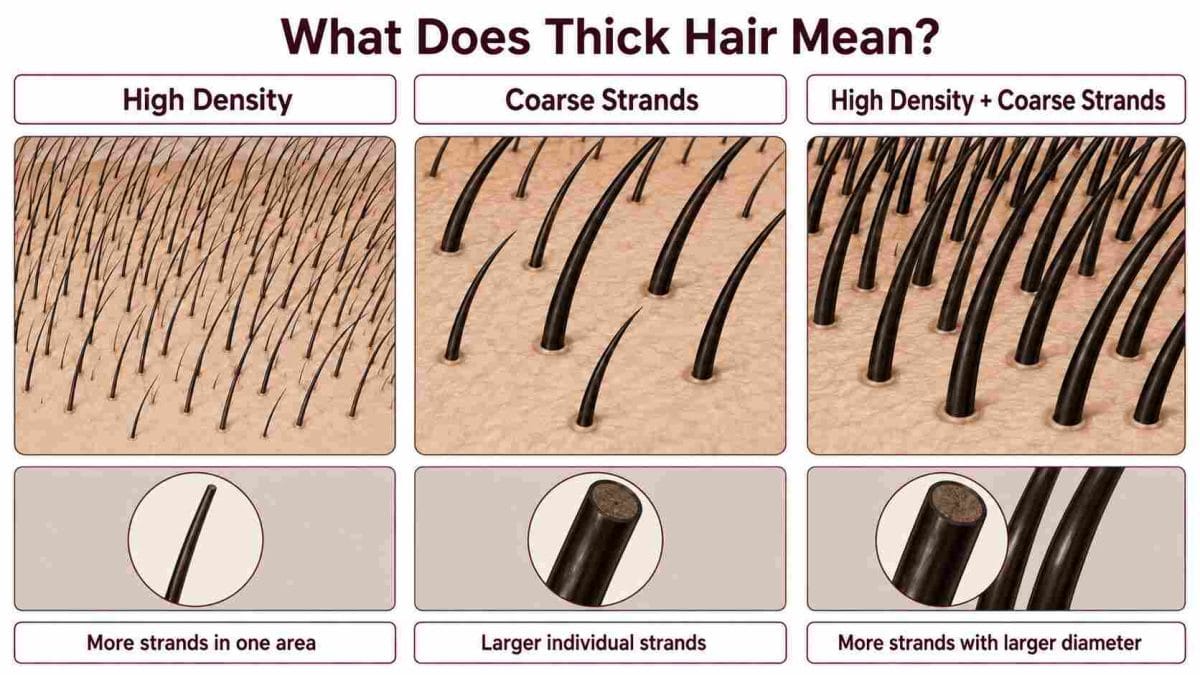
Research measures scalp hair density and diameter as separate characteristics. Hair density describes the number of hairs within a scalp area. Coarse hair has individual strands with a larger diameter. Thick hair can describe high density, coarse strands, or both.
These differences matter because dense hair and coarse hair can react differently to the same cut. Dense hair creates fullness through strand quantity. Coarse hair can hold a stronger shape because each strand is larger.
Tapers, fades, and scissor-cut sides manage bulk around the temples, ears, and neckline. A taper shortens hair gradually near the edges. A fade continues the transition toward very short hair or exposed skin. Readers comparing taper height can review the main fade types before choosing the side length.
Internal layering removes weight beneath the visible surface. Point cutting can soften a blunt edge and add separation. Preserving some perimeter weight can stabilize medium and long outlines.
The cut must also account for crown swirls, cowlicks, and frontal growth. Cutting against these patterns can create sections that lift or resist styling.
Choose a thick-hair haircut by comparing texture, face shape, preferred length, maintenance, and natural growth patterns.
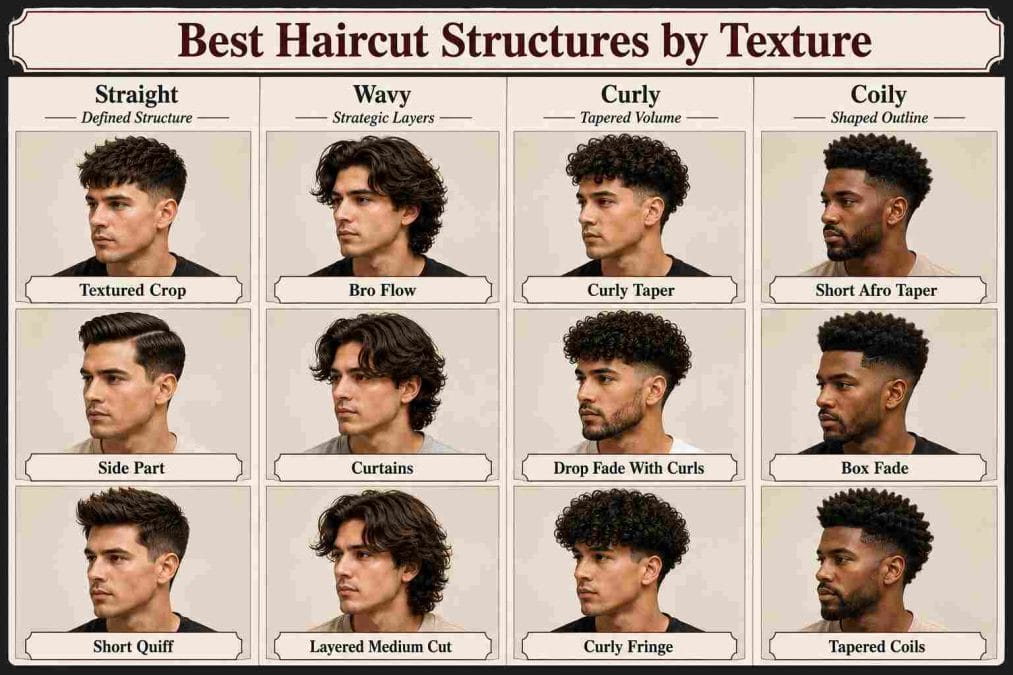
Hair texture determines how the cut distributes weight and movement.
Straight hair often responds well to textured crops, side parts, crew cuts, and Ivy League cuts. Defined outlines direct dense strands into a controlled shape. Men with dense straight strands can compare more haircuts for straight hair by length and styling effort.
Wavy hair often benefits from bro flows, curtains, textured crops, and layered medium cuts. Strategic layers can reduce side-heavy expansion. Men with thick waves can compare more men’s wavy hairstyles built around movement and layering.
Curly hair can suit curly tapers, drop fades, layered curls, and textured fringes. The selected length must account for contraction after drying.
Coily hair can suit short afro tapers, box fades, buzz cuts, and tapered coil shapes. A defined outline manages edge bulk while preserving top volume.
Face shape guides where the haircut places height, width, and fringe coverage.
Compare haircuts by face shape when deciding where to place height, width, and fringe coverage.
Round faces often benefit from reduced temple width and moderate height. Textured crops, short quiffs, and Ivy League cuts can create this balance.
Oblong faces usually suit controlled height and some upper-side fullness. Caesar cuts, side parts, and textured fringes can reduce added vertical emphasis.

Square faces can carry crew cuts, buzz cuts, pompadours, and tapers. These cuts work with a strong jaw without requiring extreme height.
Heart and diamond faces often benefit from moderate temple volume. Curtains, side parts, and layered medium cuts can balance a narrower lower face.
Triangle faces may benefit from volume around the upper sides. Bro flows, curtains, and scissor-cut tapers can widen the upper outline.
Maintenance depends on edge precision, top length, styling method, and grow-out tolerance.
Buzz cuts, crew cuts, and Caesar cuts usually require limited daily shaping. Crops, tapers, and side parts often need light drying or product application.
Pompadours, undercuts, and sharp skin fades demand more regular reshaping. Their contrast becomes more visible as the sides grow.
This comparison matches each haircut with its texture, length, bulk-control method, upkeep, and grow-out pattern.
| Haircut | Best Texture | Length | Bulk-Control Method | Upkeep and Grow-Out |
| Textured crop | Straight, wavy | Short | Point-cut top and tapered sides | Low to medium upkeep |
| French crop | Straight, wavy, loose curls | Short | Forward fringe and textured ends | Regular fringe shaping |
| Crew cut | Straight, wavy | Short | Reduced top length and tapered sides | Simple grow-out |
| Ivy League | Straight, wavy | Short | Side sweep and gradual taper | Medium upkeep |
| Caesar cut | Straight, wavy | Short | Even top and short fringe | Simple styling |
| Buzz cut | All textures | Very short | Uniform length reduction | Frequent outline cleanup |
| Scissor-cut taper | Straight, wavy | Short to medium | Soft side reduction | Softer transition |
| Low taper fade | All textures | Short to medium | Temple and neckline cleanup | Edge-focused upkeep |
| Mid fade with texture | Straight, wavy, curly | Short | Stronger side reduction | Visible fade grow-out |
| Side part | Straight, wavy | Short to medium | Directional styling | Medium upkeep |
| Short quiff | Straight, wavy | Short | Front height and narrow sides | Blow-drying often helps |
| Modern pompadour | Straight, light waves | Medium | Backward volume and short sides | Higher upkeep |
| Slick-back taper | Straight, wavy | Medium | Backward direction and gradual sides | Product-based styling |
| Undercut | Straight, wavy, curly | Medium | Disconnected short sides | Transitional blending needed |
| Curtains | Straight, wavy | Medium | Center part and long layers | Requires front length |
| Bro flow | Straight, wavy | Medium | Natural backward movement | Longer drying time |
| Layered medium cut | Straight, wavy, loose curls | Medium | Internal weight removal | Periodic reshaping |
| Modern mullet | Straight, wavy, curly | Medium | Shorter sides and longer back | Shape-focused upkeep |
| Curly taper | Curly | Short to medium | Edge taper and retained curls | Curl-length dependent |
| Short afro taper | Coily | Short | Shaped top and tapered edges | Regular outline cleanup |
These 20 haircuts manage thick hair through controlled length, weight placement, tapering, fading, or layering.
A textured crop manages short, thick straight or wavy hair through broken weight lines. Point-cut texture separates dense sections. A low taper or mid fade reduces side width.
A French crop directs thick hair forward into a short, controlled fringe. Texturing can stop dense hair from forming a solid edge. Loose curls require enough fringe length for shrinkage.
Compare additional French crop styles when choosing fringe length, texture, and fade height.

A classic crew cut reduces apparent volume through a short top and tapered sides. It suits straight, wavy, and coarse hair. The short shape requires little daily direction.
The broader crew cut variations guide compares classic, textured, faded, and Ivy League versions.
An Ivy League haircut combines a short side sweep with gradual tapering. The longer front supports controlled styling. Its moderate height suits round, oval, and square faces.
A Caesar cut directs thick hair forward with an even top and short fringe. It can accommodate frontal cowlicks when the cutting direction follows natural growth.
A buzz cut reduces length and apparent volume across the entire head. It works with straight, curly, and coily hair. It exposes the natural head shape and hairline.
Compare buzz cut guards and styles before selecting the final clipper length.
A scissor-cut taper reduces side weight without creating skin-level contrast. It preserves more upper-side length than a close fade. The transition often softens during grow-out.
A low taper fade removes bulk around the temples, sideburns, and neckline. It preserves more density above the ears than a higher fade.
A mid fade removes more side weight while retaining textured length on top. The contrast appears stronger than a low taper, especially with dark or dense hair.
A side-part haircut directs thick straight or wavy hair into a defined shape. Tapered sides reduce width. Cream or pomade can support a polished finish.
A short quiff places thick-hair volume at the front instead of the sides. A taper narrows the outline. Blow-drying upward and backward helps direct the top.
A modern pompadour uses dense hair to create backward height and structure. It suits straight or lightly wavy hair. Correctly placed layers can reduce weight while retaining length.
A slick-back taper directs medium thick hair away from the face. The gradual sides create a softer connection than a disconnected undercut.

An undercut removes side length by separating a longer top from short sides. The disconnected shape creates strong contrast. Transitional blending can reduce ledges during grow-out.
A curtains hairstyle divides medium thick hair with a center or off-center part. Long layers can distribute weight and reduce side-heavy expansion.
Curtains belong to the broader group of medium-length hairstyles that use length to distribute weight.
A bro flow uses medium length and natural weight to direct hair backward. It suits straight and wavy textures. Soft layering can improve movement without creating short surface pieces.
A layered medium-length cut redistributes weight while preserving the outer length. Strategic internal layers can reduce a wide or triangular outline.
A modern mullet retains back length while shortening or tapering the sides. Textured layers connect the top to the longer rear section.
Compare mullet fade styles when choosing how much side contrast to add.
A curly taper reduces edge bulk while retaining curls through the top. Low, temple, and drop tapers create different levels of side exposure.
A short afro taper shapes dense coily hair while cleaning the temples and neckline. The top can remain rounded, squared, or softly contoured.
The best haircut matches the hair’s texture, density, growth direction, preferred length, and styling routine.
Structured cuts direct thick straight hair into a defined outline. Suitable options include textured crops, side parts, Ivy League cuts, short quiffs, and pompadours.
Enough top length can stop short, stiff strands from projecting outward. Tapered sides reduce width without removing all upper-side density.
Layered cuts can reduce internal weight while preserving natural bends. Suitable options include bro flows, curtains, layered medium cuts, modern mullets, and textured crops.
Long or internal layers often create smoother movement than short surface layers. Placement remains important because short layers can increase lift.
Tapered and layered cuts can manage side volume while retaining the curl pattern. Suitable options include curly tapers, French crops, drop fades, layered curls, and curly fringes.
Curl contraction after drying changes the visible length. Fringe cuts therefore require enough wet or stretched length.
Shape-focused cuts manage dense coils through controlled outlines and tapered edges. Suitable options include short afro tapers, box fades, tapered coils, buzz cuts, and sponge-twist finishes.
Sponge twists describe a styling finish rather than a separate haircut. They can be added to a tapered or shaped coily cut.
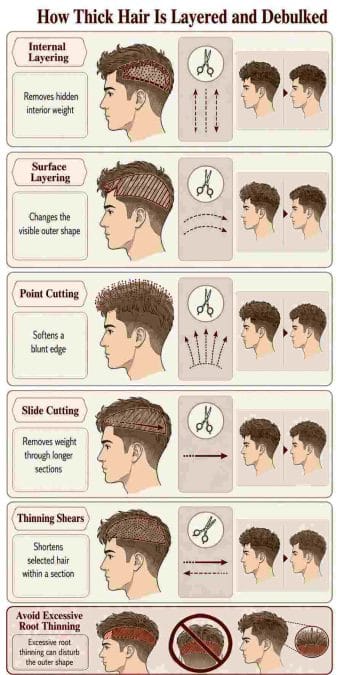
Layers and debulking can reduce hidden weight, redistribute volume, and preserve a controlled outer shape. Internal layers shorten hair beneath the visible surface. Surface layers change the outer contour. Their effects depend on placement, texture, and cutting technique.
Professional education distinguishes point cutting, slide cutting, and other texturizing methods by their cutting action. Point cutting enters the ends vertically to break a blunt line. Slide cutting removes weight through longer sections. Thinning shears shorten part of the hair within each section.
Cutting too close to the roots can leave short hairs that lift or disturb the outer shape. This risk is more visible in wavy, curly, and coily textures.
Long layers suit curtains, bro flows, and medium layered cuts. Short layers add lift and separation but can increase volume at the wrong height.
Straight hair often gains separation from controlled texturing. Wavy hair can gain movement from internal layering. Curly and coily hair require placement that respects curl grouping and shrinkage.
Perimeter weight means keeping enough fullness around the lower edge. It can stabilize the outline of medium and long cuts.
Ask your barber for controlled weight removal, a clear top length, and a grow-out plan.
Use direct wording:
Specify a low taper, mid fade, skin fade, or scissor-cut taper. Also confirm the neckline and sideburn length.

Explain how the hair behaves when air-dried or blow-dried. Mention frontal cowlicks, double crowns, or sections that stick outward.
Bring 2–3 reference sets with similar texture, density, and length. Each set should show front, side, and back views.
Ask how the shape may change after 2, 4, and 6 weeks. This question helps identify areas that require interim bulk removal.
Style and maintain thick hair by controlling drying direction, product placement, moisture, and trim timing.
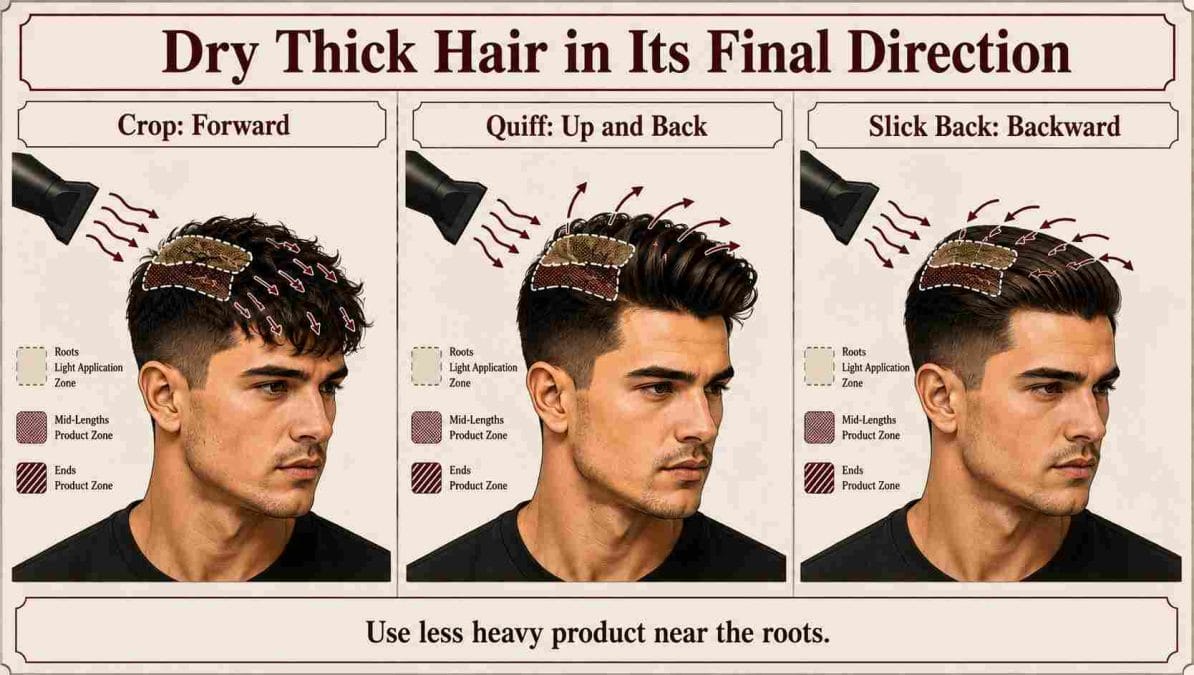
Dry the hair toward its intended final shape.
Direct crops forward, quiffs upward and backward, and slick backs away from the face. Point the airflow from the roots toward the ends.
Apply heat protection before blow-drying. Avoid placing excess product directly at the roots because added weight can flatten the shape.
Matte clay commonly adds texture and a low-shine finish to crops, crew cuts, and quiffs. Styling cream provides flexible control for curtains, bro flows, and layered cuts.
Pomade can create a polished finish for side parts, pompadours, and slick backs. Curl cream or leave-in conditioner can support curl grouping and softness. Manufacturer specifications confirm that product hold and finish vary by formula.
Compare men’s hair products by hold, shine, texture, and hair type before selecting a formula. The complete men’s hair styling techniques guide explains drying direction, application, and finishing methods.
Trim timing depends on edge precision, haircut length, growth speed, and preferred appearance. Professional haircut guides present practical haircut-maintenance ranges rather than one universal schedule.
Use these intervals as starting points:

Individual growth and preferred sharpness can shorten or extend each range. Request controlled weight removal between complete reshaping appointments when bulk returns above the ears, crown, or back.
Thick hair becomes harder to manage when cutting and styling choices create uneven weight, buildup, or difficult grow-out.

A textured crop, crew cut, or scissor-cut taper suits many men with thick hair. The final choice depends on texture, growth direction, preferred length, and maintenance.
Short thick hair provides greater width control, while longer hair provides more movement. Medium and long cuts usually require strategic layering and more drying time.
A fade can suit thick hair when its height connects smoothly with the top. Low fades preserve more upper-side fullness. High fades create stronger contrast.
Strategic layers can make thick hair easier to manage by redistributing weight. Poorly placed short layers can increase lift or expose uneven density.
Thinning shears are not automatically harmful, but placement affects the result. Cutting too close to the roots can weaken the outer shape during grow-out.
Over-thinned hair can develop uneven texture, flyaways, or visible gaps. Short internal hairs may also disturb the longer outer sections.
A low taper or scissor-cut taper can reduce weight above the ears. Enough connection to the top prevents a visible ledge.
Thick hair often refers to density, while coarse hair refers to strand diameter. A person can have dense fine hair, sparse coarse hair, or both high density and coarse strands.
Ask for controlled internal weight removal and less bulk above the ears. Mention cowlicks, crown growth, top length, fade height, and styling habits.
A haircut becomes useful when growth changes the outline or increases styling difficulty. Precise fades usually need earlier cleanup than layered medium cuts.
The best haircut controls thick-hair weight without removing the structure that gives the style its shape. Short cuts, including textured crops, crew cuts, and tapers, reduce visible volume and simplify styling. Medium cuts, including curtains, bro flows, and layered shapes, use length and weight distribution to guide movement.
The final choice must match texture, face shape, crown growth, maintenance, and preferred finish. Save 2–3 suitable references and discuss length, taper height, and bulk removal before the haircut begins.
Use the broader men’s haircut guide to compare short, long, faded, and texture-based options.


