Physical Address
Islamabad, PK
Physical Address
Islamabad, PK


A haircut does not end when you leave the barber’s chair. It starts a clock, and that clock runs at a different speed for every cut. A skin fade loses its line in days. A long cut can hold its shape for months. Booking both on the same four-week habit means one of them is always either over-cut or overgrown.
This guide gives you a schedule instead of a habit: intervals by cut type, the signs that tell you it is actually time, what you can safely do between visits, and how to grow a cut out or recover from a missed appointment. For the broader picture, see our men’s haircuts guide.
Read this section as ranges, not appointments. Sources disagree on the exact weeks for several cuts, and this guide says so where they do, because a range you can adjust is more useful than a single number that is wrong for your head. Your own interval sits inside the range — the “Adjusting Your Interval” section below shows how to place it.
Roughly every 1–2 weeks in most sources, with some giving 2–3 weeks and a high fade specifically given as 10–14 days in one source. This is the shortest interval in the guide, and the reason is the line itself: bare skin against regrowth shows within days, not weeks, and the fade’s whole effect is that contrast. If you want a skin fade to look skin-fresh every day, you book at the short end. If you are happy with the softer version a week later, you book at the long end — but you cannot stretch a skin fade to a month and still call it a skin fade. The first signal is the blend: when the sharp line above the ears starts to blur, the clock has run out.
Roughly every 2–3 weeks in most sources, with some giving 1–2 weeks or 2–4 weeks. A buzz has no blend to lose, which surprises men who expect it to last longer — but uniform length shows growth early, because every millimetre is visible against the same length everywhere else. The signal is evenness: when the head stops looking deliberately even and starts looking simply uncut, it is time. A buzz with faded sides follows the fade’s clock, not the plain buzz clock, because the sides are the part that loses its line first.
Roughly every 3–4 weeks in some sources, 3–5 weeks in others. A crew or classic short cut keeps length on top and structure on the sides, so it has more room than a fade or a buzz before the shape suffers. The signal is the sides: when they start to expand and push out over the ears, and the top starts to lose its graduation, the cut is asking for a visit. This is the most forgiving short interval in the guide — a week late still reads as a haircut, where a week late on a skin fade reads as grown out.
Roughly every 3–5 weeks in some sources, 4–6 weeks in others. A soft, low taper leaves hair visible all the way down the sides — no bare skin, no harsh line — so regrowth does not create the contrast that ends a fade’s life. That is why a taper stretches further than a fade on the same head. The signal is the neckline and the sideburns: when they lose their clean edge and the sides start to look heavy rather than graduated, book. For a full taper-versus-fade comparison, which this guide does not restate, see taper vs fade.
Roughly every 3–5 weeks in some sources, 4–6 weeks in others. Texture is forgiving: uneven strands keep reading as intentional as they grow, where a smooth, precise shape would read as overgrown. The signals are the fringe and the edges — on a French crop, when the fringe starts to cover the eyes or separate instead of sitting forward, and on a textured crop, when the edges lose their definition. A little light matte product can hold texture for a few extra days, but it cannot replace a visit once the shape itself has gone.
Roughly every 4–6 weeks in some sources, 4–8 weeks or 6–8 weeks in others. Medium cuts have the most room in the guide after long hair, because length hides small amounts of growth. The signals are weight and styling time: when layers start to feel heavy, when the cut takes noticeably longer to style in the morning, and when the shape collapses flat instead of holding its volume. A medium cut a week late is usually still a good cut; a medium cut two months late is usually a different cut — heavier, flatter, and harder to style back into shape.
Roughly every 6–8 weeks in some sources, 8–12 weeks in others. Long hair’s schedule is about ends and shape, not outline — there is no sharp line to lose. The signals are the ends themselves: when they feel rough, tangle during a normal comb-out, or split, and when layers stop sitting evenly. Waiting longer does not make long hair look sharper; it makes the ends the story instead of the shape. For long hair in depth, see how to maintain long hair for men — this article gives the interval, that guide gives the routine.
Sources conflict here, and the conflict is worth stating plainly: some give 4–6 weeks, others give 8–12 weeks. Both reasons are real. Curls coil and shrink, so length gain can look smaller than it is, which is why some guides stretch the interval — but curls also build bulk and lose their outline as they grow, which is why other guides shorten it for shaping. The deciding factor is what you are watching: if bulk and shape are the problem, book at the short end; if length is the goal and the shape still holds, book at the long end. A taper, not a skin fade, is the side treatment that stretches best on curly hair, because it keeps structure without a line that blurs fast.
A schedule only works if you can read it on your own head. Grow-out does not appear all at once. It appears in an order, and knowing the order tells you how much time you actually have left.
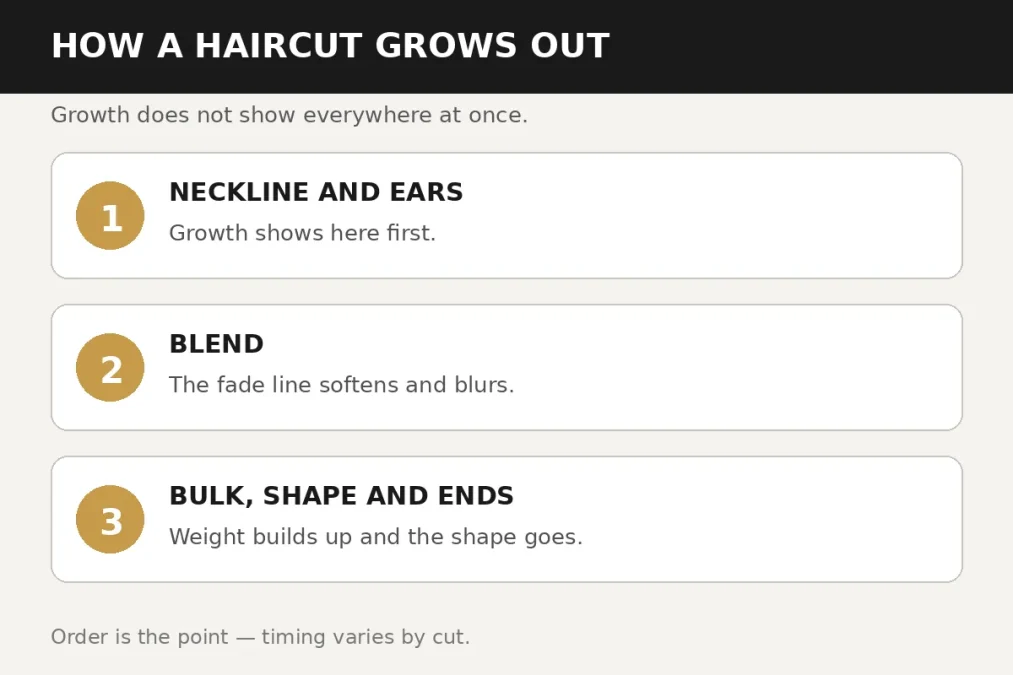
Growth shows first around the ears and at the nape. Short side hair pushes out and loses its line while the top still holds its shape — which is why a cut can look fine from the front and untidy from the side or back on the same day. Check the back with a second mirror the night before anything important; the rear hairline is the first place most cuts lose their sharp look. This is also why a neckline tidy, covered in the next section, buys real time: it resets the first signal without resetting the whole cut.
Next, the blend itself goes. On a fade, the gradient from skin to length turns from a clean transition into a soft blur, and the contrast that made the cut sharp is gone even though the top may still be perfect. On a taper, the graduation gets heavier and less defined. On a smooth top, the part or the sweep starts to sit differently because the sides are pushing weight upward. This is the point where most men feel the cut is “going” — not gone, but no longer fresh — and it is the honest moment to book, even if the calendar says there is a week left.
Last, the shape itself goes. Sides expand and bulk up on medium cuts. The top loses volume or sits flat. A fringe separates or covers the eyes. On long hair, the ends take over: rough, tangling, splitting, and layers that no longer sit evenly. By this stage a tidy will not save the cut — it needs a full reshape, because what has been lost is not an edge but the structure underneath. The difference between stage two and stage three is the difference between booking a trim and booking a reset, and it is worth knowing which one you are walking in for.
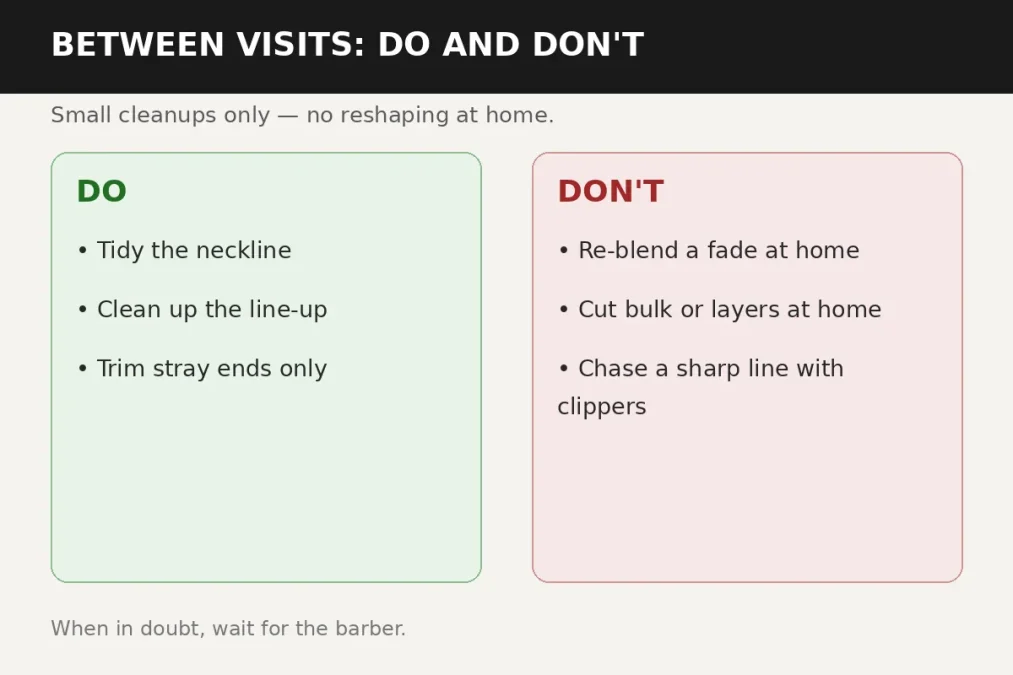
Between visits is a bridge, not a second schedule. Done right, it stretches a cut’s good weeks. Done wrong, it creates a problem the barber then has to fix.
A neckline and ears cleanup is the one between-visit service most barbershops offer, and it is the most useful tool in this guide. It tidies exactly the area that shows growth first, without touching the cut itself, and one source puts it at about 10 minutes, extending a medium cut’s life by roughly 2 weeks — treat both figures as that source’s estimate, not a promise. If you are comfortable with a trimmer, you can do the same tidy at home: neckline and around the ears only, with a mirror for the back. Stop there. The tidy works because it is small; the moment it grows into reshaping, it stops being a tidy.
A line-up resets only the hairline, the temples, and the neck. Some men book one every 1–2 weeks in the middle of a longer full-cut interval, keeping the edge sharp without paying for a whole reset. That rhythm is the point: a line-up is booked more often than a full cut precisely because it does less. It does not replace a full cut, because it does not touch the blend, the weight, or the top — and a man who only ever books line-ups will eventually have sharp edges on a shape that has gone.
Do not try to re-blend a fade at home. Sources repeat this warning because the blend needs a steady hand, a graduated eye, and a mirror angle you do not have on your own head — and a home blend that goes wrong costs more chair time to fix than the visit you skipped. Do not trim the top while you are growing a cut out; the top is the length you are waiting for, and cutting it resets the wait. And do not keep cleaning up an area you are trying to grow: every tidy on a growing section is a week added back to the transition. The home rule for this whole article is one line — tidy the edges, leave the shape to the barber.
For general hair-care guidance between visits, see the American Academy of Dermatology’s tips for healthy hair.
The table above is a general guide. Your interval is the table plus three adjusters. Apply them in order, and you get a schedule that fits your head instead of a stranger’s.
This is the biggest adjuster, and sources state it explicitly. A man who wants a fresh outline every day books at the short end of his cut’s range. A man who is happy with a softer, lived-in shape books at the long end. Neither is wrong — but they are different schedules for the same cut, and pretending otherwise is how men end up either in the chair every week or unhappy for two weeks before every visit. Decide which man you are before you decide your interval, and tell your barber; it changes what he books you for next.
Texture changes how growth appears. Straight hair shows blend lines sooner, because there is nothing to disguise the line where short meets long. Wavy hair’s texture does some of the hiding. Curly and coily hair coils and shrinks, so length gain can look smaller while bulk builds faster — the shape can be lost even as the length looks unchanged. Density matters the same way: thick hair bulks sooner at the sides, fine hair shows scalp and contrast sooner on short cuts. For hair-type depth, see good haircuts for fine hair and best haircuts for thick hair, and for face shapes, haircuts by face shape.
Length is the simplest adjuster: the shorter and sharper the outline, the sooner growth shows; the longer and softer the shape, the more room before the shape suffers. That is the whole reason the table runs from 1–2 weeks at one end to 8–12 weeks at the other, and it is why changing length is also changing schedule. If you go shorter, budget for more visits. If you grow longer, budget for fewer — and for the transition section below, because growing longer has its own clock.
Growing out is not waiting. It is a schedule with its own rules, and breaking them is what creates the awkward phase everyone dreads.
The first rule is the hardest to follow: stop taking the sides to skin, and stop trimming the top you are trying to grow. A transition guide gives the sequence plainly — first cut, stop taking the sides to skin and use a low taper or a conservative perimeter cleanup instead; then let the upper sides and back gain length over roughly 4–8 weeks while the rest is maintained. Every cut on a growing area during that window is not maintenance, it is a restart.
While length gains, clean only what is actually untidy: the neckline, around the ears, and any area that becomes messy on its own. Leave the growing sections alone, even when they look uneven for a few weeks — uneven is the transition, not a fault, and the barber will shape it once there is length to shape. Resist the urge to “even it up” in the middle, because evening up a growing cut is how a growing cut becomes a short cut again.
Once length arrives, book a reshape, not a trim. Tell the barber the length is new and the goal is shaping: scissors to connect the sides to the top naturally, layers where weight has built up, and a neckline that follows the new shape rather than the old one. A reshape after a grow-out is a different appointment from a maintenance trim, and booking it as a trim — “just take a bit off” — is how men lose the length they spent weeks growing.
A missed appointment is not a ruined cut. It is a cut at stage three of grow-out, and it needs a decision, not a panic.
Before you sit down, decide which of two visits you are booking. A reset takes the cut back to exactly what it was — same length, same blend, same outline — and it is the right choice if you liked the cut and simply ran late. A reshape changes something: longer top, softer sides, a taper where there was a fade, or a new shape altogether. Walking in without deciding is how a reset becomes an accidental reshape, or a reshape becomes a timid trim that satisfies neither goal. If you are unsure, say so at the start; a good barber would rather hear “I missed two visits and I am not sure” than discover it halfway through.
Say three things, in this order: how long it has been since the last cut, whether you want a reset or a reshape, and whether any area is being grown out and must not be cut. Bring a reference photo of the cut at its best, not of the overgrown version — the barber needs the target, not the problem. And do not try a home fix first, especially on a fade: a home blend gone wrong does not save a visit, it adds one, because the barber must first repair the shape before he can cut it.
A schedule that lives only in this article will not survive a busy month. It needs a rhythm for setting the next appointment, and that rhythm is simpler than the table.
The most reliable rhythm is this: book your next appointment when you see the first signal, not when a fixed number of weeks passes. For a skin fade, that signal may come in days; for long hair, in months — and that is the schedule working, not failing. If your barber offers it, book the next visit while you are still in the chair, at the interval you have just learned for your cut; if not, set the reminder for the first signal (neckline and ears) rather than for a date, because the signal arrives when the cut actually needs you. A calendar date is a guess. A signal is evidence.
For the broader haircut picture, return to the haircuts guide. For choosing a cut by how much effort it costs — the article that owns the choice this schedule assumes — the low-maintenance guide will be linked here once it is published; until then, this schedule stands on its own and does not depend on it. For crew cuts in depth, see 15 masculine crew cut hairstyles. For the full taper-versus-fade comparison, see taper vs fade. For guard sizes in full, see the clipper guard sizes guide — this article does not restate its chart.
The product comparisons for pomade, clay, wax, and paste, and for fine and thick hair, will be their own articles. This article’s point stands on its own: a maintenance schedule is not a date on a calendar. It is a rhythm — intervals by cut, signals in order, a tidy between visits, and a booking made when the shape asks for it — that keeps a cut looking intentional instead of merely uncut.
There is no single number, because the interval belongs to the cut, not to men in general. As ranges: skin and high fades roughly every 1–2 weeks, buzz cuts every 2–3 weeks, crew and classic short cuts every 3–5 weeks, tapers every 3–6 weeks depending on the source, textured and French crops every 3–6 weeks, medium cuts every 4–8 weeks, long hair every 6–12 weeks, and curly hair anywhere from 4–6 to 8–12 weeks depending on whether shape or length is the priority. Your place inside the range is set by how sharp you want the outline every day, your texture, and your length — the “Adjusting Your Interval” section above.
Watch the signals in order. First the neckline and ears: short side hair pushes out and loses its line while the top still holds. Second the blend: a fade softens, contrast drops, and the cut stops reading as fresh. Third the shape: sides bulk up, the top loses volume or sits flat, a fringe separates or covers the eyes. For long hair, the late signal is the ends: rough, tangling, or splitting, with layers that stop sitting evenly. When the first signal appears, book — do not wait for the third.
Two things, both small. A neckline and ears cleanup — at the barbershop or, if you are comfortable with a trimmer, at home — tidies exactly the area that shows growth first. A line-up resets only the hairline, the temples, and the neck, and some men book one every 1–2 weeks inside a longer full-cut interval. Neither replaces a full cut, because neither touches the blend, the weight, or the top.
Yes, within limits. Choose a taper over a skin fade, accept a softer shape instead of a fresh outline every day, and keep the neckline tidy between visits — all three stretch the interval honestly. What cannot be stretched is a skin fade itself: its whole effect is a sharp bare-skin line, and stretching it means accepting that the line is gone, which is a different cut, not a longer schedule for the same one.
Decide reset or reshape before you sit down, and tell the barber which one it is, how long it has been, and whether any area is being grown out. Do not try a panic home fix first, especially on a fade — a home blend gone wrong adds a repair visit instead of saving one. An overgrown cut is a cut at the last grow-out stage, not a ruined cut, and a full reshape will bring it back.
Stop cutting what you are growing: no more skin on the sides, no trims on the top you are waiting for. Clean only the neckline, around the ears, and areas that become untidy on their own, and let the upper sides gain length over roughly 4–8 weeks. Then book a reshape — scissors to connect the sides to the top and layers where weight has built up — instead of a trim. Unevenness during the transition is the transition, not a fault to even up halfway through.
Not a different schedule, a different deciding factor. Sources conflict on the weeks — 4–6 weeks in some, 8–12 weeks in others — because curls hide length gain (which stretches the interval) while also building bulk and losing outline (which shortens it). If bulk and shape are the problem, book at the short end; if length is the goal and the shape still holds, book at the long end. A taper stretches best on curly hair, because it keeps structure without a line that blurs fast.
Three things, in order: how sharp you want the outline every day (fresh outline vs softer shape), whether any area is being grown out and must not be cut, and whether this visit is a full cut, a tidy, or a reshape. Bring a reference photo of the cut at its best. A barber who knows your schedule books your next visit at the right interval instead of a default one — and that is the whole point of having a schedule at all.