Physical Address
Islamabad, PK
Physical Address
Islamabad, PK

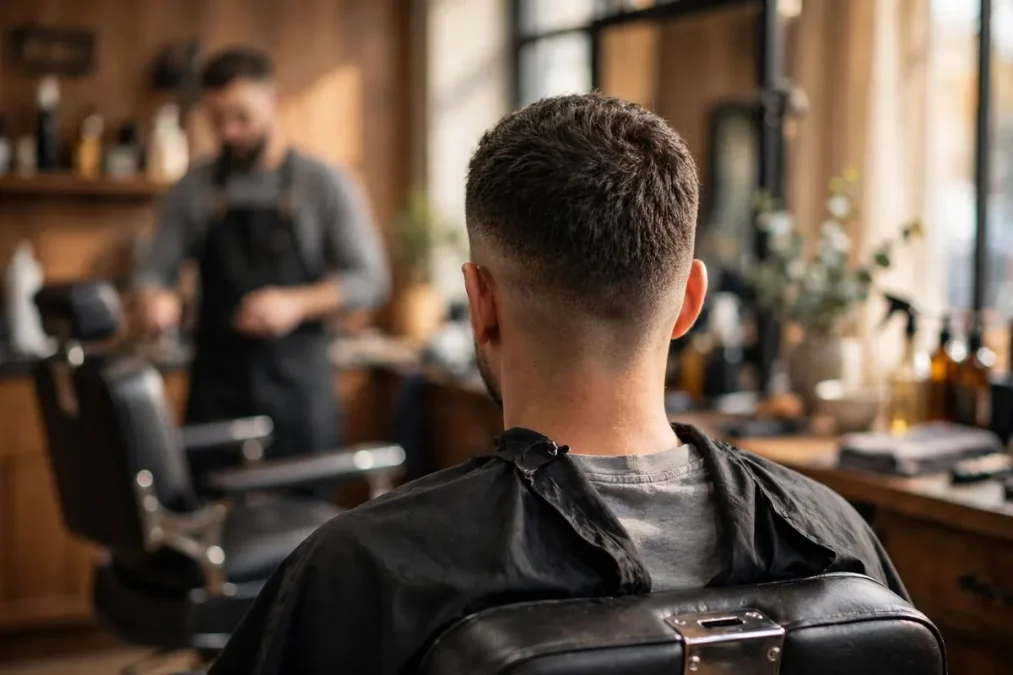
A low-maintenance haircut is not one thing. It is a trade, and the reader has to choose which side of the trade he wants. Some cuts ask for nothing in the morning and repay that ease with frequent barber visits. Others ask for a little attention each day and repay it with weeks between visits. No cut is free on both counts, and any list that pretends otherwise will put the reader in the wrong chair.
This guide covers the choice first and the cuts second: the two kinds of low-maintenance, the ten cuts grouped by kind, how each cut grows out, the morning routine each kind actually takes, and what to ask a barber so the cut stays low-maintenance after leaving the shop. For the broader picture, see our men’s haircuts guide.
Low-maintenance splits into two types, and they pull in opposite directions. Picking a type first is the whole decision; picking a cut first is how men end up with a style that looks easy in the shop and feels like work at home.
Type A cuts ask for nothing in the morning: wash, towel dry, go. Their cost is paid at the barber’s. Short shapes show growth fast, so the shape that looked sharp on day one needs revisiting sooner than a longer shape would. A man whose problem is mornings — who will not stand in front of a mirror with product and a dryer — belongs here, as long as he accepts the visits.
Type B cuts ask for a little daily attention and repay it with time between visits. Softer, longer, textured shapes grow out gracefully instead of losing their line in a week, so the reader can go longer before the next appointment. The daily cost is small — finger styling, sometimes a little light matte product — but it is real, and a reader who will do nothing at all in the morning should not pick from this group on the promise that it needs nothing.
If mornings and visits matter equally, the honest middle ground is a short taper: clean enough to need almost no morning work, soft enough to grow out without a harsh line. It is not the best at both — nothing is — but it is the cut that asks the least on both counts at once. The sections below make that case in detail, under Type B.
These cuts are for readers whose problem is mornings. Each one states what it is, why it belongs to Type A, what it costs in visits (as a range, never a fixed promise), and a one-line hair-type note.
A buzz cut clips the whole head to one short, uniform length. It is the zero-styling baseline of this guide: there is nothing to style, nothing to part, and nothing that can fall out of place during the day. Towel dry and go is the whole routine. Its cost is visits — short uniform hair shows growth quickly, so a buzz cut needs a trim every two to three weeks in most sources to keep looking intentional rather than overgrown. If this is a first buzz cut, start one or two guard sizes longer than the final goal; length can always be taken off at the next visit, but it cannot be put back once it is on the floor. A buzz suits most hair types for effort, and it suits thinning hair for a different reason — short uniform length reduces contrast — which our haircuts for thinning hair covers in full.
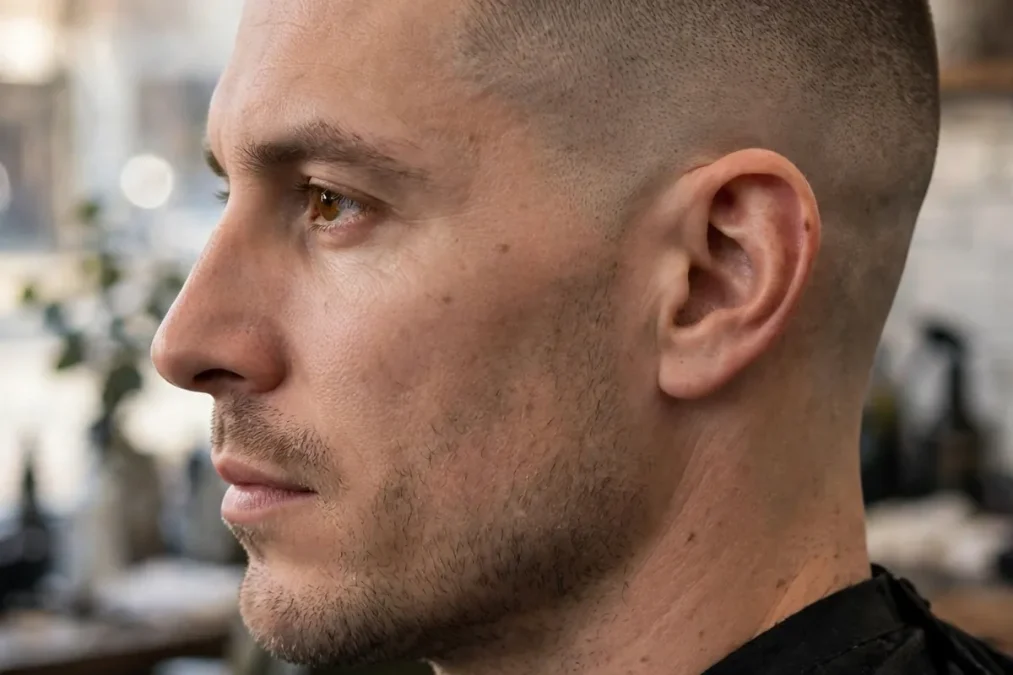
A crew cut keeps the sides short and the top slightly longer, graduated so the front sits a little longer than the back. It adds structure to the buzz cut without adding a routine: most days it is brush-and-go, and a little product can shape the top if wanted, but is not required. It is the Type A cut for a man who wants to look a bit more finished than a buzz without spending mornings on it. Visit cost is a range, and sources differ on it — roughly every two to four weeks in some, up to five to six in others — so the honest guidance is to judge by the shape: when the top starts to lose its graduation, it is time. Our full crew-cut guide is here: 15 masculine crew cut hairstyles.
A high and tight keeps the sides and back very short, with a compact, evenly clipped top. It is sharp, deliberate, and wash-and-go, which is why it reads as low-maintenance in the morning. Its cost is the shape itself: a compact top and very short sides show growth fast, so this cut needs frequent attention to stay sharp — roughly every two to three weeks to keep its lines. It suits straight and wavy hair well, and thick hair as long as the top is kept compact rather than allowed to bulk up. A man who wants this cut should want the visits too; without them, the shape that made it sharp is the first thing to go.
A French crop keeps the sides short and the top a little longer, with a blunt fringe pushed forward toward the forehead. Its morning routine is fingers, not tools: push the fringe forward on damp hair, let it dry, done. A small amount of light matte product can add definition, but the cut does not depend on it. The one caution is fringe length: too short and it reads as a bowl shape, too long and it covers the eyes — mid-forehead is the range most sources point to, and it is worth stating to the barber rather than leaving to chance. Visit cost is roughly every four to six weeks, since the shape is short but not skin-tight. It suits straight and slightly wavy hair best, where the fringe lies naturally forward.
An Ivy League is a polished crew-cut variant: short sides, a slightly longer top that can be brushed up or to the side. It is the work-appropriate Type A option — neat enough for an office, simple enough for a man who will not style. Most days it is brush-and-go; a little light product gives it a more finished look on days that need one, but the cut holds its shape without it. Visit cost sits in the same range as the crew cut, roughly every three to four weeks, because the longer top grows out more gracefully than a buzz or a high and tight. It suits straight and wavy hair, and it is a good first step for a reader who finds a buzz too bare but still wants mornings to be simple.
These cuts are for readers whose problem is barber visits. Each one states what it is, why it belongs to Type B, what it costs in daily attention (honest and small), and its visit range.
A low, soft taper shortens the hair gradually at the sideburns and nape, keeping hair visible all the way down — no bare skin, no harsh line. It is the grow-out-friendly side treatment itself, and the default Type B starting point. Because there is no skin line to blur, a taper still looks intentional weeks after the cut, which is why it can go roughly every three to four weeks between visits. Daily attention is minimal: towel dry, finger-comb into place, done. For a reader torn between both types, this is the middle ground named earlier — clean enough for mornings, soft enough for grow-out. The full taper-versus-fade comparison, which this guide does not restate, is here: taper vs fade.
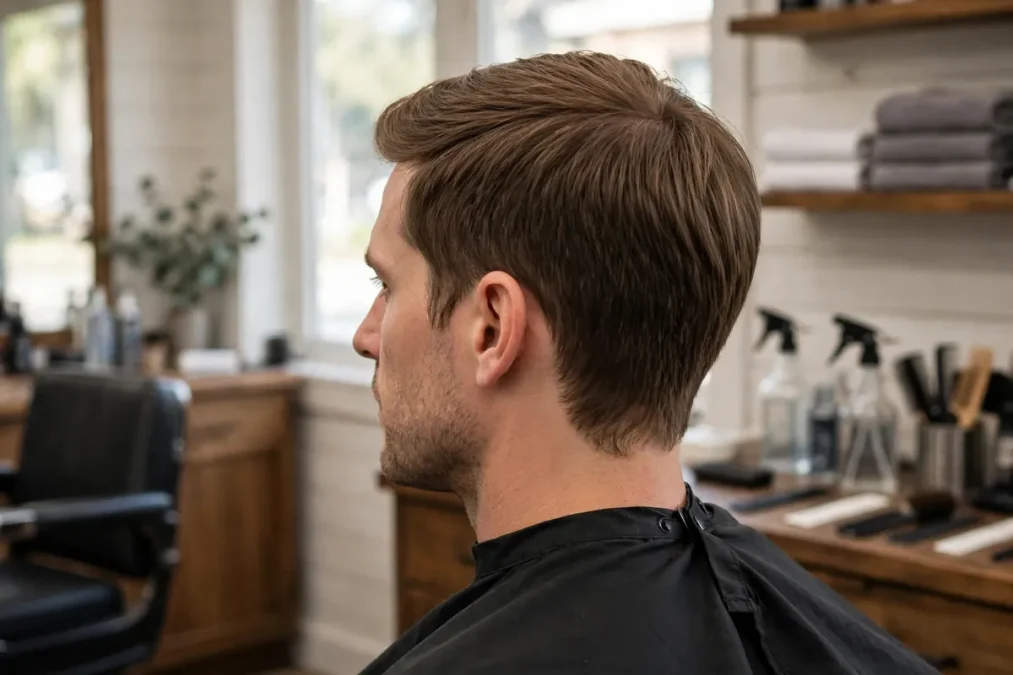
A taper fade with a short top pairs a gradual fade on the sides with a short, manageable length on top. It is sharp enough for the office and relaxed enough for weekends, and on most hair types it needs little to no styling in the morning — towel dry and go, with a tiny amount of lightweight cream only if wanted. Its visit range is roughly every three to four weeks: the fade is gradual rather than skin-tight, so it softens instead of collapsing as it grows. It suits straight, wavy, and textured hair, and it is the Type B cut to pick when the reader wants a clean, professional shape without committing to skin-fade visits.
A textured crop keeps the sides short and the top short and uneven, with strands pointing in slightly different directions so they overlap. That unevenness is what makes it low-maintenance in the visit sense: as it grows, the texture keeps reading as intentional rather than overgrown, so visits can stretch to roughly every four to six weeks. Daily attention is small but real — a little light matte product, worked through with the fingers, keeps the texture defined; without it, the cut still holds its shape on most hair, just more softly. It suits straight and wavy hair directly, and curly hair where there is enough length for texture to form. It is not a product-dependent cut, and which product suits which hair is a comparison for another article, not this one.
A medium flow, or bro flow, lets the hair grow to a medium length and relies on natural texture and layering to give it shape. It is the Type B cut for a man who wants length with minimal fuss: wash, towel dry, finger-style, and the hair’s own movement does the rest. Internal layering matters here — it stops thick hair from building into bulk and helps the hair fall smoothly instead of sitting as one heavy mass. Visit range is the longest in this guide, roughly every five to eight weeks, because a flow shape has no sharp lines to lose. The daily cost is the texture itself: on days when the hair dries unevenly or the wind moves it, the style still reads as natural, which is the point — but a reader who wants a precise, fixed shape every day will not get it from a flow.
Tapered curls keep length on top so curls can form, and taper the edges and sides for shape. This is the Type B option for curly and coily hair, and its rule is the opposite of the straight-hair rule: do not cut curls the way straight hair is cut. Curls need volume and length to sit right; cut too short, they read as frizz rather than shape, and a taper — not a skin fade — is the softest way to add structure without that commitment. Daily attention is wash-day care: a little leave-in or light curl cream on wash days, then leave the curls alone. Visit range is roughly every four to six weeks for shaping, since the top grows out gracefully while the tapered edges keep the outline clean. Moisture matters more than hold for this cut, but the full care routine belongs to a curl-care guide, not to a choosing article.
A cut should not be chosen on day-one looks alone. How it looks at week three is the real test of low-maintenance, and that test is decided mostly by the sides.
A soft taper grows out gracefully because there is no bare-skin line to blur: at week three, the blend has softened, but the shape still reads as intentional. A skin fade works the other way — its sharpness is the point on day one, and that sharpness is the first thing growth takes away. The contrast between bare skin and regrowth shows within days, not weeks, which is why skin fades demand the most frequent visits in this guide. The choice between them is not about looks on day one; it is about how much regrowth the reader is willing to see before the next visit.
On medium cuts, grow-out does not appear evenly. It appears first around the ears and at the nape, where short side hair pushes out and loses its line while the top still holds its shape. That is why a neckline clean-up between full cuts is the one between-visit tip this guide allows: a quick tidy at the neck and ears can stretch a cut’s good weeks without a full appointment. A full schedule of when to book, and how grow-out phases run, belongs to the maintenance-schedule article — this guide gives the principle, not the calendar.
A skin fade, or a high skin fade, is not a low-maintenance haircut in the visit sense, and this guide does not list it as one. It needs no morning styling, which is why it is often mislabelled as low-maintenance — but its bare-skin line starts to blur within about ten to fourteen days in several sources, and keeping it actually skin requires visits on that rhythm. A reader whose problem is barber visits should not pick a skin fade; a reader whose problem is mornings, and who accepts the visits, may — with that cost stated, not hidden. If the reader wants the clean look with fewer visits, the answer in this guide is a soft taper or a shadow fade, where a zero guard leaves stubble visible instead of bare skin, and the stubble base disguises regrowth.
Low-maintenance mornings are short, but they are not nothing. Knowing the real routine is what stops a reader from picking a cut that needs a routine he will not do.
For Type A cuts, the routine is the whole article in one line: wash, towel dry, go. Buzz, crew, high and tight, and Ivy League all hold their shape without tools. For Type B cuts, add one step: finger-comb or brush the top into place while it is still damp, then leave it. That is the routine for a taper, a textured crop, a flow, and tapered curls on an ordinary day. No dryer, no combing into tight lines, no fifteen-minute ritual — if a cut needs that, it is not a low-maintenance cut, whatever list it appeared on.
A small amount of light matte product — paste, clay, or cream, worked through with the fingers — can add texture or control where a cut section already says so. It is optional, not required, and it is the maximum product advice this guide gives. Which product suits which hair, and how pomade, clay, wax, and paste compare, are separate articles; this guide names product weight (light, matte) only, because weight is what matters to the cut’s look, not the product’s name.
Low-maintenance does not mean no washing and no trims. A cut that is never washed will not look intentional, and a cut that is never trimmed will not keep its shape, however low-effort it was sold as. The effort in this guide is moved, not removed: either to barber visits (Type A) or to a minute of morning attention (Type B). Genuinely zero care is outside this guide’s scope, and no cut here promises it.
For general hair-care guidance, see the American Academy of Dermatology’s tips for healthy hair.
Choosing the cut is only half the job. The other half is communicating it, because a barber cannot know which kind of effort the reader wants to save unless he is told.
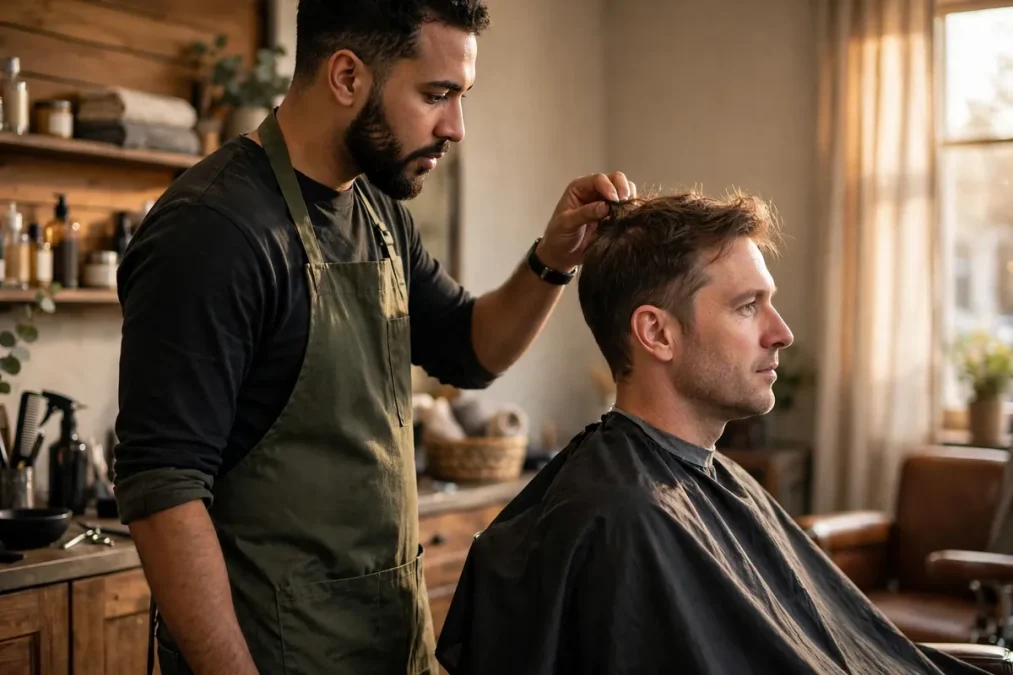
Say the effort type first, before naming a cut: “I want no daily styling” or “I want fewer visits.” Then name the side treatment, because that is the grow-out decision — a soft taper if visits are the problem, a skin fade only if mornings are the problem and visits are accepted. Then give the top length, and say whether texture is wanted. Bring a reference photo, state the hair type, and state honestly how much styling will actually happen at home. A cut that needs daily work the reader will not do is the wrong cut, however good it looked in the shop.
Do not ask for a skin fade when barber visits are the problem — the fade’s cost is visits, and asking for it while trying to avoid visits is asking for the opposite of what is wanted. Do not ask for a long, precise shape when mornings are the problem — precision needs morning work to hold. Do not ask for a cut that depends on heavy product while calling it low-effort — heavy product flattens, separates, and needs reworking daily, which is the opposite of the routine this guide describes. And do not ask for the sides to be taken to skin “just to keep it tidy for longer” — skin shows regrowth fastest, so it keeps tidy for the shortest time, not the longest.
No new cut is introduced here. This section only points back to cuts already described, by the reader’s situation.
If mornings are the problem, start with Type A: a buzz cut for zero styling, a crew cut for a little more structure, an Ivy League for work, a French crop for a forward fringe without tools. If barber visits are the problem, start with Type B: a low, soft taper first, then a taper fade with a short top for a clean shape, a textured crop for texture that grows out well, a flow for length with minimal fuss, tapered curls for curly hair. If both matter equally, the short taper is the middle ground. If hair is curly or thick, the deciding factor is not the cut’s name but its side treatment and its length: taper over skin fade, and enough length for curls or texture to form rather than frizz or bulk.
For the broader haircut picture, return to the haircuts guide. For crew cuts in depth, see 15 masculine crew cut hairstyles. For the full taper-versus-fade comparison, see taper vs fade. For guard sizes in full, see the clipper guard sizes guide — this article does not restate its chart. For hair-type depth, see good haircuts for fine hair and best haircuts for thick hair, and for face shapes, haircuts by face shape.
The full maintenance schedule will be its own article, as will the product comparisons for pomade, clay, wax, and paste, and for fine and thick hair. This article’s point stands on its own: the lowest-maintenance cut is not the shortest cut, nor the trendiest, nor the one with the sharpest day-one lines. It is the one whose cost — barber visits or morning attention — the reader is actually willing to pay.
There is no single lowest-maintenance haircut, because the answer depends on which effort the reader wants to save. For no daily styling, a buzz cut is the lowest-effort choice: wash, towel dry, go. For fewest barber visits, a soft, low taper or a taper fade with a short top is the better choice, because it grows out gracefully. The two-types section above is the way to decide, and any list that names one cut as universally lowest-maintenance is hiding one half of the trade.
As ranges, by cut, because sources differ and no single interval fits every head: skin fades roughly every ten to fourteen days to two to three weeks if kept sharp; buzz cuts every two to three weeks; tapers every three to four weeks; textured crops every four to six weeks; flow styles every five to eight weeks. Crew cuts sit across a spread in the sources, roughly two to six weeks depending on length and shape. The full schedule, with booking rhythm and grow-out phases, will be its own article; this guide gives ranges only as a choosing aid.
Only in the daily-effort sense. A skin fade needs no morning styling, but its bare-skin line blurs fastest, so it needs the most frequent visits of any cut in this guide. If barber visits are the reader’s problem, a skin fade is the wrong choice, and a soft taper is the grow-out-friendly alternative. If mornings are the problem and visits are accepted, a skin fade can work — with that cost stated, not hidden.
Say the effort type first — no daily styling, or fewer visits — then the side treatment (soft taper vs skin fade, which is the grow-out decision), then the top length, then whether texture is wanted. Bring a reference photo, state the hair type, and state honestly how much styling will actually happen at home. For a first buzz cut, start one or two guard sizes longer than the final goal and go shorter next visit.
Short answer, with the full matching in the cut sections above: straight hair shows blend lines, so a taper suits it; wavy hair’s texture does much of the work, so flow, textured crop, and taper suit it; curly and coily hair needs length for curls to form, so tapered curls suit it, with a taper rather than a skin fade; thick hair needs texture to avoid bulk; fine hair suits short cuts, which reduce contrast, and tapers, which add structure without exposing the scalp. For depth, see the fine-hair and thick-hair guides linked above.
No. No product is required for any cut in this article. At most, a small amount of light matte product can add texture or control where the cut section already says so. How pomade, clay, wax, and paste compare, and which products suit fine or thick hair, are separate articles and are not decided here.
A taper shortens gradually at the sideburns and nape and keeps hair visible all the way down; a fade blends higher up the side and can go to bare skin. For maintenance, the difference is grow-out: a soft taper stays intentional longer, while a skin fade shows regrowth fastest and needs visits soonest. The full comparison is in the taper-vs-fade guide linked above; this guide does not restate it.
It depends on the side treatment, not on the cut’s name. Soft tapers and shadow fades grow out gracefully; sharp skin lines do not. Neckline and ears show growth first, and a neckline clean-up between full cuts is the one between-visit tip this guide allows. Full grow-out phases and booking rhythm belong to the maintenance-schedule article.