Physical Address
Islamabad, PK
Physical Address
Islamabad, PK

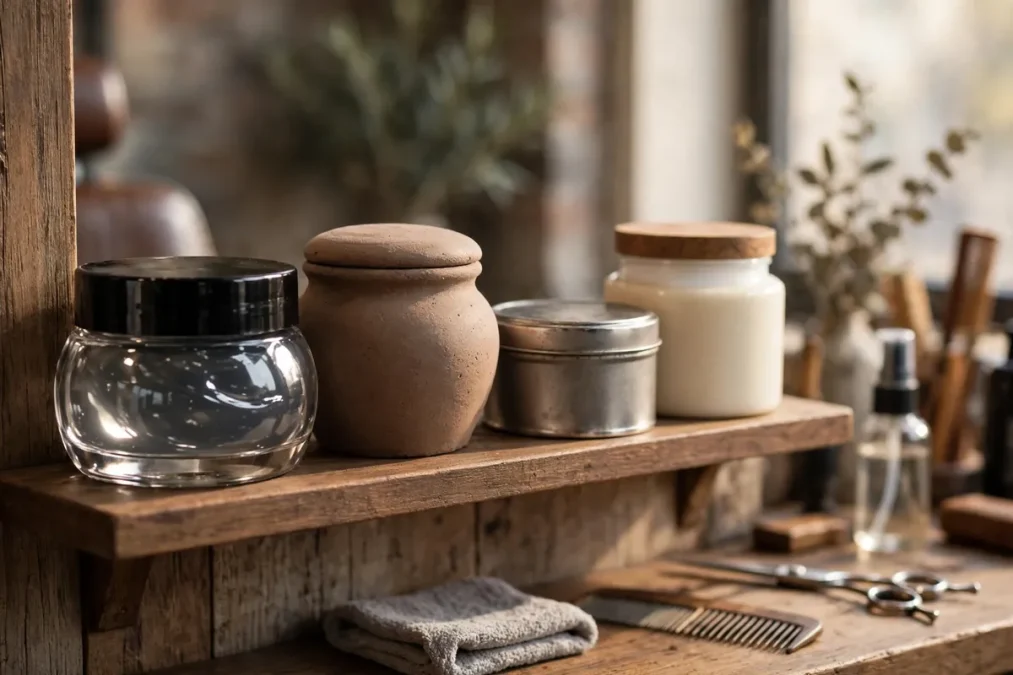
Four jars sit on the shelf, four similar prices, four similar promises — and they do four different jobs. Pick the wrong one and the problem is rarely hold. It is finish: a polished pomade on a matte textured cut looks wet when it should look dry, and a matte clay on a slicked-back style looks dusty when it should look smooth. Hold matters, but finish decides first.
This guide compares pomade vs clay vs wax vs paste on the axes that actually change the result — hold, finish, feel, restylability, and washability — then gives you four questions that pick one of them for your style, your hair, and your routine. No brand is named as a winner here, because the category is the decision: get the category right first, and the individual jar matters far less. For the broader picture, see our men’s haircuts guide.
Read this section as ranges, not ratings. No honest 1–10 scale covers all four products, because the sources use incompatible scales and because hold varies by formula inside every category. Where sources disagree, this guide says so.
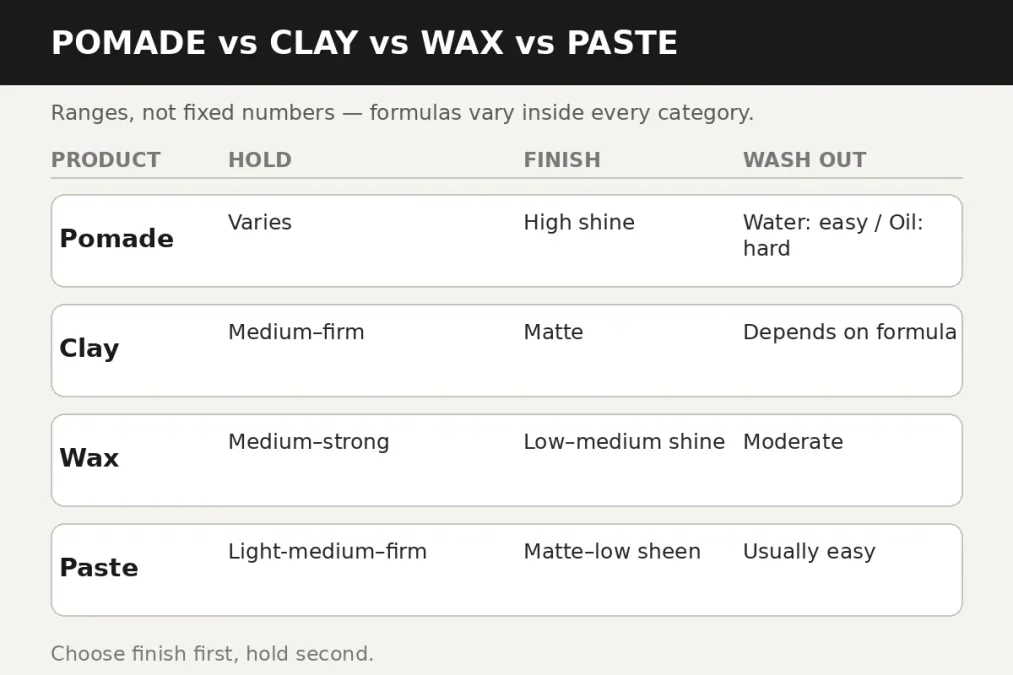
Pomade ranges from light-medium to strong depending on the formula — a light water-based pomade and a heavy oil-based pomade are barely the same product in hold terms, which is why the pomade section below splits them. Clay sits at medium to firm in most sources. Wax sits at medium to strong, with one source calling it high hold. Paste has the widest disagreement of all: one comparison table gives light to medium, while other sources give medium to firm or medium to strong. The honest range for paste is therefore light-medium to firm, depending on the formula.
The practical point is this: do not buy on a hold number printed on a jar. Two products both labelled “strong” can feel entirely different, because one is strong and slippery and the other is strong and grippy. Hold only means something once you know the finish and the feel that come with it.
Finish is the axis that decides the look, and it separates the four cleanly. Pomade is usually high shine — the gloss is part of a slicked-back, side-parted, or pompadour look, though matte pomade versions exist. Clay is matte, the most consistent finding in the whole comparison: sources agree on clay’s lack of shine far more than on its hold. Wax is usually low to medium shine, though heavier, oilier waxes can read shinier — that disagreement is recorded rather than hidden, because a man who buys a heavy wax expecting matte may be surprised. Paste is matte to low sheen, the “styled but not slick” finish.
If you remember one line from this section, make it this: choose shiny or matte before you choose strong or light. A strong matte product and a strong shiny product are not substitutes for each other, whatever their hold labels say.
Feel is what your hands tell you through the day, and it differs as much as finish. Pomade feels smooth and slippery — it combs through and lets a comb do the shaping. Clay feels dry and grippy, which is exactly why it lifts roots and holds texture: grip is the mechanism, not a side effect. Wax feels pliable and waxy, and it is the most forgiving of the four if you restyle through the day — you can push it back into shape hours later. Paste feels thick and flexible, like a heavier cream: it moves without stiffness and does not set hard.
Restylability follows feel. Pomade restyles well — oil-based pomade all day without drying, water-based pomade with a little water to reactivate it. Wax and paste restyle well too, because neither sets hard. Clay restyles, but less freely than wax or paste in one source’s account, because its grip resists being pushed around once it is in. If you run your hands through your hair all day, that difference matters more than a hold rating.
Washability is the axis men forget until the shower, and it is where the categories split hardest. Water-based pomade and most pastes wash out easily, often with a single shampoo — that ease is water-based pomade’s biggest selling point in the sources. Oil-based pomade is the hardest of the four to remove, needing a degreasing shampoo or a shampoo-first-on-dry-hair technique; its famous drawback is real, and any guide that hides it is misleading you.
Clay is formula-dependent: water-soluble clays wash out easily with no residue, while heavier clay-and-wax blends need more shampooing, so “clay washes out easily” is only true of some clays. Wax sits in the middle — moderate, harder to wash than a water-based paste because many waxes are oil-based, but not as stubborn as oil-based pomade in most descriptions.
Your washing routine is therefore a real choosing factor, not an afterthought. A man who washes daily and restyles from clean hair each morning will favour water-based formulas. A man who restyles the same product across days will tolerate, and may even prefer, an oil-based pomade’s staying power.
Pomade is the oldest product in this comparison and the most specific in its purpose: it makes combed, polished styles look intentional. If your style is shaped with a comb rather than fingers, pomade is where the comparison starts.
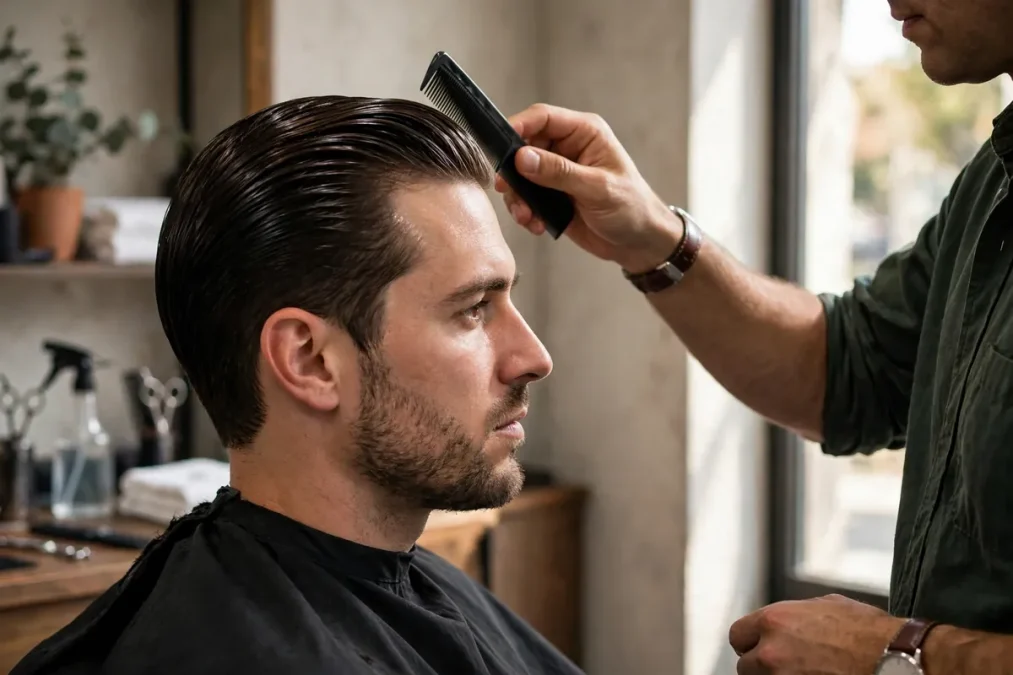
Pomade’s hold varies by formula, from light-medium to strong, so the jar matters more here than in any other category. Its finish is usually high shine — the wet, polished look of a slick back, a side part, or a pompadour is the pomade look, and for those styles the shine is not a side effect, it is the aesthetic. Matte pomade versions exist for men who want pomade’s smoothness without the gloss, but they are the exception, and a guide that calls all pomade high-shine is overstating it just as much as one that calls all pomade matte.
This split changes washability and restylability more than any other single fact in this article, so it deserves its own section. Water-based pomade rinses out easily, often with one shampoo, and starts each day from a clean slate — but it may set or harden slightly, and restyling it later in the day may need a little water. Oil-based pomade, the traditional grease, never dries: it stays pliable and reworkable all day, and one source credits it with stronger resistance to humidity, though that is that source’s claim rather than a measured result. The price is washability — oil-based pomade is notoriously hard to remove and needs a degreasing shampoo or a shampoo-first-on-dry-hair technique.
Choose between them by routine, not by loyalty to tradition. If you wash daily, want an easy reset, and restyle from clean hair, water-based is the practical pick. If you restyle across days, want all-day pliability, and do not mind the wash-out effort, oil-based earns its keep. Neither is “the real pomade” and the other a fake; they are two tools with different maintenance costs.
Pomade feels smooth and creamy, and it works best on towel-dried or slightly damp hair for slick styles: warm a small amount between your palms until it turns translucent, work it from front to back and root to mid-length, then finish with a fine-tooth comb for a sleek result or fingers for a more relaxed feel. Sources name short to medium lengths most often, and combed styles — slick back, side part, pompadour — as pomade’s home ground. On hair type, dense or coarse hair that needs taming is a pomade strength, while lighter water-based formulas suit fine to medium hair for everyday polished looks. Both are tendencies, not rules: the finish you want decides before the hair type does.
Clay is the product for men who want their hair to look thicker, drier, and more textured — without shine. If pomade is polish, clay is grip.

Clay’s hold is medium to firm in most sources — enough to hold a textured crop or a voluminous short style through the day, without the stiffness of a product that sets hard. Its finish is matte to no shine, the most agreed-upon fact in this comparison. That combination, firm hold with zero gloss, is why clay reads as natural: the style looks shaped, but it does not look like product is doing the shaping.
Clay is built around a mineral clay, usually bentonite or kaolin, and that ingredient is the whole mechanism: the clay grips the hair, lifts the roots, and gives a dry, piecey texture that makes hair look thicker and feel fuller. Wording matters here, and this guide keeps it honest — clay can make hair LOOK thicker and feel grippier, but no source in this research shows it changes the hair itself, and no claim is made here that it does. Any guide that promises thicker hair from a jar is selling something this guide will not.
That grip is also why clay suits fine or flat hair so often in the sources: where pomade’s smoothness can weigh fine hair down, clay’s dry grip lifts it. But clay is not fenced to fine hair — sources also describe it as workable on thicker styles, where its texture and separation still show. The deciding factor is the finish and volume you want, not a hair-type label.
Clay’s washability depends on the formula, and this is the one place where a flat claim about clay would mislead you. Water-soluble clays wash out easily with no residue, which several sources praise; heavier clay blends that lean on wax need more shampooing. Check the formula, not just the word “clay” on the jar.
For application, sources describe emulsifying the product between the palms until translucent or spreading it to the fingertips, then working it through from the roots outward. Damp hair spreads clay more evenly for overall texture; dry hair gives more targeted control. A dime-sized starting amount appears for one clay product in the sources — treat that as an example of the general rule, start small and add more, not as a universal dose for every clay.
Wax is the product for separation — hair that sits in defined pieces rather than one smooth mass — and for men who restyle through the day.
Wax holds at medium to strong in most sources, with one source calling it high hold; the honest category range is medium to strong. Its finish is usually low to medium shine, and this is where the sources disagree most for wax: one styling guide describes wax as high-shine, greasy, and very strong, while most comparison sources describe it as low to medium shine. This guide follows the majority and flags the exception, because the exception matters — a heavy, oily wax can read shinier than a man expecting matte would want, and the difference is in the specific wax, not the category word.
Wax’s clearest strength is its feel: pliable, waxy, and forgiving. It creates separation and texture, and it lets you rework the style hours later without it falling apart or going stiff. That is why sources name wax for textured, piecey styles and for men who restyle through the day — it is the product that tolerates being touched. Lighter wax formulas can even double as a glossing or finishing product over damp hair in one source’s account, though that is a lighter-wax use, not a property of every wax.
Wax washes out at a moderate effort — harder than a water-based paste or pomade, because many waxes are oil-based, but not as stubborn as oil-based pomade in most descriptions. Treat that as a tendency, not a ranking, because formulas vary. On suitability, sources name wax for textured and piecey styles generally, and for styles that need a comb or a defined shape.
One source cautions that wax is not a good choice for thin or curly hair that has not been heat-styled — that is one source’s caution, recorded here as such, not adopted as a rule, since other sources name wax for textured styles without that restriction. If your hair is thin or curly, the safer reading is to test a light wax in a small amount rather than to rule the category out.
Paste is the product to reach for when you do not know which of the other three you want — or when you want a natural look that does not commit to shine or to extreme matte.
Paste’s hold is the least settled of the four: one comparison table gives light to medium, while other sources give medium to firm or medium to strong. The honest range is light-medium to firm, depending on the formula, and any guide that quotes a single paste hold is picking one source and hiding the rest. Its finish is more settled: matte to low sheen, with slightly shinier options available. Sources call it the “styled but not slick” option, and that phrase captures it — the hair looks done, but it does not look wet, and it does not look dusty-dry either.
Paste is thicker than a cream and flexible rather than stiff: it gives texture and separation to shorter, choppier cuts without a wet look, and it moves through the day instead of setting. Sources name it for the widest range of lengths and styles of any product here — short, medium, and long hair, and styles from slightly shaped fringes to voluminous looks with a hair dryer. That versatility is real, but it cuts both ways: paste is rarely the best at any one extreme. It will not give you pomade’s gloss or clay’s driest matte, and if you want one of those extremes, the specialist product beats the versatile one.
For application, the same rule as everywhere else applies, and it matters more for paste than for most products because paste is thick: start with a small amount, spread it evenly through the hair, and add more only if the style needs it. A paste overloaded on the first pass is the commonest way to turn a natural finish into a heavy one.
Paste usually washes out easily, because most pastes described in the sources are water-based. That is stated as “usually,” not as a guarantee — a heavy paste can still need a proper shampoo, and the formula on the jar is what decides. On suitability, paste’s breadth is its point: it suits natural, casual, textured styles across lengths, and it is the safest first product for a man who has never used a styling product, because its failure modes are mild. Too little paste looks like nothing at all; too much looks heavy, but neither failure looks as wrong as a high-shine pomade on a matte cut or a matte clay on a slicked-back style.
No product wins this comparison, because the four do different jobs. Four questions, in order, pick one for you.
This decides more than any other question. If you want polished, glossy, combed hair, you are choosing pomade — and the rest of the guide is detail. If you want dry, natural, textured hair with no gloss, you are choosing clay or paste, with wax in the middle. Answer this before anything else, because a product with the wrong finish cannot be saved by the right hold.
If the style must hold a precise shape all day — a pompadour, a sharp side part, a sculpted crop — favour the firmer end of your finish family: a stronger pomade for shiny styles, a firm clay for matte ones. If the style is meant to move, to be pushed around, to look lived-in by evening, favour pliability: wax or paste for textured styles, oil-based pomade for polished ones. Structure and movement are a trade-off, and pretending otherwise is how men end up with a style that is either too stiff or too loose by noon.
Hair type adjusts the choice; it does not make it alone. Fine or flat hair that needs lift tends toward clay or a light paste, because grip and volume help more than weight — for hair-type depth, see good haircuts for fine hair. Thick or coarse hair that needs control tends toward a stronger pomade or wax, because weight and hold help more than lift — for hair-type depth, see best haircuts for thick hair.
Length matters the same way: shorter, choppier cuts take paste, clay, and wax well; longer styles lean toward paste or lighter formulas that do not stiffen the length. These are tendencies, and a man whose finish answer points one way should not let a hair-type tendency overrule it.
If you wash daily and restyle from clean hair, water-based formulas — water-based pomade, most pastes, water-soluble clays — make your mornings easy. If you restyle the same product across days, oil-based pomade’s all-day pliability earns its wash-out cost. If you restyle through the day with your hands, wax or paste’s reworkability matters more than either. Your routine is not a footnote to this decision; it is the fourth question because it decides whether the product you chose is one you will actually keep using.
Put together, the path looks like this: shiny and structured means pomade; matte and voluminous means clay; matte and natural across lengths means paste; piecey and reworkable means wax. If two answers pull in different directions — matte finish but a combed shape, for instance — let finish win, because a combed shape in a matte product still reads as your style, while the wrong finish reads as the wrong product entirely.
The commonest mistake in this whole comparison is buying the strongest product on the shelf without asking whether its finish matches the style. A strong pomade on a textured crop gives you a wet crop; a firm clay on a slick back gives you a dusty slick back. Both are hold successes and style failures. Finish first, hold second, every time.
Overuse is the commonest cause of a greasy or stiff result, and it is blamed on the category far more often than it should be. Every product in this guide works on a small starting amount, added to only if the style needs it. If your hair looks greasy after pomade or wax, or stiff after clay or paste, the first fix is not a new product — it is half the amount next time. If half the amount still fails, then the category is wrong.
Hair state changes what a product does. Damp hair spreads product more evenly and suits slick, combed styles; dry hair gives more targeted control and suits textured styles. Pomade sources name towel-dried or slightly damp hair for slick results; clay sources name damp hair for even distribution and dry hair for targeted control. Applying a matte clay to soaking wet hair, or a slick pomade to bone-dry hair, fights the product instead of using it — and the result is blamed on the jar.
A product holds a style; it does not replace a cut. Once the shape itself has gone — the blend softened, the sides bulked, the length lost its structure — no pomade, clay, wax, or paste will bring it back, and adding more product only makes the lost shape heavier. That is a scheduling problem, not a product problem, and the maintenance schedule guide will be linked here once it is published. If your usual product has stopped working, check the cut before you change the jar.
Take this comparison to your next visit and ask one question: given my cut, which finish and hold do you think suits it? A barber who knows your cut can answer that in seconds, and the answer narrows this guide’s four products to one or two. Tell him also how you wash and whether you restyle through the day — those two facts change his answer as much as the cut does. Bring a reference photo of the style at its best, not of the product jar: the barber needs the target, not the tool.
For general hair-care guidance, see the American Academy of Dermatology’s tips for healthy hair.
For the broader haircut picture, return to the haircuts guide. The product guides for fine hair and for thick hair will be their own articles, and this comparison stands on its own without them. The point of all four products is one line: the right product is not the strongest, the shiniest, or the most expensive — it is the one whose finish and hold match the style you actually wear, on the hair you actually have, in the routine you actually keep.
None of them, because they do different jobs. Pomade wins on polished shine, clay on matte volume, wax on pliable separation, paste on versatile natural texture. The best product is the one whose finish matches your style first, whose hold matches your structure need second, and whose washability fits your routine third — the four questions above, in that order.
Pomade is the polished, shiny, combed product. Clay is the matte, grippy, volumising product. Wax is the pliable, piecey, reworkable product. Paste is the flexible, natural, versatile product. If you only remember those four lines, you already know more than a hold label tells you.
Usually water-based pomade and most water-based pastes, which often rinse out with a single shampoo. Oil-based pomade is the hardest of the four and needs a degreasing shampoo or a shampoo-first-on-dry-hair technique. Clay and wax sit between those poles and depend on the formula: water-soluble clays wash out easily, heavier clay and wax blends need more shampooing. No absolute ranking holds for every jar, because formulas vary inside every category.
As a tendency, not a rule: clay or a light paste, because grip and volume help fine hair look fuller without weighing it down, while heavy or oily formulas can flatten it. That is a product-type tendency only; the dedicated products-for-fine-hair guide will go deeper, and it will be linked here once it is published.
As a tendency, not a rule: a stronger pomade or wax for control, or clay or paste where texture is wanted instead of polish. Thick hair has the weight to carry a stronger product without being flattened by it, which is why control products suit it — but the finish you want still decides first. The dedicated products-for-thick-hair guide will go deeper, and it will be linked here once it is published.
Pomade. Water-based pomade if you wash daily and want an easy reset; oil-based pomade if you restyle across days and want all-day pliability. Clay and matte paste are the wrong finish axis for a slick style, however strong they are — shine is part of what a slick style is.
Clay first for volume and grip, paste for a softer natural texture, wax for piecey separation. Pomade is the wrong finish axis for a matte style, however light it is — a shiny product on a matte cut reads as wet, not as textured.
Start with a small amount and add more only if the style needs it — that rule matters more than any mixing advice. Some men use more than one product type, for instance one for hold and one for finish, but no mixing recipe is claimed here, because the combination depends on the specific formulas. Overloading, whether with one product or two, is the commonest cause of a greasy or stiff result, and halving the amount is the first fix to try.


