Physical Address
Islamabad, PK
Physical Address
Islamabad, PK

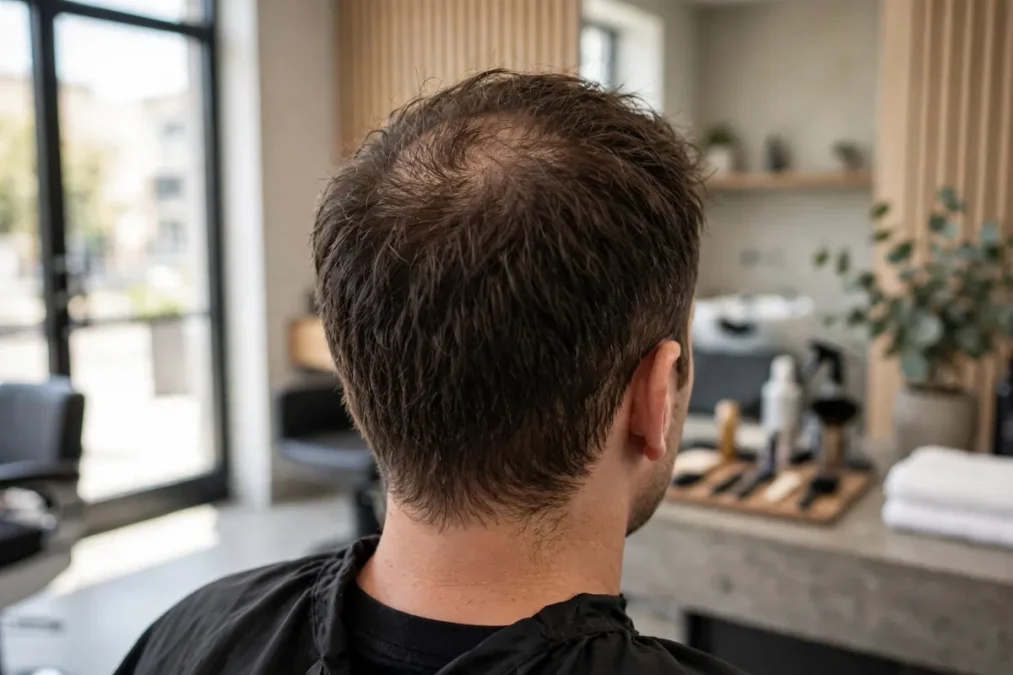
A thinning crown needs a different haircut decision than a receding hairline or thinning all over. Short, even, textured cuts tend to make a crown look fuller, because they reduce the contrast between dense hair and the thinner patch. Long hair left to cover the crown usually does the opposite: it separates around the natural swirl and shows more scalp, not less.
This guide covers the crown specifically: how to tell the thinning is at the crown, how the right cut changes as thinning advances, which cuts suit a thinning crown, what to ask your barber, and how to style the crown day to day. For the broader picture, see our men’s haircuts guide.
The crown, also called the vertex, is the top-back of the head, around the natural swirl where hair changes direction. Crown thinning often shows up first from behind, or in a photo taken by someone else, while the front and temples still look full. That is one reason it can be missed for a while: the view you see in the mirror every morning is the front, not the crown.
Receding temples move the front hairline back at the corners, forming an M shape. Crown thinning thins a patch at the top-back while the front hairline may stay where it is. The two problems need different cuts. A receding front is a front-hairline problem, not a crown problem, so it needs a different guide. An even, short cut can blend a crown patch, but it is not the answer to a receding hairline on its own.
Diffuse thinning means density drops fairly evenly across the whole top, with no single patch standing out. Crown thinning is localised: one area, the crown, thins while the surrounding hair stays denser. That distinction matters, because a localised patch can be blended with length and direction choices around it, while even thinning across the top is usually handled with a uniform short cut.
Fine hair describes narrow strands. Thinning hair describes reduced density — fewer hairs covering the same area. A man can have fine hair with full coverage, or coarse hair that is thinning. The distinction matters for a crown cut, because fine hair needs lift and texture to avoid lying flat, while thinning hair needs cuts that reduce contrast and avoid exposing the scalp. This guide is about the second problem, at the crown.
The right crown cut depends on how much density is left, so it helps to judge the stage honestly before choosing.
In the early stage, the crown looks slightly lighter under bright light or when the hair is wet, but the scalp does not show clearly in normal light. The whorl may start to look a little wider. Most short, textured cuts still work here, because there is enough surrounding hair to overlap the lighter area.
In the moderate stage, the crown patch is visible in normal light and in photos from behind, and the hair around the whorl parts more easily. Length becomes the key decision: keeping the crown at a similar length to the surrounding hair helps the patch blend, while extra length at the crown tends to separate and draw attention to it.
In the advanced stage, the crown patch is clearly visible and there is little hair left to overlap it. At this point, cuts that try to cover the patch usually fail, because there is not enough hair to cover with. A uniform, very short cut removes the contrast altogether and makes the thinning look deliberate rather than hidden.
The cuts below are presented in their crown aspect only: crown length, blending around the whorl, and contrast with the sides. A cut that works for a crown does not automatically work for temples or for diffuse thinning, and the stage notes say where each cut fits best.
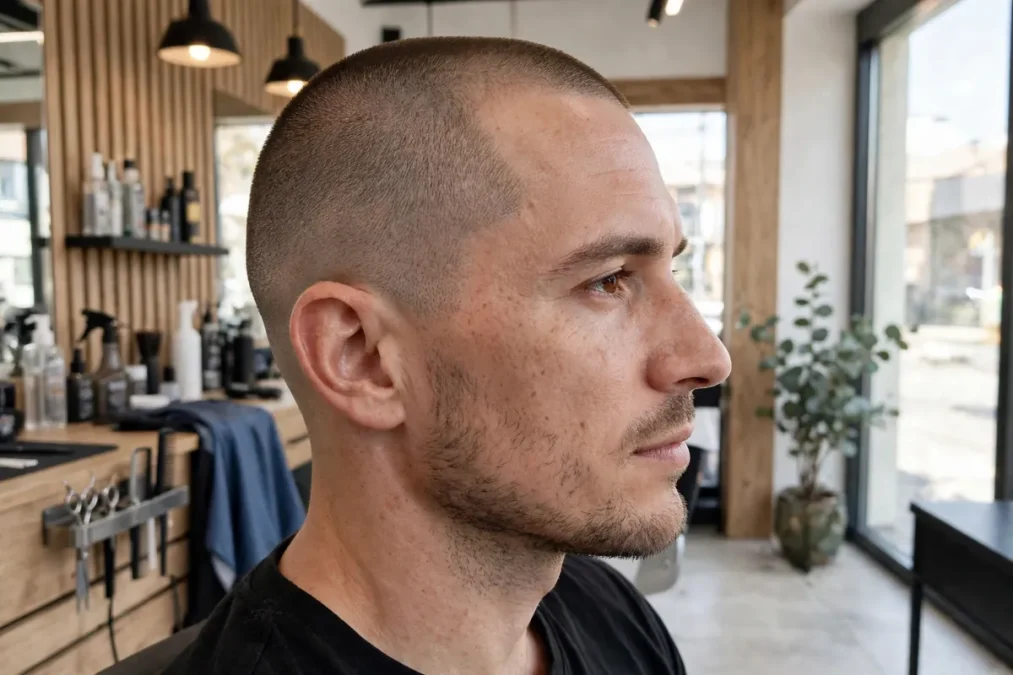
A buzz cut clips dense and sparse areas to a uniform length, so the contrast that makes a crown patch stand out largely disappears. It suits moderate to advanced crown thinning, and it suits a man who wants the lowest-maintenance option. The trade-off is clear: a buzz cut does not hide a crown patch by covering it. It makes the whole head read as one even length, so the patch stops standing out.
A short textured crop keeps the top short and uneven, with strands pointing in slightly different directions so they overlap. That overlap is what helps a thinning crown: neighbouring strands cover the lighter area instead of lying in one flat direction and parting over it. It suits early to moderate crown thinning, where there is still enough hair on top to create texture. Keep the crown at a similar length to the rest of the top, and keep the sides close with a low taper, so the contrast stays gentle.
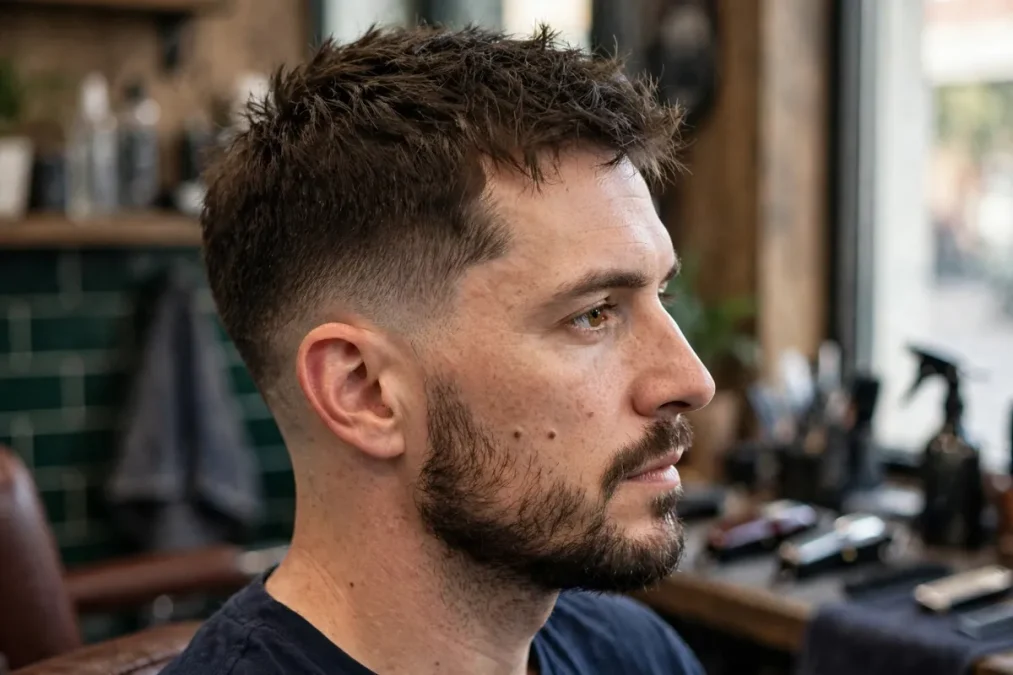
A crew cut is short on the sides with a slightly longer top, graduated so the front sits a little longer than the crown. A textured crew cut adds light, uneven texture through the top. Both suit early to moderate crown thinning. The textured version helps more at the crown itself, because the uneven strands break up the whorl area instead of lying flat over it. Deep texturising is best avoided on sparse sections, because removing too much weight there can leave stringy ends that expose more scalp.
A high and tight keeps the sides and back very short, with a compact, evenly clipped top. It suits a man who wants a sharp, deliberate shape and whose crown density is still adequate. Its short top limits the length that could separate around the whorl, and its clean sides keep the focus on the shape rather than on any one thin area. Where crown density is already low, the compact top has less hair to work with, so this cut fits the earlier stages better than the advanced stage.
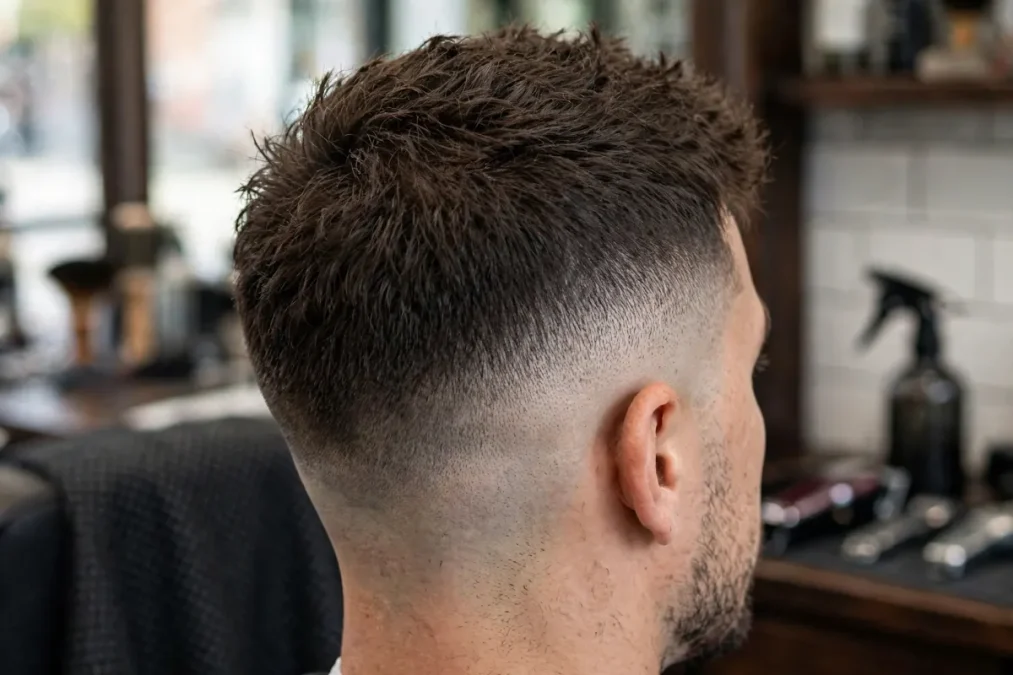
A low taper fade keeps the blend low, near the natural hairline, while the top stays textured. That low blend matters for a thinning crown: a high or skin-tight fade over a thin crown creates a harsh contrast between bare sides and a sparse top, which draws the eye straight to the thin area. A low taper cleans the edges while preserving side coverage, so the top-to-side transition stays soft. Keep the top at a length that still holds texture, and keep the finish matte rather than slick.
A short side part with a soft, narrow part can redirect texture diagonally across the top, which can help a mild crown patch read as part of the style rather than as a gap. A messy comb-over works on the same idea in a more casual form: the top is swept across with an airy, matte finish so the strands overlap rather than sitting in shiny, separated lines. That difference is the point. A long, shiny, classic comb-over is a different style, and it is one to avoid for a thinning crown: long strands separate, show the scalp between them, and fail in wind or rain. The short, matte version works because it is short and textured, not because it covers more.
A slicked-back direction can work for a crown patch only in one situation: where the front density is still strong enough to carry length back over the crown, so the hair lying back actually covers the patch. Where front density is not strong, the same direction is a poor choice, because lifting the front and sweeping it back exposes the crown rather than covering it. Treat this as a conditional option, not a default crown cut, and be honest about which situation applies before choosing it.
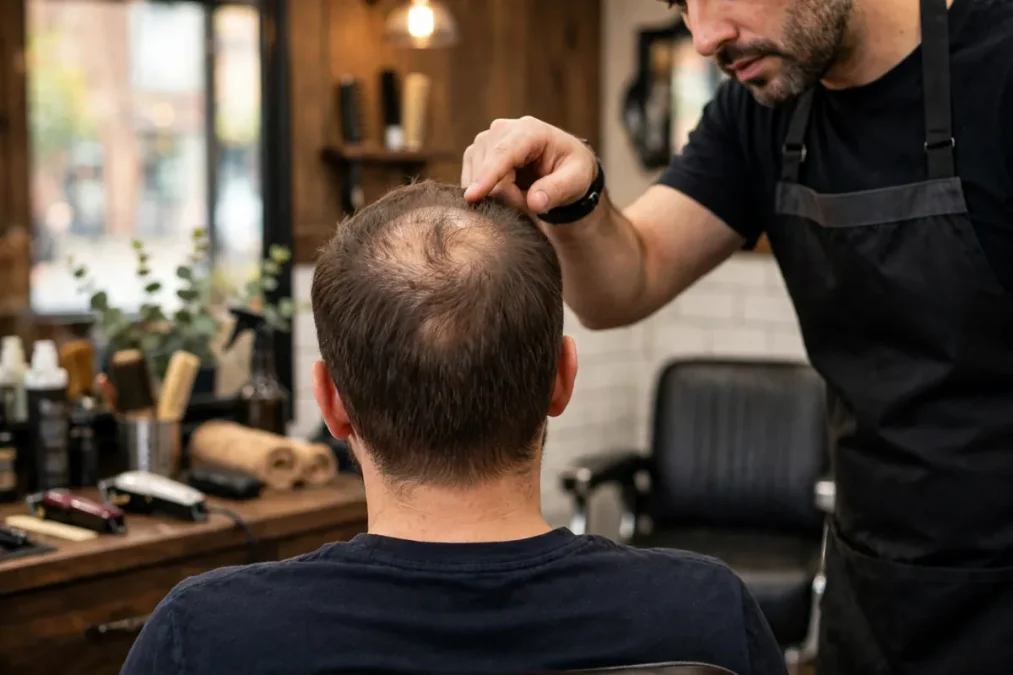
Choosing the cut is only half the job. The other half is communicating it clearly, because a barber cannot see the crown the way you see it in photos, and “short back and sides” does not say where the problem is.
Tell your barber where the thinning is before discussing length: at the crown, around the whorl. Show photos of the crown from behind and from the side, not just the front, so the barber can see how the whorl sits and where the hair parts. Ask for the crown to be kept at a similar length to the surrounding hair, with blending around the whorl rather than a sharp step, and for close or low-tapered sides that keep the contrast gentle. Ask for light, shallow texture on top rather than deep texturising, so the top keeps its weight. If you have a cut in mind from this guide, name it and name the stage you think you are at, so the barber can adjust it to your density rather than cutting a standard version of it.
Do not ask for the crown or the back to be left longer “to cover it”. Longer crown hair splits open around the swirl and usually makes the gap more obvious, not less. Do not ask for a high skin fade over a thin crown, because the bare sides next to a sparse top increase the contrast you are trying to reduce. Do not ask for a hard, shaved part line through a thin area, because a hard part exposes the scalp along the line and grows back unevenly. And do not ask for heavy thinning shears on the sparse sections themselves: removing weight from the thinnest hair leaves less to overlap the patch.

A good crown cut can still look thin if it is styled against itself. The daily rules below are about direction, finish, and checking what you cannot see.
Style the crown with the whorl, not against it, and work the hair in different directions around the swirl rather than combing it all one way. Hair combed in a single flat direction over a whorl tends to part along the swirl and open the patch. Short, overlapping strands worked in mixed directions break up that parting and let neighbouring hair cover the lighter area. Blow-drying against the direction of growth, with the airflow lifting the roots, can add lift at the crown, but keep the heat and the hold light: the goal is movement, not a stiff shape that separates into strands.
A matte, lightweight finish suits a thinning crown better than a shiny, heavy one. A matte finish tends to diffuse light, so the scalp underneath reads less clearly. Shiny or wet-look products separate hair into distinct strands and highlight the gaps between them, which is the opposite of what a crown cut is trying to do. Heavy products have a similar problem: they weigh fine or thinning hair down, flatten it, and make it separate. A small amount of matte clay, paste, or powder, worked through with the fingers rather than combed into tight lines, usually holds a crown style without flattening it. This is a styling caution, not a product comparison: which product suits fine versus thick hair deserves its own comparison, and is not decided here.
Avoid a sharp, wide part over or near the crown, because a wide part line exposes the scalp along its length. A soft, narrow part, or no hard part at all, keeps the top reading as one surface. And check the back view. A crown style that looks fine from the front can still part open at the back, so check it in a second mirror or a photo from behind after styling, especially on the first few days with a new cut. If the crown parts open every time, that is information for the next barber visit: the crown length, the texture, or the direction needs adjusting, not more product.
A thinning crown cut keeps its shape only if it is revisited regularly. As thin hair grows, it tends to separate, flatten, and expose more scalp, so a shape that looked full on day one can look patchy a few weeks later. How often that happens depends on growth rate and on the cut: shorter, more uniform cuts tend to hold their shape with regular trims, while longer tops separate sooner. No single interval is fixed here, because growth rate and cut length change the answer. What matters for now is the principle: book the next trim before the crown starts parting open on its own, rather than waiting until it does.
A haircut changes how thinning looks, not growth at the follicle. If hair loss becomes sudden, patchy, painful, itchy, inflamed, or unusually rapid, see a clinician rather than trying to style around it.
For what counts as a warning sign and when to seek care, see the NHS hair loss guide and the American Academy of Dermatology’s hair loss guidance.
If, after reading this guide, your thinning turns out to be somewhere other than the crown, the right guide is a different one. For thinning across the whole top, see our haircuts for thinning hair. For a receding hairline at the temples and front, see our haircuts for receding hairlines.
There is no single best cut for every thinning crown, because the right choice depends on the stage and on how much density is left. As a starting point, a short textured crop or a crew cut tends to suit early to moderate crown thinning, where there is still hair to overlap the patch, while a buzz cut tends to suit moderate to advanced thinning, where a uniform length removes the contrast altogether. The stage section above is the way to narrow it down, and the barber section is the way to communicate it.
Short, in almost every case. Short, even hair reads as denser, because the strands do not have enough length to separate around the whorl and expose the scalp. Long hair at the crown is heavier, lies flatter, and parts open around the swirl, which makes the patch more visible. If some length is wanted, it should stay short and textured rather than long and flat.
Tell the barber the thinning is at the crown, show photos from behind and from the side, and ask for the crown kept at a similar length to the surrounding hair, blended around the whorl, with close or low-tapered sides. Ask for light, shallow texture on top rather than deep texturising. Do not ask for the back left long to cover the patch, a high skin fade over a thin crown, or a hard part through a thin area.
No. A haircut changes how thinning looks, not how hair grows, because growth happens at the follicle below the skin. A good cut can make a crown patch much less visible, but it does not treat the cause of the thinning. If loss is sudden, patchy, painful, itchy, inflamed, or unusually rapid, see a clinician.
Only conditionally. A slicked-back direction can work where front density is still strong enough to carry length back over the crown, so the hair lying back genuinely covers the patch. Where front density is not strong, the same direction lifts the front and exposes the crown, so it is a poor choice. It should not be picked as a default crown style; the condition has to be true first.
Regularly, before the crown starts parting open on its own. As a guide only, our own general thinning guide suggests every two to six weeks, and the right interval within that range depends on your growth rate and cut length — agree it with your barber at the first trim.
Crown thinning is a patch at the top-back of the head, around the whorl, while the front hairline may stay in place. A receding hairline moves the front hairline back at the temples, forming an M shape. The cut strategies differ for the same reason: an even, short crown cut blends a back patch, while a forward fringe softens a receding front. If your thinning is at the temples and front, our haircuts for receding hairlines is the right guide.
When hair loss becomes sudden, patchy, painful, itchy, inflamed, or unusually rapid. Those signs are different from gradual, patterned thinning, and they are not something a haircut can address. This guide makes no diagnosis and no treatment recommendation.


