Physical Address
Islamabad, PK
Physical Address
Islamabad, PK


The best men’s haircuts for thinning hair use short length, controlled texture, and balanced sides. Does your current haircut expose more scalp than expected? Long comb-overs, flat slick-backs, and high skin fades can highlight sparse areas.
Poor length and texture choices can expose thinning around the temples, crown, or frontal hairline. As contrast increases, fine hair may appear flatter and less balanced.
This guide covers 21 cuts, barber requests, styling products, trim schedules, and haircut mistakes.
A suitable haircut removes excess length, preserves visible weight, and reduces scalp contrast. Short, structured cuts, including crew cuts and textured crops, can create lift when enough density remains. Male Androgenetic Alopecia reports that pattern hair loss affects 30% to 50% of men by age 50.
Fine hair describes narrow strands, while thinning hair describes reduced hair density. Some men have fine hair with full coverage. Others have coarse strands with reduced density. Androgenetic alopecia commonly affects the temples, frontal hairline, and crown.

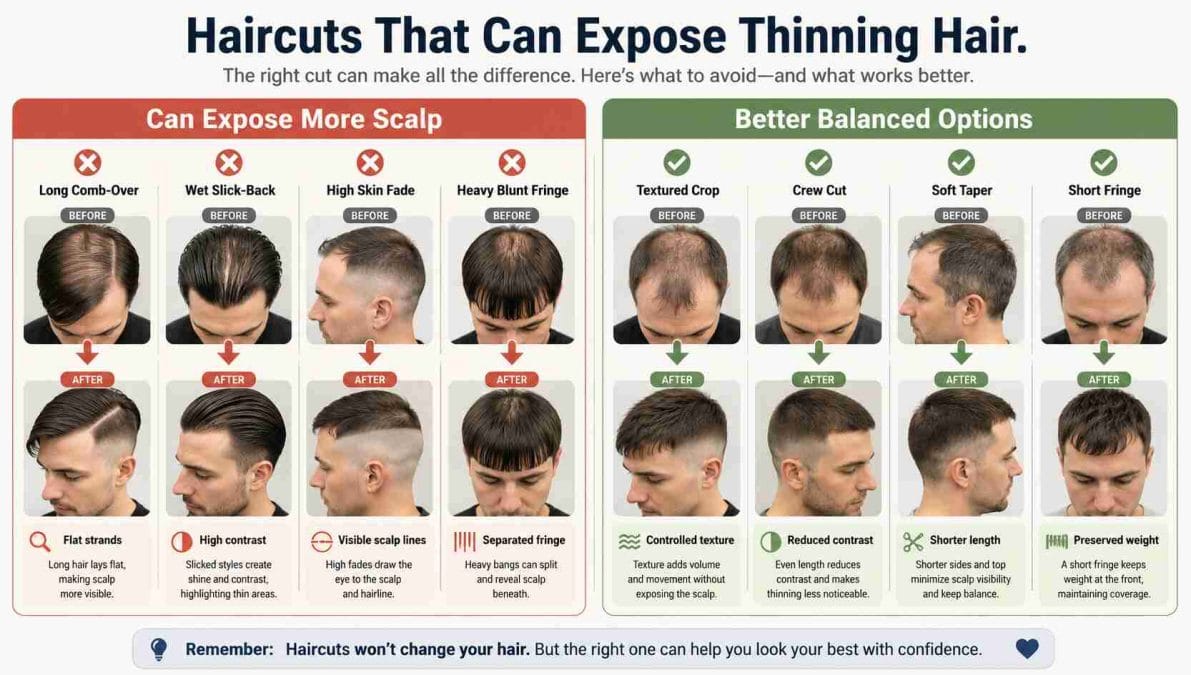
Short length reduces flatness, controlled texture creates lift, and blended sides limit scalp contrast. Crew cuts, textured crops, and buzz cuts reduce visible gaps between strands. Shallow point-cutting adds movement while removing less weight than deep texturizing. Soft tapers and low fades can balance dense sides with a sparse top. Heavy layering and thinning shears can remove useful weight from sparse sections.

Choose a haircut by matching its length, direction, and contrast to the thinning area and remaining density. The Norwood Scale classifies male-pattern hair loss across 7 stages.

Short textured cuts create lift across a sparse top. Textured crops, crew cuts, and short quiffs reduce visible gaps between strands. Shorter sides can also limit heavy contrast.
Forward-styled cuts soften frontal thinning and receding temples. Caesar cuts, French crops, and textured fringes cover uneven hairlines. Wet products and long comb-overs can expose recession.
Short overlapping layers reduce visible scalp around the crown. Crew cuts, textured crops, and buzz cuts follow the natural hair whorl. Extra crown length can separate and reveal thinning.
Uniform short cuts balance reduced density across the entire top. Buzz cuts, burr cuts, and clean-shaven heads reduce contrast between dense and sparse areas.

These 21 haircuts reduce scalp contrast across thinning patterns, including temple recession, crown thinning, and diffuse loss. The 25 Short Haircuts for Men in 2026: The Ultimate Face-Flattering Guide compares short cuts by face shape and hair texture.

A textured crop creates the appearance of density through short, uneven texture across the top. Start with 1 to 2 inches on top. Adjust the final length for density and styling direction. A low fade or soft taper reduces contrast.

A French crop covers frontal thinning with a short fringe styled forward. This cut suits receding temples and uneven hairlines. The 12 French Crop Hairstyles for Men (Every Face Shape) covers textured, curly, faded, and short versions. Advanced crown thinning may remain visible.

A Caesar cut softens frontal recession with a short, horizontal fringe. Its even length reduces visible gaps between strands. This style suits fine, straight hair.

A classic crew cut balances mild thinning with tapered sides and graduated top length. The front remains longer than the crown. This shape suits early temple recession. 15 Masculine Crew Cut Hairstyles for Men compares taper, fade, and top-length options.

A textured crew cut adds movement without leaving excessive length on top. Light point-cutting separates flat strands while preserving visible weight. Deep texturizing can create stringy ends.

A buzz cut lowers contrast by clipping dense and sparse areas very short. Number 1, 2, or 3 guards provide different coverage levels. What Type of Buzz Cut Should I Get? 27 Styles, Guards 0–16, and Fades (2026) compares guard lengths and fade options. This cut suits diffuse thinning.

A burr cut is a short buzz-cut variation using a number 1 or 2 guard. Its even finish reduces visible thinning. This cut requires little daily styling.

An Ivy League haircut suits early thinning when enough frontal density remains. Keep 1.5 to 2 inches on top. A soft side sweep adds controlled coverage.

A high and tight blends temple recession into closely shaved sides. Its compact top creates a deliberate shape. This style works best when crown density remains adequate.

A regulation cut gives mild thinning a clean, professional shape. The short top supports a soft side sweep. Avoid hard parts that expose the scalp.

A short side-swept crop balances uneven recession by directing texture diagonally across the front. Its compact length provides coverage without resembling a long comb-over.

A short textured fringe covers frontal thinning without creating heavy bangs. Irregular ends soften an uneven hairline. Matte products reduce visible strand clumps.

A short quiff adds height when enough density remains near the frontal hairline. Keep 1.5 to 2.5 inches on top. Diffuse thinning may weaken the finished shape.

A classic taper creates a soft transition between the top, sides, and neckline. It preserves more visible side weight than a skin fade. This balance suits mild thinning.

A low taper fade cleans the temples and nape while retaining more visible side coverage. The blend stays near the natural hairline. It complements crops, fringes, and crew cuts.

A low fade with a textured top combines clean sides with controlled volume. Keep 1.5 to 3 inches on top. The lower transition limits harsh scalp contrast.

A short side part redirects hair across mild temple or crown thinning. Keep the part soft and narrow. Deep or shaved lines can expose more scalp.

A short pompadour adds height when the frontal section retains moderate density. Keep 2 to 3 inches at the front. Lightweight mousse supports lift without greasy separation.
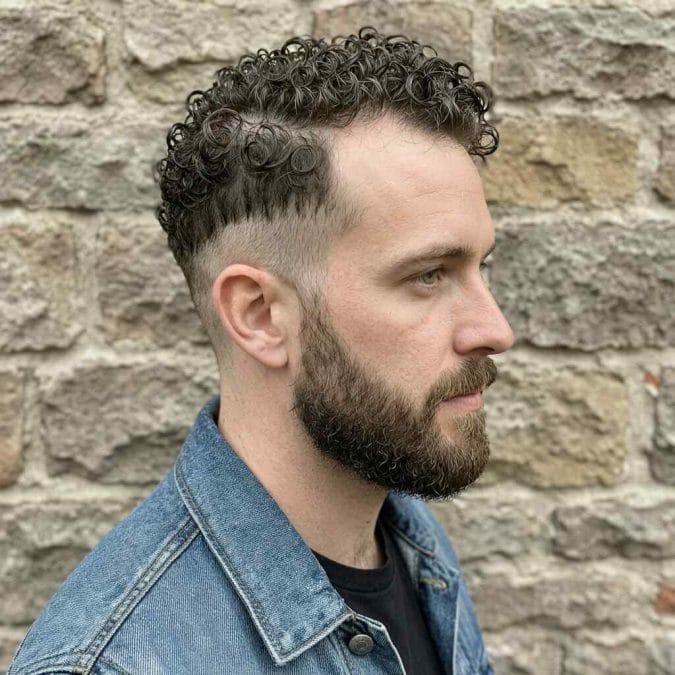
A curly crop uses natural bends to add volume across a thinning top. Keep curls compact at 1 to 2 inches. A soft taper controls side bulk.
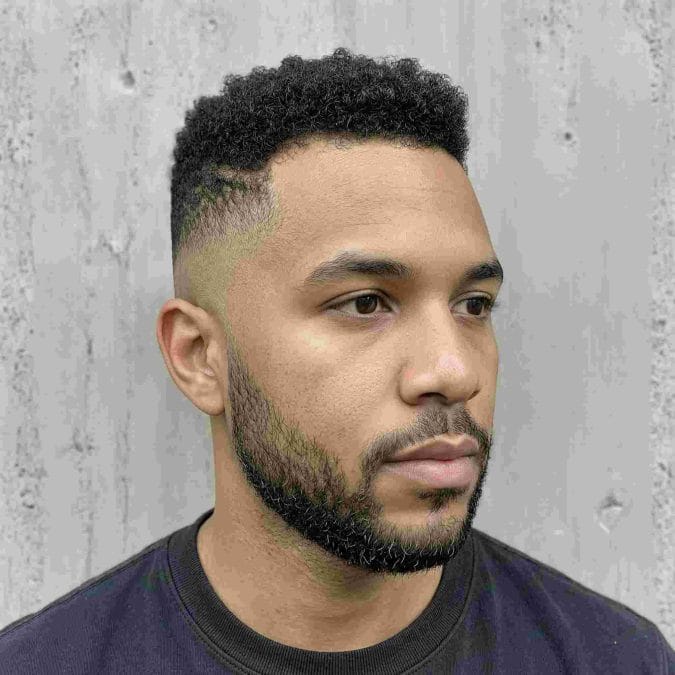
A short Afro taper preserves coily texture while creating a balanced outline. Keep 1 to 2 inches on top. Avoid aggressive lineups around receding temples. The 20 Haircut Ideas for Black Men: Fresh, Clean, and Modern Styles covers Afro tapers, fades, waves, twists, and braids.

A clean-shaven head removes contrast when advanced thinning leaves little top coverage. It suits widespread loss and exposed crowns. Regular shaving, moisturizer, and sunscreen protect the scalp.
The best haircut matches hair texture, strand thickness, and remaining density. One common classification defines fine hair as strands below 60 microns in diameter.
Straight or fine hair suits compact cuts that preserve visible weight and reduce flatness. Textured crops, Caesar cuts, and classic tapers limit visible gaps. Light point-cutting helps prevent stringy ends.
Wavy hair suits cuts that retain 1.5 to 2.5 inches on top. Crew cuts, short quiffs, and side-swept crops use natural bends to create lift.
Curly or coily hair suits short, structured cuts that preserve natural volume. Curly crops, short Afro tapers, and soft fades control side bulk. Keep 1 to 2.5 inches after drying.

The best haircut balances facial proportions, including face length, forehead width, and jaw width. This guide uses 7 common categories: round, oval, square, triangle, oblong, heart, and diamond.
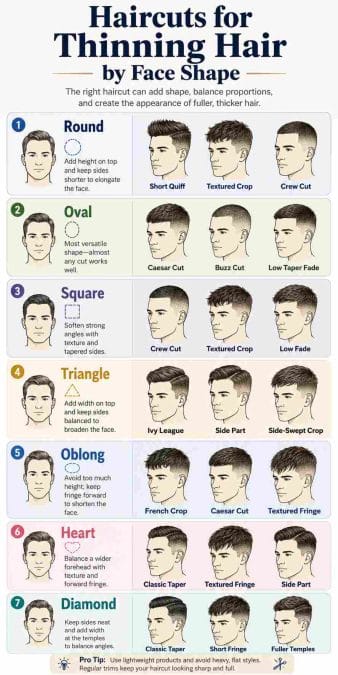
Round faces suit controlled height and shorter sides. Short quiffs, textured crops, and crew cuts can create more visual length. Oval faces suit Caesar cuts, buzz cuts, and low taper fades.
Square faces suit clean cuts that support a broad jawline. Crew cuts, textured crops, and low fades maintain structure. Triangle faces benefit from added temple width through Ivy League cuts, side parts, and side-swept crops.
Oblong faces suit forward fringes and limited top height. Caesar cuts and French crops reduce visible length. Heart and diamond faces benefit from classic tapers, textured fringes, and added temple width.
Short, structured cuts often suit men over 40, 50, and 60 because they reduce contrast and simplify styling.
Early thinning can suit textured crops, crew cuts, and classic tapers at any age. Moderate thinning can suit Caesar cuts, low fades, and buzz cuts. Advanced thinning can suit burr cuts, buzz cuts, and clean-shaven heads.
Hair density, texture, and thinning location matter more than age. 23 Timeless Men’s Haircuts Over 40 for Classic Style compares crew cuts, side parts, and tapers for gray or thinning hair. Matte products reduce shine and may make scalp contrast less noticeable.
Long, flat, or high-contrast haircuts can make thinning hair more visible. Long comb-overs, wet slick-backs, and hard middle parts expose sparse areas. Heavy fringes may also separate across a thin hairline.
High skin fades can highlight a sparse top when little density remains. Heavy layers, razor cuts, and thinning shears remove useful weight. Hairstyles that pull can lead to hair loss when braids, buns, and cornrows create repeated tension.
Tell your barber where thinning appears and request a cut that preserves weight and reduces scalp contrast.
Identify the affected areas, such as the temples, crown, or entire top. Ask for a dry-hair density check before cutting. Request shallow point-cutting only where enough density remains. Avoid thinning shears on sparse sections.
Choose a soft taper or low fade when top density is limited. Bring 3 photos showing the front, side, and crown. Select examples with similar texture, density, and thinning patterns.
Style thinning hair with root lift, lightweight products, and a matte finish to reduce visible scalp. Apply volumizing mousse or tonic to damp roots. Hair loss: Tips for managing recommends gentle combing, lower dryer heat, and limited use of flat irons and curling irons.
Blow-dry upward or against the hair’s normal direction using medium heat. Finish with cool air to help maintain the lift. The 7 Pro Hair Styling Techniques for Men (That Last All Day) explains blow-drying, product layering, and hold control.
Apply conditioner only to longer mid-lengths and ends. The 19 Expert HairCare Tips for Men: Best Hair Care Routine – How to Take Care of Your Hair covers washing, conditioning, drying, and heat protection.

Lightweight products add grip and volume without flattening fine strands. Use volumizing mousse, texture powder, matte clay, or light styling paste. The 10 Must Have Products For Mens Hair: Best Hair Product for Men compares clay, mousse, paste, cream, gel, and pomade.
Apply texture powder near the crown or part. Start with a pea-sized amount of clay or paste. Mousse, texture powder, clay, and paste improve appearance but do not treat hair loss.

Heavy, shiny, or excessive products clump strands and increase scalp visibility. Avoid wet-look gel, heavy pomade, thick wax, and excess hair oil. Flat irons can also flatten roots and expose sparse areas.
A thinning-hair haircut usually keeps its shape with trims every 2 to 6 weeks. The exact schedule depends on cut length, fade height, and preferred sharpness. Anatomy, Hair reports that scalp hair grows about 1 centimeter per month.
Buzz cuts and burr cuts usually retain their shape with trims every 2 to 4 weeks. Crew cuts, textured crops, and low fades often hold their shape for 3 to 5 weeks. Caesar cuts, classic tapers, and short fringes usually last 4 to 6 weeks.
Five common mistakes include keeping excess length, removing weight, creating harsh contrast, cutting too short, and delaying trims.
Long comb-overs and slick-backs expose sparse areas. Heavy layers, razor cuts, and thinning shears remove useful weight from thin sections. High skin fades can highlight a sparse top.
Very short cuts may expose the crown or temples when density is low. Delayed trims create bulky sides and weaken the haircut’s shape.
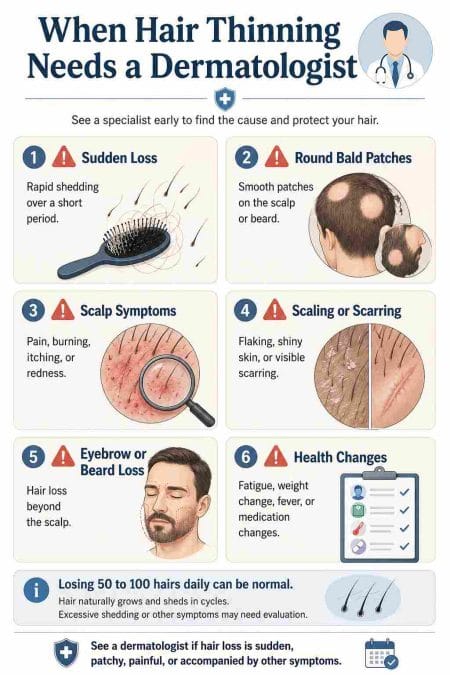
Hair thinning needs medical assessment when loss becomes sudden, patchy, painful, itchy, inflamed, or unusually rapid. The American Academy of Dermatology states that losing 50 to 100 hairs daily is normal.
Book an assessment for round bald patches, scalp burning, redness, scaling, scarring, or broken hairs with irritation. Alopecia areata can cause patchy loss across the scalp, beard, or eyebrows.
High fever, major illness, medication changes, fatigue, or weight changes also require evaluation. Do not stop prescribed medication without speaking with the prescribing clinician. These signs can indicate alopecia areata, scalp infection, inflammatory disease, or excessive shedding.
In conclusion, the best men’s haircuts for thinning hair reduce scalp contrast and preserve visible weight. Short, structured styles like textured crops, crew cuts, Caesar cuts, and buzz cuts create a fuller appearance. The right choice depends on the thinning area, hair texture, face shape, and remaining coverage.
Soft tapers, controlled texture, matte products, and regular trims support a balanced result. Avoid long comb-overs, high skin fades, thinning shears, and heavy styling products. Seek medical advice when hair loss becomes sudden, patchy, painful, or unusually rapid.
Choose 2 suitable styles from this guide and show your barber 3 clear reference photos.
Short hair often makes thinning less visible because it reduces contrast between dense and sparse areas. Buzz cuts, crew cuts, and textured crops also prevent longer strands from separating across the scalp.
A low fade or soft taper can suit thinning hair when enough density remains on top. High skin fades may increase contrast between short sides and a sparse top. The final fade height depends on the thinning pattern and head shape. The 27 Fade Hairstyles for Men: Proven 2026 Picks explains low, mid, high, skin, zero, and shadow fades.
A short textured crop, crew cut, or buzz cut can make crown thinning less noticeable. Shorter lengths reduce gaps between strands and create a more even appearance. Crown growth direction also affects the final result.
A buzz cut suits widespread thinning, while a crew cut suits mild loss with usable top density. Buzz cuts create uniform length. Crew cuts retain extra top length for shape and texture.
Long hair can work when thinning remains mild and evenly distributed. Longer strands may separate and expose the scalp when density drops. Short or medium textured cuts usually provide more controlled coverage.
A buzz cut requires little daily styling, though it may need frequent clipping. Its uniform length creates an even appearance across the scalp. A crew cut provides more shape but requires regular styling and trimming.
Fine hair describes narrow strands, while thinning hair describes reduced density. Men can have fine hair without hair loss. Others may have reduced density with thick strands. Pattern hair loss gradually reduces the number and thickness of visible terminal hairs.
Tell the barber where thinning occurs and request short length, preserved weight, and soft blending. Bring 3 reference photos showing the front, side, and crown. Ask the barber to avoid removing excess weight from sparse areas.
Heavy, shiny products can make thinning clearer by clumping strands together. Lightweight matte products create texture with less visible scalp shine. Apply a small amount after blow-drying for controlled lift.
See a dermatologist when hair loss becomes sudden, patchy, painful, itchy, or unusually rapid. Dermatologists can distinguish pattern loss from excessive shedding, alopecia areata, thyroid disease, nutritional deficiency, and scarring alopecia.


