Physical Address
Islamabad, PK
Physical Address
Islamabad, PK


Medium length hairstyles for men provide enough hair for movement, texture, volume, and flexible styling. For this guide, medium length hair generally means 3 to 6 inches on top.
Popular options include bro flows, curtains, textured crops, pompadours, fringes, layered lobs, and relaxed slick-backs. Styles like bro flows, curtains, and pompadours work differently with straight, wavy, curly, or thinning hair.
The right choice depends on hair density, face shape, natural texture, work setting, and daily styling effort. This guide compares 19 hairstyles, barber requests, styling methods, products, trim schedules, and common mistakes.
Medium length hair for men generally measures 3 to 6 inches on top in this guide. The sides often stay shorter through tapering, fading, or scissor cutting.
This range supports bro flows, curtains, and relaxed slick-backs. Hair measuring 4 to 6 inches may tuck behind the ears. Side length and head shape affect whether it reaches.
According to Physiology, Hair, scalp hair grows about 0.5 inches each month on average. Growing 3 inches from a close buzz cut takes approximately 5 to 6 months. Curly and coily strands can appear shorter after drying because they contract into their natural pattern.

Choose a medium hairstyle by matching 4 factors: hair type, density, face shape, and styling effort. Together, these factors affect volume, balance, movement, and maintenance.


Straight and fine hair suits textured crops, fringes, and layered comb-overs. Controlled layers can reduce side bulk in thick hair. Wavy hair works with bro flows, surfer cuts, and natural flow styles.
18 Men’s Wavy Hairstyles Ideas for a Soft Modern Look compares 18 texture-focused options.

Match the hairstyle’s height and width to the proportions of your face. Added height can visually lengthen round faces. Fringes and wider shapes can reduce visible length on oblong faces.
Soft layers suit square faces. Face-framing movement around the temples can balance heart and diamond shapes.
Natural flow styles require less daily work than pompadours, blowouts, and structured slick-backs. Bro flows and messy layers usually need simple finger shaping. Pompadours and soft blowouts require directional blow-drying.
The 19 best medium length hairstyles for men combine movement, texture, balanced shape, and flexible styling. Most use approximately 2 to 6 inches on top, depending on texture and shape.
These measurements are approximate starting ranges, not fixed haircut standards. Daily styling ranges from basic finger shaping to structured blow-drying.
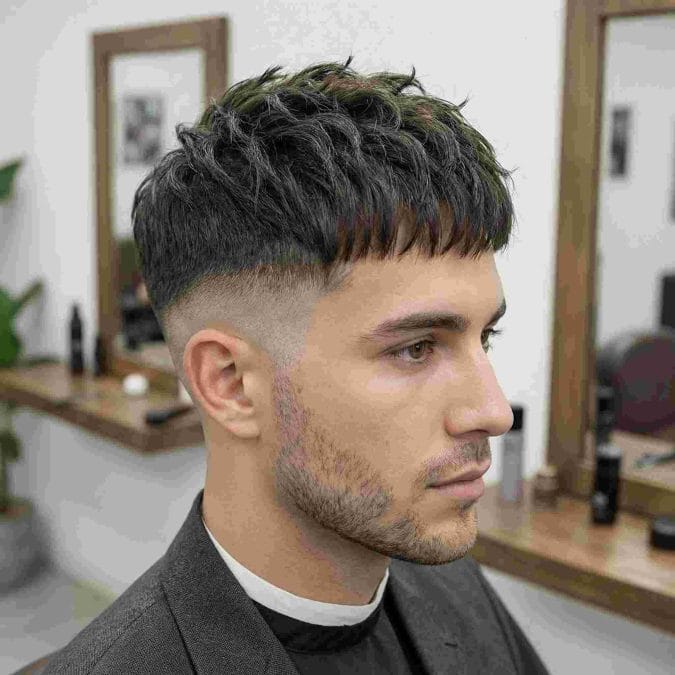
A textured crop uses 2 to 3 inches on top with choppy layers and tapered sides. The separated finish suits straight, wavy, or fine hair.
12 French Crop Hairstyles for Men (Every Face Shape) covers related fringes, textured tops, curls, and faded variations.
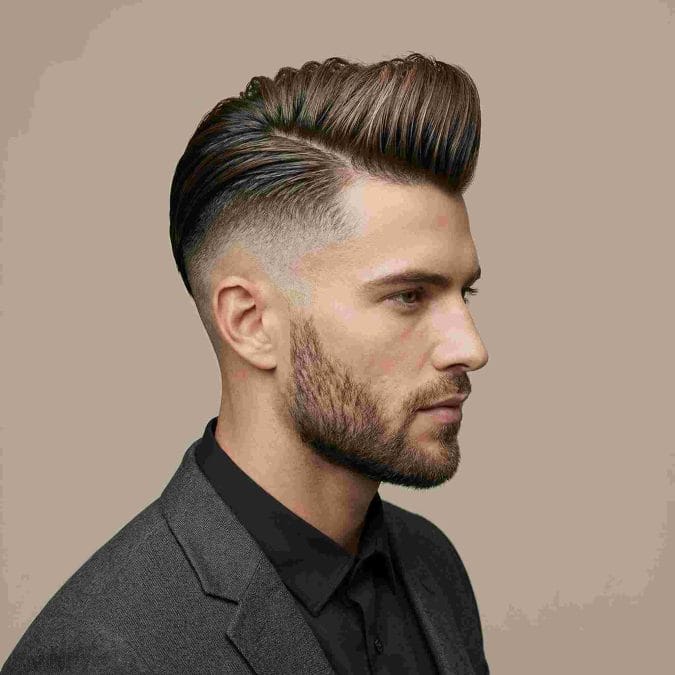
A modern pompadour lifts 3 to 5 inches upward and backward over faded or tapered sides. Thick hair often supports its structured volume.

Side-swept flow directs 4 to 6 inches backward and toward one side. Soft layers help control thick or wavy hair.

Bro flow sweeps medium hair behind the ears with soft, natural movement. A lightweight styling cream can control straight or wavy versions.

A curtain hairstyle divides 4 to 6 inches with a center or off-center part. Its face-framing sections can balance oval, heart, and oblong faces.

A tapered fringe pairs a smooth forward fringe with gradually shortened sides. Forward coverage can reduce visible forehead height and balance longer faces.

A messy layered hairstyle uses choppy layers for controlled texture and movement. This shape suits thick, wavy, and loose-curly hair.

A relaxed pompadour creates lower height and softer movement than a structured pompadour. Scissor-cut or tapered sides maintain balance. A light-hold cream keeps the finish flexible.

A disconnected undercut pairs 4 to 6 inches on top with closely clipped sides. Short sides reduce visible bulk around thick hair.

A surfer hairstyle uses 4 to 6 inches of loose, blended waves. Sea salt spray can add grip. Air-drying preserves the natural wave pattern.

A layered comb-over sweeps 3 to 5 inches across a defined side part. Subtle layers can add visible volume to straight or fine hair.

A casual brush-back directs 3 to 5 inches away from the forehead. Blow-drying and matte clay create soft, controlled volume.

A medium faux hawk raises 2 to 4 inches along the center. Tapered sides and matte clay create height that can lengthen round faces.

A textured fringe falls forward in choppy, separated sections. Uneven layers create movement in straight or wavy hair.

Natural flow follows the hair’s growth direction with minimal forced styling. Styling cream controls frizz in wavy, curly, or coily hair.

A layered lob falls between the chin and shoulders with soft face-framing layers. It suits straight, wavy, and curly hair.
Longer options appear in 15 Epic Long Haircuts for Men in 2026: Styles That Wow for Every Lifestyle.

An updated Caesar uses 2 to 3 inches with a short, blunt-textured fringe. Forward styling can reduce contrast around receding temples.

A soft blowout lifts 3 to 5 inches with airy volume and tapered sides. Mousse, heat protection, and blow-drying shape thick curls or waves.

A relaxed slick-back directs 4 to 6 inches backward without a stiff, wet finish. Styling cream provides controlled movement for formal or office settings.
Medium hairstyles suit each hair type when the cut matches texture, density, curl pattern, and natural growth direction.
Straight and fine hair suits textured crops, layered comb-overs, and updated Caesar cuts. Limited layering preserves the appearance of fuller ends. Lightweight mousse, texture powder, and matte clay add lift without flattening strands.
Wavy and thick hair suits bro flows, surfer hairstyles, and messy layered cuts. Internal layers can remove bulk around the temples, ears, and crown.
Curly and coily hair suits natural flows, soft blowouts, and layered lobs. Extra cutting length accounts for shrinkage after drying. Curl cream and leave-in conditioner support moisture and definition.
The American Academy of Dermatology recommends moisturizing curly hair and avoiding dry brushing in 6 curly hair care tips from dermatologists.
Thin or thinning hair suits textured crops, tapered fringes, and layered comb-overs. Controlled texture improves coverage around the temples, crown, and frontal hairline. Lightweight matte products can reduce shine and visible scalp contrast.
21 Men’s Haircuts for Thinning Hair That Look Fuller compares cuts for temple recession, crown thinning, and diffuse loss.

Medium hairstyles suit each face shape by balancing height, width, forehead size, and jawline shape. The 7 common shapes are oval, round, square, oblong, heart, diamond, and triangle.
Oval faces work with bro flows, curtains, and relaxed slick-backs. Pompadours, faux hawks, and brush-backs can visually lengthen round faces. Side-swept flows, messy layers, and natural waves complement square faces.
Textured fringes, tapered fringes, and Caesar cuts can reduce visible length on oblong faces. Curtains and layered lobs can add jaw-level fullness to heart-shaped faces.
Added temple width can balance diamond-shaped faces. Fuller tops can offset the wider jawline of triangle-shaped faces.
Men over 40, 50, and 60 can use medium styles that preserve fullness and reduce visible recession. Layered comb-overs, brush-backs, textured crops, side parts, short bro flows, and tapered fringes provide controlled shape.
23 Timeless Men’s Haircuts Over 40 for Classic Style covers mature hairlines, gray texture, face shapes, and low-maintenance cuts.
According to Male Androgenetic Alopecia, pattern hair loss affects 30% to 50% of men by age 50. Soft tapers, scissor-cut sides, and matte products can reduce contrast around the temples, crown, and frontal hairline.
Lightweight styling cream can also control dryness and movement in gray or coarse hair.
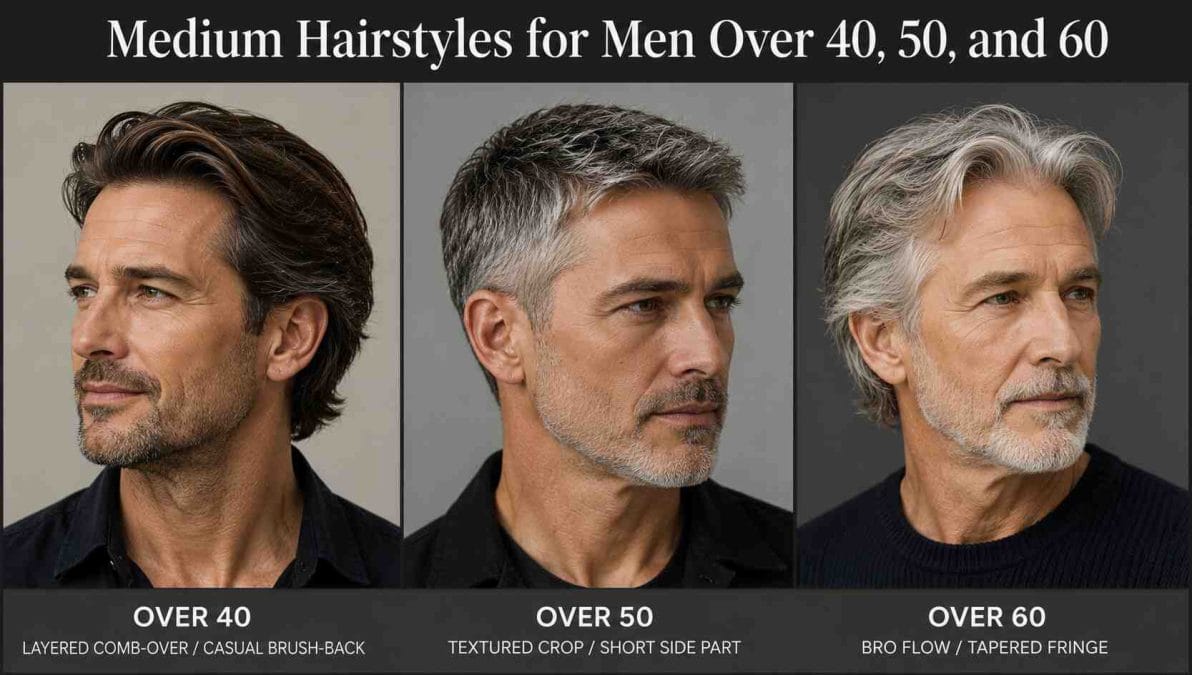
Ask your barber for exact lengths, side treatment, layer placement, styling direction, and neckline shape. Request 3 to 6 inches on top. Then choose scissor-cut sides, a soft taper, or a low fade.
27 Fade Hairstyles for Men: Proven 2026 Picks explains low, mid, high, skin, drop, and burst fade options.
Bring 2 to 3 reference photos showing front, side, and back views. Select images with hair texture and density similar to yours. Explain whether the hair must use a center part, fall forward, or sweep backward.
Discuss light layering for movement or internal weight removal to control thick hair. Finish by stating whether you prefer a natural, matte, or polished result.

Style medium length hair in 4 steps: towel-dry, protect, blow-dry, and apply a finishing product. Use heat protectant before operating a dryer. Sea salt spray or mousse can add texture and volume.
Set the dryer to medium heat and keep it moving. The American Academy of Dermatology explains the risks of repeated high heat in Hair styling without damage.
Use fingers for natural flow, a diffuser for curls, or a round brush for lift. 7 Pro Hair Styling Techniques for Men: Ultimate Guide explains blow-drying, parting, texture control, and product application.
Start with a pea-sized amount of cream, clay, or pomade. Work it from the back toward the fringe.

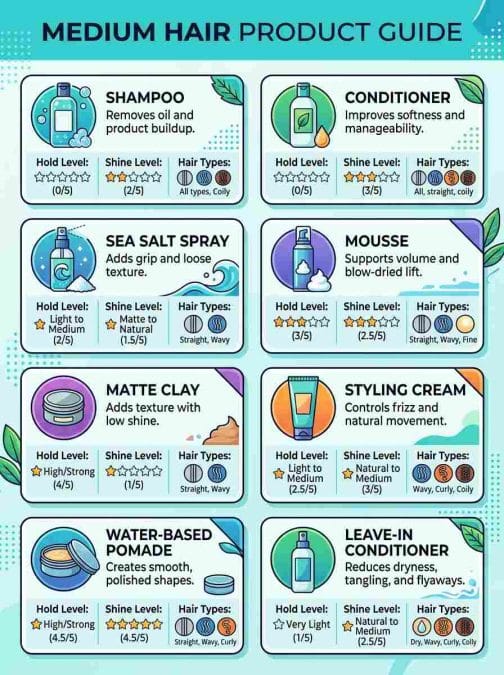
The best products for medium length hair include 5 categories: cleansers, pre-stylers, texturizers, finishers, and moisture treatments. Selection depends on hair texture, density, hold level, and finish, such as matte, natural, or polished.
10 Must Have Products For Mens Hair: Best Hair Product for Men compares pomade, clay, cream, mousse, salt spray, and conditioner.
Use shampoo to remove buildup. Follow with a conditioner matched to your hair texture. Sea salt spray and mousse add lift before blow-drying.
Matte clay, texture paste, and styling powder add grip to crops, fringes, and faux hawks. Styling cream controls thick, wavy, or coarse hair. Water-based pomade smooths side parts, comb-overs, and slick-backs.
Leave-in conditioner and light oil can reduce dryness, tangling, and frizz on longer ends. The American Academy of Dermatology explains these benefits in Dermatologists’ top tips for using leave-in conditioner.
Begin with a pea-sized amount. Add more only when required.
Medium length hair usually needs trimming every 3 to 12 weeks, depending on shape and growth goals. Sharp styles, including skin fades, undercuts, and faux hawks, often need trims every 3 to 4 weeks.
Structured styles, including pompadours, curtains, and textured fringes, often need maintenance every 5 to 8 weeks. Looser styles, including bro flows, layered lobs, and natural flows, can reach 8 to 12 weeks between trims.
Scalp hair grows about 0.5 inches monthly. However, necklines, sideburns, and hair around the ears lose definition sooner.
Six mistakes make medium length hair look untidy: delayed trims, excess product, excessive layering, dry brushing, poor drying, and unprotected heat styling. Long trim gaps can blur necklines, sideburns, and hair around the ears.
Heavy gels, pomades, and waxes can flatten roots or create greasy sections. Excessive layers may make fine or thinning hair appear less dense.
Dry brushing can increase frizz in curls or waves. Frequent high heat without protection can damage strands and increase flyaways.

In conclusion, medium length hairstyles for men offer flexible options for straight, wavy, curly, coily, fine, thick, or thinning hair. Bro flows, curtains, textured crops, pompadours, fringes, and slick-backs provide different levels of movement, volume, and control.
The right cut depends on hair type, density, face shape, styling effort, and work setting. Clear barber instructions, lightweight products, controlled heat, and regular trims help maintain the intended shape.
Most styles keep about 3 to 6 inches on top and require trims every 3 to 12 weeks. Choose 2 to 3 reference photos, match the cut to your natural texture, and discuss the final shape with your barber.
For daily medium length hairstyles inspiration – follow @mensminimal90 on Instagram, @MensMinimal on Youtube and @mensminimal on Pinterest! Join us for endless cute outfit ideas and aesthetic tips.
Medium length hair for men usually measures about 3 to 6 inches on top. The sides and back may remain shorter through tapering or scissor cutting. Curly and coily hair can appear shorter because the strands contract into their natural pattern.
Medium length hairstyles usually require moderate maintenance. Natural styles, including bro flow and curtains, require less daily work than pompadours or slick-backs. Hair texture, layering, and edge sharpness affect styling time and trim frequency.
Bro flow, natural flow, and layered waves are among the easiest medium hairstyles to style. These cuts follow the hair’s natural direction and texture. Styling cream or leave-in conditioner can reduce frizz without creating stiffness.
Thin hair can suit medium length hairstyles when the cut preserves visible fullness and adds controlled texture. Side-swept fringes, textured crops, and short brush-backs can reduce flatness.
Excessive layers, heavy pomade, and long slick-backs may expose more scalp.
A side part, brush-back, or relaxed slick-back creates a controlled style for many office settings. Each option keeps the hair neat while preserving natural movement.
A soft taper and low-shine styling cream create a clean finish without making the hair rigid.
Ask for the exact top length, side length, layer placement, and preferred finish. Explain whether the hair must sweep backward, part at the center, or fall forward.
Bring front, side, and back reference images to clarify the intended shape.
The best product depends on the required hold, texture, and shine. Sea salt spray adds texture, mousse supports volume, and styling cream controls frizz.
Matte clay creates separation. Pomade suits smoother side parts and slick-backs.
Medium length hair usually needs trimming every 3 to 12 weeks, depending on cut structure and growth goals. Sharp fades and undercuts may need trims every 3 to 4 weeks.
Natural flow styles can reach 8 to 12 weeks because they depend less on sharp edges.
Too many layers can reduce visible fullness and create an uneven shape. Fine hair may appear thinner. Thick hair can become wider or harder to control.
Balanced layers remove weight while preserving the haircut’s structure.
Frequent high-temperature styling can cause dryness, breakage, and frizz. The American Academy of Dermatology recommends low or medium heat and reduced heat exposure.
Air-drying when practical also limits repeated thermal damage.


