Physical Address
Islamabad, PK
Physical Address
Islamabad, PK


Learning how to grow long hair for men takes more than simply avoiding haircuts. Your hair needs time to grow, but keeping that new length also matters. New hair may keep growing, but breakage, damage, and unnecessary cutting can reduce the progress you see.
A successful growing-out process starts with realistic expectations and a simple hair-care routine. You do not need unproven shortcuts to make steady progress.
This guide explains what affects your progress, how to care for your hair as it grows, and how to make better decisions along the way.
TL;DR
- Hair grows about 1 cm per month, so growing it long takes patience.
- Protect new length by reducing breakage, heat, friction, and rough handling.
- Follow a simple routine, trim only when needed, and avoid “fast-growth” shortcuts.
- Good nutrition supports normal growth, while unusual shedding or scalp problems may need professional help.
Growing long hair successfully takes time. You also need to keep as much of that new length as possible. Hair care cannot force fast growth. However, reducing breakage, damage, and unnecessary cutting can help you keep more length over time.
New hair grows from follicles in the scalp. The visible strands then become longer over time. Hair growth means producing new length. Length retention means keeping that length without losing too much to breakage or cutting.
Both processes affect how long it takes to reach your goal. Your hair may grow normally at the scalp, but breakage or frequent cutting can remove some of that progress.

Breakage does not slow growth at the follicle. Instead, it removes some of the length you have gained, so your progress may look slower. Repeated damage can weaken the hair shaft and increase breakage over time. Preventing avoidable length loss helps more of your new growth to stay intact.
On average, men’s scalp hair grows about 1 cm per month. That adds up to roughly 12 cm, or about 5 inches per year. Growth varies from person to person. These numbers are better for estimating a timeline than predicting an exact date. (NCBI Bookshelf)
Hair does not grow at the same rate for every man. Age and individual differences can make your monthly growth a little faster or slower than average.
Breakage and trimming can also affect how much length you keep. Because of this, your actual timeline may not match a simple estimate based only on average growth.
Your starting length and your goal determine how much more hair you need to grow. Someone with medium-length hair will usually reach the same target sooner than someone starting with a buzz cut.
You can estimate your timeline by comparing the length you still need with your average monthly growth. Treat this as a rough estimate because the growth rate, breakage, and trims can change the actual timeline.
At about 1 cm of growth per month, 6 months may add roughly 6 cm, or about 2.5 inches, of new length. One year may add around 12 cm, or about 5 inches.
These estimates do not mean your hair will reach your ears, chin, or shoulders by a certain month. Your starting length, the length you keep, and your hair texture can all change how progress looks.

There is no proven method that makes healthy hair grow much faster for everyone. A better approach is to support normal growth and keep as much of that new length as possible.
Good nutrition and overall health support normal hair growth. However, they do not reliably make healthy hair grow faster than its natural rate.
Preventing avoidable breakage helps you keep more of the length your hair naturally grows. It does not make the hair grow faster, but it can improve your overall progress.
Be careful with claims that promise much faster hair growth from supplements, scalp massage, rosemary oil, rice water, or other “growth hacks.” Some of the evidence behind these claims is limited. Other studies may focus on certain hair conditions or measure different results.
Hair thickness, hair density, regrowth, reduced breakage, and faster length growth are different outcomes. A benefit in one area does not prove that hair grows faster. Before trusting a growth claim, check what the study actually measured and who took part. (PubMed evidence review)
A useful hair-growing routine focuses on proper washing, conditioning, gentle handling, and simple scalp care. Adjust your routine to your scalp, hair type, and daily activities. Avoid following a fixed schedule or adding treatments you do not need.
Wash your hair when your scalp becomes oily, sweaty, dirty, or covered with product buildup. There is no single washing schedule that works for every man.
Apply shampoo mainly to the scalp, where oil and buildup collect. You may need to wash more often if your scalp gets oily or sweaty quickly. A drier scalp may need less frequent washing.
The goal is simple: keep your scalp and hair clean without forcing yourself to wash on a fixed schedule.
Use conditioner to make your hair smoother and easier to detangle. Give extra attention to longer sections that become dry or tangled. Work through knots gently instead of forcing a brush or comb through resistance.
A wide-tooth comb can help you detangle your hair with less pulling. Start near the ends and work upward when needed. Adjust the method based on your hair texture and condition.
Good scalp care does not require a long list of oils, exfoliators, massages, or “growth” treatments. Start with regular cleansing that suits your scalp. Avoid aggressive scratching or anything that causes irritation. Persistent scalp problems should not be treated as a normal part of growing long hair.
Preventing damage helps you keep more of the length that you grow. As your hair gets longer, the older sections have already faced more wear. These areas may need extra care to stay in good condition.
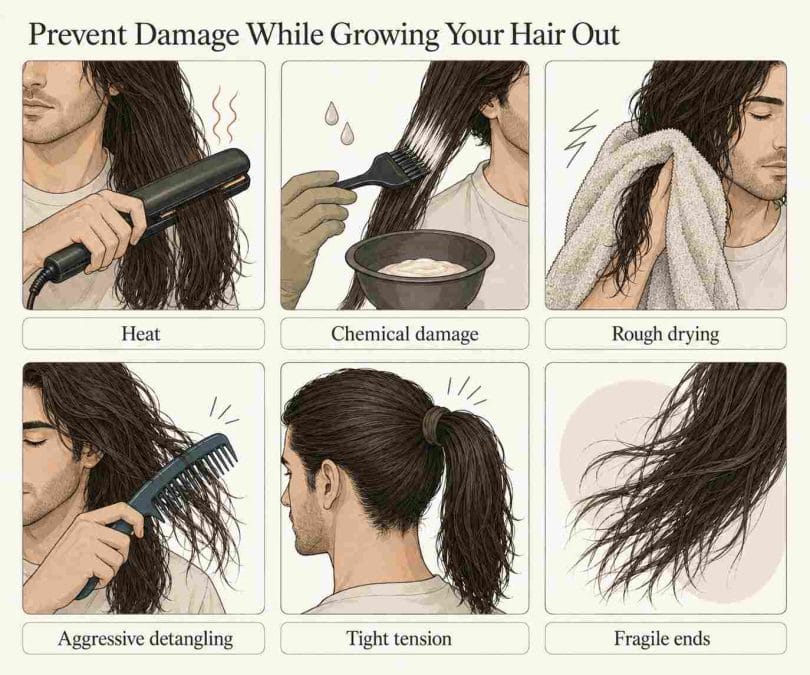
Frequent high heat and chemical processing can weaken the hair shaft. Limit straighteners, high-heat blow-drying, bleaching, and chemical straightening when possible.
When you use heated styling tools, apply a heat protectant and keep the heat as low as practical. Heat protectants can help reduce damage, but they do not make repeated high-heat styling harmless. (American Academy of Dermatology)
Handle your hair gently during washing, drying, and styling. Avoid aggressive towel rubbing, repeated pulling, and unnecessary tension.
Blot or gently squeeze out extra water instead of rubbing the hair roughly. Reducing repeated rubbing and friction helps to limit physical damage over time.
The ends are the oldest part of long hair and have experienced the most cumulative wear. As your hair grows, protect them from repeated friction, tangling, and excessive tension.
Condition dry or tangle-prone lengths and ends, handle them gently, and avoid repeatedly securing tight styles in the same position. Products can temporarily smooth damaged ends and improve manageability, but they cannot permanently repair a split hair shaft.
You can trim your hair while growing it long, but trimming does not make hair grow faster from the scalp. The right approach depends on your hair’s condition and the shape you want. It also depends on whether you want maximum length or a neater look while your hair grows.
A trim can help when the ends are visibly split, frayed, damaged, or difficult to manage. It can also improve an unbalanced growing-out shape without changing the natural growth rate.
Every trim removes some of the length you have gained. Frequent or larger trims can, therefore, make it take longer to reach your target.
A fixed trimming schedule does not work for everyone. How often you trim should depend on your goals. Some men want to keep as much length as possible, while others prefer a cleaner shape during the growing-out stage.
Base your decision on damage, manageability, and your final hair goal, not the calendar. Trim when damaged ends need attention or when the shape becomes difficult to manage.

If maximum length is your priority, keep trims small and avoid cutting healthy new growth without a clear reason. If appearance matters more during the awkward stages, an occasional light trim can improve the shape without removing too much progress.
Awkward stages are a normal part of growing short hair into longer hair. Different parts of your hair may become harder to control as the original haircut loses its shape. The goal is to manage these in-between lengths without repeatedly cutting away your progress.

Hair can become harder to manage when it outgrows your old haircut but has not yet reached your target length or shape. Shorter sections may stick out, while longer areas may fall unevenly. Your old styling routine may also stop working as well.
This does not mean your hair is growing incorrectly. The starting haircut, growth pattern, texture, and differences in section length all affect how the transition looks.
Adapt your styling to the length you have instead of cutting it back whenever the shape becomes difficult. You can change your part, use a small amount of styling product, or tuck longer sections behind your ears. These simple changes can make in-between lengths easier to manage.
Tell your barber that you are growing your hair out before any shaping.
Fades, undercuts, and other short-sided cuts start with uneven lengths. Because of this, the shorter sides and back need more time to grow.
You can let every section grow, or use light shaping from time to time to keep the haircut more balanced. The best choice depends on your target hairstyle and how much temporary unevenness you are comfortable with.
Hair texture, strand thickness, and density affect how your hair looks and how you manage it as it grows. They do not decide how fast everyone’s hair will grow. These differences can affect visible length, shrinkage, tangling, volume, and how easy the hair is to manage.

Curly and coily hair can look shorter because the strands shrink into their natural pattern. This can make progress seem slower than it really is. These textures can also tangle more easily, so gentle handling and consistent progress tracking are especially useful.
Straight hair often shows added length more directly. Stronger wave patterns can make visible length vary. Adjust your care based on your scalp, strand type, and hair density. Also, pay attention to whether your hair becomes oily, dry, flat, or tangled.
Fine and coarse describe how thick each strand is. Hair density means how much hair you have on your scalp. In everyday language, “thick hair” can mean thicker strands, more hair, or both. Fine strands may need gentler handling to reduce damage. Hair with high density can become fuller and harder to control as it grows.
Good nutrition and overall health support normal hair growth. However, they are not a shortcut to making healthy hair grow faster.
Hair is made largely of a protein called keratin. Getting enough protein, therefore, supports normal hair growth. Nutrients such as iron and zinc also help the body maintain normal hair function. A balanced diet provides a good foundation for normal hair growth. Very restrictive diets or nutrient deficiencies can cause problems.
However, getting more nutrients than your body needs is not proven to make healthy hair grow faster. (peer-reviewed vitamin and mineral review)
Supplements such as biotin, iron, or zinc do not boost hair growth for everyone. They are most useful when a real deficiency or specific need has been identified.
Avoid using high-dose supplements as a shortcut for faster growth. When a deficiency is suspected, professional guidance is safer than guessing with supplements.
Tracking your hair helps you see your progress more clearly. It can also help you notice changes that may not be part of normal growth. Because hair changes gradually, comparing progress over time is more useful than checking it every day.
Take progress photos from time to time. Try to use similar lighting, angles, hairstyles, and hair conditions each time. You can also measure the same section from the same starting point.
Use the same measurement method each time. Curl pattern, styling, and stretching can all change how long your hair appears.

Some shedding is normal; however, a clear or lasting change from your usual pattern deserves attention. Watch for unusual shedding, visible thinning, or patchy hair loss. Also, pay attention to ongoing scalp problems such as redness, pain, severe itching, or irritation.
These changes may be caused by more than simply growing your hair long. If they appear suddenly, continue, or get worse, speak with a qualified healthcare professional instead of relying only on changes to your hair care routine. (American Academy of Dermatology)
Many men can grow long hair, but not everyone can grow it to the same length. Genetics and the hair-growth cycle affect how long your hair can keep growing. Breakage and hair care affect how much of that length you keep.
It depends on your starting haircut and target style. Growing everything keeps the most length. Light shaping can help balance faded sides, an undercut, or other shorter sections.
You can tie your hair back once enough of it reaches the tie without being pulled tightly. The timing varies with your starting haircut, texture, and growth pattern. Do not force shorter sections into a tight style. Repeated pulling can put extra stress on the hair.
Normal hat use does not prevent hair from growing from the follicles. However, very tight headwear or repeated rubbing may irritate the scalp or damage the hair strands. A comfortable fit is more important than avoiding hats while growing your hair.
Your hair may seem to stop growing for several reasons. Progress may be hard to notice; breakage may remove new length, or your growth cycle may limit how long the hair can grow. Track your progress consistently. Seek professional help if you notice thinning, patchy hair loss, unusual shedding, or ongoing scalp problems.


