Physical Address
Islamabad, PK
Physical Address
Islamabad, PK

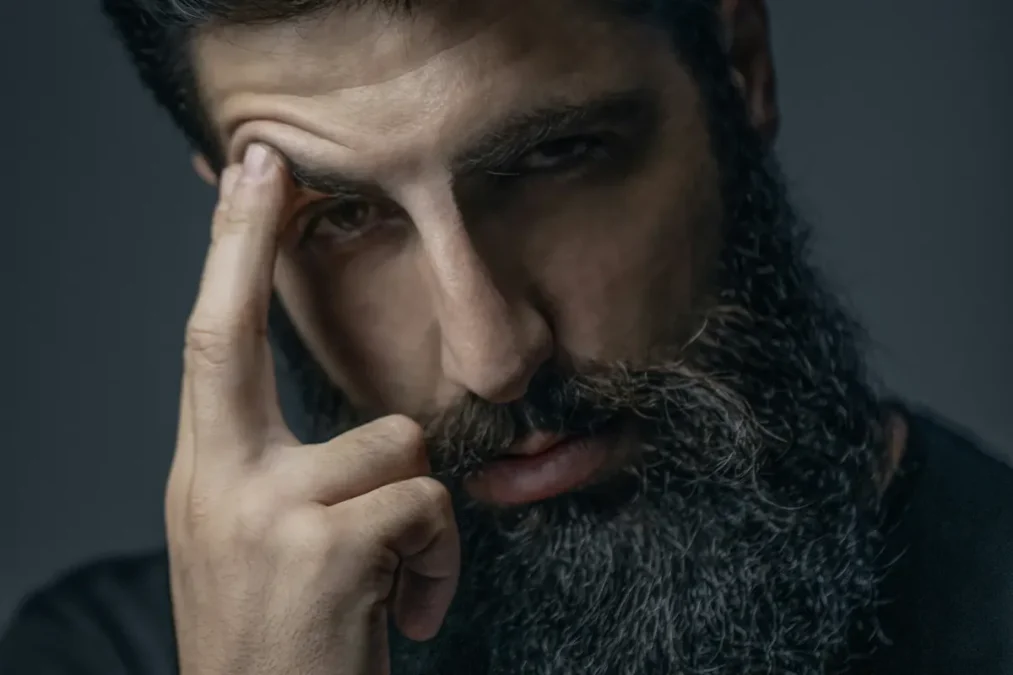
A beard changes how a face reads. The same beard can look tidy on one face and heavy on another. The difference is often shape, not effort. A beard that balances your face makes the whole look read as planned. A beard that fights your face can make a good beard look wrong.
This guide matches beard styles to face shape. It covers beards only. For beard basics — growing, washing, shaping, and shaving the edges — see our beard and shaving basics guide. For haircut matching by face shape, see our haircuts by face shape guide. What follows is the beard catalogue only: 7 face shapes, and the styles that tend to suit each one.
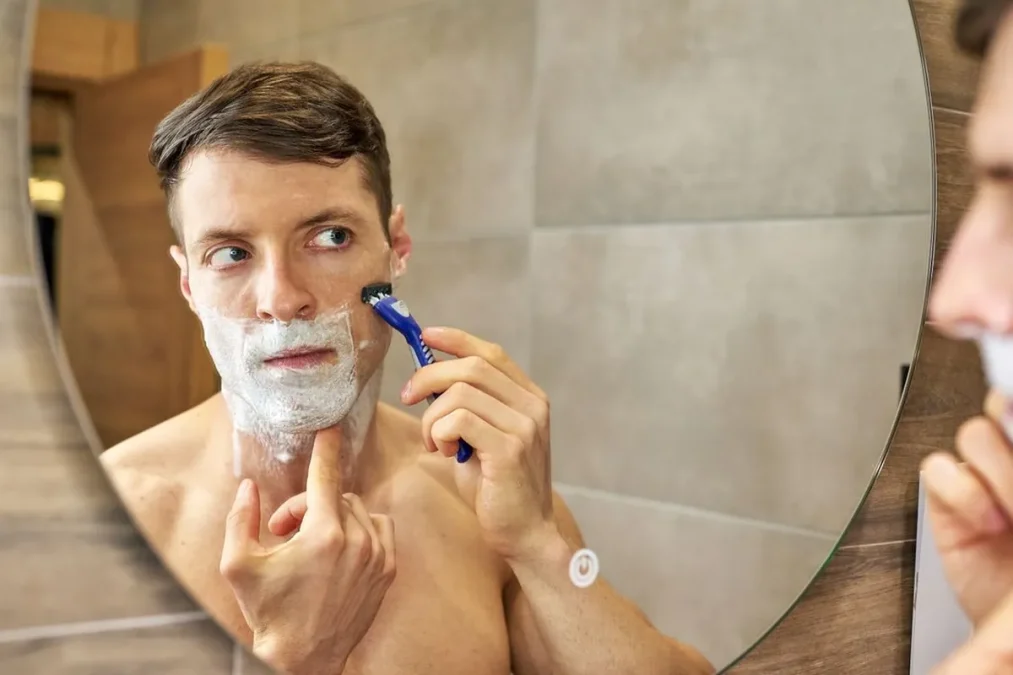
Start with a mirror. Pull your hair back so your full face shows. Look straight on, not at an angle. Then ask four plain questions.
First, is your face longer than it is wide, about equal, or wider than it is long? Second, where is it widest — at the forehead, at the cheekbones, or at the jaw? Third, is your jaw soft and rounded, or sharp with clear corners? Fourth, is your chin round or pointed?
Those four answers point to a shape. No tape measure is needed for this guide, and no number confirms a shape. The comparisons are enough. If two shapes seem to fit, pick the closer one. That is normal. Most faces sit between shapes, and the guide is built for that.
The balancing idea runs through every shape below. A beard adds shape where you put it. Length at the chin stretches a face down. Fullness at the sides widens a face out. A rounded outline softens sharp angles. Weight low, at the jaw and chin, balances a wide top. Each shape section uses that idea in its own terms. Nothing here is a rule. Every line below is a tendency, stated with “tends to” and “can” on purpose, because faces and beards both vary.
Read the shape that matches you, or read all seven and pick the closest one.
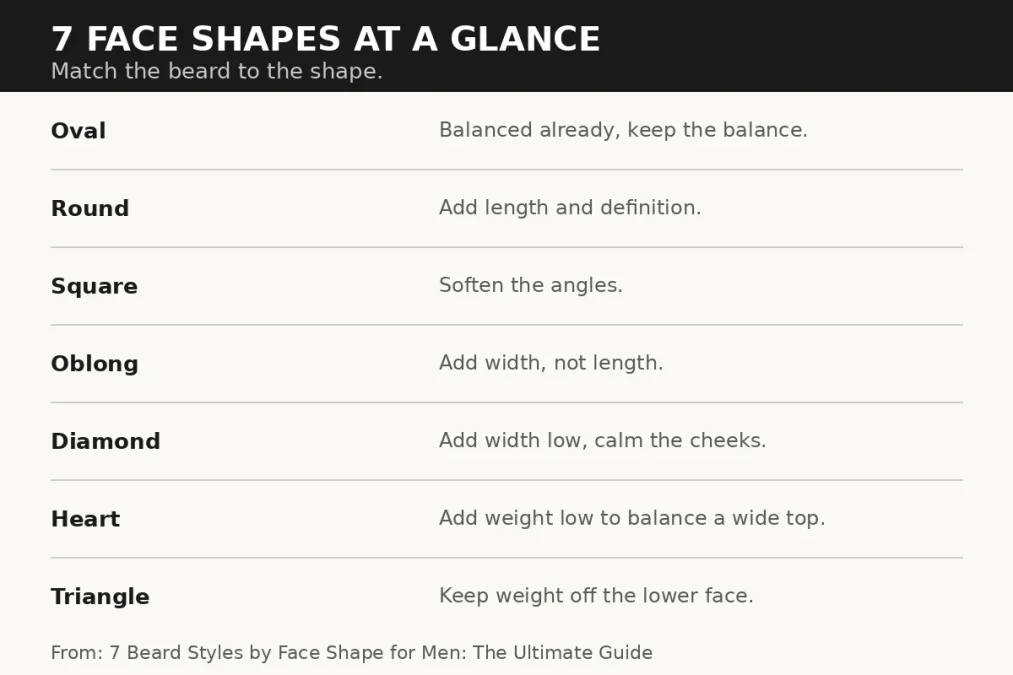
An oval face is longer than it is wide. The forehead is a little wider than the jaw. The jaw rounds off softly. No single feature stands out. The whole face looks balanced.
Keep the balance. Nothing needs fixing here. The beard should not push the face in any one direction.
Most styles suit an oval face. A short boxed beard keeps things clean and neat. A full beard adds a strong, full look without fighting the shape. Stubble adds light texture and shape with little upkeep. A circle beard — a moustache joined to a rounded beard around the mouth — also tends to work well.
Very long length at the chin can stretch the balance into a longer look. That is the main thing to watch. If you want length, keep the sides tidy so the face does not narrow too much.
“I have an oval face, so most styles work. I want a short boxed beard with a clean outline. Keep the length even, and do not let the chin run long.”
A round face is about as wide as it is long. The cheeks are full and are often the widest point. The jaw is soft, with no sharp corners. The chin is short and rounded.
Add length and definition. The beard should stretch the face down a little and give the jaw a clearer line.
An extended goatee — a goatee that runs wider than the mouth, with the cheeks kept short — tends to suit a round face well. A Van Dyke, a pointed chin beard worn with a separate moustache, adds a clear vertical line. An anchor beard, shaped like an anchor around the mouth and chin, adds the same kind of length. A short boxed beard can also work, if the sides are kept tight and the length sits at the chin.
Wide, bushy volume at the cheeks tends to widen the look further. That is the opposite of the goal here. A full, round beard that matches the cheek curve can make the face look rounder still.
“I have a round face, so I want length at the chin and short sides — an extended goatee. Please do not add width at the cheeks.”
A square face has a forehead, cheeks, and jaw close in width. The jaw has sharp corners. The whole face looks strong and even.
Soften the angles without hiding the jaw. The beard should round the outline a little, not repeat the box.
A full beard with rounded corners tends to suit a square face well. The round outline softens the jaw while the jaw itself still shows. A circle beard also works: its round shape draws the eye to the centre of the face. A short beard with tapered sides — shorter at the sides, a little fuller at the chin — keeps the look clean and less boxy.
Hard, boxy lines tend to repeat the squareness of the jaw. A very short, sharply squared beard can make the face look more box-like, not less. The same goes for sharp corners left hard at the jaw.
“I have a square face, so I want soft, rounded corners — a full beard with rounded edges. Please do not leave the outline hard and boxy.”
An oblong face is clearly longer than it is wide. The forehead, cheeks, and jaw sit close in width, and the length runs from hairline to chin. The jaw may be soft, as in an oval face, or sharp, as in a square face — length is the main sign either way.
Add width, not length. The beard should widen the face out, not stretch it down further.
A full beard with side fullness and a shorter chin tends to suit a long face well. The sides add width, and the short chin stops the length growing further. A short boxed beard works the same way in a neater form. A beardstache — a strong moustache with shorter beard or stubble on the cheeks — balances length by putting weight higher and wider. For the bold, mutton chops add clear width at the sides.
Long, pointed chin styles tend to stretch the face further. A narrow goatee does the same. Both add length where length is already the main feature, so both are the styles to approach with care here.
“I have a long face, so I want width on the sides and a shorter chin — a full beard with side fullness. Please do not let the chin run long or pointed.”
A diamond face has cheekbones as its widest point. The forehead is narrower than the cheekbones, and the jaw is narrower too. The chin is often pointed. The face narrows at both ends and widens in the middle.
Add width low and calm the cheeks. The beard should fill out the jaw and chin a little, so the lower face balances the wide cheekbones, without adding more width in the middle.
A short full beard carried a little fuller at the jaw and chin tends to suit a diamond face well. The low fullness balances the cheekbones. A chin strap — a narrow band of beard along the jawline — can also work, by giving the jaw a clear line. An extended goatee with some width adds weight at the chin without narrowing to a point.
Narrow, pointed chin styles tend to stress the taper of the face: they make the chin look narrower still against wide cheekbones. Heavy volume at the cheeks tends to widen the middle further, which is also the opposite of the goal.
“I have a diamond face, so I want fullness at the jaw and chin and tight sides — a short full beard, fuller low. Please do not leave the chin pointed or the cheeks heavy.”
A heart face is wider at the forehead than at the jaw. The chin is narrow and often pointed. The top of the face holds the width, and the bottom narrows away from it.
Add weight low. The beard should give the lower face a stronger base, so the narrow chin balances the wider forehead.
A medium full beard with mass at the chin tends to suit a heart face well. A full beard with fullness at the jaw does the same job in a fuller form. A goatee with some width can also work, by putting clear weight at the chin. In each case, the point is the same: the lower face gains presence.
Bare-chin styles tend to leave the chin looking smaller still, because nothing balances the wide top. Very thin, sculpted styles do the same. They take weight away from exactly the place that needs it.
“I have a heart face, so I want weight low — a medium full beard with mass at the chin. Please do not leave the chin bare or thin.”
A triangle face is the reverse of a heart face. The forehead is narrower than the jaw, and the jaw is the widest point. The face gains width as it goes down.
Keep weight off the lower face and avoid a pointed chin. The beard should not add more mass where the face is already widest.
A short boxed beard tends to suit a triangle face well: it is tidy, even, and does not pile weight low. Stubble with a tidy outline works the same way, adding light shape without bulk. A circle beard kept short can also work, by keeping the beard close to the mouth rather than wide at the jaw.
Long, pointed chin styles tend to add more weight low and draw the eye down to the widest part. Heavy, full volume at the jaw does the same. Both push the balance further in the direction the face already leans.
“I have a triangle face, so I want a tidy, even shape without heavy weight low — a short boxed beard. Please do not let the chin run long or the jaw run heavy.”
If you sit between two shapes, use both goals together. A face that is round and square, for example, may want a little length and a little softness. Pick the closer shape as the main guide, borrow the second shape’s goal where it fits, and let taste decide the rest. A barber can read your shape at a glance and confirm the closest match. That glance is often more useful than a long self-check.
Patchy growth changes the choice in a plain way. Shorter, more defined shapes tend to read tidier on patchy growth than long, full styles, because long styles show gaps more plainly. A short boxed beard or tidy stubble often looks better on uneven growth than a long full beard does. This guide makes no claim about growing hair or treating patchiness, and no product is named for it. If a spot stays thin, a shorter shape is the honest option, not a fix.
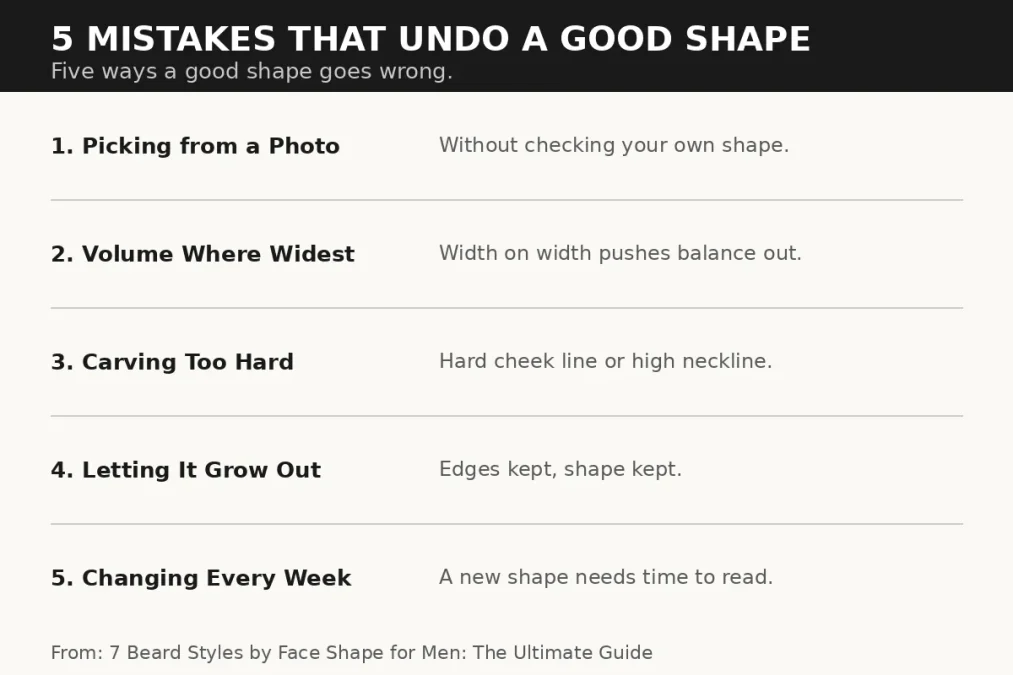
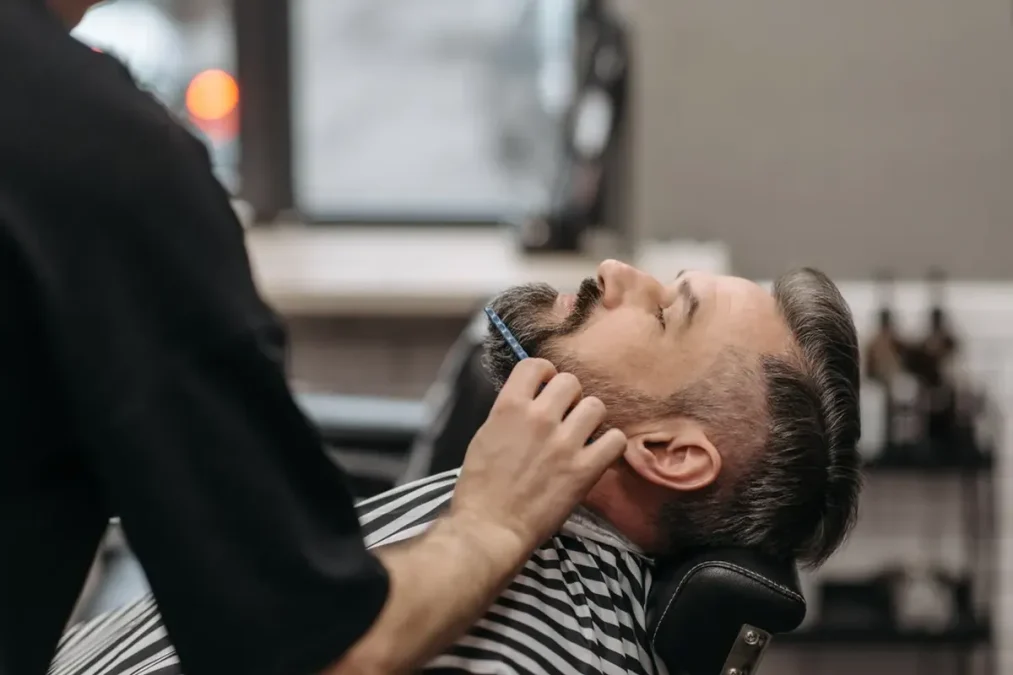
A beard shape is kept, not set once. Tidy it when the shape grows out of shape, not on a fixed date. Short outlines show growth sooner than long ones, so they need a tidy-up sooner. Check the outline in a mirror from the front and from each side. A shape that looks even from the front can look uneven from the side.
For the basics of shaping and washing, see our beard and shaving basics guide. For the schedule system itself, see our guide to haircut maintenance schedules. For guard detail, see our guide to hair clipper guard sizes. None of that detail is repeated here, because it already lives in those guides.
For general hair-care guidance, see the American Academy of Dermatology’s tips for healthy hair.
A good beard shape starts with good words. Say the shape, then the goal, then the style, then what not to cut. The script below is written to be spoken, not memorised. Use the parts that fit your face, and leave the rest.
Start with the shape and the goal in one line: “I have a round face, so I want length at the chin.” Or: “I have a long face, so I want width on the sides.” Or: “I have a square face, so I want soft, rounded corners.” The goal line tells the barber what the beard is for, not just what it looks like.
Then name the style: “an extended goatee,” “a short boxed beard,” “a full beard with side fullness.” A style name plus a goal line leaves little room for misunderstanding.
The exclusions matter as much as the request. Say them plainly: “do not add width at the cheeks,” “do not let the chin run long,” “do not leave the outline hard and boxy.” A barber who hears the exclusion will not add the detail to be helpful, and you will not discover it in the mirror at home.
Ask the question plainly: “How do I keep this shape at home between visits?” A good barber will show you the outline and tell you which tool category to use for it. That answer is worth more than the cut itself, because the cut lasts a day and the upkeep lasts until the next visit.
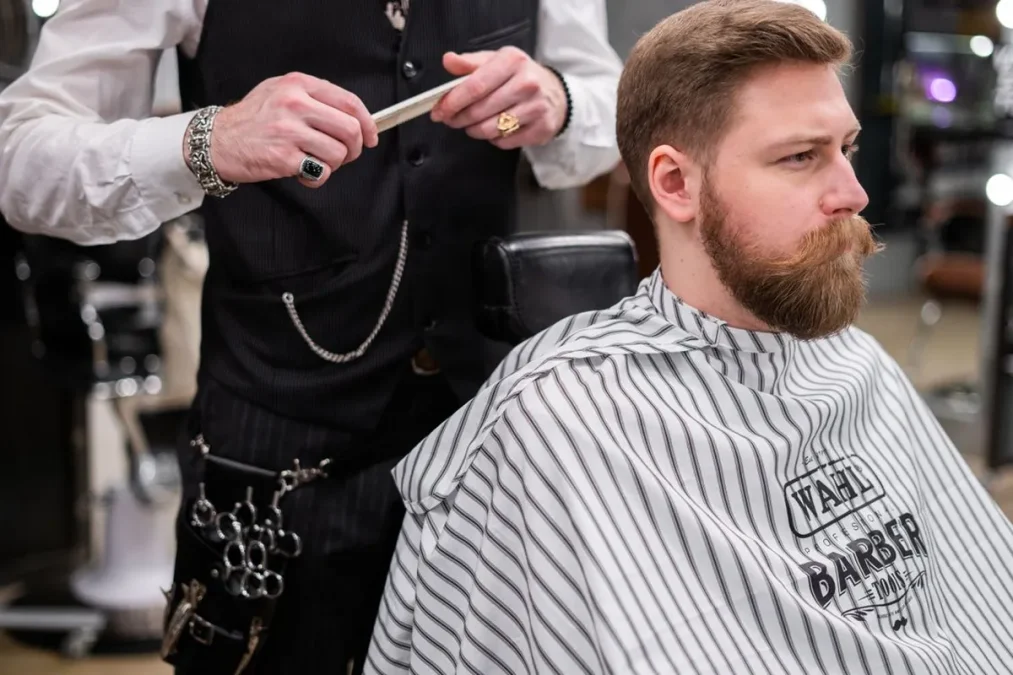
For the broader picture of haircuts, see our men’s haircuts guide. For beard basics, see our beard and shaving basics guide. For haircut matching by face shape, see our haircuts by face shape guide. For general grooming beyond beards, see our grooming essentials guide. The skincare routine guide is next in the queue and will cover skin care in full.
A beard that fits your face shape is not about following a rule. It is about balance: length for a round face, width for a long face, softness for a square face, weight low for a narrow chin, and a tidy, even shape where the face is already wide low. An oval face can wear most styles. Every other shape has a short list that tends to suit it and a short list to approach with care. Pick the closest shape, say the goal and the style to your barber in plain words, and keep the shape tidy between visits. That is the whole system.
Pull your hair back and look straight into a mirror. Compare length with width, find the widest point of your face, and check whether your jaw is soft or sharp and whether your chin is round or pointed. Those comparisons point to one of the 7 shapes in this guide. No measurements are needed, and no shape needs a number to confirm it.
Most styles suit an oval face, because it is already balanced. A short boxed beard, a full beard, stubble, or a circle beard all tend to work. The main thing to watch is very long chin length, which can stretch the balance into a longer look. With an oval face, taste and upkeep time matter more than shape rules.
A style that adds length at the chin with short sides tends to suit a round face: an extended goatee, a Van Dyke, an anchor beard, or a short boxed beard kept tight on the sides. Wide, bushy volume at the cheeks tends to widen the look further, so that is the style family to approach with care.
A style with softer, rounded outlines tends to suit a square face: a full beard with rounded corners, a circle beard, or a short beard with tapered sides. Hard, boxy lines tend to repeat the squareness of the jaw, so they are the ones to approach with care. The goal is to soften the angles without hiding a strong jaw.
A style that adds width, not length, tends to suit a long face: a full beard with side fullness and a shorter chin, a short boxed beard, or a beardstache. Long, pointed chin styles and narrow goatees tend to stretch the face further, so they are the ones to approach with care.
Pick the closest match and use it as a starting point, not a rule. Many faces sit between shapes. You can borrow the goal from each of the two shapes — for example, a little length and a little softness — and let taste and upkeep time decide the rest. A barber can also read your shape at a glance and confirm the closest match.
In general terms, yes: shorter, more defined shapes tend to read tidier on patchy growth than long, full styles, because long styles show gaps more plainly. This guide makes no claim about growing hair or treating patchiness, and no product is named for it. If a spot stays thin, a shorter shape is the honest option, not a fix.
Say the shape and the goal in plain words, then the style, then what not to cut. For example: “I have a round face, so I want length at the chin and short sides — an extended goatee — and please do not add width at the cheeks.” Then ask how to keep that shape at home between visits. The barber script section gives the full wording.