Physical Address
Islamabad, PK
Physical Address
Islamabad, PK

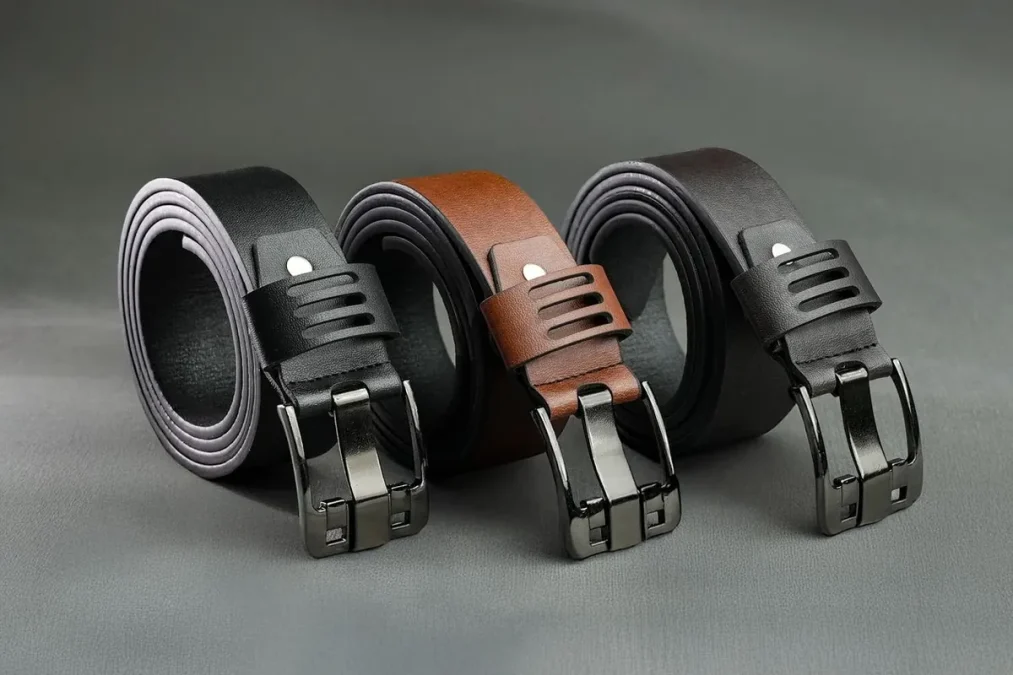
A belt is a small thing, but it is the thing that finishes an outfit. It holds your trousers up, it fills the belt loops, and it ties the shoes to the rest of what you wear. Most men own one or two belts and wear them with everything. That works, until it does not. A wide casual belt with a suit looks off, and a narrow dress belt with jeans looks off too.
This guide gives you thirteen plain belt styles for every outfit: what each one is, when to wear it, how it should fit, and how to match it to your shoes. It also explains what a belt is made of, how a belt should fit, what to avoid, and a simple routine that puts it all together.
You do not need a drawer full of belts. You need to know the thirteen styles, pick the right one for the outfit, and match it to your shoes. That is what this guide is for.
A belt is a strap worn around the waist. It holds trousers up and finishes an outfit. It is a simple thing, and it has four plain parts.
The strap is the long band that goes around your waist. It is the part you see most. The buckle is the metal piece at the front that fastens the belt. The holes are where the buckle pin goes. They are how you set the fit. The tip is the end of the strap, the part that goes past the buckle.
That is all a belt is: a strap, a buckle, holes, and a tip. The thirteen styles in this guide are just thirteen ways of putting those four parts together: different materials, different widths, different buckles, for different outfits.
For a broader background on belts, see the Wikipedia article on Belt (clothing).
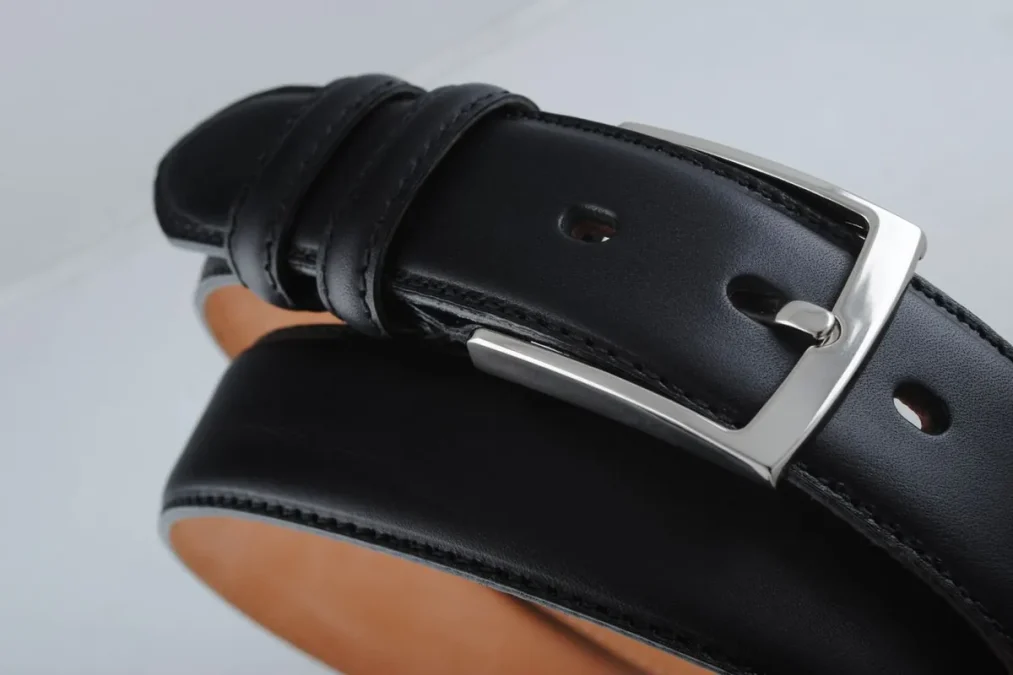
A belt should fit so the buckle pin goes into a middle hole. Not the first hole, and not the last hole. A belt that fits has room on both sides, and the tip ends a short way past the buckle.
If the pin goes into the first hole, the belt is too long. If it goes into the last hole, the belt is too tight. Either way, the belt does not fit, and a belt that does not fit pulls the outfit out of shape.
One thing to know: trousers that fit well at the waist do not need a belt to stay up. The belt finishes the outfit, it does not do all the work. If your trousers fall down without a belt, the trousers do not fit. A tighter belt is not the fix.
“The details are not the details. They make the design.”
Charles Eames, quoted in An Eames Primer (2001)
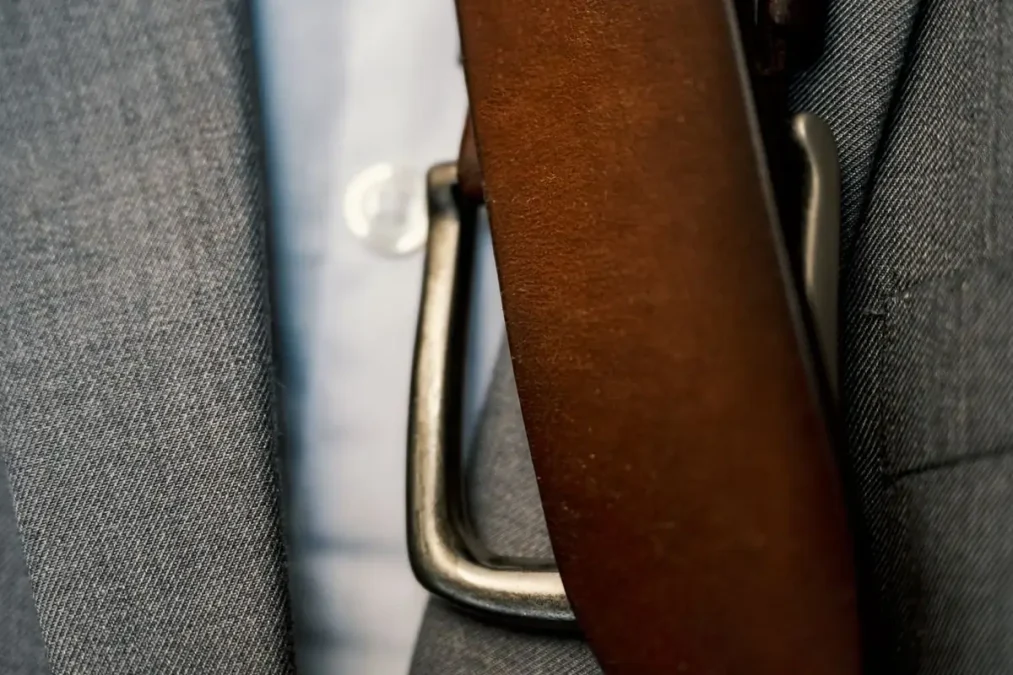
This is the belt for formal trousers and suits. It finishes a formal outfit without adding anything to it. The buckle is small and plain on purpose: a big, bold buckle would fight with the suit.
Wear it with a suit or formal trousers, matched to dark leather shoes as a tendency. If the shoes are black, the belt is black. If the shoes are dark brown, the belt is dark brown. The dress belt is not the belt for jeans. It is too narrow and too plain for them.
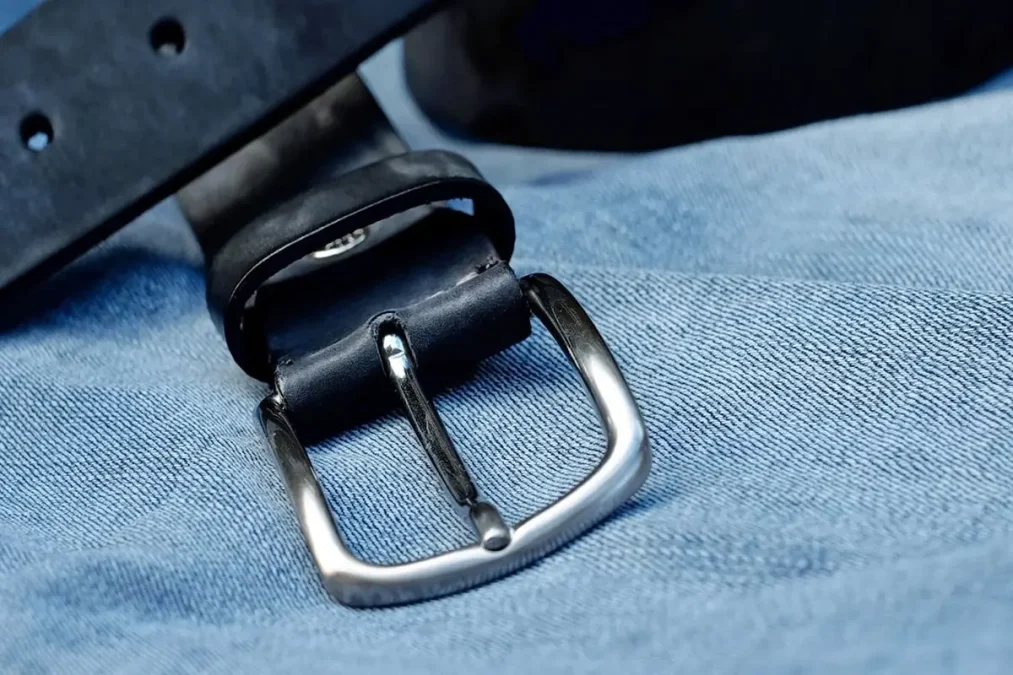
A casual leather belt is a thicker, softer leather belt with a bigger buckle. It tends to be wider than a dress belt, and it looks like what it is: an everyday belt.
This is the belt for jeans and casual trousers. It is the one most men wear most days. The thicker leather and the bigger buckle suit the weight of jeans. A thin dress belt would look lost next to them.
Wear it with jeans or casual trousers, matched to the shoes as a tendency. Brown leather with brown shoes, dark leather with dark shoes. If you own only one belt, this is the one to own first. It covers the most days.
A woven belt is made of strands woven together, often in leather or fabric. It stretches a little, and it has no fixed holes. The buckle pin goes between the strands, wherever it lands.
This is a casual belt, and it suits warm weather and relaxed outfits as a tendency. It is the belt for a linen shirt, light trousers, or a warm day out. The woven look is relaxed by nature. It is not a formal belt.
Wear it with casual outfits. The stretch means it fits in many places, and the lack of fixed holes means it always sits just right. It is a good belt for a day when you want comfort and ease.
A canvas belt is made of strong cloth. It is light and casual, often with a simple metal buckle, and it is the lightest belt of the thirteen.
This is the belt for warm days and casual outfits. It suits shorts and light trousers, and it is the belt to reach for when leather feels too heavy for the day. The cloth is strong, so it holds its shape, and the buckle is simple on purpose.
Wear it with casual trousers or shorts, in warm weather, as a tendency. It is not a belt for a suit or a formal outfit. It is a casual belt, and it looks best where casual belongs.
A suede belt is made of soft, brushed leather with a dull finish. It looks softer than smooth leather, and it feels soft to the touch.
This is the belt that sits between dress and casual. It softens an outfit. It is less sharp than a smooth leather belt, and more put together than a canvas belt. It suits casual and smart-casual outfits as a tendency: a shirt and chinos, a knit and trousers, a relaxed day that still needs to look neat.
Wear it where you want a soft finish. Suede is not a belt for rain or rough use. It is a belt for a calm day. Keep it dry, and it keeps its soft look.
A reversible belt has two sides, usually two different colours. One belt can be worn two ways: flip it over, and it is a different belt.
This is the belt for travel, as a tendency. One belt does the work of two, which means one less thing to pack. Black on one side and brown on the other is the common pair: the side you wear is the side that matches the shoes for the day.
Wear it by flipping it to the side that matches the shoes. It is a plain, practical belt, not a showpiece, but a smart one. If you travel light, this is the belt to pack.
A ratchet belt has no holes. The strap slides through the buckle and locks at many small steps, so the fit can be adjusted in small amounts.
This is a plain, modern belt, and it suits men who want a precise fit as a tendency. There is no middle hole to aim for. You slide the strap until it sits just right, and it locks there. It is worn like any other belt. The only difference is how it fastens.
Wear it like any other belt, in plain and modern styles. If you have ever found that one hole is too loose and the next is too tight, the ratchet belt is the answer to that problem.
A perforated leather belt is a leather belt with holes punched all the way along the strap, not just in a few places. The buckle pin can go through any hole, so the fit can be set in small steps.
This is a belt for days when the usual holes never sit just right. It looks like a plain leather belt, and it suits casual and smart-casual outfits as a tendency: jeans, chinos, a shirt and trousers. The holes all along the strap are the whole point: the belt fits where it lands, not where a few holes allow.
Wear it like a casual leather belt, matched to the shoes as a tendency. It is not a formal belt. The row of holes is a casual detail, so it belongs with casual and smart-casual outfits, not with a suit.
A webbing belt is made of a flat strip of strong woven tape, often nylon. It is light, flat, and strong, and it usually fastens with a slide buckle or rings, not a pin.
This is the belt for active days and warm weather as a tendency. It suits shorts, light trousers, and casual outfits, and it is the belt to reach for when leather feels too heavy or too warm for the day. The flat tape sits close to the body and does not add bulk.
Wear it with casual outfits. It is not a belt for a suit or a formal outfit. It is a plain, practical belt, and it looks best where casual belongs.
A double-ring belt fastens with two metal rings instead of a pin buckle. The strap threads through both rings, then back through one, and the rings hold it in place.
This is a simple, casual belt, and it suits relaxed outfits as a tendency. It has no fixed holes, so the fit can be set anywhere along the strap. It is often made of canvas or webbing, and it is the belt for a day when you want a plain, easy fit.
Wear it with casual trousers or shorts. Pull the strap until it sits just right, and tuck the tip through a belt loop so it stays flat. It is not a formal belt. The rings are a casual fastening, so it belongs with casual outfits.
An elastic stretch belt is made of a stretchy woven band that gives a little as you move. It often has a flat buckle, and it fastens without fixed holes.
This is the belt for comfort as a tendency. It suits long days, travel, and casual outfits, and it is the belt for a day when a stiff belt would dig in. The stretch means it sits flat and moves with you, and there is no pin hole to aim for.
Wear it with casual trousers or jeans. It is not a belt for a suit. The stretch band is a casual thing, so it belongs with casual outfits. If comfort is the first need for the day, this is the belt to reach for.
A western belt is a wide leather belt with a large plate buckle, a flat, shaped buckle that covers the front of the belt. It is the boldest belt in this guide, and it is made to be seen.
This is a casual belt, and it suits jeans as a tendency. It is the belt for a relaxed day with boots or casual shoes, when the belt is part of the outfit, not just a quiet finish. The wide strap and the plate buckle are the whole look: plain leather, a big buckle, nothing else.
Wear it with jeans and casual trousers. It is not a belt for a suit or a formal outfit. The plate buckle is too bold for formal wear. Keep the rest of the outfit plain, and the belt does the rest.
A grommet belt is a leather or fabric belt with metal rings, called grommets, set in a row along the strap. The buckle pin goes through a grommet, and the row of rings is part of the look.
This is a casual belt, and it suits jeans and casual trousers as a tendency. The metal rings give it a tougher, plainer look than a smooth leather belt, and it is the belt for a relaxed day when a plain belt feels too quiet. It is not a formal belt. The rings are a casual detail.
Wear it with jeans or casual trousers, matched to the shoes as a tendency. The rings are metal, so the buckle rule still holds: match the metal to your other metal where you can.
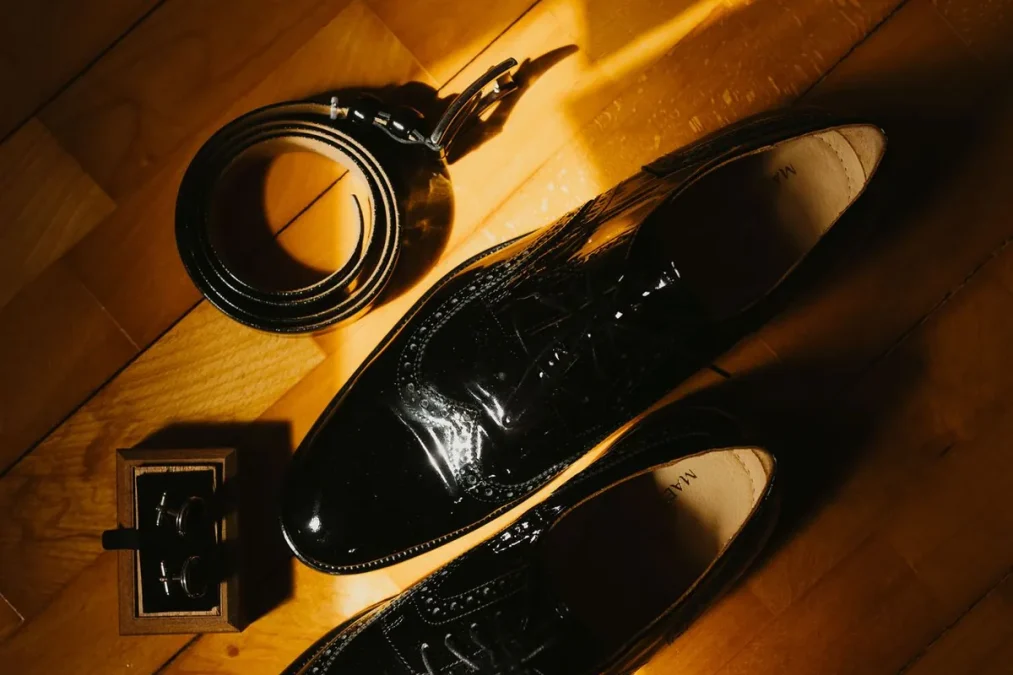
Matching a belt is simple. There are three rules, and they are all plain.
First, match the belt to the shoes. A dark leather belt goes with dark leather shoes. A brown leather belt goes with brown leather shoes, as a tendency. The belt and the shoes do not need to be the same shade, a dark brown belt with medium brown shoes is fine, but they should be in the same family. Black belt with black shoes. Brown belt with brown shoes.
Second, match the buckle metal to your other metal. The watch, the cufflinks, or the ring: the metal of the buckle should match them, as a tendency. Silver buckle with silver. Gold buckle with gold. It is a small detail, and it is the one that makes an outfit look put together.
Third, match the belt to the moment. A dress belt goes with formal trousers and suits. A casual belt goes with jeans and casual trousers. Mixing them, a wide casual belt with a suit, or a narrow dress belt with jeans, tends to look off. The belt should sit at the same level of dress as the rest of the outfit.
Three rules, and that is all: belt to shoes, metal to metal, belt to the moment.
“Fashion is architecture: it is a matter of proportions.”
Coco Chanel, quoted in Coco Chanel: Her Life, Her Secrets (1972)
“Have nothing in your houses that you do not know to be useful, or believe to be beautiful.”
William Morris, “The Beauty of Life” (1880)
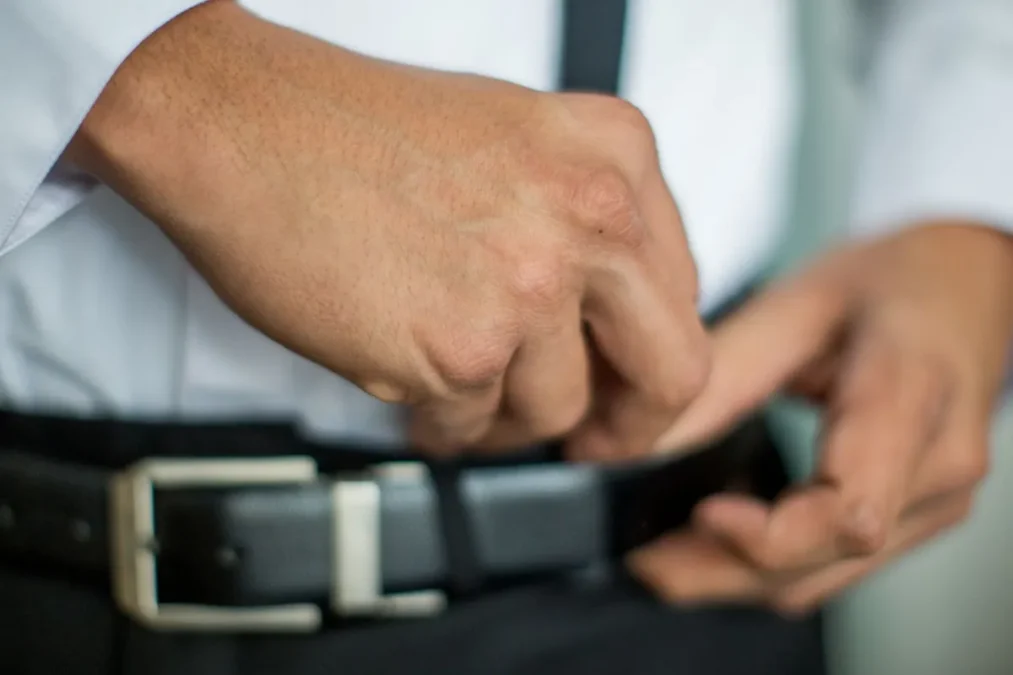
Choose. Pick the belt that fits the outfit: a dress belt for a suit, a casual belt for jeans. If you are not sure, the casual leather belt is the safe pick for most days.
Check. The pin goes into a middle hole, and the tip ends a short way past the buckle. If it does not, the belt does not fit.
Match. Belt to shoes, buckle metal to your other metal. Black with black, brown with brown, silver with silver, gold with gold.
Care. Keep it dry and clean, and hang it or lay it flat so it keeps its shape. A belt that is looked after keeps its shape for years, as a tendency.
Nothing new here. This is the thirteen styles, the fit, and the matching in order, as a habit: choose, check, match, care. Do it the same way each day, and the belt stops being a question.
A belt is a strap with four parts: strap, buckle, holes, tip, and it finishes an outfit. It should fit so the buckle pin goes into a middle hole, with the tip ending a short way past the buckle. The thirteen styles, leather dress belt, casual leather belt, woven belt, canvas belt, suede belt, reversible belt, ratchet belt, perforated leather belt, webbing belt, double-ring belt, elastic stretch belt, western belt, and grommet belt, cover every outfit, from a suit to jeans. Matching is three plain rules: belt to shoes, buckle metal to your other metal, belt to the moment. What to avoid is just as plain: a belt that does not fit, the wrong belt for the moment, a belt that does not match the shoes, and a belt that is wet or out of shape. And the routine is only four steps: choose, check, match, care.
A belt should fit so the buckle pin goes into a middle hole, not the first hole and not the last, as a tendency. The tip ends a short way past the buckle. A belt that fits has room on both sides. This guide gives no fixed sizing numbers, because a belt that fits is judged by the middle hole, not by a number.
A dress belt is a plain, smooth leather belt with a small, simple buckle, and it tends to be narrow. It is the belt for formal trousers and suits. A casual leather belt is thicker and softer, with a bigger buckle, and it tends to be wider. It is the belt for jeans and casual trousers. The two are not the same belt for the same moment. A wide casual belt with a suit, or a narrow dress belt with jeans, tends to look off.
Yes, as a tendency: match the belt to the shoes. A dark leather belt goes with dark leather shoes; a brown leather belt goes with brown leather shoes. The belt and the shoes do not need to be the same shade, but they should be in the same family. This is the plain matching rule, and it is the one to follow first.
Yes, as a tendency: the metal of the buckle should match the other metal you wear: the watch, the cufflinks, or the ring. Silver buckle with silver, gold buckle with gold. It is a small detail, and it is the one that makes an outfit look put together.
Yes, jeans are where the casual leather belt belongs. A thicker, softer leather belt with a bigger buckle is the everyday belt for jeans and casual trousers. A narrow dress belt is the wrong belt for jeans, as a tendency. Pick the casual belt, check the middle hole, and match it to the shoes.
A ratchet belt has no holes. The strap slides through the buckle and locks at many small steps, so the fit can be adjusted in small amounts. It is a plain, modern belt, and it suits men who want a precise fit as a tendency. It is worn like any other belt. The only difference is how it fastens.
Keep it dry and clean, as a tendency. Leather lasts longer when it is kept dry. Do not let it stay wet, and do not bend it out of shape. Hang it or lay it flat so it keeps its shape. A belt that is wet or bent out of shape can lose its shape over time.
Not to hold them up. Trousers that fit well at the waist do not need a belt to stay up. But a belt still finishes an outfit: it fills the belt loops, it matches the shoes, and it makes the outfit look complete. The belt finishes the outfit, it does not do all the work.