Physical Address
Islamabad, PK
Physical Address
Islamabad, PK


A good hat does three simple jobs. It sits well on your head. It suits the weather. And it fits in with the rest of your outfit. When all three are true, you forget you are wearing it. When one is wrong, you feel it all day.
This guide helps you pick a hat by shape, not by brand name. You will learn the parts of a hat, how to check fit, and eleven hat styles in plain words. You will also learn which materials suit which weather, and how to keep a hat in good shape. There are no product picks here, no prices, and no brand advice. This is a guide to choosing, not a shop list.
Every hat in this guide has the same basic parts. Once you know them, it is much easier to tell hats apart and to spot a bad fit.
The crown is the top part of the hat. It covers your head. Some crowns are tall, some are low, some are creased, and some are soft. The crown sets much of the hat’s look.
The brim is the edge that sticks out from the crown. Some brims go all the way round the hat. Others sit at the front only. The brim gives shade, and it shapes how the hat looks on you.
The band is the strip where the crown meets your head. It sets how snug the hat feels. A band that is even all the way round feels good. A band that grips in one spot and hangs loose in another does not.
The lining is the inside layer, where one exists. Not every hat has one. It changes how the hat feels against your head.
The adjustment is how the size is set. Some hats have a strap or a snap at the back. Some have a stretch band. Some have no adjustment at all, and must fit as they are. When a hat has no adjustment, getting the size right matters even more.
These parts matter for fit, not just for looks. A crown that is too tall looks odd. A brim that blocks your sight gets in the way. A band that presses will hurt after an hour. Learn the parts, and you can judge any hat in a few seconds.
For a broader background on hats, see the Wikipedia article on the Hat.
Do these four checks before you decide a hat is yours. They take a few minutes, and they save you from a hat that lives in a cupboard.
First, the sit test. Put the hat on straight and level. It should sit on your head, not tipped back like it is about to fall off, and not pulled low over your eyes. A hat that only looks right when you hold it in place is not the right hat.
Second, the band test. The band should feel snug all the way round. It should not grip hard at one spot and hang loose at another. Take the hat off after a short wear. If it leaves a sore line, it is too tight.
Third, the brim-line test. The brim should sit clear of your eyes. You should see well without tipping your head back or pushing the hat up. A brim that blocks your sight will be pushed up and down all day, and that ruins the look.
Fourth, the wear test. Wear the hat for a short while indoors. Walk around, sit down, and move your head. A hat that slips, presses, or needs fixing all the time will do the same thing all day outside.
Fit beats looks. A hat can look great in your hand and still be wrong on your head. If it slips, presses, or blocks your sight, the size or the shape is wrong, whatever the type name says.
The ability to simplify means to eliminate the unnecessary so that the necessary may speak.
Hans Hofmann, Search for the Real (1948)
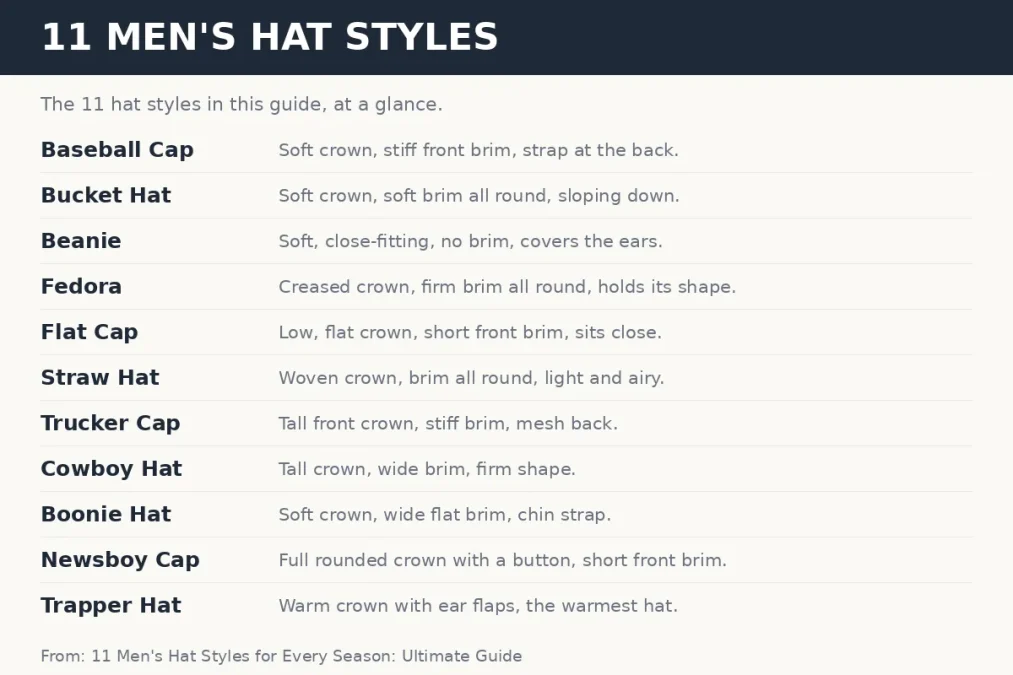
The baseball cap has a soft crown and a stiff brim at the front only. Most have a strap or a snap at the back to set the size.
It sits close on the head. The front brim shades your face from the front. The back adjustment sets how snug it feels, so it is easy to get a decent fit.
It suits warm and mild days, and everyday outdoor wear. It is a plain pick for everyday wear, sport, outdoor days, and casual days out.
Fit note: the brim is the look. If the brim sits too high on your forehead, the cap looks odd. If it sits too low, it blocks your sight. Set it level, and the cap does its job quietly.

The bucket hat has a soft crown and a soft brim that goes all the way round and slopes down. Nothing about it is stiff.
It sits relaxed on the head. The brim shades all round, not just from the front. The soft shape moves with your head, so it feels easy to wear.
It suits warm days, holidays, and outdoor days. It is a casual hat. As a rule, it does not suit a smart occasion, because its soft, sloping shape reads as relaxed.
Fit note: size matters more than it looks. A bucket hat that is too loose slides down over your eyes. One that is too tight loses its relaxed shape and grips your head. It should sit easy and stay put.
The beanie is a soft, close-fitting cap with no brim. You pull it down over your head. Some have a folded cuff at the bottom edge.
It hugs your head and, as a rule, covers your ears. It keeps warmth close to your head, which is why it is the plain pick for cold days.
It suits cool and cold days, everyday winter wear, casual days out, and outdoor days in the cold.
Fit note: the cuff sets the look. A beanie pulled too low hides your face. One worn too high slips off. Find the spot where it covers your ears, stays put, and leaves your face clear.
The fedora has a creased crown and a brim that goes all the way round. It is firmer than a bucket hat, and it holds a clear shape.
It sits on your head with a clear outline. The brim frames your face from all sides. That firm shape is what makes it look smarter than a soft hat.
Felt versions tend to suit mild and cool days. Lighter versions tend to suit warmer days. The material, more than the shape, sets the season.
It suits smart and smart-casual wear, and days out where your outfit is a step up from everyday clothes.
Fit note: the crown crease is the shape. A fedora worn tipped too far back loses its line and looks careless. Wear it level, and the shape does the work.
The flat cap has a low, flat crown that slopes forward, with a short, stiff brim at the front. It sits close and low on your head.
The front brim shades your eyes from the front. The low shape makes it quiet and neat. It does not shout, and that is the point.
It tends to suit mild and cool days. It suits smart-casual wear and everyday wear with a smarter outfit.
Fit note: do not mix it up with a fedora. The flat cap sits lower and flatter, with a front-only brim. The fedora stands taller, with a brim all round. If the brim goes all the way round, it is not a flat cap.
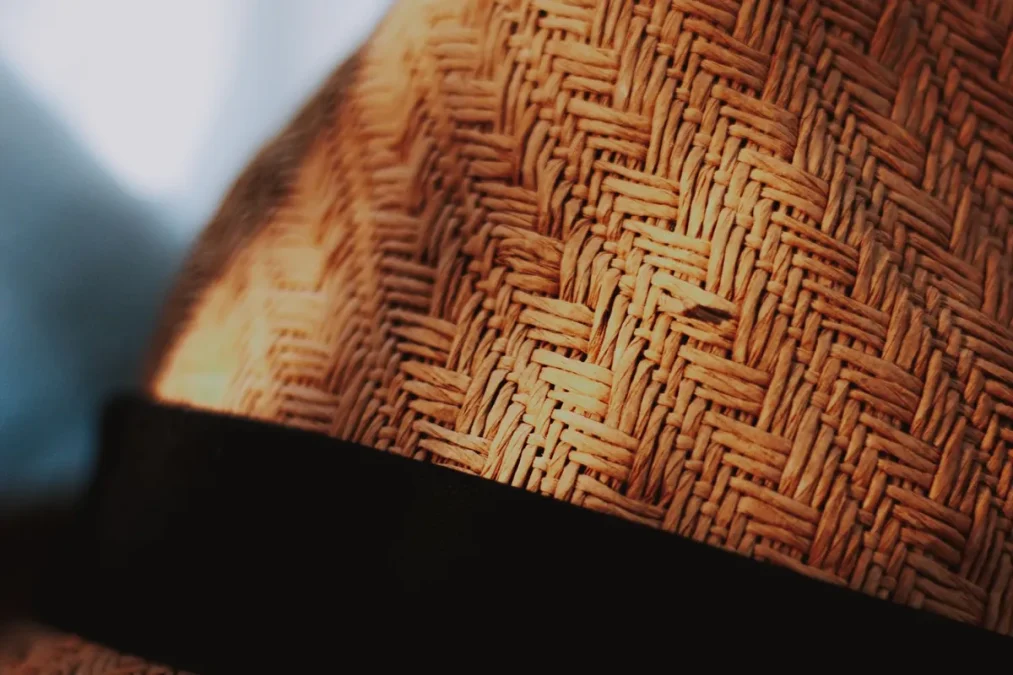
The straw hat has a woven crown and a brim that goes all the way round. It is light in your hand, and air moves through the weave.
It sits light on your head. The brim shades all round. On a hot day, that mix of shade and air is hard to beat.
It suits warm and hot days, holidays, and garden and outdoor days. It is a casual hat, made for days in the sun.
Fit note: straw keeps its shape best when it is not crushed. How you store it matters as much as how it fits. A crushed straw hat looks tired, even if it fits well.
The trucker cap has a taller front crown, a stiff front brim, and a mesh back, often with a snap to set the size.
It sits a little higher and airier than a baseball cap, as a rule. The mesh back lets air through, which helps on a warm day.
It suits warm days, outdoor work, and days out. Like the bucket hat, it is a casual hat, not a smart-occasion hat as a rule.
Fit note: do not mix it up with a baseball cap. The trucker stands taller at the front and has a mesh back. The baseball cap sits lower and is cloth all round. If the back is mesh, it is a trucker.
The cowboy hat has a tall crown and a wide brim that goes all the way round. The brim often curves up at the sides. It is a firm hat that holds a clear shape.
It sits on your head with the wide brim shading your face, neck, and ears from the sun. The tall crown leaves air above your head, so it feels less close than a low cap.
It suits warm and sunny days, and outdoor days. It is a casual hat, made for days outside in the sun.
Fit note: the brim is wide, so it needs room. In a crowd or a low doorway, a wide brim bumps into things. Wear it level, and keep the brim clear of your eyes.
The boonie hat has a soft crown and a wide, flat brim that goes all the way round, with a chin strap to hold it in place. It is soft all over, like a bucket hat, but wider.
It sits relaxed on the head. The wide brim shades all round, and the chin strap keeps it on when the wind blows. It feels easy to wear, and it stays put.
It suits warm days, wet days, and outdoor days. It is a casual hat, made for days outside when the weather turns.
Fit note: do not mix it up with a bucket hat. The boonie has a wider brim and a chin strap. The bucket hat has a narrower, sloping brim and no strap. If it has a chin strap, it is a boonie.
The newsboy cap has a full, rounded crown with a button on top, and a short, stiff brim at the front. It sits fuller and rounder than a flat cap.
The full crown gives it a soft, puffed look. The short brim shades your eyes from the front. It feels light on the head, and it sits easy.
It tends to suit mild and cool days. It suits smart-casual wear and everyday wear with a smarter outfit.
Fit note: do not mix it up with a flat cap. The newsboy cap is fuller and rounder, with a button on top. The flat cap lies flatter and lower. If the crown puffs up and has a button, it is a newsboy.
The trapper hat has a warm crown with ear flaps that fold down over your ears, or fold up and tie on top. It is the warmest hat in this guide, as a rule.
It sits snug on your head. With the flaps down, it covers your ears and the back of your neck. With the flaps up, it wears like a plain warm cap.
It suits cold days, snow days, and outdoor days in the cold. It is a casual hat, made for days when warmth matters most.
Fit note: the flaps are the point. A trapper hat worn with the flaps up on a cold day loses its warmth. Fold them down when it is cold, and fold them up when it is not.
The material changes how a hat feels and which weather it suits. It is not just about colour.
Cotton is a soft plant-fibre cloth. It feels light and casual, as a rule. You find it in caps and bucket hats. It is an easy everyday material.
Wool and felt are warmer and smarter, as a rule. Felt is pressed wool, firmer in feel. You find felt in fedoras and flat caps. A felt hat feels more dressed-up than a cotton cap.
Straw is a woven plant material. It feels light in the hand and airy on the head, as a rule. You find it in summer hats. It is made for warm days.
Synthetic is a man-made material made to look and feel like cotton, wool, or straw. Its feel and look vary with the material it copies. So judge a synthetic hat by touch, not by its name alone.
Pick by feel on your head and by the weather, not by the material name alone. A material name tells you little. Your head tells you more.
On warm days, pick a light shape with shade and air. A straw hat, a bucket hat, a baseball cap, or a trucker cap all work. A cowboy hat or a boonie hat works too — both shade all round. The straw hat and the bucket hat shade all round. The caps shade from the front. Pick by how much shade and air the day needs.
On cool days, pick a closer, warmer shape. A beanie, a flat cap, or a fedora all work. A newsboy cap works too, for a smarter cool day. The beanie is warmest, as a rule. The flat cap and the fedora suit cooler days when your outfit is smarter.
On cold days, pick the warmest shape. A trapper hat, with its ear flaps down, or a beanie both work. The trapper hat is the warmest, as a rule.
On wet days, pick a hat that keeps its shape when damp, as a rule. A boonie hat suits a wet day well, with its wide brim and chin strap. And whatever hat you wear, let it dry well in the air after rain. Do not wear it wet again the next day. A hat that never dries out loses its shape fast.
For everyday wear, a baseball cap does most jobs. In the cold, a beanie or a trapper hat takes over. With a smarter outfit, a flat cap fits in well.
For outdoor days, a bucket hat, a straw hat, a trucker cap, a boonie hat, or a cowboy hat works best. Shade and air matter more than a smart look out here.
For smart and smart-casual wear, a fedora, a flat cap, or a newsboy cap is the plain pick. Their firm, clear shapes match a smarter outfit.
For casual days out, a baseball cap, a bucket hat, or a straw hat in warm weather all work. Pick the one that suits the day, not the one you wore yesterday.
Fashion fades, only style remains the same.
Coco Chanel, as quoted in Architectural Digest (1994)
A little care keeps a hat looking good for a long time. These three habits cover most of it.
First, dry it well. Let a damp hat dry in the air, away from direct heat, before you wear it again. Heat can warp a shape. Air drying is slow, but it is safe.
Second, keep its shape. Store a firm hat so nothing presses on the crown or bends the brim. Do not crush a straw hat. A hat that is stored well holds its shape. A hat that is crushed does not get it back easily.
Third, clean gently. Brush off dust and dirt. Wash only in the way the hat’s own care label allows. This guide gives no blanket washing advice, because hats differ too much. When in doubt, brush it and leave it.
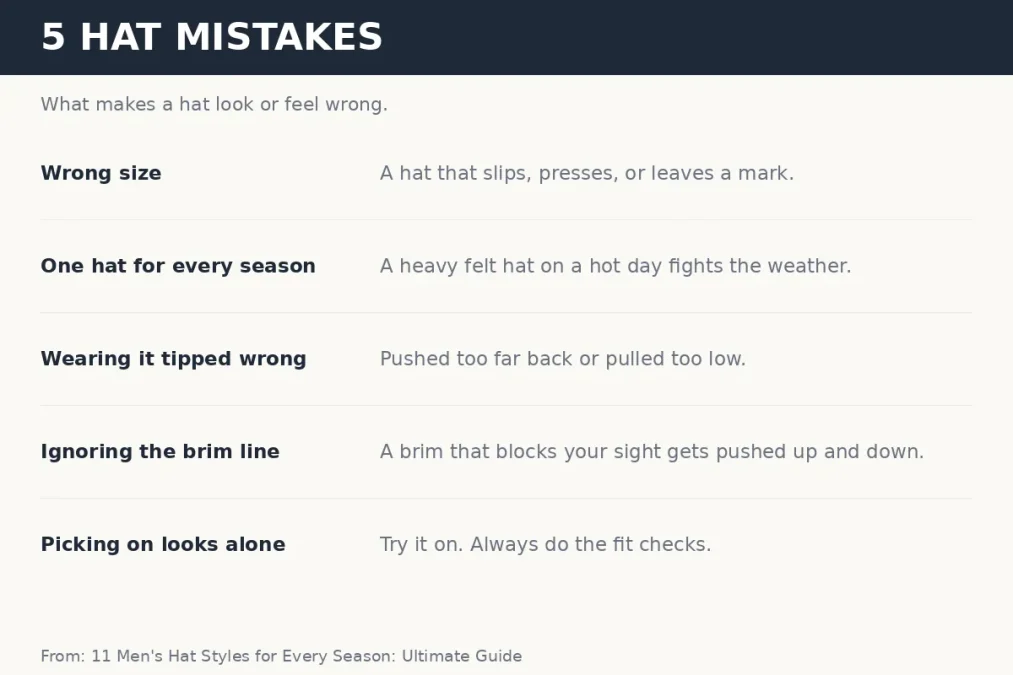
Wrong size is the first mistake. A hat that slips, presses, or leaves a mark is the wrong size, whatever the type name or size label says.
One hat for every season is the second mistake. A heavy felt hat on a hot day and a straw hat on a cold day both fight the weather. Two hats beat one hat forced into every season.
Wearing it tipped wrong is the third mistake. A hat pushed too far back or pulled too low changes the whole look. Level is almost always right.
Ignoring the brim line is the fourth mistake. A brim that blocks your sight will be pushed up and down all day. That fiddling ruins the look and the comfort.
Picking on looks alone is the fifth mistake. A hat that looks good in your hand can still slip, press, or shade your eyes badly on your head. Always try it on. Always do the fit checks.
Have nothing in your houses that you do not know to be useful, or believe to be beautiful.
William Morris, “The Beauty of Life” (1880)
A good hat sits well, suits the weather, and fits in with your outfit. Shape comes first, fit second, and looks last.
The eleven styles in this guide are the baseball cap, bucket hat, beanie, fedora, flat cap, straw hat, trucker cap, cowboy hat, boonie hat, newsboy cap, and trapper hat. The fit checks are simple: level sit, even band, clear brim line, and a short wear test. Cotton feels light and casual, wool and felt feel warmer and smarter, straw feels light and airy, and synthetic feels like the material it copies. Care is simple too: dry it well, keep its shape, and clean it gently.
Pick the hat that fits your head and your day, not the one that looks best in your hand. That is the whole guide, in one line.
A baseball cap. Its shape is simple, its back adjustment sets the fit, and it suits everyday and outdoor wear. If one hat must do a lot of jobs, start there, then add a second hat for cold or smart days.
It sits level on your head, the band feels snug all round without pressing at one spot, the brim stays clear of your eyes, and it still feels right after a short wear indoors. A hat that slips, presses, or needs constant fixing does not fit, whatever its size label says.
A fedora has a taller, creased crown and a brim that goes all the way round. A flat cap sits lower and flatter, with a short, stiff brim at the front only. The fedora stands up; the flat cap lies low.
A baseball cap sits lower and is cloth all round, with a stiff front brim. A trucker cap stands taller at the front and has a mesh back, which lets more air through as a rule. Both have a front-only brim and a back adjustment.
A straw hat, a bucket hat, a baseball cap, or a trucker cap. All four are light shapes with shade: the straw hat and bucket hat shade all round, while the caps shade from the front. Pick by how much shade and air the day needs.
A beanie. It hugs the head, covers the ears as a rule, and keeps warmth close. A flat cap or a fedora suits cool, smarter days, but for real cold, the beanie is the plain pick.
Not well. A hat that is warm enough for cold days feels heavy on a hot day, and a light summer hat gives little warmth in the cold. Two hats — one light, one warm — cover far more days than one hat forced into every season.
Let a damp hat dry in the air before wearing it again, store a firm hat so nothing presses on the crown or bends the brim, do not crush a straw hat, and brush off dust and dirt. Wash only in the way the hat’s own care label allows.