Physical Address
Islamabad, PK
Physical Address
Islamabad, PK

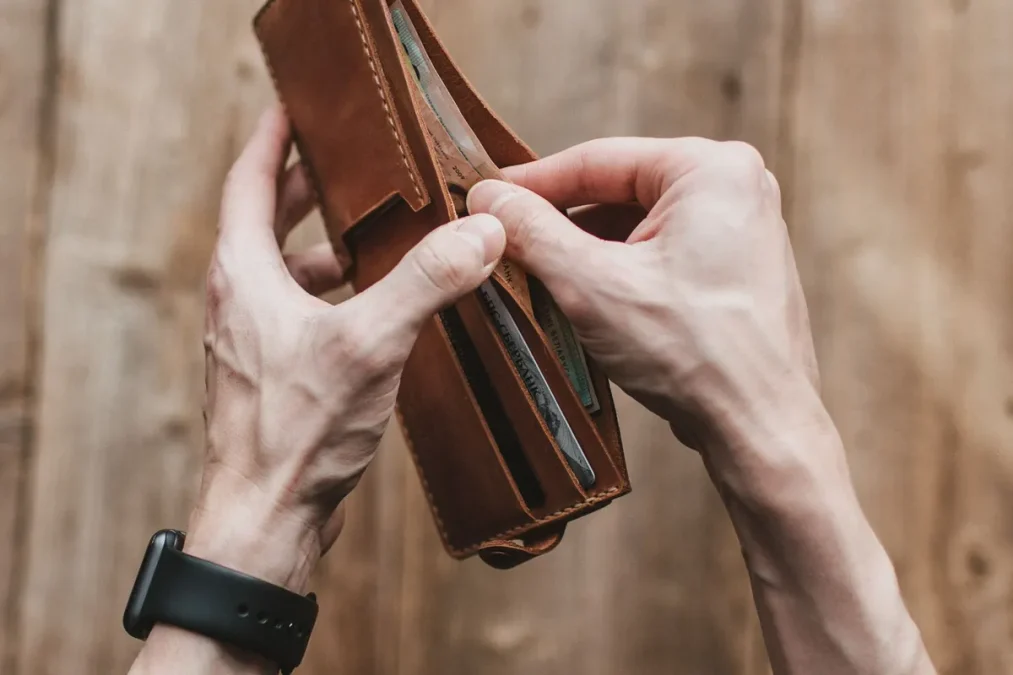
A wallet is a small thing that gets used every day, and it shows. A wallet that fits its carry looks neat in the pocket and feels easy to reach. A wallet that fights its carry bulges, presses when seated, or spills when opened. The difference is rarely the look of the wallet on its own. It is the match between what goes in, the pocket it lives in, and the shape of the wallet itself.
There is no single “correct” wallet. A wallet works when three things line up: it holds what is actually carried each day, it fits the pocket it will live in, and it stays slim when full. Pick by what is carried and by pocket fit first, and let the type name follow.
This guide covers wallets only: the parts, the size and carry checks, 7 wallet types one by one, materials, wallets by pocket, wallets by occasion, care, and mistakes. For the wider accessory picture — how a wallet sits next to watches, bags, and other pieces — see our accessories overview. Here, we stay on wallets: how to pick one that looks neat and feels easy to carry.
A wallet has a few parts, and each one matters for carry.
The folds set the shape. A bifold folds once down the middle and has two sections. A trifold folds twice and has three sections that fold in on each other. The fold also sets the bulk: every fold adds a layer, so a wallet with more folds tends to feel thicker when full, even when its outline looks small when closed.
The card slots are the small pockets that hold cards, set in rows or stacked. They decide how many cards a wallet can hold in an organised way. Cards kept loose in a note section tend to slide around and wear the wallet out of shape, so slots matter more than they first seem.
The note section is the long section that holds paper notes. In a bifold, notes fold once. In a trifold, notes fold twice. In a long wallet, notes lie flat, without folding at all. The note section is the longest part of most wallets, and it sets how wide or tall the wallet is.
The coin section is a small pocket or zip section for coins. Some wallets have one, and slim wallets often do not. A coin section is handy on days with coins to carry, and dead weight on days without — so it is worth asking whether coins are part of the real daily carry before picking a wallet for its coin section alone.
The closure is how the wallet stays shut. A fold on its own holds a bifold or trifold closed. A snap adds a firmer close. A zip closes all the way around and holds everything inside shut, coins and receipts included. The closure matters most when the wallet is full: a closure that strains at the corners is a sign the wallet is carrying more than its shape allows.
A note on words used in this guide. A card holder is a flat case with a few card slots and little or no note section. A money clip is a clip that holds notes together, with a few card slots beside it. A long wallet is a tall wallet that holds notes flat. A zip wallet is a wallet that closes all the way around with a zip. These words come up in every section below. For a broader background on wallets, see Wikipedia’s article on the Wallet.
Size is easy to check, and it is worth checking before a wallet becomes the wallet carried every day. Check four things, in order.
Start with the pocket check. Fill the wallet as it will really be carried — daily cards, notes, coins, and all — and put it into the pocket it will live in. It slides in without force and sits flat. A wallet that needs force to go in will fight the pocket every day, and a wallet that sits crooked will show through the clothes.
Next, do the card-count check. Count the cards carried every day, not the cards owned. The wallet needs room for the daily cards, not for every card in a drawer. Old cards, loyalty cards never used, and cards kept “just in case” are the usual reason a wallet grows thick. Clearing them out first often changes which wallet type fits at all.
Then check the bulk. Fill the wallet as it will be carried and look at it from the side. A slim outline tends to look neat whatever the type. A round, stuffed outline tends to look bulky whatever the type. Bulk is the fastest way to spot a wrong carry: a wallet judged empty can look slim in the hand and thick in the pocket once the real daily carry goes in.
Last, do the sit check. Sit down with the wallet in its pocket. It stays flat and does not press or bulge. A wallet that presses when seated will press all day, since sitting is a large part of most days. A wallet that bulges when seated will change the line of the clothes too.
Carry beats looks here. If a wallet presses, bulges, or spills, the size is wrong for that carry, whatever the type name says.
It seems that perfection is attained not when there is no longer anything to add, but when there is no longer anything to take away.
Antoine de Saint-Exupéry, Wind, Sand and Stars (1939)
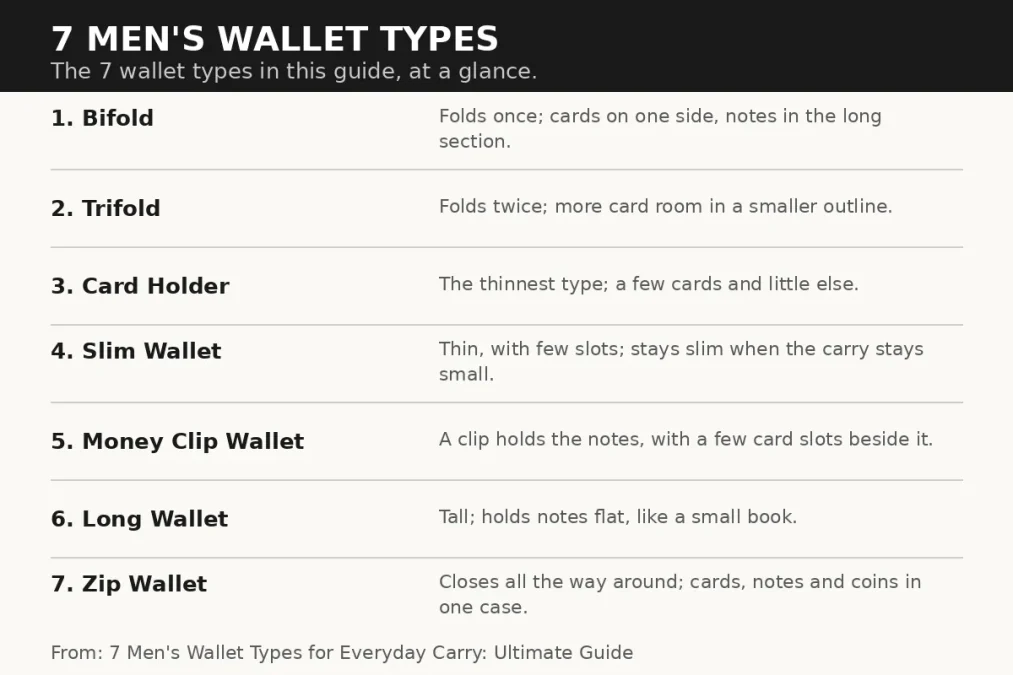
Each type below gives the shape in plain words, the carry feel, a pocket feel, an occasion tendency, and a fit note. Pick by what is carried and by pocket fit first, and let the type follow.
The shape: folds once down the middle, two sections, a classic rectangle shape. The bifold is the most common wallet shape, and the easiest to picture — open it, and one side holds cards while the other side holds the note section.
The carry feel: cards on one or both sides, notes in the long section, folded once. A middle ground — more room than a card holder, less bulk than a trifold as a tendency. It covers a normal daily carry without asking for a big change in habits.
The pocket feel: tends to fit a back pocket or a jacket pocket well. In a tight front pocket, a bifold can feel thick when full, so the pocket check matters more here than with thinner types.
Occasion tendency: everyday wear and work. The bifold is the classic all-round shape, quiet enough for smart wear and sturdy enough for daily use.
Fit note: the fold is the bulk. Check the wallet filled, not empty, since a bifold grows thicker with every card added. A bifold that looks slim empty and thick filled is carrying more than its shape allows.
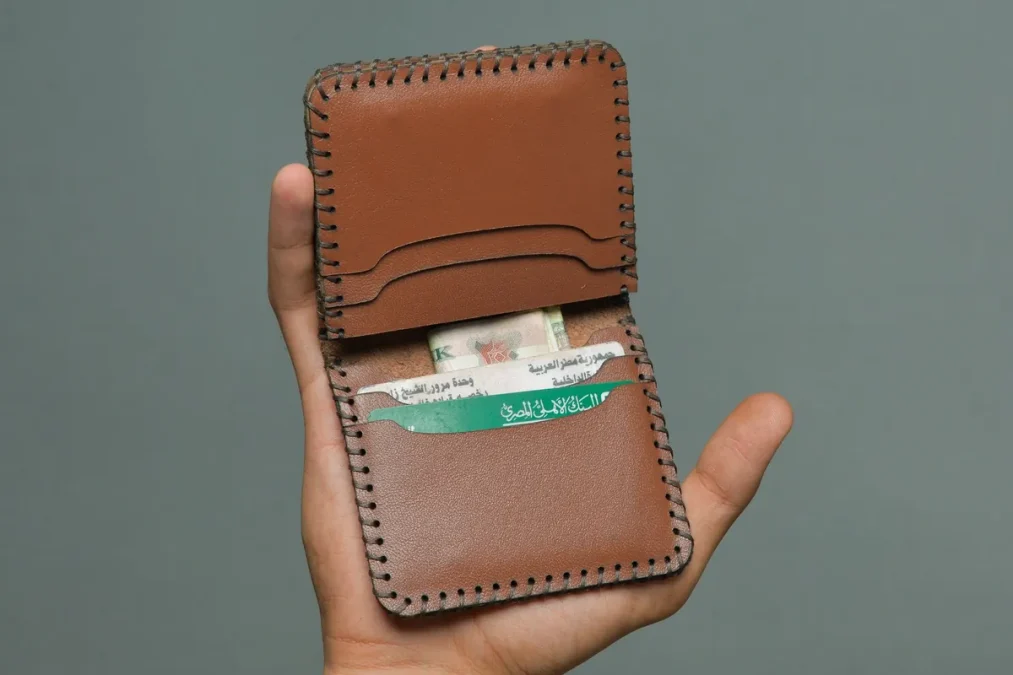
The shape: folds twice, three sections that fold in on each other, a compact outline when closed. Open it, and the three sections fan out — card rows on the sides and the note section behind them.
The carry feel: more card room and more sections than a bifold, as a tendency. Notes fold twice, which suits a carry with more cards and more to organise. The extra section is the point of the trifold: room for a fuller carry in a smaller outline.
The pocket feel: a smaller outline but a thicker wallet when full. A trifold tends to suit a back pocket or a bag more than a tight front pocket, where its thickness shows.
Occasion tendency: days with more to carry, and travel. When the carry grows past a normal day — more cards, more notes, more to keep organised — a trifold tends to be the shape that holds it without spilling.
Fit note: thickness is the main thing to check. A trifold that looks small closed can still feel thick in the pocket when full, so judge it filled, seated, and in its pocket, not closed on a table.
The shape: a flat case with a few card slots and little or no note section. It is the thinnest type in this guide, close to the size of the cards themselves.
The carry feel: a few cards and little else. Notes, where carried, fold small and tuck in beside the cards. There is no room for coins, receipts, or extras, and that limit is the point — a card holder stays thin because it holds so little.
The pocket feel: tends to fit a front pocket best, where its thin shape stays flat and easy to reach. It is the easiest type to carry without changing the line of the clothes.
Occasion tendency: light days out and card-only days. When the carry is a few cards and nothing else, a card holder tends to be the neatest answer.
Fit note: the limit is the point. If the daily carry grows past a few cards, a card holder stops being the right tool, and forcing extra cards into it bends the slots and thickens the case. When the carry grows, the wallet type needs to grow with it.
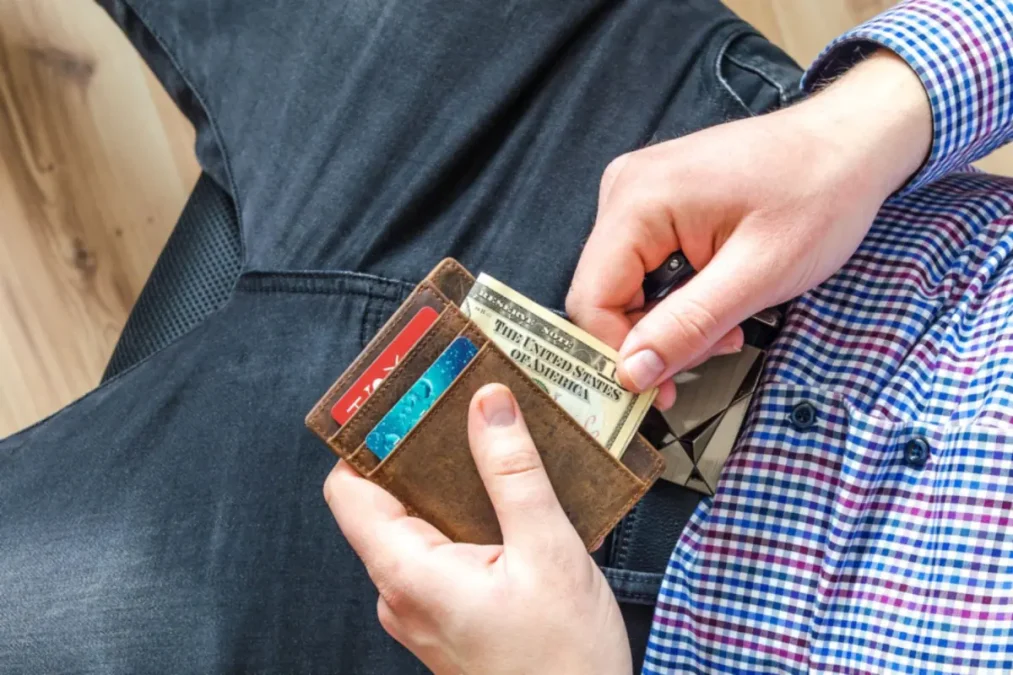
The shape: a thin wallet with a small number of slots, made to stay slim even when filled with the daily carry. It looks close to a bifold, but thinner, with fewer slots and less extra material.
The carry feel: a few cards and a small number of notes. Less room than a bifold, more structure than a bare card holder, as a tendency. It covers a small card-and-notes carry in a shape that stays neat.
The pocket feel: tends to fit a front pocket well and sits flat in a back pocket too. The thin outline is the whole idea — a slim wallet is picked for the line it keeps, not for the room it adds.
Occasion tendency: everyday wear and smart wear. A slim wallet tends to suit smarter clothes best, since it does not change the line of a jacket or a pair of trousers.
Fit note: slim only stays slim if the carry stays small. Extra cards and old receipts undo the slim shape fast, so a slim wallet pairs with a regular clear-out habit. A slim wallet kept full is just a thick wallet with fewer slots.
The shape: a clip that holds notes together, with a few card slots beside it. There is no full fold around the notes — the clip itself is the wallet, with card slots built into its sides or back.
The carry feel: notes held by the clip, a few cards beside them. The smallest full wallet in this guide as a tendency, built for a carry of notes and a few cards and nothing else.
The pocket feel: tends to fit a front pocket best, where the clip keeps the carry flat and easy to reach. Notes slide out easily, and cards sit beside them, so the whole carry is in hand in one motion.
Occasion tendency: light days out, evenings, and days with little cash and a few cards. When the carry is at its smallest, a money clip wallet tends to be the lightest answer.
Fit note: the clip holds only what it can grip. A thick stack of notes slips, and too many cards defeat the flat shape. If the clip strains or the notes slide, the carry has grown past what a clip wallet is built for.
The shape: a tall wallet that holds notes flat, without folding them. It opens like a small book, with cards in rows and the note section running the full height.
The carry feel: notes flat, cards in rows, room for more notes and cards than a bifold as a tendency. It is the largest wallet in this guide, and the neatest for a carry that values flat notes and clear rows over a small outline.
The pocket feel: tends to fit a jacket pocket or a bag best. A long wallet is often too tall for most trouser pockets as a tendency, and a tall wallet in a short pocket rides up and shows.
Occasion tendency: work and smart wear with a jacket, and travel. When a jacket is part of the outfit, a long wallet tends to sit naturally in its inner pocket, flat and out of sight.
Fit note: height is the main check. A long wallet needs a pocket tall enough for it, or it rides up, shows above the pocket line, and bends at the top. Check it in the jacket it will live in, not in the hand.
The shape: a wallet that closes all the way around with a zip, holding everything inside shut. Open it, and cards, notes, and the coin section all sit inside one closed case.
The carry feel: cards, notes, and coins in one closed case. The coin section is the key extra here — a zip wallet is the natural home for coins, receipts, and small items that would spill from an open wallet.
The pocket feel: tends to fit a jacket pocket or a bag best. The zip and the fuller shape can feel thick in a tight trouser pocket, so a zip wallet tends to ride in a jacket or a bag rather than a front pocket.
Occasion tendency: travel, and days with coins and receipts to keep. When the carry needs to stay shut — on the road, in a bag, in a crowd — a zip wallet tends to be the shape that keeps it all in place.
Fit note: the zip is the fit. It needs to close easily when the wallet is full, not strain at the corners. A zip that strains is a sign the wallet is carrying more than its shape allows, and a strained zip wears out faster as a tendency.
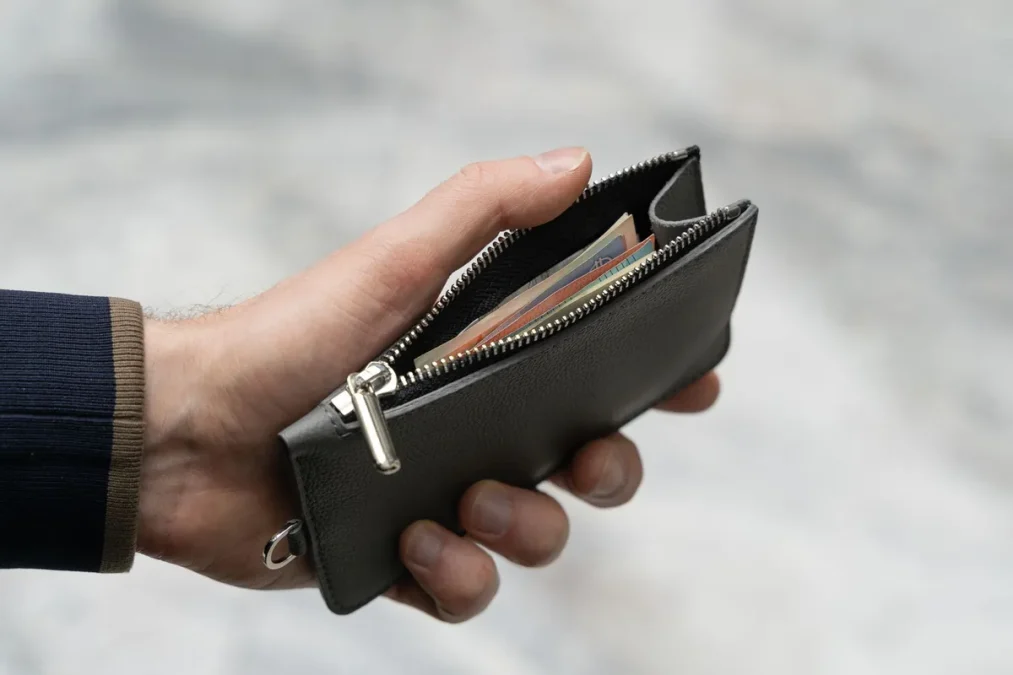
Material changes look and feel, not just colour. Three material types cover most wallets.
Leather is a natural hide material, soft in feel, with a look that changes with use as a tendency. It tends to feel warmer and more dressed-up than fabric, and it suits smarter wear as a tendency. Leather also softens and takes on marks with use, so a leather wallet tends to look more lived-in over time, not newer.
Fabric or canvas is a woven material, lighter in feel and more casual in look as a tendency. It tends to suit relaxed, everyday wear, and it often feels softer and less stiff in the pocket than a thick leather wallet. Fabric also shows wear differently — it tends to fade or fray at the edges with long use, rather than changing colour all over.
Synthetic is a man-made material made to look and feel like leather or fabric. Feel and look vary by the material it copies, so a synthetic wallet is best judged by touch, not by the name alone. Some feel close to leather, some feel close to fabric, and some feel like neither — the hand and the pocket decide, not the label.
Pick by feel in the hand and in the pocket, not by the material name alone. A material that feels good empty can still feel stiff or bulky filled, so judge the wallet filled, in its pocket, as with every other check in this guide.
The pocket often picks the wallet. Four pockets cover most days.
The front pocket suits thin shapes: a card holder, a slim wallet, or a money clip wallet. Their flat shapes stay flat in the pocket and are easy to reach. A thick or tall shape in a front pocket tends to bulge and press, so front-pocket carry leans thin.
The back pocket suits classic shapes: a bifold or a trifold. The larger back pocket holds their wider shapes, and the sit check matters most here, since a thick wallet in a back pocket presses when seated. If a back-pocket wallet presses on sitting, it is too thick for that pocket, whatever the type.
The jacket pocket suits taller and fuller shapes: a long wallet or a zip wallet. A jacket pocket is taller and looser than a trouser pocket, so it holds shapes that would ride up or bulge elsewhere. A long wallet in a jacket pocket tends to sit flat and out of sight.
Bag carry suits fuller shapes: a zip wallet, a long wallet, or a trifold. When the wallet rides in a bag, not a pocket, bulk matters less and room matters more, so a fuller wallet tends to be the better answer for bag days.
Occasion changes the carry, and the carry picks the wallet. Five occasions cover most days.
Everyday wear tends to suit a bifold or a slim wallet — middle-ground shapes for a normal daily carry, quiet enough for most clothes and roomy enough for the usual cards and notes.
Work and smart wear tend to suit a slim wallet or a long wallet — quiet shapes that keep the line of smarter clothes clean. A thin wallet in a jacket pocket and a flat wallet in a trouser pocket both keep the outfit looking neat.
Travel tends to suit a zip wallet, a trifold, or a long wallet — fuller shapes for more cards, notes, coins, and receipts on the road. Travel is the occasion where a fuller wallet earns its bulk, since the carry is at its largest.
Sport and outdoor days tend to suit a card holder or a money clip wallet — the smallest carry, easy to reach and light to hold. When the day is active, less in the pocket tends to feel better.
Light days out tend to suit a card holder or a money clip wallet — a few cards and little else. A light day is the wrong day for a full wallet, and the right day for the thinnest shape that holds the carry.
Three habits keep a wallet in good shape.
Clear it out now and then. Take everything out and put back only what is used each day. Old receipts, cards never used, and loose change are the usual reason a wallet grows thick, and clearing them out is the fastest way to get a slim wallet back.
Keep it dry. Water and damp pockets wear a wallet out faster as a tendency, whatever the material. A wet wallet left to dry in a pocket tends to stiffen or mark, so a dry pocket and a dry bag are part of wallet care.
Do not overstuff it. A wallet kept slim tends to hold its shape longer than a wallet stretched full every day. Stretched slots, strained zips, and bent folds all come from the same cause: a carry bigger than the wallet’s shape allows.
Buy less, choose well, make it last.
Vivienne Westwood
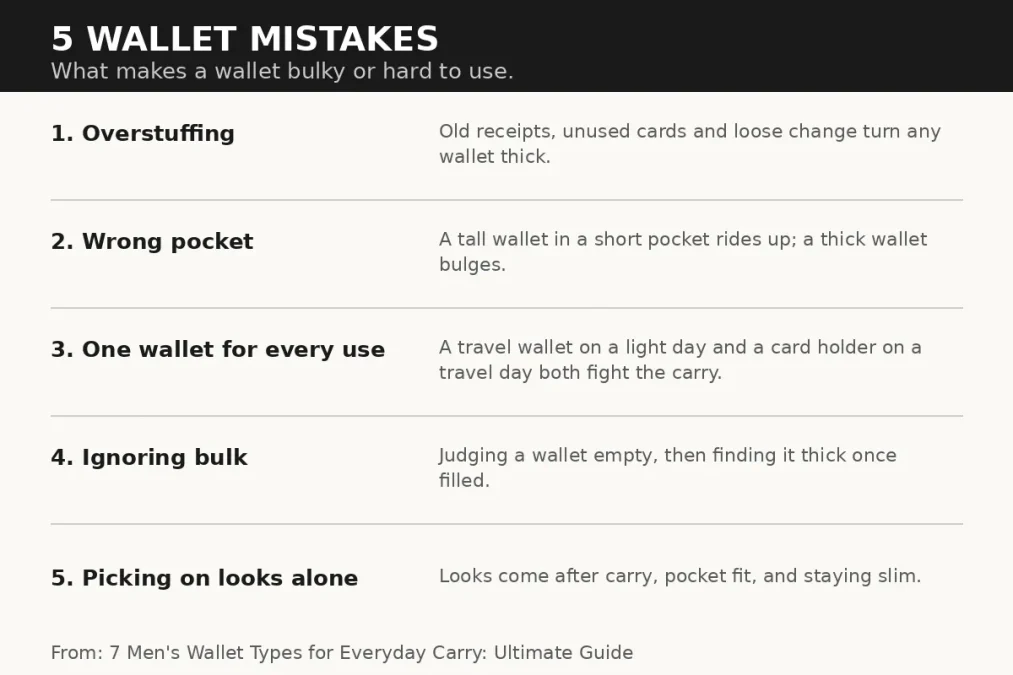
Overstuffing is the first mistake. Old receipts, cards never used, and loose change turn any wallet thick, even a slim one. The wallet is rarely the problem — the carry is.
The wrong pocket is the second mistake. A tall wallet in a short pocket rides up. A thick wallet in a tight pocket bulges. The pocket check, done filled and seated, catches this before the wallet becomes the daily carry.
One wallet forced into every use is the third mistake. A travel wallet on a light day out and a card holder on a travel day both fight the carry. When the carry changes a lot between days, two wallets — one slim, one fuller — tend to cover more ground than one wallet forced into every use.
Ignoring bulk is the fourth mistake. Judging a wallet empty, then finding it thick once filled with the real daily carry, is the most common way to end up with a wallet that bulges. Judge every wallet filled, in its pocket, seated.
Picking on looks alone is the fifth mistake. A wallet that looks good in the hand can still press, bulge, or spill in the pocket. Looks matter, but they come after carry, pocket fit, and staying slim — in that order.
Beware of little expenses; a small leak will sink a great ship.
Benjamin Franklin, The Way to Wealth (1758)
Carry first, pocket fit second, staying slim third — in that order. The 7 types give a shape for every carry, from a card holder for a few cards to a zip wallet for a full travel carry. The size checks — pocket, card count, bulk, and sitting — catch a wrong wallet before it becomes the daily carry. Materials change look and feel, not just colour, and three habits — clearing out, keeping dry, and not overstuffing — keep any wallet in good shape. Pick the wallet that fits what is actually carried, and the pocket it will live in, and the rest follows.
A bifold tends to be the easiest start, as a tendency. It holds a normal daily carry — cards on one or both sides and notes in the long section — without the extra bulk of a trifold and without the tight limit of a card holder. If the daily carry is only a few cards, a slim wallet or a card holder tends to be the easier start instead. Start from what is carried, not from the type name.
Fill the wallet as it will be carried, then put it in the pocket it will live in. It slides in without force and sits flat. Then sit down with it in place — it stays flat and does not press or bulge. A wallet that presses when seated will press all day. If it bulges, spills, or needs force to go in, the size is wrong for that pocket, whatever the type name says.
A bifold folds once and has two sections. A trifold folds twice and has three sections that fold in on each other. The trifold tends to hold more cards and has a smaller outline when closed, but it tends to feel thicker when full. The bifold tends to stay thinner as a middle ground. Pick by what is carried: a fuller carry leans trifold, a normal carry leans bifold.
A card holder is a flat case with a few card slots and little or no note section — the thinnest type in this guide. A slim wallet is a thin wallet with a small number of slots and a little more structure, with room for a small number of notes as well as cards. Both stay slim, but the card holder is for a card-only carry, while the slim wallet covers a small card-and-notes carry too.
Thin shapes tend to fit a front pocket best: a card holder, a slim wallet, or a money clip wallet. Their flat shapes stay flat in the pocket and are easy to reach. Thicker or taller shapes — a full trifold, a long wallet, a zip wallet — tend to bulge or ride up in a tight front pocket. The pocket check decides it: filled, flat, and easy to reach.
Not always, but travel tends to change the carry: more cards, more notes, coins, and receipts. A zip wallet, a trifold, or a long wallet tends to fit that fuller carry better than a card holder, which is built for a small carry. If the normal wallet already holds the travel carry without bulging, it can stay. If it bulges or will not close easily, a fuller wallet tends to be the better travel choice.
Rarely well. A slim card holder tends to fit a light day out but not a travel day, and a full zip wallet tends to fit travel but feels heavy on a light day out. One wallet can cover most days if the carry stays steady — a bifold or a slim wallet tends to be that middle ground. When the carry changes a lot between days, two wallets — one slim, one fuller — tend to cover more ground than one wallet forced into every use.
Three habits: clear it out now and then, putting back only what is used each day; keep it dry, since water and damp pockets wear a wallet out faster as a tendency; and do not overstuff it, since a wallet kept slim tends to hold its shape longer than a wallet stretched full every day. Bulk is the main wear on a wallet — what is left out matters as much as what is put in.