Physical Address
Islamabad, PK
Physical Address
Islamabad, PK

A pair of sunglasses can pull an outfit together. It can also sit wrong all day — sliding down, pinching at the sides, or looking too wide for the face. The difference is rarely the price or the name on the arm. It is fit. A pair that fits looks right without effort, and a pair that does not fit keeps reminding you it is there.
There is no single “correct” pair. A pair looks right when three things line up: the frame width roughly matches the width of the face, the bridge and arms sit without pinching or sliding, and the shape fits the life it will be worn in. Pick by width and comfort first, and let face shape guide the choice, not rule it.
This guide covers sunglasses only: the parts, the fit checks, 7 frame styles shape by shape, materials, lens tints, face-shape tendencies, sunglasses by occasion, care, and mistakes. For the wider accessory picture — how sunglasses sit next to watches, bags, and other pieces — see our accessories overview. Here, we stay on sunglasses: how to pick a pair that looks right and feels right all day.
A pair of sunglasses has four parts, and each one matters for fit.
The frame front is the front piece that holds the lenses. It sets the shape you see in the mirror — square, round, aviator, and the rest. It also sets the width. If the frame front is far wider or narrower than the face, no other part can fix the look.
The lenses are the dark pieces you look through. Their shape follows the frame front. Large lenses give more coverage. Smaller lenses give a lighter look, but they cover less of the eye area from sun and glare at the sides.
The bridge is the part that joins the two lenses and rests on the nose. The bridge carries most of the weight of the pair. If the bridge pinches, the pair feels tight. If the bridge is loose, the pair slides down. A good bridge rests evenly and stays put.
The temple arms are the arms that run back from the frame front and rest over the ears. They hold the pair in place. If the arms press hard behind the ears, the pair feels tight after a short time. If the arms are loose, the pair slips forward when you look down.
A note on words used in this guide. A browline frame has a stronger top bar across the brow, with a lighter lower rim or no lower rim at all. A wrap frame has lenses that curve around the sides of the face, close to the head. A mirrored finish is a shiny outer surface on a lens — a look choice, not a separate lens type. A polarised lens is a lens made to cut reflected glare, such as glare off water or a road surface. These words come up in every section below.
Fit is easy to check, and it is worth checking before a pair becomes the pair you wear every day. Check three places, in order.
Start with the bridge. Put the pair on and let it settle. The bridge rests on the nose without pinching and without sliding down. If it pinches, the bridge is too tight for that nose shape. If it slides, the bridge is too loose, and the pair will keep sliding all day. A pair that slides in the shop will slide at home too.
Next, check the arms. The arms rest over the ears without pressing. Pressing behind the ears is easy to miss in a quick try-on, but it grows uncomfortable over a full day. If the arms press, the pair is too tight at the sides. If the arms feel loose and the pair rocks, the arms are too wide for that head shape.
Then check the width. Stand in front of a mirror and look straight ahead. The frame width roughly matches the width of the face. The arms do not bow out at the sides, and they do not squeeze in. As a rough guide, the outer edges of the frame sit near the edges of the face, not far past them and not well inside them. Width is the fastest way to spot a wrong pair: a pair far wider than the face looks oversized, and a pair far narrower looks pinched.
Last, do the sit-and-move check. Look down, then shake your head gently from side to side. A good fit stays in place without sliding. If the pair slides forward when you look down, the bridge or the arms are not holding it. Comfort beats every style rule here. If a pair pinches or slides, the shape is wrong for that face, whatever the style name says.
Each style below gives the shape in plain words, the face-width feel, a lens note, an occasion tendency, and a fit note. Pick by width and comfort first, and let the shape follow.

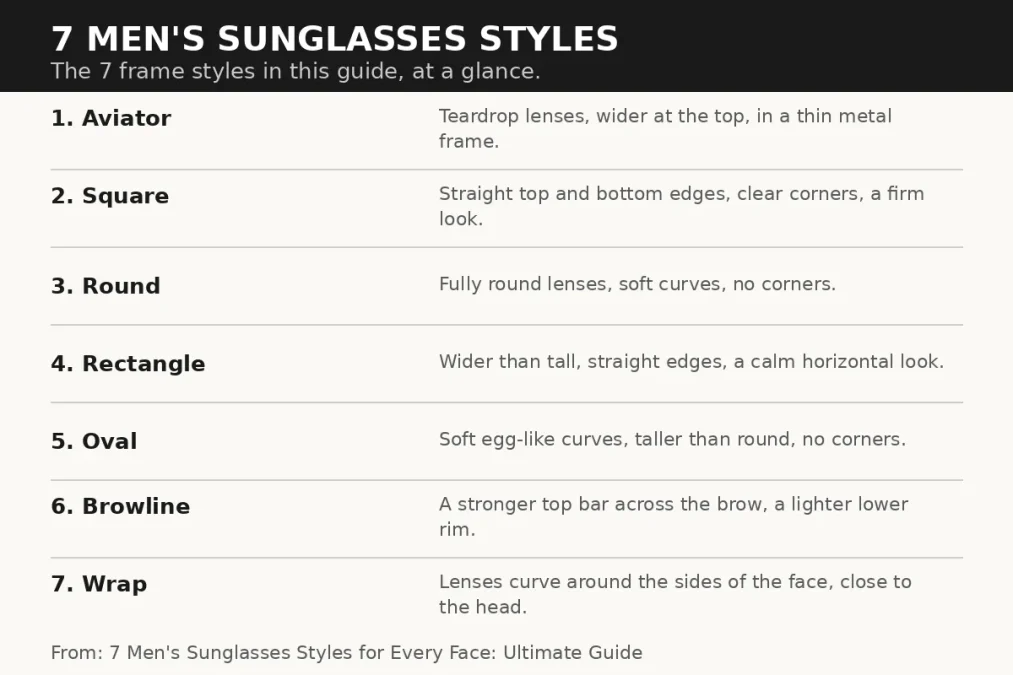
The shape: teardrop lenses, wider at the top and narrower at the bottom, in a thin metal frame. The teardrop shape is the key feature. You can see it at once — a soft, rounded top with a narrower lower edge.
The face-width feel: the lenses are wide, so this shape tends to sit easily on wider faces as a tendency. On a narrow face, a large aviator can look oversized, so the width check matters more here than with smaller shapes.
The lens feel: large lenses, more coverage than most shapes. The large lens area also means more of the eye area is shaded, which tends to feel comfortable on bright days.
Occasion tendency: everyday wear and driving. The aviator is a classic, easy shape that goes with most casual clothes and reads as relaxed, not dressed up.
Fit note: the bridge and the wide lenses set the fit. Sliding is the main thing to check, since a large, thin-metal pair can slide if the bridge is loose.

The shape: straight top and bottom edges, clear corners, a firm, angular look. The corners are the key feature. They give the pair a direct, tidy outline.
The face-width feel: strong, clear lines. As a tendency, square frames contrast with rounder faces, since the straight edges stand against soft curves. The contrast is a tendency only — width still matters more than the corner shape.
The lens feel: medium to large lenses, a straight, even look. The straight edges make the pair easy to read at a glance: tidy, direct, no fuss.
Occasion tendency: everyday wear and smart wear. The square shape reads as neat and low fuss, which fits a workday as well as a weekend.
Fit note: the corners make width easy to judge. The corners sit near the edges of the face, not far past them. If the corners stick out well past the face, the pair is too wide.
The shape: fully round lenses, soft curves, no corners. The curve is the whole look. Nothing about a round pair is straight or angular.
The face-width feel: a softer look. As a tendency, round frames contrast with more angular faces, since the curves soften straight lines. Small round lenses can look lost on a wide face, so the width check still comes first.
The lens feel: medium lenses, a gentle, easy look. Round lenses tend to read as relaxed and a little vintage-leaning, not sharp or formal.
Occasion tendency: everyday, relaxed wear. A round pair goes well with soft, casual clothes and reads as easy rather than dressed up.
Fit note: check the width before the curve. A round pair that is too narrow looks small on the face, and the soft shape cannot hide a width miss.
The shape: wider than tall, straight edges, a horizontal look. The horizontal line is the key feature. The pair reads as calm and level.
The face-width feel: the horizontal shape tends to add width, so it tends to sit well on longer faces as a tendency. The straight top edge also makes it easy to see if the pair sits level.
The lens feel: medium lenses, a calm, straight look. The rectangle is one of the quietest shapes in this guide — nothing about it shouts.
Occasion tendency: everyday, work, and smart wear. The quiet shape goes with most clothes and most settings, which makes it a good first pair.
Fit note: the straight top edge is your level check. If the top edge tilts, the pair is not sitting evenly, and the bridge or an arm needs attention.
The shape: soft, egg-like curves, taller than round but still curved, no corners. The oval sits between round and rectangle: curved like round, but with a little more height.
The face-width feel: a gentle middle ground. The oval does not push a strong contrast in either direction, so it tends to sit easily on most faces as a tendency.
The lens feel: medium lenses, a soft, easy look. The oval reads as calm and friendly, never harsh.
Occasion tendency: everyday wear, relaxed and smart wear alike. If no strong look is wanted, the oval is a safe, quiet pick.
Fit note: a good first shape when no strong contrast is wanted. The width check still applies — an oval pair far wider or narrower than the face still looks wrong.
The shape: a stronger top bar across the brow, with a lighter lower rim or no lower rim at all. The top bar is the key feature. It draws the eye to the brow line and gives the pair a dressed-up feel.
The face-width feel: the strong top line sets the look, so the pair reads as neat and put together. The top bar also makes the pair look a little more formal than a full-rim pair in the same shape.
The lens feel: medium lenses, a neat, dressed-up look. The lighter lower rim keeps the pair from looking heavy, even with the strong top bar.
Occasion tendency: smart wear, and everyday wear with a smarter edge. A browline pair goes well with a collared shirt and tidy clothes.
Fit note: the top bar needs to sit level across the brow. If it tilts, the whole pair looks off, since the top bar is the feature the eye goes to first.

The shape: lenses that curve around the sides of the face, close to the head. The curve is the whole point. Unlike flat shapes, a wrap pair covers the sides as well as the front.
The face-width feel: the pair hugs the face. The close fit gives more coverage, but it also means the curve has to match the face — a wrap pair that presses at the sides feels tight fast.
The lens feel: large, curved lenses, more side coverage than flat shapes. The side coverage cuts glare from the sides as well as the front, which tends to feel comfortable on very bright days.
Occasion tendency: sport, beach and water, and bright outdoor days. The wrap shape stays put better than flat shapes during movement, which is why it fits sport best.
Fit note: the curve is the fit. If it presses at the sides, the curve is wrong for that face, and no adjustment to the arms will fix a curve miss.
Don’t be into trends. Don’t make fashion own you, but you decide what you are, what you want to express by the way you dress and the way to live.
Gianni Versace, after his fall 1997 collection
Frame material changes how a pair looks and feels, not just what colour it comes in. Two broad types cover most pairs.
Metal frames feel thin and light. The thin feel gives a quiet, clean look, and the pair feels light on the nose and ears. Metal can bend a little without breaking, as a tendency, and a bent metal arm can often be bent back into shape. The trade-off is a thinner look: metal frames tend to read as quiet and neat rather than bold.
Plastic-type frames look thicker and come in a wider range of colours. The thicker look reads as bolder and more casual, and the colour range is wider than with metal. As a tendency, plastic-type frames feel heavier than thin metal frames, though the difference is small on a well-fitting pair. The trade-off is a bolder outline: a thick plastic-type frame is a visible part of the outfit, not a quiet one.
Pick by feel on the face, not by the material name alone. A light-feeling pair that sits well beats a material rule every time. If a pair feels heavy on the nose after a few minutes, the material and the fit together are telling you something — try another pair.
Lens tint is the colour of the lens, and it changes how the world looks through the pair. Three tints cover most pairs.
Grey keeps colours looking closest to normal. The view stays natural, with no strong colour shift. As a tendency, grey is a good everyday starting tint, since the natural view feels easy all day.
Brown makes the view look warmer. Colours take on a warm, golden cast, and bright days tend to gain a little contrast. Brown tends to feel pleasant on bright, sunny days, though the warm cast is a taste choice, not a rule.
Green softens bright light and keeps colours fairly even. The view looks a little softer and less harsh, without the warm cast of brown. Green tends to feel calm on bright days.
Two more terms come up often. A mirrored finish is a shiny outer surface on a lens. It is a look choice — the shiny surface is visible from the front — not a separate tint. The tint underneath still sets how the view looks. A polarised lens is a lens made to cut reflected glare, such as glare off water or a road surface. Polarised is a feature to ask about when glare is the problem, not a claim about eye health. This guide quotes no protection rating and makes no health claim for any lens type. Check the label for the sun-protection rating of any pair you consider, and treat tint as a feel choice first: pick the view that feels most natural to you. For background on sunglasses in general, see the Sunglasses entry on Wikipedia.
Face shape can guide a sunglasses choice, but it cannot rule it. The notes below are tendencies, not rules, and width and comfort beat every one of them. For face-shape thinking in a different area — haircuts — see our haircuts by face shape guide. Here, the notes are about frames only.
A round face has soft curves and similar width and length. Angular shapes — square, rectangle — tend to add contrast, since straight edges stand against soft curves.
A square face has a strong jaw and a broad brow. Softer shapes — round, oval — tend to soften the angles, since curves stand against straight lines.
An oval face is longer than wide, with soft curves. Most shapes tend to work on an oval face as a tendency, so the width check becomes the main decision: pick the width that matches the face, and the shape can follow taste.
A longer face is clearly longer than wide. Wider, horizontal shapes — rectangle, aviator — tend to add width, which tends to balance the length.
A heart face has a wider brow and a narrower chin. Lighter, lower shapes — oval, round — tend to balance a wider brow, since they do not add more weight at the top.
A diamond face has wide cheekbones and a narrower brow and chin. Oval and softer shapes tend to sit easily, since they do not fight the cheekbone width.
In every case, the same check applies: if a pair pinches, slides, or presses, it is the wrong pair for that face, whatever the shape guide says. A shape tendency is a starting point for trying pairs on, not a verdict.
Beauty is in the eye of the beholder.
Margaret Wolfe Hungerford, Molly Bawn (1878)
Everyday wear suits the quiet shapes: square, rectangle, and oval. They go with most clothes, they read as neat without trying hard, and they do not demand a particular outfit. A quiet pair for everyday wear is the easiest pair to live with.
Driving suits larger lenses and a calm look: aviator and browline. Larger lenses cover more of the eye area, and a calm shape does not distract. Lenses made to cut reflected glare can help on the road as a tendency, since road glare is reflected light. The fit still matters most — a pair that slides while driving is a poor pair for driving, whatever its shape.
Sport suits the wrap shape. The curve hugs the face, the pair stays put during movement, and the side coverage cuts glare from the sides. A flat, quiet pair can work for a gentle walk, but for running, cycling, or court games, the wrap shape tends to be the easier answer.
Beach and water suit wrap and aviator shapes. Coverage matters here — side coverage from a wrap pair, large-lens coverage from an aviator — and glare-cutting lenses tend to help, since water throws back a lot of reflected light. A secure fit matters too: a pair that slides off on a beach day is a pair that gets lost.
Smart and formal wear suits quiet shapes: browline, rectangle, and a thin metal aviator. The shapes are neat, the lenses are dark, and the finish is calm rather than loud. A mirrored finish or a very bold frame tends to fight a smart outfit, so the quieter the pair, the easier it sits with formal clothes.
Nothing is better than simplicity.
Walt Whitman, Preface to Leaves of Grass (1855)
Three habits keep a pair in good shape. None of them takes more than a few seconds.
First, keep sunglasses in a case when not worn. Loose in a pocket or a bag, lenses pick up marks from keys, coins, and cloth. The case is the simplest habit, and it prevents most lens marks.
Second, wipe lenses with a soft cloth. A soft cloth clears dust and smudges without marking the lens surface. A rough cloth or a shirt sleeve can leave fine marks over time, so the soft cloth is worth keeping with the case.
Third, keep sunglasses away from strong heat. Strong heat can bend or loosen a frame over time, and it can warp a plastic-type frame. A car dashboard on a hot day is the classic case: the heat builds up, and the frame softens. The case helps here too, but shade helps more — keep the pair out of direct, strong heat.
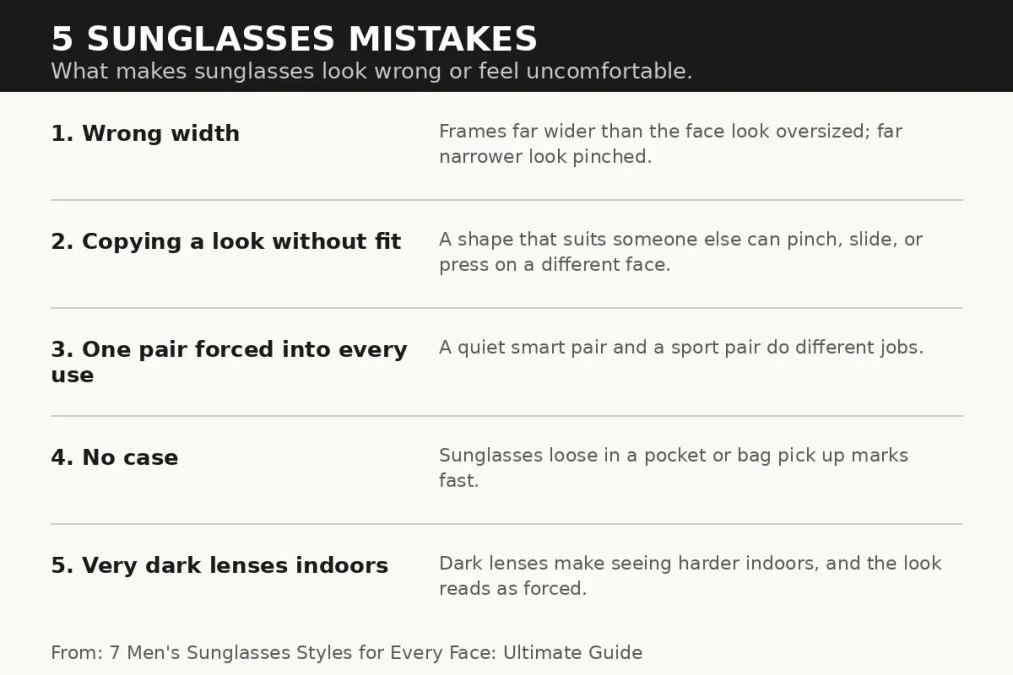
Wrong width is the biggest mistake. Frames far wider than the face look oversized, and frames far narrower look pinched. The width check in the mirror catches this in seconds, yet it is the mistake people skip most often. Check the width first, every time.
Copying a look without fit is the second mistake. A shape that looks good on someone else can pinch, slide, or press on a different face. Face width, nose shape, and ear position all change the fit. A pair has to fit the face wearing it, not the face in the photo.
One pair forced into every use is the third mistake. A quiet smart pair and a sport pair do different jobs. Forcing one pair into both jobs means it does neither job well — it slides during sport, or it looks too sporty with smart clothes. Two pairs for two very different uses tend to be the easier answer.
No case is the fourth mistake. Sunglasses loose in a pocket or bag pick up marks fast, and marked lenses make even a good pair look tired. The case is a small habit with a large payoff.
Very dark lenses indoors is the fifth mistake. Very dark lenses make seeing harder indoors, and the look reads as forced — sunglasses indoors draw attention for the wrong reason. Save dark lenses for bright light, where they belong.
For the wider accessory picture, see our accessories overview. For a fellow accessory guide, see our watches guide. For quiet styling in general, see our minimalist fashion tips. For face-shape thinking for haircuts, see our haircuts by face shape guide.
A pair of sunglasses looks right when the frame width roughly matches the width of the face, the bridge and arms sit without pinching or sliding, and the shape fits the life it will be worn in. The 7 styles in this guide cover that range: the aviator for a classic, wide-lens look, the square for a tidy, angular look, the round for a soft, relaxed look, the rectangle for a quiet, horizontal look, the oval for a gentle middle ground, the browline for a neat, dressed-up look, and the wrap for sport and bright outdoor days. Three habits carry any of them: check the width in the mirror, check the bridge and arms for pinching or sliding, and keep the pair in a case. Pick the shape that fits your face width and your days, and let fit do the work.
The rectangle or the oval. Both are quiet shapes with no strong feature — straight edges on the rectangle, soft curves on the oval — and both tend to sit easily on most faces. Start with the width check: the frame width roughly matches the width of the face, and the pair sits without pinching or sliding.
Check three places. The bridge rests on the nose without pinching and without sliding down. The arms rest over the ears without pressing. The frame width roughly matches the width of the face, so the arms do not bow out or squeeze in. Look down and shake your head gently — a good fit stays in place without sliding.
An aviator has teardrop lenses — wider at the top, narrower at the bottom — in a thin metal frame, with large lenses and more coverage. A square pair has straight top and bottom edges and clear corners, a firm, angular look with medium to large lenses. The aviator reads as classic and easy; the square reads as tidy and direct.
A polarised lens is made to cut reflected glare, such as glare off water or a road surface. It is a feature to ask about when glare is the problem. This guide makes no claim about eye health or protection from any lens type — check the label for the sun-protection rating.
Grey, as a tendency. Grey keeps colours looking closest to normal, so the view stays natural through the day. Brown tends to make the view look warmer, and green tends to soften bright light. Tint is a feel choice first — pick the view that feels most natural to you.
No. Face-shape notes here are tendencies, not rules. A frame shape that contrasts with the face shape tends to read as balanced — angular frames on a rounder face, softer frames on a more angular face — but width and comfort matter more. If a pair pinches, slides, or presses, it is the wrong pair for that face, whatever the shape guide says.
It can, but one pair rarely fits every use well. A quiet pair with larger lenses tends to work for driving, while a wrap shape tends to stay put better during sport and covers the sides. If sport is a regular use, a second, wrap-shaped pair tends to be the easier answer than forcing one pair into both jobs.
Three habits. Keep them in a case when not worn. Wipe the lenses with a soft cloth. Keep them away from strong heat, which can bend or loosen a frame over time. Loose in a pocket or bag, lenses pick up marks — the case is the simplest habit of the three.