Physical Address
Islamabad, PK
Physical Address
Islamabad, PK


Your haircut should not fall flat 10 minutes after styling. Many men try fades, trims, or random layers. The result still looks flat, heavy, or shapeless. That problem gets worse when your hair has no crown lift. Straight hair can look limp. Thick hair can puff out. Wavy hair can lose shape without the right layers.
Wolf Cut Hairstyles feature short, textured layers on top and longer, feathered ends. This guide presents 11 styles for men in 2026. You’ll discover the best style for your hair type, face shape, and length. It also includes routine tips, barber instructions, product suggestions, and maintenance advice.
The wolf cut is a layered men’s haircut. It features short, choppy layers on top and longer, feathered ends at the back and sides. The name comes from its resemblance to a wolf’s rough, untamed mane. The cut builds on 4 key parts: crown volume, length contrast, feathered ends, and face-framing layers.
The wolf cut sits structurally between 2 iconic retro styles. The 1970s shag, popular with stars like David Bowie and Stevie Nicks, added layers around the face and lifted the crown. The 1980s mullet contributed short-to-long length contrast and an elongated nape.

The wolf cut became popular through South Korean pop culture and K-pop, with roots dating from the mid-2000s into the 2010s. South Korean salons helped popularize softer, layered versions of the style. K-pop idols including BTS’s V (Kim Taehyung), EXO’s Kai, and Stray Kids’ Hyunjin brought the cut to international visibility. TikTok accelerated global adoption. Gen Z drove the crossover from a regional K-pop style to a global barbershop staple within 3 years.The wolf cut is still popular in 2026. Major hairstyle magazines continue to feature it as a trendy textured haircut. This shows it’s not just a passing trend. Its popularity comes from three main reasons. First, it works for straight, wavy, and curly hair. Second, it fits casual, creative, and office styles. Third, it needs only 3 to 5 minutes of care each day. It’s one of the most gender-neutral textured hairstyles today. It fits naturally among the modern styles covered in our men’s haircut guide.
The wolf cut differs from 4 similar styles in layering pattern, crown volume, and length distribution.

The mullet creates contrast through length. The wolf cut creates contrast through layers. The mullet has short sides and a long back that stands apart. Compare the sharper length contrast with modern mullet fade haircuts. The wolf cut uses heavy crown layers and a feathered perimeter to produce a softer, more blended shape.
| Feature | Wolf Cut | Mullet |
| Crown volume | High, lifted interior layers | Low to moderate, flat top |
| Layer distribution | Crown, mid-lengths, and ends | Front-to-back length contrast only |
| Texture | Choppy, piecey, disconnected | Smooth or blunt |
The shag has more uniform layers. The wolf cut has more crown volume and sharper layer separation. Professional barber Andrew Does Hair confirms the wolf cut has “more chunking, more disconnection” at the crown. A shag has a smoother flow from top to bottom.
| Feature | Wolf Cut | Shag |
| Crown volume | Pronounced, lifted | Moderate, evenly spread |
| Layer graduation | Sharp contrast between short and long sections | Gradual blending throughout |
| Silhouette | Top-heavy, flowing outward | Even, curtain-like fall |
Curtain hair and the wolf cut are compatible styles, not competing ones. Curtain hair is a styling choice. The wolf cut is a structural layered haircut. Curtain hair adds a center-parted, face-framing fringe. The wolf cut defines internal layering, crown volume, and back length. Both combine in the wolf cut with curtain bangs, the most requested wolf cut variation in barbershops globally in 2026.
The butterfly cut uses soft, flowing layers that sweep away from the face. The wolf cut uses choppy, disconnected layers that build crown volume. The butterfly cut, worn by celebrities like Selena Gomez, prioritizes elegant uniformity. The wolf cut prioritizes texture and movement. These 2 cuts produce different silhouettes and suit different styling preferences.
The wolf cut works well for men with medium to thick hair. It considers four key factors: face shape, hair type, starting length, and how much daily maintenance you can handle.
The wolf cut delivers 3 practical advantages: visual fullness, an effortless textured look, and 3 to 5 minutes of daily styling.
A pompadour usually takes more styling effort than a wolf cut because it needs blow-drying, volume, and controlled shape. A slick-back needs product and brushing to keep the hair smooth. Men who wash daily, use heavy products, or brush hair flat need to adjust their routine. The optimal routine is 2 to 3 washes per week using lightweight products like sea salt spray, mousse, or matte clay.
The Norwood-Hamilton scale classifies male pattern hair loss. However, changing hairstyles won’t stop hair loss. Men with early thinning can try softer layers for a fuller look. They should also get medical advice for diagnosis and treatment. A blended wolf cut features subtle layers at the crown and a dense perimeter. This style creates a fuller look without showing sparse areas. Remember, it’s a styling choice, not a clinical hair loss treatment.
The wolf cut suits oval, square, and heart faces best, with specific adjustments needed for round, oblong, and diamond shapes.

Each shape needs a unique layer placement. This helps balance crown volume with facial proportions.

Knowing your hair type is key to picking the right cut. Our men’s haircare routine explains how to assess texture, scalp condition, and daily care needs.
Straight hair needs point cutting at the crown and a root-lifting spray before blow-drying. Without these 2 steps, straight hair lies flat and eliminates crown lift. Wavy hair is the ideal texture. Natural bends create layer separation without additional product. Curly hair requires a dry cut. Curly hair can shrink a lot after drying, especially Type 3 and Type 4. Ask your barber to keep the layers longer than the desired length. Then, refine the shape once the curls settle naturally.
Hair density also determines which approach the barber takes:
| Density | Suitability | Required Adjustment |
| Fine or thin | Works with modification | Use soft layering without thinning shears |
| Medium | Ideal | Apply standard wolf cut execution |
| Thick or coarse | Works with modification | Apply internal bulk removal at mid-lengths |
The minimum starting length for a wolf cut is 3 to 4 inches on top, depending on the variation.
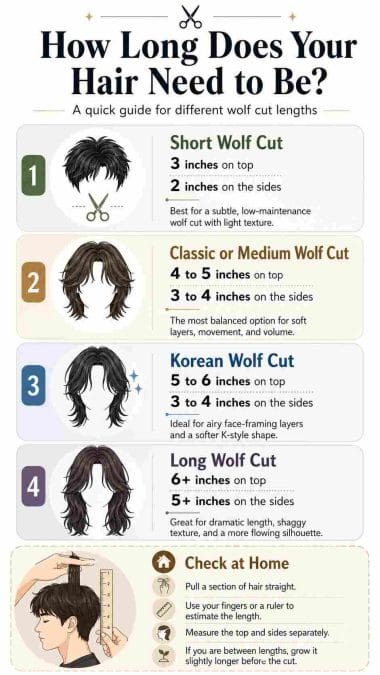
Check length at home using this method: pull a section of crown hair straight up between 2 fingers. Hair reaching the index finger (3 to 4 inches) supports a short wolf cut. Hair reaching the middle finger (4 to 5 inches) supports a classic or medium wolf cut. Scalp hair grows by about 0.5 inches per month, according to guidance on average scalp hair growth. A crew cut at 1.5 inches requires 6 to 7 months of growth before a classic wolf cut becomes achievable.
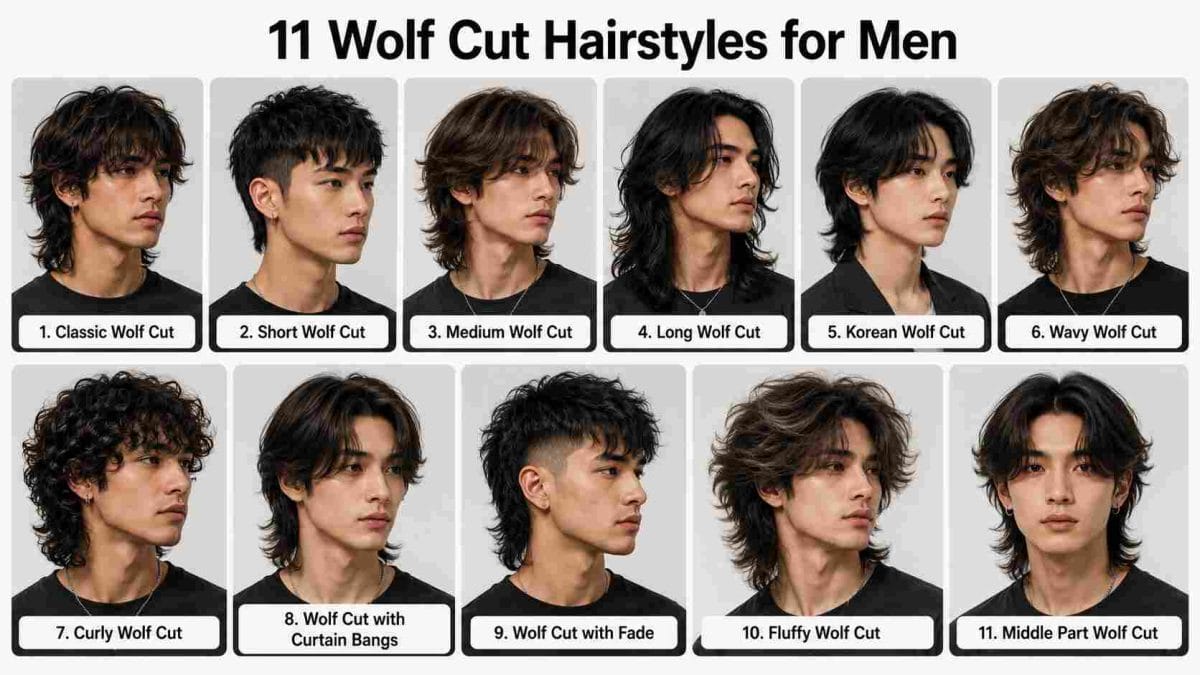
These 11 wolf cut variations cover every hair type, face shape, and length preference available in 2026. Men’s grooming interest continues to grow. NIQ men’s grooming sales data reported U.S. category sales of $7.1 billion. That’s a 6.9% rise from last year. TikTok and Instagram contributed to greater brand engagement.
The classic wolf cut has thick layers on top, about 3 to 4 inches long. These layers flow down to a soft, tapered nape that is 5 to 7 inches long, ending with feathered tips. It merges 1970s shag internal texture with 1980s mullet length graduation into 1 unified shape. Point cutting at the ends produces the piecey, feathered texture that defines this variation.
The short wolf cut has 2 to 3 inches of length on top. It fits nicely among other professional short haircuts. The short wolf cut also fits among other professional short haircuts for men. Also called the Pup Cut, it keeps the wolf cut’s crown lift and layered energy without collar-length commitment. Sides sit at 1.5 to 2 inches.

The medium wolf cut has 4 to 6 inches on top and 3 to 4 inches on the sides. This makes it the most versatile style. It falls just below the collar rather than grazing it. Hair grows at 0.5 inches per month according to the American Academy of Dermatology. A short cut needs 4 to 5 months to reach medium wolf cut length.
Thick, wavy textures work best for this style. Compare the length, layering, and upkeep of other long haircuts for men. Fine straight hair requires daily heat styling to maintain volume at this length.

The Korean wolf cut uses longer, softer crown layers with a subtle neck taper, producing a controlled and fluid finish. It differs from the Western version in 3 ways. First, it has softer layer transitions. Second, it features a clean tapered neckline. Lastly, it includes polished face-framing pieces. The Korean wolf cut matches perfectly with K-fashion’s neat grooming style. The Korean wolf cut also complements the polished grooming associated with the Ulzzang aesthetic.

The wavy wolf cut boosts natural waves with layers. These layers add movement and bounce, especially at the crown. The barber cuts the hair in its natural wavy state. Cutting it blow-dried straight prevents layers from aligning with the wave pattern. Use sulfate-free shampoo between washes to preserve natural wave integrity.
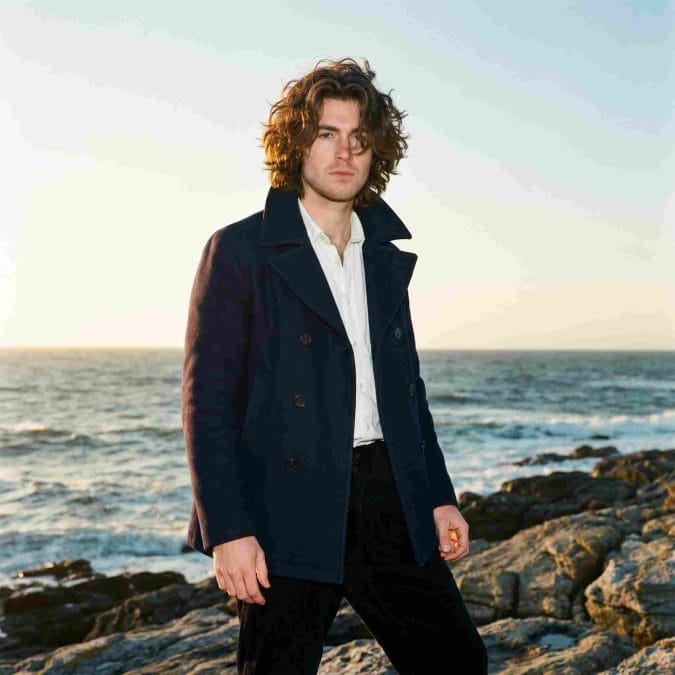
The curly wolf cut uses dry cutting to define curl clusters. It is cut 2 to 4 inches longer than your desired length. This technique takes into account 25 to 50% curl shrinkage. According to the DevaCurl training methodology, cutting curly hair wet produces unpredictable results. Razoring causes frizz on curly textures and must be avoided entirely.
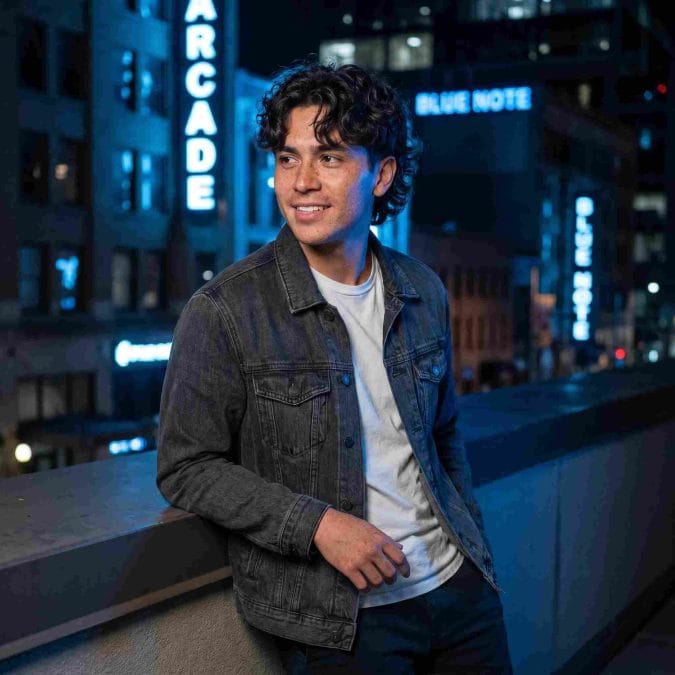
The wolf cut with curtain bangs features 4 to 5 inch, cheekbone-length bangs. These bangs are center-parted and blend smoothly into the side layers without any harsh separation. Point-cut ends create a feathered rather than blunt fringe finish. Bangs that split unevenly need dampening, a round brush re-blow-dry, and a light-hold spray to reset.

A mid fade stops at the temple, creating strong contrast. Compare fade heights, techniques, and grow-out timelines across different fade hairstyle types. The fade grows out within 2 to 3 weeks. This variation requires barber visits every 3 to 4 weeks rather than the standard 6 to 8 weeks.

The fluffy wolf cut gives great crown volume. It features short, razor-cut layers that are 2 to 3 inches long. These layers focus on the crown and face. Face-framing layers start at eyebrow length. The rounded silhouette merges 1970s shag fullness with wolf cut length contrast. Fine hair benefits most from this version.

The middle part wolf cut features a clean center part and shaggy layers on both sides, at least 5 to 6 inches long on top. This style offers a gentler disconnection compared to the classic version. It’s great for both casual and professional settings. You can wear it forward over your face or push it back with the product.

The wolf cut styling routine takes 3 to 5 minutes and follows 5 steps from towel-dry to finished look.
Complete the wolf cut routine in 5 steps:

These steps use the same men’s hair styling techniques covered in our detailed guide. This guide covers blow-drying direction, diffuser use, and product layering in detail.
Heat-free option (1 to 2 minutes): Apply sea salt spray to damp hair and scrunch once through mid-lengths. Flip the head upside down for 30 seconds to boost crown volume. Air-dry completely. This method suits wavy and curly textures (Type 2A to 3C). Straight hair (Type 1) requires blow-drying to achieve crown volume that air-drying alone cannot produce. Sleep on a silk or satin pillowcase to reduce friction overnight and prevent crown layers from flattening.
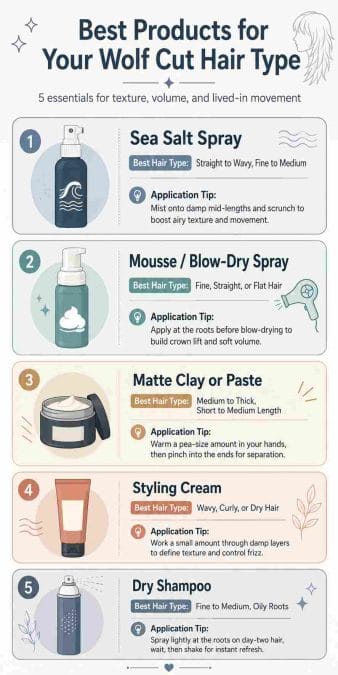
The wolf cut uses 5 product categories, each matched to a specific hair texture.
| Product | Function | Best For | Application |
| Sea salt spray (magnesium sulfate) | Creates gritty texture and locks strands apart | Wavy, medium to long hair | 3 to 5 sprays into damp hair before air-drying |
| Mousse or blow-dry spray | Adds lightweight root lift during heat styling | Straight and fine hair | Golf-ball-sized amount from roots to mid-lengths before blow-drying |
| Matte clay or paste (kaolin and bentonite clays) | Absorbs light and scalp oils for flexible, dry hold | All wolf cut variations | Pea-sized amount pressed into ends and layers |
| Styling cream | Controls frizz and smooths ends with flexible separation | Thick, coarse, and Korean wolf cuts | Pea-sized amount into mid-lengths on dry hair |
| Dry shampoo (natural starches) | Absorbs scalp oil and restores root lift | All textures between washes | Hold 6 to 8 inches from scalp, wait 60 seconds, massage in |
Our guide to men’s hair styling products compares clay, mousse, salt spray, and other options. It features brand recommendations for five categories, including clay, mousse, and salt spray. We highlight top picks for all hair textures.
Matte clay or paste is the most versatile product across all 11 wolf cut variations. A light-hold spray applied as a final step locks the shape for 8 to 12 hours.
3 products to avoid on any wolf cut:
The wolf cut can fit into a professional setting by making 3 adjustments. These changes lessen the surface texture but keep the layered structure intact.
Adjustment 1: Switch from matte clay to styling cream like Bumble and Bumble Grooming Creme or Kevin Murphy Free Hold. Styling cream smooths the outer layer surface. The layered shape underneath stays intact.
Adjustment 2: Blow-dry with a round brush directed downward instead of using fingers. This reduces crown volume by 30 to 40%. The cut looks groomed and controlled rather than rough and textured.
Adjustment 3: Apply a smoothing serum containing Argan oil to damp hair before blow-drying. Davines OI Oil helps control frizz, add shine, and soften hair without weighing it down.
Use a side part rather than a center part for a more structured silhouette. Tuck longer side layers behind 1 ear for a sharper profile. Keep the neckline clean. A fresh neckline makes the wolf cut look intentional in any professional environment. Avoid sea salt spray and texturizing powder on professional days. Both create a casual, gritty finish that does not suit office environments like finance, law, and consulting.
The wolf cut needs 4 maintenance actions:
Trim schedule: The crown layers, face-framing pieces, and textured ends are the shortest sections of the cut. They lose definition the fastest. This timeline shows what happens without consistent trimming:

A maintenance trim, or refresh appointment, lasts 15 to 20 minutes and costs $20 to $40 at many barbershops. It sets the crown height, updates the face-framing layers, point-cuts the ends, and cleans up the neckline.
Grow-out management: At 8 to 10 weeks, crown layers puff outward and layer disconnection flattens. Request these 4 specific actions at a refresh appointment:
This refresh extends the cut by 4 to 6 weeks before a full restyle is needed. On days when the cut looks flat between visits, dampen the crown with a spray bottle. Apply a small amount of mousse and blow-dry upward with fingers for 60 seconds. This resets crown volume without restyling the full head.
Wash frequency: The American Academy of Dermatology states that men with non-oily scalps should wash their hair 2 to 3 times a week. This is enough for most. Daily washing strips the natural sebum that provides grip, movement, and second-day texture. It also causes the scalp to produce more oil faster. Use a clarifying shampoo once per month to remove product buildup from clay, paste, and dry shampoo use. On non-wash days, use dry shampoo brands like Batiste, Living Proof Perfect Hair Day, or Klorane to absorb oil. A water-only rinse on workout days removes sweat without stripping natural oils.
Wash frequency, scalp health, and product buildup are essential for grooming.
Neckline care: If you neglect the neckline, the wolf cut might look accidental. This can happen even if the crown layers are styled well. The neckline grows out visibly within 2 to 3 weeks. The wolf cut pairs best with a natural, tapered neckline that follows the hairline. A hard blocked neckline creates a formal contrast that does not match the cut’s textured finish. The exception is the wolf cut with fade (Style 9), which uses a defined perimeter by design. Clean the neckline every 10 to 14 days using a trimmer. Most barbershops offer neckline cleanup for $5 to $15 between full visits.
5 ways to extend the life of the cut between visits:
The wolf cut has 7 common mistakes, each with a specific fix that restores the cut’s structure without a full restyle.

Mistake 1: Overwashing strips the natural scalp oil that provides grip, texture, and second-day quality. The American Academy of Dermatology confirms that washing your hair daily can strip away the scalp’s natural oil. This leads to dryness, flyaway hair, and loss of texture.
Fix: Reduce washing to 2 to 3 times per week. Switch to a sulfate-free shampoo. Use dry shampoo brands like Batiste or Living Proof on alternate days to restore root lift.
Mistake 2: Over-smoothing removes the crown lift and layer separation that define the style. Brushing the hair flat or using a flat iron daily collapses the textured structure.
Fix: Use fingers or a wide-tooth comb instead of a brush. Reserve flat irons for face-framing pieces only. Apply heat protectant before any heat tool use. Blow-dry with a diffuser to preserve natural texture.
Mistake 3: Heavy products on fine or straight hair weigh down crown layers and eliminate lift. Thick waxes, oil-based pomades, and high-shine gels collapse the layered structure. Product buildup from daily use adds weight that makes the crown fall flat over time.
Fix: Switch to Schwarzkopf Osis+ Dust It texturizing powder, Kenra Volume Mousse 12, or Oribe Dry Texturizing Spray. Apply to ends and mid-lengths only.
Mistake 4: Layers cut too short on curly hair cause 25 to 50% shrinkage, creating an uneven shape. Curly hair (Type 3A to 3C) springs upward when dry. Layers that look correct wet become dramatically shorter once the curls contract.
Fix: Request layers 2 to 4 inches longer than the desired visual length. Ask the barber to cut dry. Minimize thinning shears and remove bulk through strategic layering instead.
Mistake 5: The mushroom effect on thick straight hair when it puffs out at the sides instead of hanging down. Too much internal weight pushes the layers horizontally.
Fix: Request internal bulk removal at the mid-lengths. Use this exact request: “Thin out the internal bulk at the mid-lengths so the layers fall downward, not outward.” The barber uses slide-cutting or twist-razoring on 1-inch sections in alternating directions.
Mistake 6: Skipping the neckline makes the wolf cut look unintentional regardless of crown condition. Hair at the nape grows irregularly within 2 to 3 weeks. People notice unkempt necklines more than any other grow-out feature on a wolf cut.
Fix: Clean the neckline every 10 to 14 days with a trimmer. Book neckline-only appointments for $5 to $15 between full cuts.
Mistake 7: Not fixing a bad wolf cut correctly applies the wrong remedy to the wrong problem. Home-cut wolf cuts and miscommunicated salon cuts are the 2 most common sources of structural failure. Bring 2 to 3 reference photos to every corrective appointment. A skilled barber corrects most problems in 1 appointment lasting 20 to 30 minutes.
| Problem | Structural Cause | Barber Fix |
| Flat, lifeless silhouette | Excess side weight with no crown lift | Deep point-cutting at the crown to release weight and build lift |
| Harsh mullet-like separation | Severe length disconnect with zero graduation | Vertical texturizing shears blend the weight line throughout |
| Mushroom bulging at sides | Growing-out sideburns expanding outward | Block graduation (blending the side weight into the top layers) |
| Flat crown with no volume | Crown layers left too long or cut uniformly | Re-cut crown layers 1 to 2 inches shorter than surrounding lengths |
| Looks like a generic shag | No crown volume or layer disconnection | Create a visible transition between the short crown and longer sections |
| Thin, see-through ends | Over-thinning with texturizing shears | Grow out 4 to 6 weeks. Re-cut with point cutting only. |
| Uneven sides | Inconsistent technique or tilted head position | A different barber re-balances both sides with point cutting. Do not fix at home. |
When to adjust vs. when to start over: Most bad wolf cuts can be fixed with targeted adjustments at one appointment. A full re-cut is needed in two cases: if the overall length is too short or if the layering is so uneven that blending makes problems worse.
The wolf cut pairs with 3 beard lengths: stubble, medium beard, and full beard. Each length produces a different balance between the textured crown and the lower face.
No current competitor covers this pairing. The key principle is visual balance: hair volume above must complement beard density below. Mismatched proportions create an unbalanced overall appearance.
Stubble (1 to 3mm) suits all 11 wolf cut variations. It keeps the face visible and lets the crown volume and face-framing layers do their structural work. A facial-hair attractiveness study found that survey participants often rated heavy stubble highly. Trim stubble every 2 to 3 days. Use a trimmer set at 1 to 3mm for uniform length.
Medium beard (10 to 25mm) works best with the classic, long, fluffy, and wavy wolf cuts. The beard adds weight to the lower face and balances the textured volume above. Keep cheek lines clean. Define the beard neckline 2 fingers above the Adam’s apple. Trim every 5 to 7 days. Without sharp boundaries, the beard blends into the side layers and the overall shape looks undefined.
Full beard (25mm or more) requires a fade or taper at the sides. Pairing a long or fluffy wolf cut with a full beard and no fade creates unbroken texture from forehead to chest. The face loses definition entirely. Works best with the wolf cut with fade (Style 9), medium wolf cut, and short wolf cut. Trim and shape every 7 to 10 days. Apply beard oil daily to keep the full beard soft and separate from the hair.
Skaters love the wolf cut. The wolf cut also works with the relaxed, layered outfits associated with skater style. In fact, it’s one of their top recommended haircuts.
How a fade connects the wolf cut to the beard: A low or mid fade creates the cleanest transition between any beard length and the layered crown. The structure follows 3 distinct zones:
Without a fade, use point-cutting at the sideburns to gradually thin the density from beard weight into hair weight. A hard unblended line between sideburn and hair looks disconnected.
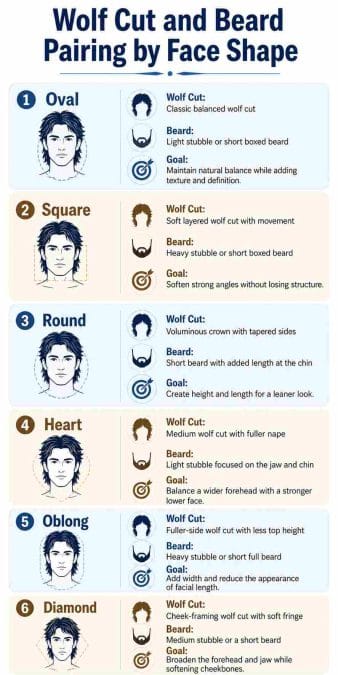
The universal rule: Match hair volume above with beard density below for face shape. Oval faces can use any combination. Other shapes should compensate by adding width where the face is narrow. Also, keep clean transition lines where density is highest.
The wolf cut’s layered style is among the 4 most color-responsive men’s haircuts in 2026. Color on layered hair appears in 3 to 5 levels. These levels are the crown, mid-lengths, face-framing pieces, interior layers, and perimeter ends. Each level catches light at a different angle. Copper remains a strong warm color direction for 2026, with L’Oréal trend coverage highlighting vibrant and muted copper tones. Color techniques produce 2 to 3 times more visual impact on a wolf cut than on a blunt or single-length cut.
Color placement changes with layered cuts. Men thinking about the wolf cut can compare it to other textured styles. For shorter textured alternatives, compare these French crop hairstyles.
The 4 best color techniques for the wolf cut are balayage, money piece, foil highlights, and color melt.
Balayage hand-paints color onto the surface of the crown and mid-length layers. It creates a natural sun-kissed gradient that moves with the hair. Best suited for medium and long wolf cuts where layers have enough length for color to flow naturally.
Money piece places lighter contrasting panels on the front 2 to 3 face-framing strands on each side. It draws attention to the curtain bangs or face-framing layers. The color is placed in isolated sections, so the grow-out is gradual and low-maintenance. Best suited for the wolf cut with curtain bangs and the middle part wolf cut.
Foil highlights place contrasting tones through the crown layers using traditional foil sections. They provide more precise lighting than balayage. Best suited for short and medium wolf cuts where the layers are shorter and more tightly spaced.
Color melt blends 2 to 3 tones from root to end. Examples include copper to caramel to blonde, black to ash brown, and chocolate to warm gold. The wolf cut’s layer graduation from short top to long back makes color melts appear more dimensional than on flat cuts.
The 4 trending color directions for the wolf cut in 2026 are:
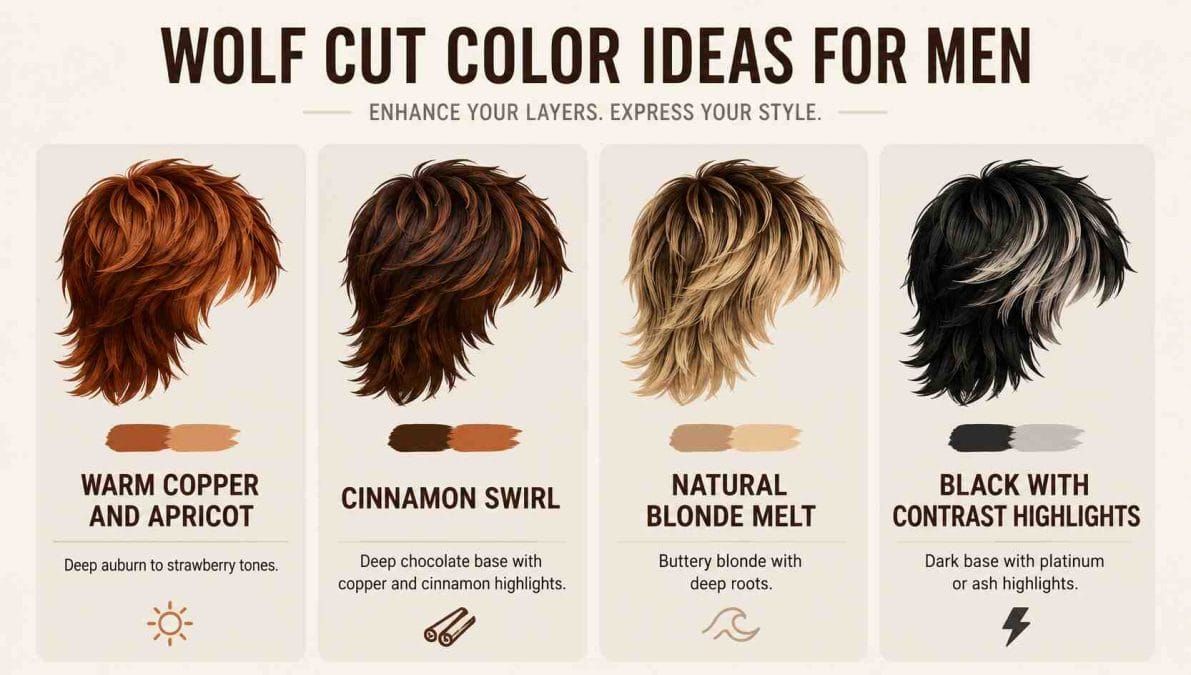
For color work, book a session with a professional colorist rather than a barber. Colorists skilled in balayage and color melt create results that barbers usually don’t provide.
6 specific requests to use at your color appointment:
Colored wolf cuts require 3 additional maintenance steps:
Balayage and color melts grow out gradually and need a color refresh every 12 weeks. Money pieces and foil highlights show regrowth at 6 to 8 weeks and need refreshing sooner.
Yes, the wolf cut is still worth getting in 2026 because textured men’s haircuts remain in demand. Longer styles are taking over. Shags, modern mullets, and layered wolf cuts are popular now. They replace stiff fades and rigid short cuts.
Improve your overall style, not just your haircut by starting with great grooming. Improve the rest of your routine with these men’s grooming essentials.
The style works across 3 style groups: musicians, skaters, and K-pop idols. It also adapts to straight hair, wavy hair, curly hair, curtain bangs, textured fringes, short lengths, and long lengths.
Consider the commitment before booking. Straight hair often needs mousse, texture spray, or blow-drying. Curly hair needs dry cutting. Grow-out needs trims because short crown layers lose shape first. Conservative workplaces may suit a medium wolf cut with cleaner styling.
Get a wolf cut in 2026 if you want volume, movement, and flexible styling value. Bring 2 to 3 reference photos and choose a barber experienced in layered cutting.
In conclusion, Wolf Cut Hairstyles For Men are a strong 2026 choice for volume, texture, and movement. The cut works because it can be adapted for straight, wavy, curly, fine, thick, short, medium, and long hair.
The right version depends on your face shape, hair length, density, routine, and styling comfort. A short wolf cut gives cleaner control. A Korean wolf cut gives a softer finish. A curly, wavy, or long wolf cut gives more natural movement. Maintenance, products, beard pairing, and color placement also shape the final result.
Choose the wolf cut that matches your hair type first. Then bring 2 to 3 reference photos and clear barber instructions to your next appointment.
A wolf cut is a layered men’s haircut with short crown layers and longer feathered ends. It blends the choppy texture of a 1970s shag with the length contrast of a 1980s mullet. The result is a bold, textured shape with volume, movement, and a deliberately undone finish.
The wolf cut came from Asian pop culture and became global through social media. South Korean actors, K-pop singers, Chinese idols, and Japanese anime helped shape its early image. TikTok and Instagram pushed the style into global men’s grooming during the early 2020s.
No, a wolf cut is not the same as a mullet. A mullet uses a sharper short-front, long-back contrast. A wolf cut uses heavier crown layers, softer transitions, and more texture through the sides and back. It looks more blended than a traditional mullet.
You need at least 3 to 4 inches on top for a short wolf cut. A fuller wolf cut works better with 5 to 6 inches. If you are growing it out, book a shape-and-trim appointment after 3 months to control the grow-in phase.
The wolf cut suits oval, square, and heart face shapes best. Oval faces suit most versions. Square faces benefit from soft layers. Heart faces suit chin-level movement. Round faces need longer face-framing layers to add angles and reduce fullness.
Yes, fine or thinning hair can work with a softer wolf cut. Ask for blended layers, not heavy thinning. Avoid razor cutting on fine hair because it can make the ends look weaker. The wolf cut adds visual fullness, but it does not treat hair loss.
Yes, straight hair can work with a wolf cut when the crown has enough lift. Straight wolf cuts look cleaner and sharper than curly versions. Use lightweight mousse, a round brush, and a blow dryer. Avoid heavy waxes because they flatten the layers.
A Korean wolf cut is softer and cleaner than a Western wolf cut. It has smoother layers, airy movement, and a subtle neckline taper. The Western version usually has choppier layers, heavier texture, and a rougher finish. Bring a reference photo to your barber.
The best wolf cut product depends on your hair type. Straight hair works best with mousse or matte clay. Wavy hair works best with sea salt spray. Curly hair works best with curl cream or lightweight mousse. Avoid wet-look gels because they flatten the crown.
You need a diffuser only if your hair is wavy or curly. A diffuser dries waves and curls without breaking their pattern. Straight hair does not need one. Use a round brush and blow dryer instead to build crown volume.
Trim a wolf cut every 6 to 8 weeks. The crown layers grow out first and lose shape quickly. After 10 weeks, the haircut can start looking flat or shapeless. A maintenance trim resets the layers without changing the full style.
An unmaintained wolf cut loses crown volume, feathered ends, and clear shape. The layers merge together and the haircut starts looking accidental. Regular trims keep the texture intentional and prevent the back from becoming too heavy.
Yes, the wolf cut remains relevant in 2026 because textured men’s haircuts are still in demand. The style has moved beyond its TikTok phase. Current versions use softer layers, cleaner shaping, better fades, and more controlled styling.
Choose a barbershop for fades and a salon for longer layers or color work. Barbers handle tapers, fades, and neckline cleanup well. Salon stylists are better for Korean wolf cuts, long wolf cuts, perms, balayage, and detailed texture cutting.


