Physical Address
Islamabad, PK
Physical Address
Islamabad, PK


A good skin routine is short, not long. A few steps, in the same order, done gently, beat a long list that gets skipped. Most men do not need a shelf full of jars. They need a routine they will actually do, morning and evening, without thinking hard about it.
This guide gives you that routine. It covers skin only. For general grooming beyond skin, see our grooming essentials guide. For beard and shaving detail, see our beard and shaving basics guide. What follows is the skin routine itself: 5 steps, in order, in plain words.
Before you pick a routine, look at your own skin. You do not need a test for this. You need a mirror and a little attention.
Skin is often described in four plain groups. Oily skin tends to look shiny, mainly in the middle of the face — the forehead, the nose, and the chin. Dry skin tends to feel tight after washing, and it can flake. Combination skin is oily in places and dry in others. Sensitive skin reacts easily. It may feel sore or look red after a wash that feels fine to someone else.
Check in a simple way. Wash gently, then notice how your skin feels right after, and again later in the day. Does it feel tight? Does it look shiny by midday? Does it react to a new wash? Those answers point to a group. No group is a diagnosis. Groups are only a starting point.
Many men sit between groups. Skin can also change. Cold, dry air can make skin feel drier. Hot, humid air can make it feel oilier. So do not lock yourself into one label. Use the label to guess how gentle to be and how much moisture to use, then adjust by watching. The routine below works for all four groups, with small changes in how much you use and how gently you wash.
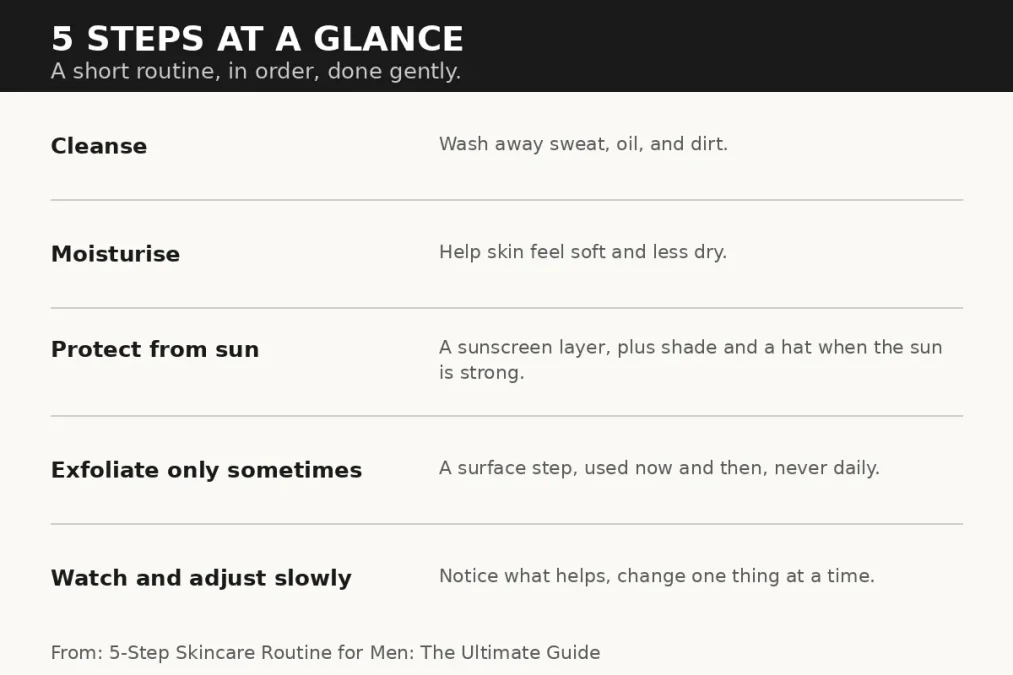
Read the step that you are unsure about, or read all five in order. They build on each other.

Cleansing is washing away the day’s sweat, oil, and dirt. It is the first step, morning and evening. Everything else in the routine sits on clean skin.
Use lukewarm water in general terms — not hot, not cold. Wet your face. Use a small amount of a cleanser category wash. Spread it with light hands, over the whole face. Rinse well. Pat dry with a clean towel. Do not rub hard.
The wash should be short. A long wash does not clean better. It tends to dry the skin out. Light hands matter more than a strong wash. If your skin feels clean and calm after, the wash did its job.
Tight, dry feeling after washing often means the wash was too harsh or too long. It does not mean you need more steps. It means you need a gentler wash. Simplify first. A gentle cleanser category wash, lukewarm water, and a short wash cover most cases. If tightness keeps coming back even with a gentle wash, notice it and keep it in mind for Step 5.
Moisturising is the step that helps skin feel soft and less dry. It comes right after cleansing, morning and evening. A moisturiser category layer sits on clean skin and helps it feel calm.
Use a small amount. Spread it evenly over the face, in a light, even layer. It often feels best on skin that is still slightly damp after washing, but that is a matter of feel, not a rule. If damp skin feels odd to you, dry skin works too. The point is an even, light layer, not a thick one.
Oily skin still often likes a light layer. Dry skin tends to want a little more. Start small in both cases. You can always add a little more. A heavy layer does not help more. It just sits on the skin and feels greasy.
If skin feels greasy or sticky, use less. If it still feels tight after moisturising, the wash may be too harsh, or the layer may be too light. Change one thing at a time. Do not add three new categories to fix one tight feeling. Fix the wash first, then the amount, then the category — one change, then watch.

Sun protection is the daytime step. It comes last in the morning routine, after cleansing and moisturising. A sunscreen category layer is the main part of it. Shade and a hat also help when the sun is strong. Together, they are the plain habits that limit sun exposure in the daytime.
Apply the sunscreen category layer in the morning, as the last daytime step, in an even layer over the face. Put it on before you go out, so it is in place when you step into daylight. That is the whole habit. No number is promised here — no factor number, no clock, no amount. This guide stays with the habit itself: an even layer, in the daytime, as part of the routine.
Cloudy days still bring daylight. So treat sun protection as a daytime habit, not a sunny-day-only habit. A grey sky does not mean the step can be skipped. If you spend a long time outside, shade and a hat are simple extra help, and they cost nothing.
If a label’s claims sound medical — if it promises to treat or prevent a skin condition — that claim is outside this guide. This guide makes no such promise. Sun protection here is a routine habit, stated in plain terms, not a medical claim. If you have a skin problem that worries you, Step 5 says what to do: ask a doctor.
Exfoliation is a surface step. An exfoliant category wash or layer helps remove surface dullness, so skin can look fresher. It is an extra step, not a core step. The key word in its name here is “sometimes.” It is never a daily step.
Use a light touch. Use it now and then, with days left between uses. Do not scrub hard. Do not use it on sore skin. After exfoliating, go back to the simple steps: cleanse gently, moisturise lightly. That is all. The occasional step should never push the core steps out.
Soreness or redness after exfoliating is a sign to stop. Go back to the simple steps and let skin settle. Do not push through soreness, hoping skin will get used to it. More often does not mean better here. In fact, more often is the commonest way this step goes wrong. If soreness keeps coming back even with gentle, occasional use, drop the step. A routine without exfoliation is still a full routine. The core steps — cleanse and moisturise — carry the routine on their own.
Watching and adjusting is the habit that holds the other four steps together. It is not a wash or a layer. It is noticing how your skin responds, and changing one thing at a time. Without it, a routine is guesswork. With it, a routine slowly fits your own skin.
When you try something new, change only that one step. Keep everything else the same. Give it time. Notice whether skin feels better, worse, or the same. That answer tells you whether to keep the change or drop it. If you change three things at once and skin gets worse, you will not know which change caused it. One change at a time is slower, but it is honest.
Keep notes in your head, not on paper, if that suits you. “This wash felt tight, so I went gentler” is enough. “This layer felt greasy, so I used less” is enough. Small notes like these build a routine that fits you, not a routine copied from someone else.
Lasting soreness, rash, or flaking belongs to a doctor, not to a grooming guide. This guide gives no diagnosis and no treatment for skin problems. General care covers normal dryness, tightness, and mild irritation that clears when you simplify. Problems that stay, spread, or keep coming back are different. They are reasons to ask a doctor, plainly and soon, rather than to add another category and hope.
Order matters because it turns the routine into a habit. The same order, every day, needs no thought. Here it is, plainly:
Morning: cleanse, moisturise, protect from sun.
Evening: cleanse, moisturise.
Exfoliation, when you use it, does not replace any step. It is an extra, occasional step, done gently, with days between uses. It never becomes a daily step, and it never comes before cleansing.
That is the whole order. Two steps in the evening. Three in the morning. One occasional step, now and then. A routine this short is easy to keep, even on busy days. And a short routine kept beats a long routine skipped.
A routine is not one fixed list for every day. Small changes fit the day you are having. The core steps stay the same. Only the touch changes.
After sweat, rinse or wash, then moisturise lightly, in the same gentle way. Do not scrub harder because you sweated more. Sweat is washed away by a normal, gentle wash. A harder wash after a workout tends to dry skin out, not clean it better.
On shaving days, keep the routine gentle around a fresh shave. Wash lightly. Moisturise lightly. Do not exfoliate on the same day as a close shave if your skin feels tender. For shaving detail itself — how to shave, how to shape, how to care for skin under a beard — see our beard and shaving basics guide. That detail lives there, not here, and it is not repeated.
With the seasons, adjust by feel. Dry, cold air tends to call for a little more moisture. Hot, humid air tends to call for a lighter layer. Change one thing at a time, as in Step 5, and watch how skin responds. A routine that fits winter may feel heavy in summer, and that is normal. The routine is not failing. The weather changed, so the amount changed with it.
Picking a routine can feel confusing because shelves are full of names. The way through it is simple: pick by category first. The category tells you the job. A cleanser category wash cleans. A moisturiser category layer moisturises. A sunscreen category layer is the daytime step. An exfoliant category layer is the occasional step. That is all you need to build the routine above.
Read the label for the category, and for plain words like gentle or light. Sensitive skin often suits gentle, plain categories. That is a tendency, not a rule, and it is worth trying if your skin reacts easily. A long list of claims on the front tells you little about whether a category will suit you. Your own skin, watched over time, tells you more.
Keep the count low. A routine with a few categories is easier to keep, and easier to fix when something irritates you. If you have five categories and skin gets sore, you will not know which one caused it. If you have three, you will find out fast. Simple is not a compromise here. Simple is the point.
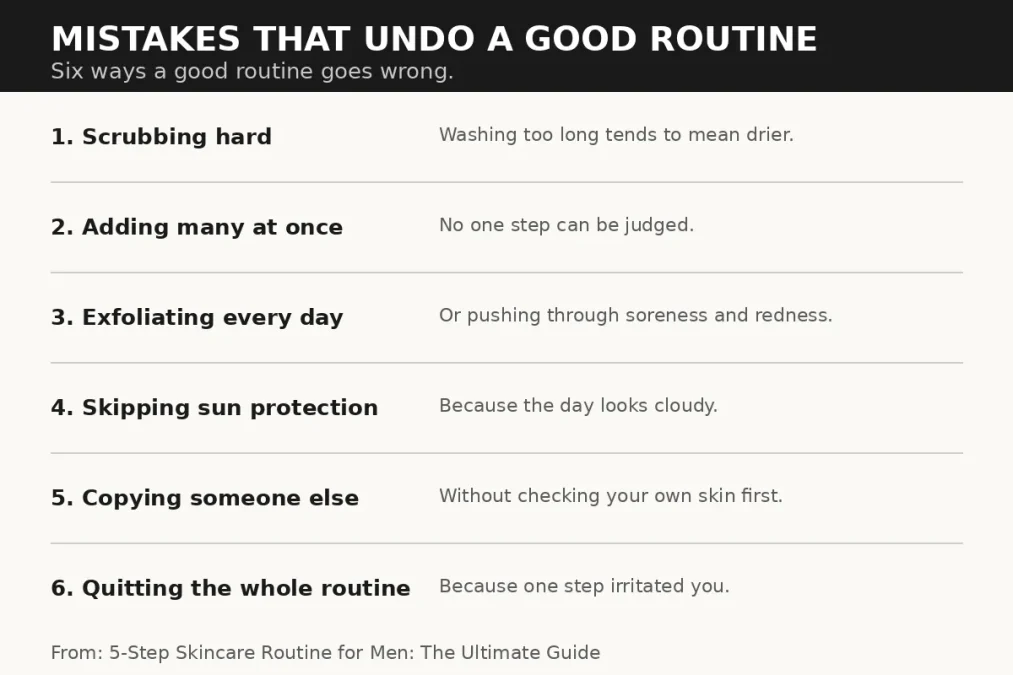
Each of these mistakes has the same fix: go back to the simple steps, change one thing, and watch. A routine is easy to repair when it is short. That is one more reason to keep it short.

A routine only works if it survives busy days. So make it easy to keep. Keep the categories where you wash, in order, so the routine takes minutes and needs no thought. Morning: cleanse, moisturise, protect from sun. Evening: cleanse, moisturise. That is it.
Judge the routine by how skin feels over time, not by one day. One tight morning does not mean the routine failed. One shiny afternoon does not mean it failed either. Skin changes with weather, sleep, and sweat. Watch the pattern over time, not the single day.
When life gets busy, keep the core steps and let the occasional steps wait. Cleanse and moisturise, morning and evening, carry the routine. Exfoliation can wait. A new category can wait. A short routine kept, day after day, beats a long routine that gets skipped for a week and then restarted in a rush. For general skin-care guidance, see the American Academy of Dermatology’s skin care basics.
For general grooming beyond skin, see our grooming essentials guide. For beard and shaving detail, see our beard and shaving basics guide. For the broader picture of haircuts, see our men’s haircuts guide.
A skincare routine for men does not need to be long. It needs to be short, in order, and gentle: cleanse, moisturise, protect from sun in the daytime, exfoliate only sometimes, and watch and adjust slowly. Morning adds sun protection, evening drops it, and the rest stays the same. Read your skin in plain terms, pick by category, change one thing at a time, and drop any step that irritates you. If a problem lasts, ask a doctor. That is the whole system, and it is easy to keep.
A few steps, in the same order, done gently: cleanse, moisturise, and protect from sun in the daytime, plus exfoliation only sometimes, and watching and adjusting slowly. Morning adds sun protection; evening drops it. That is the whole routine — a short routine kept beats a long routine skipped.
Look in a mirror and notice how your skin feels after washing and later in the day. Oily skin tends to look shiny, mainly in the middle of the face. Dry skin tends to feel tight and can flake. Combination skin is oily in places and dry in others. Sensitive skin reacts easily. Many men sit between groups, and skin can change with the weather — the label is a starting point, not a diagnosis.
Not really. The routine stays the same, with one difference: sun protection is a daytime step. So morning is cleanse, moisturise, protect from sun, and evening is cleanse, moisturise. Keeping the same order each day turns the routine into a habit.
Yes, as a daytime habit. Cloudy days still bring daylight, and this guide treats sun protection as a daytime step, not a sunny-day-only step. Shade and a hat also help when the sun is strong. No factor number or reapplication clock is promised here.
Only sometimes, never every day. Use a light touch, leave days between uses, and stop at once if your skin feels sore or looks red. Soreness or redness after exfoliating is a sign to go back to the simple steps — more often does not mean better here.
That often means the wash was too harsh or too long. Simplify: use a gentle cleanser category product, lukewarm water in general terms, light hands, and a short wash, then moisturise lightly. Do not fix dryness by adding many new steps at once.
Stop that one step and go back to the simple routine. Change one thing at a time, so you can tell what helped and what irritated. If soreness, rash, or flaking lasts, ask a doctor — this guide gives no diagnosis and no treatment.
In small ways, not as a new routine. After sweat, rinse or wash and moisturise lightly, without scrubbing harder. On shaving days, keep the routine gentle around a fresh shave, and see the beard hub for shaving detail. In dry, cold air, skin tends to want a little more moisture; in hot, humid air, a lighter layer tends to suit better. Adjust by feel, one change at a time.