Rarest Classic Watches: 5 That Sold for Millions

Table of Contents

I. What the Rarest Classic Watches Reveal About Horological History

Five of the rarest classic watches reveal that value depends on a few key factors. These include production volume, case material, provenance, and mechanical complexity. Age is secondary to these criteria. We can assess these five watches using these four measurable factors:

  • Production numbers
  • Case material
  • Provenance
  • Mechanical complexity
What the Rarest Classic Watches Reveal About Horological History
Classic watch rarity factors

Production volume determines rarity. The Patek Philippe Ref. 1518 was produced in 281 total examples. Four of those examples exist in stainless steel. A watch produced in the thousands is not rare, regardless of age.

Auction prices confirm scarcity levels. The Patek Philippe Grandmaster Chime Ref. 6300A-010 sold for CHF 31 million at Christie’s Geneva in November 2019. This sale set the record for the highest price ever paid for a watch at auction, as noted in the Christie’s Geneva — Only Watch 2019 auction record. In November 2025, a stainless steel Patek Philippe Ref. 1518 from 1943 sold for USD 17,631,075 at Phillips Geneva. This set a new auction record for any vintage Patek Philippe wristwatch.

Rarity in classic watches develops from three primary sources:

  • Restricted production limits the total number of examples
  • Historical circumstances create unintentional rarities
  • Provenance establishes a documented ownership history that distinguishes specific examples from identical models

Patek Philippe, Rolex, and Vacheron Constantin made at least five ultra-rare models each. All had fewer than 300 examples produced. Certain case material variants have as few as four confirmed surviving examples. In the 1940s, Italy was a key market for Swiss luxury goods. However, a gold embargo during the war limited the materials watchmakers could send. Manufacturers viewed steel as inferior to gold, so they moved complex movements into stainless steel cases. This made those pieces rare by accident. The Patek Philippe Ref. 1518 and Ref. 2499 are two documented examples of this pattern.

Provenance is the documented record of a watch’s ownership history. Verified ownership by a historical figure makes one example stand out from all other examples of that model. For instance, Bao Dai, the last emperor of Vietnam, owned a Rolex Ref. 6062, making his specific watch unique.

This section covers the five rarest classic watches ever made:

  • Patek Philippe Henry Graves Supercomplication
  • Patek Philippe Ref. 1518 in stainless steel
  • Bao Dai Rolex Ref. 6062
  • Rolex Ref. 4113 Split-Seconds Chronograph
  • Vacheron Constantin Chronometer Royal Ref. 4907

Experts test each watch based on four factors: production numbers, case material, provenance, and mechanical complexity.

Cited data include verified auction records, confirmed production records, and documented surviving examples.

II. The 5 Rarest Classic Watches Ever Made

The five rarest classic watches have unique rarity factors:

  • Fewer than 300 were made
  • Only a few still exist
  • They have documented provenance
  • They have more than 20 mechanical complications

Each watch is assessed using four rarity factors: production numbers, case material, provenance, and mechanical complexity.

The 5 watches are:

  • Patek Philippe Henry Graves Supercomplication
  • Patek Philippe Ref. 1518 in stainless steel
  • Bao Dai Rolex Ref. 6062
  • Rolex Ref. 4113 Split-Seconds Chronograph
  • Vacheron Constantin Chronomètre Royal Ref. 4907
5 Rarest Watches Comparison Table

1. Patek Philippe Henry Graves Supercomplication

Patek Philippe Henry Graves Supercomplication

The Patek Philippe Henry Graves Supercomplication is the most complex watch ever made by hand. It has 920 parts and 24 complications, as confirmed in the Sotheby’s official auction catalog, Lot 345. A complication is any function a watch performs beyond displaying hours and minutes. The watch was completed in 1932. Henry Graves Jr., a New York banker, received it in 1933.

Three key complications include:

  • Westminster chimes
  • A perpetual calendar accurate until the year 2100
  • A celestial map of the night sky above Graves’s Fifth Avenue apartment, adjusted to his exact geographic coordinates

The Origins of the Henry Graves Supercomplication

Henry Graves Jr. and American car maker James Ward Packard both aimed to order the world’s most complicated watch from Patek Philippe. Packard’s request came first in 1925. Graves followed with his order in 1927. He won the competition when Patek Philippe delivered his watch in 1933 after eight years of effort. Sadly, Packard died in 1928, five years before Graves received the record-breaking movement.

What Did the Henry Graves Supercomplication Sell For?

The watch sold for $24 million at Sotheby’s in Geneva in November 2014. This set a world record for the most expensive timepiece sold at auction at the time. The Patek Philippe Grandmaster Chime Ref. 6300A-010 exceeded this record in November 2019, selling for CHF 31 million.

Rarity Factors:

  • Production: 1 example made
  • Case material: 18K gold
  • Provenance: Commissioned and owned by Henry Graves Jr., a prominent American banker and watch collector
  • Complexity: 24 complications across 920 individual parts

2. Patek Philippe Ref. 1518 in Stainless Steel

Patek Philippe Ref. 1518 in Stainless Steel

The Patek Philippe Ref. 1518 in stainless steel is the first mass-produced perpetual calendar chronograph wristwatch. Today, only four known examples in stainless steel exist, as confirmed by Phillips — Patek Philippe Reference 1518 in Steel. For collectors aiming for this market tier, our guide to Top Entry-Level Luxury Watches highlights key models. These watches bridge accessible collecting and the exclusive world of auction records. Mass-produced means this model was part of a catalog, not a one-off commission. A perpetual calendar adjusts automatically for different month lengths and leap years without manual changes. From its launch in 1941 to 1954, only 281 pieces were made. Most were in yellow or pink gold, but some clients requested stainless steel. Professionals like doctors and engineers chose these durable cases for their complex movements.

Stainless steel is the rarest case material for mid-20th century complex Patek Philippe models. That the Patek Philippe Museum in Geneva holds no stainless-steel examples of the Ref. 1518 shows that the manufacturer’s archive has no surviving example in this material.

Two of the four known stainless-steel examples have a documented wartime history. Both watches reached Budapest in February 1944. This was during the German military retreat and the Soviet advance from the east. Both watches survived the conflict and remain in existence today.

What Did the Ref. 1518 in Stainless Steel Sell For?

A stainless-steel Ref. 1518 from 1943 sold for CHF 14,190,000 ($17,631,075) at Phillips Geneva in November 2025. The auction was titled “Watches: Decade One.” 1,886 registered bidders from 72 countries participated. Five bidders competed across 9 minutes of bidding. A telephone bidder secured the lot. This is the highest price ever paid for a vintage Patek Philippe wristwatch at a public auction. The result exceeded the previous record of CHF 11,002,000, set at the same auction house in 2016.

Patek Philippe Ref. 1518 in Stainless Steel
Patek Philippe Ref. 1518 Auction Timeline

Rarity Factors:

  • Four known surviving examples in stainless steel
  • Documented wartime ownership history from Budapest, February 1944
  • First serially produced perpetual calendar chronograph in wristwatch history

3. Bao Dai Rolex Ref. 6062

Bao Dai Rolex Ref. 6062
Bao Dai Rolex Ref. 6062 emperor watch

The Bao Dai Rolex Ref. 6062 was once the most valuable Rolex watch ever sold at auction. It features a unique dial. Nguyen Phuc Vinh Thuy, known by his royal title Bao Dai, was the last Emperor of Vietnam. He purchased the watch in 1954. The Ref. 6062 includes an 18-karat yellow gold case, a triple calendar, and a moonphase display. Diamond hour markers appear only at even-numbered hour positions on this example.

3 confirmed examples of the black-dial Ref. 6062 with diamond indexes exist. The Bao Dai is unique, featuring diamond markers at even hours only.

What Did the Bao Dai Rolex Ref. 6062 Sell For?

Phillips Geneva sold the watch in 2017 for $5,062,500. The same watch sold in 2002 for $235,000. The price increased by 2,051% over 15 years. The appreciation reflects the market premium assigned to verified imperial provenance.

Rarity Factors:

  • Only one known example with this specific dial configuration
  • Directly commissioned by the last Emperor of Vietnam in 1954
  • Documented ownership by a named historical figure
  • 2,051% price appreciation over 15 years of auction records

4. Rolex Ref. 4113 Split-Seconds Chronograph

Rolex Ref. 4113 Split-Seconds Chronograph
Rolex Ref. 4113 Split-Seconds Chronograph Watch

The Rolex Ref. 4113 is the only split-seconds chronograph ever made by Rolex. It was produced in 1942, with only 12 examples created. Of these, eight are confirmed to still exist. This “rattrapante” (or split-seconds) complication features two overlapping seconds hands. One can be stopped independently, letting you measure two time intervals at the same time. To meet the timing needs of motorsport professionals, this model features a 44mm stainless steel case. This size was unusually large for 1942, when the standard case size was only 36mm to 38mm.

“Rolex didn’t sell these 12 examples to the public; instead, it sent them to professional racing teams and drivers for competitions, as confirmed in Phillips — Rolex Reference 4113, Lot 56.”

What Did the Rolex Ref. 4113 Sell For?

A confirmed Ref. 4113 example sold in 2016 for approximately CHF 2.41 million, as recorded by Phillips — Rolex Reference 4113, Lot 56.

Rarity Factors:

  • 12 total examples produced
  • 8 confirmed surviving examples in public records
  • No public retail distribution by Rolex
  • The only split-seconds chronograph in Rolex’s manufacturing history
  • 44mm steel case, larger than the 36mm to 38mm standard of 1942

5. Vacheron Constantin Chronometer Royal Ref. 4907

Vacheron Constantin Chronometer Royal Ref. 4907
Vacheron Constantin Chronometer Royal Watch

The Vacheron Constantin Chronometer Royal Ref. 4907 has one confirmed surviving example. Vacheron Constantin introduced the Chronometer Royal series in 1907. A chronometer is a high-precision watch that has passed rigorous timing tests to ensure accuracy. This white gold reference has incomplete production records. This fits with early 20th-century practices. Back then, Swiss manufacturers often did not use standard logging methods.

The single known example appeared at auction in unrestored, factory condition. Its dial, movement, and case are all unmodified. This confirms the watch’s authenticity and maintains the historical value that collectors appreciate. These original parts are exceptionally rare.

Rarity Factors:

  • 1 publicly confirmed existing example
  • No verified total production number in available records
  • White gold case material
  • Unrestored original condition across dial, movement and case

III. How History Created Accidental Watch Rarity

Three types of historical events created unintentional watch rarity. They forced manufacturers to make unique designs. Each design was one of a kind. These include United States import tax laws in the 1960s, the Cuban Revolution in 1959, and the Swiss Quartz Crisis between 1969 and 1983. Each event created watches that served as practical market adaptations at the time. Now, they are some of the rarest finds on the secondary market.

How History Created Accidental Watch Rarity
Historical events accidental watch rarity timeline

1. The 14-Karat Gold American Market Rolex

In the 1960s, U.S. import tax laws raised duties on 18-karat gold watches. Rolex made special 14-karat yellow gold models for the American market. They used lower purity to lower taxable value. This helped keep retail prices affordable. By avoiding excessive price hikes, Rolex maintained its market presence and prestige among American buyers. Rolex produced references including the Daytona Ref. 6241 in 14-karat yellow gold. Distribution was limited to the American market. Total production of 14-karat gold models was less than that of stainless steel or 18-karat gold references.

A 14-karat gold Rolex Daytona Ref. 6241 sold for $350,000 at Phillips Geneva in 2022. This price shows the rarity premium for American market versions. The case material reduced the original retail price in 1965. The same case material creates measurable scarcity today.

Rarity Factors:

  • Distribution limited to the United States
  • Lower total production than equivalent stainless steel or 18-karat gold references
  • Rolex did not offer these specific reference numbers in other case materials in later catalogs

2. The Cuban Revolution and Riviera-Signed Rolexes

Before the Cuban Revolution in 1959, Riviera was a high-end jeweler in Havana. They sold Swiss watches with their signature on the dials. When Fidel Castro’s government took power in January 1959, luxury imports stopped. Riviera then ceased private operations. This led to a limited stock of Riviera-signed Rolexes. No more watches entered the Cuban market after that date. Every surviving example is linked to this pre-revolutionary era.

Public records do not verify the exact number of surviving Riviera-signed Rolex dials. The Riviera signature confirms three key facts. First, it shows the point of sale. Second, it identifies the distribution market. Finally, it notes the production period, which ended in January 1959.

Geopolitical events halted the supply of these watches; now, they are rare collectibles.

  • The Iranian Revolution in 1979 stopped Western luxury goods from entering Iran
  • Political changes in Southeast Asia during the 1970s closed many regional retailers

Rarity Factors:

  • Hard production cutoff established by the January 1959 Cuban Revolution
  • Retailer-signed dial confirming a specific point of sale, market, and period
  • Surviving examples with no public production record

3. The Quartz Crisis and the Patek Ref. 3587/2

The Swiss Quartz Crisis from 1969 to 1983 led to at least three rare Patek Philippe case designs. One of these is the Reference 3587/2. Early quartz movements were bigger than standard mechanical calibers. This made Swiss makers design larger cases to fit them. The bracelet is built right into the watch case. For the Reference 3587/2, it features large perforated links. Collectors refer to this link pattern as the “cheese grater” configuration.

16 Swiss watch manufacturers formed the Centre Electronique Horloger (CEH) consortium in 1969. Members included Patek Philippe, Rolex, and Omega. The consortium created the Beta 21, the first Swiss quartz movement. The Federation of the Swiss Watch Industry (FHS) keeps historical production and export data from this era. Their records show how the quartz transition changed manufacturers. The Beta 21 movement was bigger. It had a larger diameter and height than the mechanical calibres Patek Philippe used in regular production. Patek Philippe made the Reference 3587/2 with a larger case and a built-in bracelet. This was needed to fit the movement properly.

Confirmed production numbers for the Reference 3587/2 are not public. Its rarity stems from three distinct factors:

  • The Beta 21 movement had a short production window; it was commercially relevant for about four years. After that, more advanced and compact quartz movements replaced it
  • Aesthetic departure from Patek Philippe’s standard case proportions and design language
  • Low sales volume resulted in fewer examples entering private ownership. This perceived rarity often encourages preservation. This helps existing pieces survive better. Collectors typically prioritize maintaining rare items in their original condition

Watches with low original sales numbers are naturally rare. During the Quartz Crisis, manufacturers often dismantled or repurposed unsold or returned inventory.

Rarity Factors:

  • Undisclosed production numbers
  • Short Beta 21 production window of approximately four years
  • Oversized integrated case required by the dimensions of the Beta 21 movement
  • Low original consumer demand has limited the number of surviving examples in private circulation

IV. Stealth Wealth Watches and Hidden Complications

Stealth wealth watches look simple on the outside. However, they hide complex and rare internal movements featuring complications. This philosophy of understated quality over visible display mirrors a broader approach to men’s style; one documented in our Exclusive Men’s Guide To Old Money Style Mastery. The same restraint that defines a plain-dialed Blancpain defines an entire way of dressing. These watches are rare due to four reasons: limited production, special case materials, a documented history, and complex mechanics. Notable makers include Blancpain, Gérald Genta, Breguet, and F.P. Journe.

1. Blancpain Minute Repeater in Platinum

The Blancpain Minute Repeater in platinum is a key example of a stealth wealth watch. This minute repeater complication uses over 200 parts to chime the time on demand. This watch is rare for three main reasons: its platinum case, low production numbers, and the craftsman’s signature.

2. Gérald Genta Skeleton Minute Repeaters

Gérald Genta was a well-known watch designer. He designed famous pieces like the Patek Philippe Nautilus and the Audemars Piguet Royal Oak. Their history and design legacy are detailed on the Audemars Piguet — Royal Oak Heritage page. His skeletonized minute repeater perpetual calendars are some of his rarest pieces. They date back to the early 1990s and combine these three complex features. They were produced in a small, independent atelier, and no two examples are identical. Each piece has unique component variations, including different crystal types and crown designs.

3. Breguet Watches from the Daniel Roth Period

Breguet watches produced from 1980 to 1989 are highly collectible. This 10-year production window is rare. These watches feature unique hand-finishing techniques used by master watchmaker Daniel Roth. Collectors identify Roth-period pieces by two main signs. First, they have smooth case backs. Second, they feature detailed movement finishing. This era also had complications, like perpetual calendars and tourbillons, such as the reference 3350.

4. F.P. Journe Early Brass Movement Pieces

Early F.P. Journe watches, made from 1999 to 2002, are rare. They feature brass movements, a material later replaced by 18-karat gold. The first production examples are even rarer because they feature a straight Côtes de Genève finish, which was later changed to a circular pattern. The manufacturer does not publicly list the exact production figures for this straight finish.

V. Materials That Define Rarity in Watches

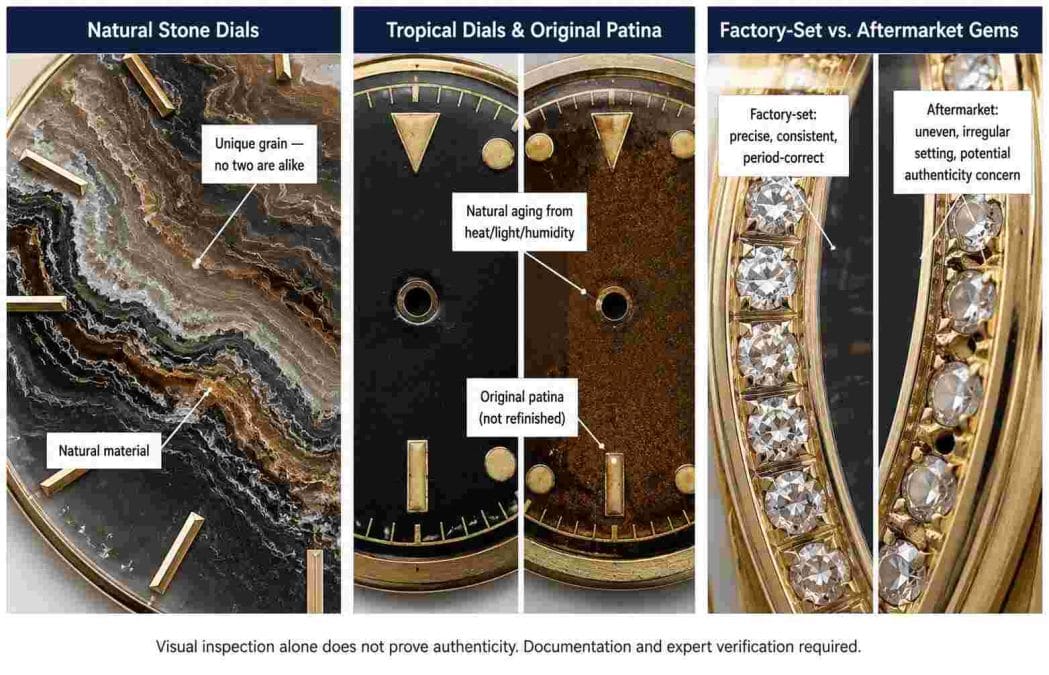
Certain material choices can make classic watches rare. These include natural stone dials, original “tropical” patina, and factory-applied gem settings. These features drive rarity more than the mechanical parts. Auction results show that these aesthetic variations sell for higher prices. This is true compared to standard versions of the same movement.

Materials That Define Rarity in Watches
Classic watch material rarity hierarchy pyramid

1. Natural Stone Dials

Natural stone dials make a watch special. No two slices of stone look the same. This unique quality means that every watch in a production run will be one of a kind. Common stone materials used in classic watches include onyx and tiger’s eye.

Metal choice matters in luxury accessories, not just watches. Our guide on Tungsten Vs Titanium Rings: Pros, Cons & Sizing covers the pros and cons of each. It looks at metal hardness, finish, and durability. These factors affect long-term value in men’s wearables. We use a material-science framework to explain it all.

Yellow gold is the standard case material. The rarest setups use white metals, such as white gold and platinum, with these dials. The value of a stone dial is highly dependent on its condition. The rarest and most valuable pieces feature a crack-free stone dial in a white metal case, a setup produced in the smallest quantities.

2. Tropical Dials and Original Patina

A tropical dial is a vintage watch dial that has changed color due to a non-replicable chemical process. This unique aging process makes the watch exceptionally rare. The discoloration occurs over time through exposure to UV light, heat, and humidity. These elements affect the original lacquer, but the watch must remain in unrestored condition to keep its value.

This effect is documented on famous Rolex references, including the Submariner Ref. 5513, the Daytona Ref. 6263, and the GMT-Master Ref. 1675. Tropical examples are rare because aging depends on each watch’s unique history. These aged pieces account for only a small fraction of surviving watches. Sales records show these examples sell for 2 to 3 times more than standard dials. This price gap remains even when tropical and standard watches are in similar, unrestored condition.

3. Factory Gems vs. Aftermarket Modifications

The main difference between factory-set and aftermarket gems is factory-original status. Factory-set gems are added by the brand during production and include proof from the manufacturer. Aftermarket versions come from third parties and lack documentation. These modifications alter the original design and lack the pedigree of factory pieces.

Specialists can detect aftermarket work by checking setting techniques and tool marks. Auction houses, including Phillips, Christie’s, and Sotheby’s, must disclose any modifications. For this reason, aftermarket gem modifications permanently reduce a watch’s auction value.

VI. Neo-Vintage Watches and Their Rarity

Neo-Vintage watches are rare timepieces made between 1980 and 2000. They mix old hand-finishing techniques with unique designs. To understand why design languages from this era are popular again, you need to know how fashion cycles work. This pattern is detailed in our Men’s Fashion Trends Seasonal Style Guide. The rarest pieces have integrated bracelet designs and unique materials. They were made in runs of fewer than 32 examples.

1. Integrated Bracelet References

The primary rarity factor for these watches is their specialized, single-unit case-and-bracelet construction. An integrated bracelet flows smoothly from the watch case. This design requires a more complex manufacturing process than simply attaching a standard strap. Two key examples are the Piaget Polo and Audemars Piguet Cobra, which are particularly scarce when found in rare materials. While white metals like white gold are the rarest, most pieces were made from yellow gold, which was the standard at the time.

2. Salmon Dials in White Gold Cases

The rarest Neo-Vintage models have two unique features: a salmon dial and a white gold case. A salmon dial is a specific pink-gold or coppery dial color that was not a standard catalog option. This rarity is documented by two Audemars Piguet references:

  1. Audemars Piguet Ref. 25661: Official records show that only 32 examples of this perpetual calendar were made in white gold. The salmon dial version is an even smaller, unconfirmed subset
  2. Audemars Piguet Ref. 14790: This configuration was a special-order item. Only five examples are known to have appeared on the secondary market

For both references, white gold was produced only in response to specific client or distributor requests. This led to much lower production volumes compared to the standard yellow gold and steel versions.

VII. New Collectors and Ethical Auction Models

Today’s rare watch market is driven by young collectors who prioritize originality. Alongside this shift, new auction models provide better financial structures for the industry. These trends change how collectible watches are priced and distributed in the secondary market.

1. How Do Under-30 Collectors Influence the Market?

Collectors under 30 shape the market. They focus on original, unrestored items. This trend boosts demand and prices for well-preserved examples. In a recent interview, Jasper Lijfering from Amsterdam Vintage Watches said that this group makes up 40% of his main clients. They seek high-end vintage watches, like 1950s Rolex tool watches and 1970s Day-Date models. Specifically, they have two strict criteria:

  1. Condition Priority: They demand watches with original, unrestored dials, hands, and unpolished cases
  2. Historical Accuracy: They reject examples with incorrect or replaced components
New Collectors and Ethical Auction Models
Rare Watch Collector Market Stats

2. How Do Alternative Auction Commission Structures Differ?

Alternative models disrupt traditional auctions. They cut out seller commissions and return a part of the sale price to the original watchmaker. The MTO auction platform charges a 0% seller commission. It also gives back 3% of the hammer price to the brand. This builds a lasting financial link between secondary market value and the original creator. This model is considered more ethical than the traditional approach used by firms like Phillips or Christie’s. Those companies charge seller commissions of 10% to 15%.

3. Which Independent Watchmakers Qualify as Future Collectibles?

Many elite independent watchmakers create fewer than 50 pieces each year. These watches are future collectibles. They are rare, well-finished by hand, and in high demand on the secondary market. Three makers exemplify this category:

  1. Simon Brette: Produces fewer than 20 Chronomètre Artisan pieces per year, each with extensive hand-finishing
  2. Sylvain Berneron: Uses unique materials like natural stone dials in very limited production runs
  3. Rexhep Rexhepi (Akrivia): One of his chronometers recently sold at auction for CHF 252,000, exceeding its high estimate of CHF 160,000

VIII. A Collector’s Handbook: 4 Rules for the Rare Watch Market

Collectors of rare watches should follow four key rules to protect their value:

  • Prioritize the original condition
  • Secure complete documentation
  • Cultivate dealer relationships
  • Use secure storage and insurance
A Collector’s Handbook: 4 Rules for the Rare Watch Market
Rare Watch Collector Handbook 4 Rules for the Market

1. Why is Original Condition a Priority?

Keeping the watch in its original, unrestored condition is the top priority. This way, we maintain its historical authenticity and preserve its factory specifications. Polishing a case takes off original metal. This alters the case geometry and lowers the watch’s value. Collectors should focus on the top 5% of preserved examples and evaluate three key markers of originality:

  1. Unpolished Cases: The case retains its original sharp edges, bevels, and factory finish
  2. Original Components: The dial, hands, and bezel have not been replaced
  3. Honest Patina: This refers to natural aging, like a “tropical” dial. Such aging shows its history and is highly prized

2. What Documentation Is Essential?

Complete documentation is essential. It shows a watch’s history and verifies its original factory specifications. The two most important forms of documentation are:

  1. Extract from the Archives: This official document is typical for brands like Patek Philippe. It lists the watch’s original specifications, including the movement number and dial type
  2. The key document for any Patek Philippe watch is the official Extract from the Archives. This confirms the watch’s original specs. It includes the movement number, dial type, case material, and delivery date, all from the brand’s records.
  3. Full Set: box, warranty papers, original certificates, and hang tags

3. How Can Collectors Source the Rarest Watches?

The rarest watches are sourced through private dealer networks, not public sales. New collectors can gain access by following three primary steps

  1. Build Dealer Relationships: Establish trust with reputable dealers over time
  2. Join Private Groups: Get invites to exclusive digital networks. This includes private WhatsApp groups where dealers share pieces first
  3. Use Social Media: Follow dealers and collectors on Instagram. This helps you find rare pieces

A rare watch is ultimately one element within a broader philosophy of curating accessories with intention. The key ideas for buying rare watches; originality, provenance, and quality also fit men’s wearables. We have a list of 10 Classy Men’s Accessories. Take a look!

4. How Should High-Value Collections Be Protected?

High-value collections need special protection and insurance that standard policies don’t provide. Two protection methods are necessary:

  1. Indestructible Storage: Use strong cases, like Peli™ or To the Hour™, to protect fragile parts, like stone dials, during travel and storage
  2. Specialized Insurance: Get worldwide coverage with no deductibles. This policy needs an investment protection clause covering up to 150% of the insured value to account for market appreciation

IX. Conclusion: What Defines a Collectible Watch?

A collectible watch has four key factors: mechanical complexity, material rarity, documented provenance, and original condition. These traits, not personal taste, build long-term value in the secondary market.

Market analysis shows that rarity is a product of specific, measurable characteristics. These include:

  • Mechanical Complications: Perpetual calendars and minute repeaters
  • Rare Materials: such as natural stone dials, original tropical patina, and factory-set gems
  • Verifiable Provenance: Confirmed through documents like an extract from the Archives
  • Original Condition: Including unpolished cases and unrestored components

These factors directly determine a watch’s value as an alternative asset. Sales records, like the $17.6 million sale of a Patek Philippe Ref. 1518, show that the market values most highly the examples that meet these criteria. A watch’s value as a collectible isn’t about feelings. It’s based on clear, measurable traits that show its rarity and historical importance.

FAQs

What is the rarest Rolex model ever made?

The Rolex Ref. 4113 is the rarest Rolex model. Only 12 examples were produced, and it is the only split-second chronograph ever manufactured by the brand.

Why are some steel vintage watches more valuable than gold?

Some steel watches are more valuable. This is because they were made in smaller numbers than gold ones for specific, complex models. The Patek Philippe Ref. 1518 in steel is one such example.

What defines a “supercomplication” in watchmaking?

A supercomplication is a mechanical watch that includes many functions beyond timekeeping. The Patek Philippe Henry Graves Supercomplication is an example that features 24 distinct complications.

Which attributes cause classic watches to increase in value?

Classic watches increase in value for three key reasons. First, they have rare complications. Second, they have a clear historical background. Third, they are in original, unrestored condition.

How is the provenance of a rare watch verified?

The provenance of a rare watch is verified by obtaining an “Extract from the Archives” from the manufacturer. This document confirms the watch’s original production details.

What is a double-signed dial?

A double-signed dial is a watch dial that features the name of the manufacturer and the name of the retailer, such as “Patek Philippe” and “Tiffany & Co.”

What is the function of an “Extract from the Archives”?

An “Extract from the Archives” is an official document from the manufacturer. It details a watch’s original configuration. This document is key for authenticating rare models.

What are the risks of buying rare watches on open marketplaces?

Buying rare watches on sites like eBay has risks. You might end up with watches that have non-original parts, known as “frankenwatches.” There could also be undisclosed polishing or incorrect movements.

What is the effect of polishing a vintage watch?

Polishing a vintage watch can lower its value. It removes original metal and changes the factory shape. Collectors care about these details.

What factors contribute to the value of neo-vintage watches?

Neo-vintage watches are valuable because they blend classic hand-finishing with modern designs. This unique mix makes them both reliable and appealing.

What is a “tropical dial”?

A tropical dial is a watch dial that has changed color naturally. It turns brown or amber, which many collectors find rare and desirable.

Abdul Basit
Abdul Basit

Abdul Basit is the founder of MensMinimal. He writes about men’s grooming, haircuts, hairstyles, and fashion. His focus is on clean and timeless style. His goal is to help modern men feel more confident with simple but powerful style choices. He loves simplicity and pays attention to small details. He creates easy guides to help men look sharp without much effort, whether they like classic cuts or styles like old money, preppy, or skater.

Articles: 38

Leave a Reply

Your email address will not be published. Required fields are marked *