Physical Address
Islamabad, PK
Physical Address
Islamabad, PK


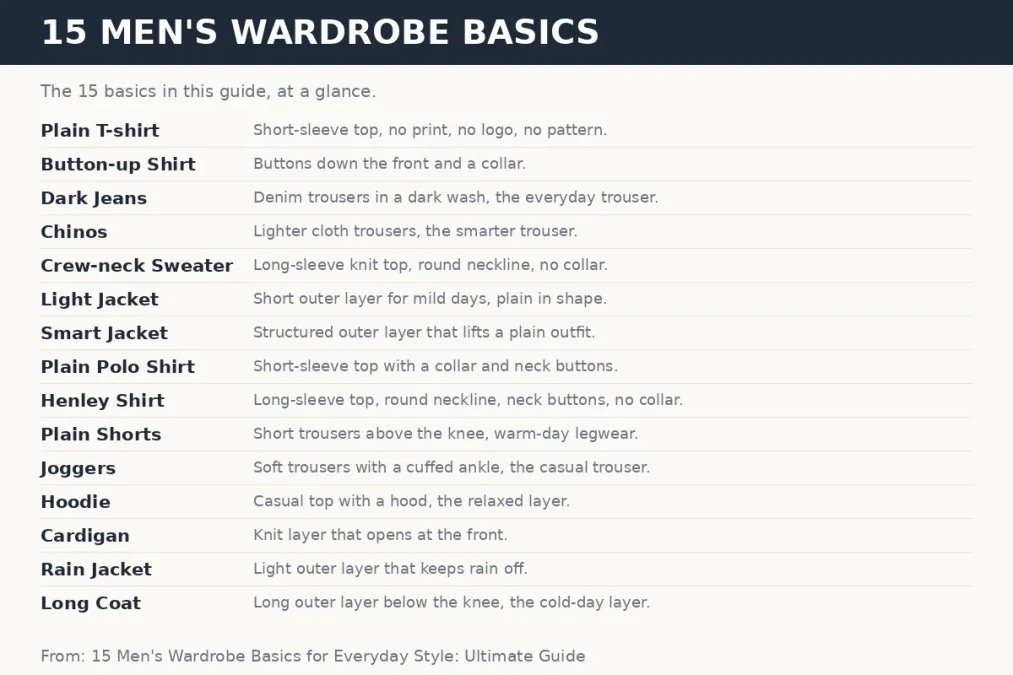
A wardrobe basic is a plain piece that matches most of your other clothes. A white T-shirt goes with jeans. It goes with chinos too. A dark pair of jeans goes with a T-shirt, a shirt, and a sweater. When each piece matches most of the rest, a small set of clothes gives you many outfits.
This guide builds that set. You will learn fifteen core pieces, how to check fit, how colours work together, what fabrics feel like, and how to layer without feeling bulky. You will also learn a simple order for building the set, and how to keep it in good shape. There are no product picks here, no prices, and no brand advice. This is a guide to choosing, not a shop list.
Style is the best way of expressing who you are without having to speak.
Rachel Zoe, Flipboard interview (2016)
A plain piece matches more of your other clothes than a loud piece does. A plain T-shirt goes with jeans, chinos, and under a jacket. A shirt with a big print goes with far fewer things. That is the whole idea behind basics. Plain gives you more outfits from fewer pieces.
Few pieces, many outfits. The same fifteen pieces pair up in different ways. A T-shirt with jeans is one outfit. The same T-shirt with chinos is another. Add a jacket, and it changes again. You do not need a full cupboard. You need a small set where each piece works hard.
Basics suit everyday life first. They are not party clothes. They are not work uniforms. They are the clothes for days out, errands, meet-ups, and ordinary days. If a piece only works for one rare occasion, it is not a basic.
Plain does not mean dull. Fit and clean lines do the work, not prints or logos. A plain shirt that fits well looks better than a loud shirt that pulls at the buttons. Get the fit right, keep the colours plain, and the set looks tidy on its own.
Fashions fade, style is eternal.
Yves Saint Laurent, Interview magazine (1975)
For a broader background on capsule wardrobes, see the Wikipedia article on the Capsule wardrobe.
The plain T-shirt is a short-sleeve top with no print, no logo, and no pattern. It is the simplest piece in the set, and it is the one you will wear most.
It sits on the shoulders. The sleeves end near the upper arm. The hem sits near the waistband. It should feel easy, not tight and not loose.
It suits warm and mild days, and everyday wear. On cool days, it works as the first layer under a shirt, a sweater, or a jacket.
Fit note: a T-shirt that rides up or pulls at the belly is the wrong size, whatever the label says. If it pulls when you sit, it will pull all day.
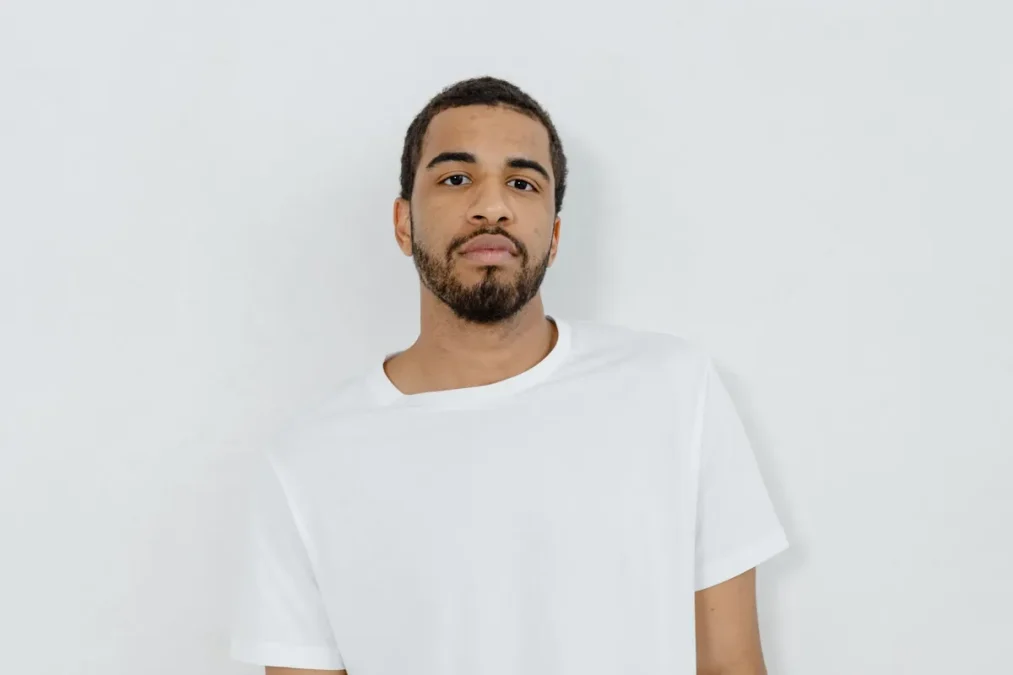
The button-up shirt has buttons down the front and a collar. A plain cloth shirt is the basic form. It is the piece that lifts an outfit a step up from a T-shirt.
It sits on the shoulders, with the seam at the shoulder line. The sleeves end near the wrist bone. No buttons should gape when you stand. It should feel easy when you sit, with no pulling across the front.
It suits smart-casual days and days out. It also layers well. Wear it under a sweater or a jacket, and it adds a collar and a smarter edge to a plain outfit.
Fit note: button-up versus T-shirt is the key pair in this set. The T-shirt is the everyday piece. The shirt is the step up. Together, they cover most days between casual and smart-casual.
Dark jeans are trousers made from denim cloth, in a dark wash. Denim is a sturdy cotton cloth. It feels heavier than shirt cotton, and it holds up well to everyday wear.
The waist should sit without a belt doing all the work. The hem should sit near the shoe. There should be no tight pull at the knee when you sit down.
Dark jeans suit everyday wear, casual days out, and mild and cool days as a tendency. They are the everyday trouser in this set.
Fit note: dark versus light is the point here. Dark jeans read smarter as a tendency, which is why dark is the basic and light is not. Light, faded jeans are a different piece, not a basic.
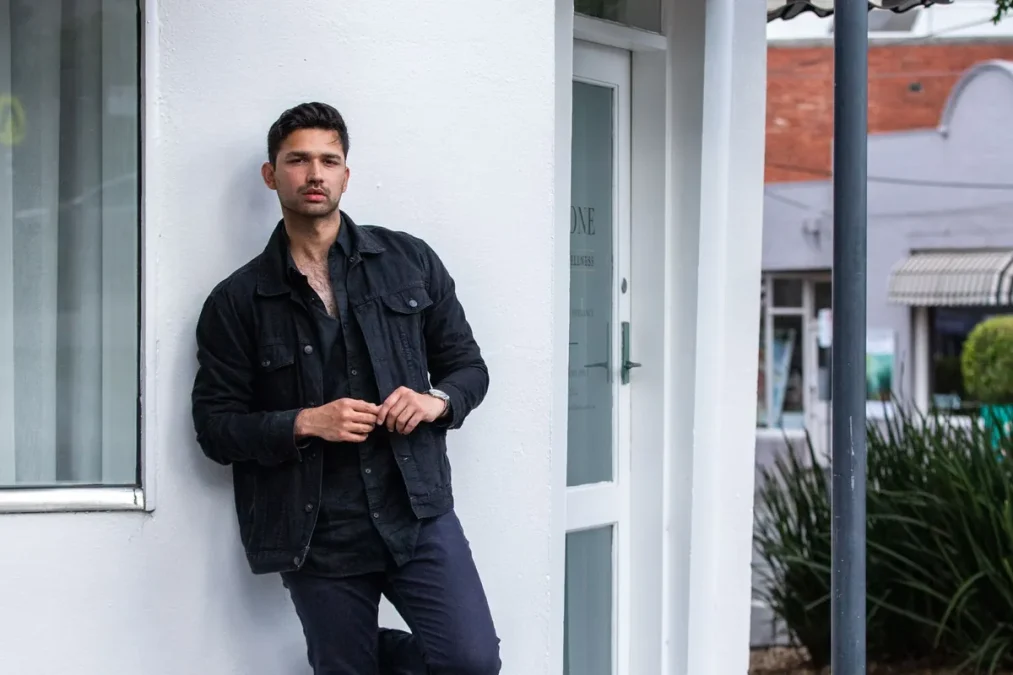
Chinos are cloth trousers. They feel lighter than jeans as a tendency, and they have a flat front as a tendency. They are the smarter trouser in this set.
The fit checks are the same as for jeans. The waist sits easy. The hem sits near the shoe. Sitting feels easy, with no pull at the knee.
Chinos suit smart-casual days, warm and mild days, and days when jeans feel too casual. They pair with a T-shirt for a neat everyday look, and with a button-up shirt for a smarter one.
Fit note: chinos versus jeans is a feel and a look difference. Chinos feel lighter and read a step smarter. Jeans feel sturdier and read more casual. Own both, and you cover both moods.
The crew-neck sweater is a long-sleeve knit top with a round neckline and no collar. Knit is a looped cloth. It feels soft and warm as a tendency.
It sits on the shoulders. The sleeves end near the wrist bone. The hem sits near the waistband. There should be room for a shirt under it, since that is how it layers best.
It suits cool days, layered over a T-shirt or a button-up shirt. Worn over a collared shirt, the collar shows at the neck, and the outfit reads a step smarter.
Fit note: the neckline is the shape. A crew neck sits round and plain. It layers cleanly over a collared shirt, with no collar fight at the neck.
The light jacket is a short outer layer for mild days, plain in shape. It is the everyday outer layer in this set.
The shoulders sit at the shoulder line. The sleeves end near the wrist bone. There should be room for a sweater under it on cool days, so it does not feel tight when layered.
It suits mild days, evenings, and days out when a coat feels too much. It finishes an outfit without adding weight.
Fit note: light jacket versus smart jacket is the outer-layer pair. The light jacket is the everyday layer. The smart jacket lifts the outfit. Own both, and your outer layers cover casual and smart-casual days.

The smart jacket is a structured outer layer that lifts a plain outfit a step up. It has more shape and structure than a light jacket. That shape is the point.
The shoulders sit clean. The sleeves show a little shirt cuff as a tendency. The front closes without pulling. If it pulls when closed, the size or the shape is wrong.
It suits smart-casual days, dinners out, and days when the outfit needs to look a step up. Worn over a plain T-shirt and dark jeans, it lifts the whole outfit. Worn over a button-up shirt and chinos, it reads smarter still.
Fit note: one smart piece per outfit is enough as a tendency. A smart jacket over plain basics does the work. Two smart pieces on top of each other tend to fight, not help.
The plain polo shirt is a short-sleeve top with a collar and a few buttons at the neck. It is a knit top as a tendency, softer than a button-up shirt and smarter than a plain T-shirt. It sits between the two.
It sits on the shoulders. The sleeves end near the upper arm. The collar sits flat, and the buttons close without pulling. It should feel easy, not tight and not loose.
It suits warm and mild days, and days when a T-shirt feels too plain but a button-up shirt feels too smart. It pairs with dark jeans, chinos, and shorts.
Fit note: polo shirt versus T-shirt is the key pair here. The polo adds a collar, so it reads a step smarter. If the collar curls or the buttons gape, the size or the shape is wrong.
The henley shirt is a long-sleeve top with a round neckline and a few buttons at the neck, but no collar. It is plainer than a polo shirt and a step up from a plain T-shirt as a tendency.
It sits on the shoulders. The sleeves end near the wrist bone. The buttons at the neck close without pulling. It should feel easy across the chest, with no tight pull when you sit.
It suits mild and cool days, and everyday wear. It works on its own, and as a first layer under a sweater, a cardigan, or a jacket.
Fit note: henley versus T-shirt is a neckline difference. The buttons at the neck add a little detail without a collar. If the buttons pull open when you sit, the size is wrong.
Plain shorts are short trousers that end above the knee as a tendency. They are the warm-day legwear in this set, plain in shape with no loud print.
The waist sits easy, and the hem sits above the knee. Sitting feels easy, with no tight pull. If they ride up when you sit, they are too short or too tight.
They suit warm days, holidays, and relaxed days out. They pair with a plain T-shirt, a polo shirt, or a henley shirt.
Fit note: shorts versus trousers is a weather difference. Shorts suit warm days only as a tendency. If the day turns cool, chinos or dark jeans are the better pick.
Joggers are soft trousers with a cuffed ankle as a tendency. They feel relaxed, and they are the casual trouser in this set.
The waist sits easy, often with a drawstring. The cuffs sit at the ankle. Sitting feels easy, with no pull at the knee. They should feel soft and easy, not tight at the thigh.
They suit relaxed days at home, casual days out, and travel days. They pair with a plain T-shirt, a henley shirt, or a hoodie.
Fit note: joggers versus chinos is a mood difference. Joggers read casual and relaxed. Chinos read a step smarter. Own both, and you cover both moods.
The hoodie is a casual top with a hood, made from soft cloth as a tendency. It is the relaxed layer in this set, warmer than a T-shirt and more casual than a sweater.
It sits on the shoulders. The sleeves end near the wrist bone. The hood sits flat at the back when it is down. It should feel easy, with room to move your arms.
It suits cool days, relaxed days out, and travel days. It layers over a T-shirt or a henley shirt, and under a light jacket or a rain jacket on colder days.
Fit note: hoodie versus crew-neck sweater is a mood difference. The hoodie reads casual. The sweater reads a step smarter. If the hood bunches under a jacket, wear the hood outside the jacket or pick the sweater instead.
The cardigan is a knit layer that opens at the front, with buttons or a zip as a tendency. It is the open layer in this set, easy to put on and take off.
It sits on the shoulders. The sleeves end near the wrist bone. The front closes without pulling, and it sits open easily too. There should be room for a shirt under it.
It suits cool days, layered over a T-shirt, a polo shirt, or a button-up shirt. Worn open over a plain top, it adds warmth without the weight of a jacket.
Fit note: cardigan versus crew-neck sweater is an opening difference. The cardigan opens at the front, so it layers and unlayers fast. The sweater pulls over the head and stays put. If the front pulls when closed, the size is wrong.
The rain jacket is a light outer layer that keeps rain off as a tendency. It is the wet-day layer in this set, plain in shape with a hood as a tendency.
The shoulders sit at the shoulder line. The sleeves end near the wrist bone. There should be room for a sweater or a hoodie under it, so it does not feel tight when layered.
It suits wet days, and days when the weather may turn. It finishes an outfit without adding weight, and it keeps the layers under it dry.
Fit note: rain jacket versus light jacket is a weather difference. The rain jacket is the pick when rain is likely. The light jacket is the pick on dry mild days. If the rain jacket feels stiff, that is normal for rain cloth as a tendency — check the fit and the movement, and the stiffness matters less.
The long coat is a long outer layer that reaches below the knee as a tendency. It is the cold-day layer in this set, and the longest piece in the guide.
The shoulders sit at the shoulder line. The sleeves end near the wrist bone. The front closes without pulling, and there is room for a sweater or a cardigan under it.
It suits cold days, and smart days when the weather is cold. Worn over a sweater and dark jeans, or over a button-up shirt and chinos, it covers the whole outfit in one layer.
Fit note: length is the main check. A long coat needs to sit straight and not catch at the knee when you walk. If it pulls at the shoulders when closed, the size or the shape is wrong.
These four checks apply to every piece in the set. Learn them once, and you can judge any piece in a few seconds.
First, the shoulder check. The seam sits at the shoulder line. Not past it, and not before it. A seam that hangs past the shoulder looks sloppy. One that sits before it pulls.
Second, the sleeve check. Shirt and jacket sleeves end near the wrist bone. T-shirt sleeves end near the upper arm. A sleeve that covers the hand is too long. One that rides up the arm is too short.
Third, the hem check. Tops sit near the waistband. Trouser hems sit near the shoe. A top that rides up when you sit is too short. A hem that pools on the shoe is too long.
Fourth, the sit-and-stand check. Sit down, then stand up again. Nothing should pull, gape, or dig. A shirt that gaps at the buttons when you sit will gape all day. Trousers that pull at the knee when you sit will pull all day.
Fit beats the label. If a piece pulls or gaps, the size or the shape is wrong, whatever the size tag says. Sizes differ between makers, but your four checks do not change.
Clothes make the man. Naked people have little or no influence on society.
Mark Twain, More Maxims of Mark (1927)
Dark colours tend to match more pieces. A dark pair of jeans goes with a light T-shirt, a plain shirt, and a sweater. Dark pieces also read smarter as a tendency, which is why dark jeans and dark chinos anchor this set.
Light colours suit warm days as a tendency. A light T-shirt with dark jeans is a simple pair that works. Light pieces also pair well with dark pieces, and that dark-with-light pair is the easiest way to match basics.
Plain first. A plain piece matches more than a patterned piece, as a tendency. That is why every piece in this set is plain. Patterns are fine on their own, but they narrow what a piece goes with, and basics need to go with a lot.
Match by pairing, not by rule. Put a dark piece with a light piece, keep the rest plain, and most basics pair up fine. You do not need a colour system to dress well in basics.
No colour system is claimed here. No skin-tone rules, no colour-wheel rules, no must-match claims. Tendencies and simple pairs are enough for a basics set.
Cotton is a soft plant-fibre cloth. It feels light and casual as a tendency. It is common in T-shirts and shirts. Cotton feels easy on the skin, which is why it leads this set.
Denim is a sturdy cotton cloth used for jeans. It feels heavier than shirt cotton as a tendency. That weight is why jeans feel sturdier than chinos, and why they suit everyday wear so well.
Knit is a looped cloth used for sweaters. It feels soft and warm as a tendency. A knit sweater stretches a little as you move, which is part of why it layers so easily.
Jacket cloth is firmer cloth used for jackets. It holds a shape better than shirt cloth as a tendency. That firmness is what gives a smart jacket its structure, and a light jacket its clean line.
Pick by feel and weather, not by the fabric name alone. Touch it, wear it, and judge how it feels on you. A fabric name tells you less than five minutes of wearing does.
Layer in order: thin close to the body, thicker further out. A T-shirt first, then a shirt or a sweater, then a jacket. This order keeps warmth close and bulk low.
Count your layers. Two layers suit mild days and three suit cool days, as a tendency. More layers than that tend to feel bulky, and bulk fights both comfort and looks.
Keep movement easy. Each layer should be a little looser than the one under it. If the jacket feels tight over the sweater, the pair is wrong. Arms and shoulders should move easy, not strain.
One smart piece per outfit is enough as a tendency. A smart jacket over plain basics lifts the whole outfit. A smart jacket over a smart shirt over smart trousers tends to look overdone for an everyday day.
Step one: start with three. A plain T-shirt, dark jeans, and a light jacket. These three alone cover many everyday days. A T-shirt with jeans is the base. The jacket finishes it on mild days and evenings.
Step two: add the button-up shirt and chinos. Now smart-casual days are covered too. The shirt lifts the jeans, and the chinos lift the T-shirt. Four new pairs appear from two new pieces.
Step three: add the crew-neck sweater and the smart jacket. Now cool days and smarter days are covered. The sweater layers over both tops. The smart jacket lifts any pair in the set.
Step four: add the polo shirt and the henley shirt. Now warm and mild days have more tops, and the collar and the buttoned neck give you two steps between a T-shirt and a button-up shirt.
Step five: add shorts and joggers. Now warm days and relaxed days are covered, with legwear to match the weather and the mood.
Step six: add the hoodie and the cardigan. Now cool days have two more layers — a casual one, and an open one that comes off fast.
Step seven: add the rain jacket and the long coat. Now wet days and cold days are covered, and every kind of day has an outer layer.
Step eight: check the set. Every piece should match at least two other pieces. A piece that matches nothing is not a basic yet. Swap it for a plainer piece, and the set works again.
No shopping order beyond this build order is claimed. No prices, brands, or shops are named. The order is about which pieces unlock the most outfits first, not about where to buy them.
Wash gently. Follow the care label on each piece. No blanket washing advice is given here, because pieces differ and labels differ.
Dry well. Let pieces dry in the air where you can, away from direct heat, before wearing them again. A piece worn damp loses its shape faster.
Keep shape. Hang shirts and jackets so they hold their shape. Fold knits so they do not stretch. A sweater on a hanger stretches over time; a folded sweater keeps its shape.
Fix small things early. A loose button or a fraying hem is easier to fix early than late. Basics earn their keep by lasting, and small fixes are part of that.
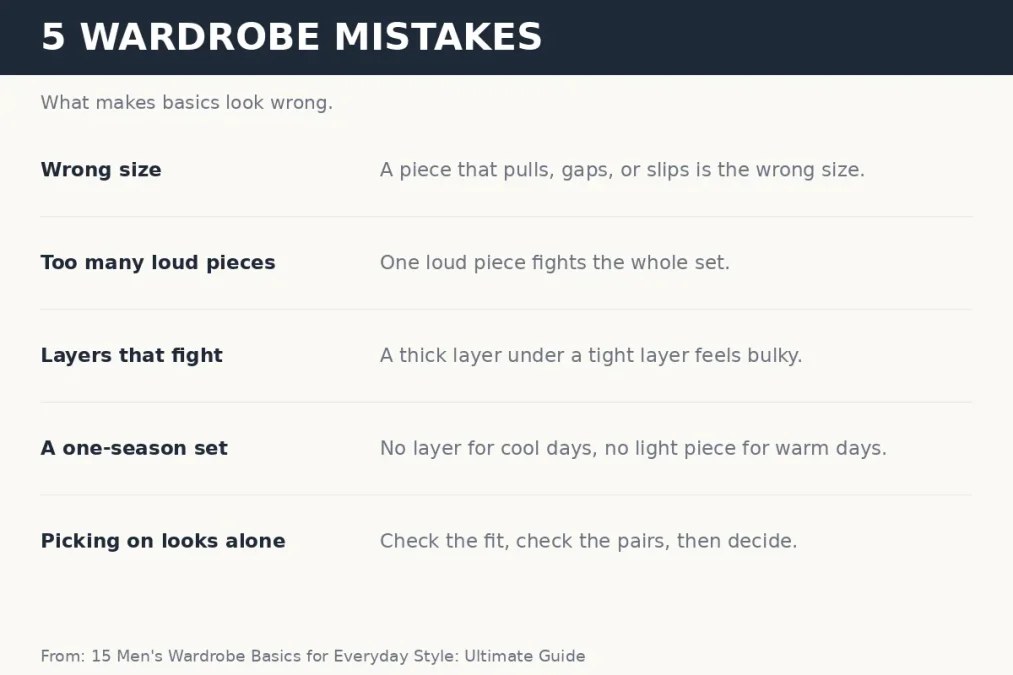
Wrong size. A piece that pulls, gaps, or slips is the wrong size, whatever the label says. Fit checks beat size tags every time.
Too many loud pieces. One loud piece fights the whole set. Basics work because they stay plain. If everything shouts, nothing matches.
Layers that fight. A thick layer under a tight layer feels bulky and looks wrong. Layer thin to thick, and keep each layer a little looser than the one under it.
A one-season set. A set with no layer for cool days and no light piece for warm days leaves gaps. The fifteen pieces cover warm, mild, cool, wet, and cold days between them.
Picking on looks alone. A piece that looks good in the hand can still pull, gap, or match nothing at home. Check the fit, check the pairs, and then decide.
Plain pieces that match each other, fit checked, layered thin to thick. That is the whole set: a plain T-shirt, a polo shirt, a henley shirt, a button-up shirt, dark jeans, chinos, shorts, joggers, a crew-neck sweater, a hoodie, a cardigan, a light jacket, a rain jacket, a smart jacket, and a long coat. Start with three, add the rest in order, and check that every piece matches at least two others. Wash gently, dry well, keep the shape, and fix small things early. Fifteen plain pieces, worn well, cover far more days than a cupboard full of pieces that match nothing.
Start with the plain T-shirt, dark jeans, and light jacket. These three cover many everyday days on their own, and each one pairs with the pieces you add later.
Fifteen pieces make the full set in this guide: a plain T-shirt, a polo shirt, a henley shirt, a button-up shirt, dark jeans, chinos, shorts, joggers, a crew-neck sweater, a hoodie, a cardigan, a light jacket, a rain jacket, a smart jacket, and a long coat. You can start with three and build up in the order given in the guide.
Jeans are made from denim cloth and feel sturdier and more casual. Chinos are cloth trousers that feel lighter and read a step smarter as a tendency. Dark jeans are the everyday pick; chinos are the pick when jeans feel too casual.
Check four things: the shoulder seam sits at the shoulder line, the sleeves end near the wrist bone, no buttons gape when you stand, and nothing pulls or digs when you sit down and stand up again. If it pulls or gaps, the size or the shape is wrong, whatever the size tag says.
Layer thin to thick: a T-shirt, then a shirt or sweater, then a jacket. Keep each layer a little looser than the one under it, so your arms and shoulders move easy. Two layers suit mild days and three suit cool days as a tendency; more layers than that tend to feel bulky.
Plain, dark colours tend to match more pieces, and light colours suit warm days as a tendency. A simple way to pair basics is to put a dark piece with a light piece and keep the rest plain. No colour system or skin-tone rule is claimed here.
They can look smart. The smart jacket is the piece that lifts a plain outfit a step up, and the button-up shirt and chinos cover smart-casual days. One smart piece per outfit is enough as a tendency — a smart jacket over plain basics lifts the whole outfit.
Follow the care label on each piece, let pieces dry in the air away from direct heat where you can, hang shirts and jackets so they hold their shape, fold knits so they do not stretch, and fix small things like a loose button early.


