Physical Address
Islamabad, PK
Physical Address
Islamabad, PK


A significant number of top entry level luxury watches buyers resell their purchase within the first year. Main reasons include poor wrist fit, lifestyle mismatches, and impulse buys from social media trends.
Entry-level luxury watches span $500 to $10,000. That range covers hundreds of models from brands including Tissot, Longines, Tudor, Omega, and Grand Seiko. Without a clear framework, the decision is overwhelming.
The stakes are real. A $4,000 watch depreciates 30% to 45% without the right documentation. A watch chosen on social media hype loses market relevance within 24 months. The 2026 market favors buyers who grasp the basics in our Mens Fashion Trends Seasonal Style Guide. It punishes those who don’t.
This guide covers 11 decision areas in one place. It defines entry-level luxury and explains why sources disagree on the price. A 5-step buying framework, movement specifications, and wrist fit guidance follow. Budget-organized model picks span 4 tiers from under $1,000 to $10,000. Women’s options, head-to-head comparisons, and buying channel analysis are included. Ownership costs and 7 common buyer mistakes close the guide. All recommendations use 2026 prices from Hodinkee, Bob’s Watches, TNS Diamonds, and SwissWatchExpo.
Entry-level luxury ($500–$10,000) is defined by quality (Swiss/Japanese movements, sapphire crystal, stainless steel) rather than just price. To avoid regret, prioritize wrist fit (lug-to-lug) and total cost of ownership over social media hype.
A luxury watch costs more than the sticker price. Over 10 years, budget extra for:
Entry-level luxury watches meet five standards: Swiss or Japanese movements, sapphire crystal, 316L stainless steel, authorized service networks, and brands with decades of heritage. No governing body defines the term. That is why experts disagree on price.
Five sources report different entry points:
Most first-time watch buyers have budgets under $2,000. This range includes brands like Tissot, Longines, Oris, and TAG Heuer. This information comes from pricing data by Chrono24 and surveys from authorized dealers.
The functional range is $500–$10,000, with the strongest value between $1,500 and $5,000.
Entry-level luxury splits into three tiers based on price and features.
1. Accessible Luxury ($300–$1,500) Includes the Tissot PRX, Hamilton Khaki Field, and Seiko Presage. They feature automatic movements and sapphire crystals. However, they lack the prestige of premium brands and have low resale value.
2. Core Entry Luxury ($1,500–$4,000) Features like the Longines HydroConquest, Oris Aquis Date, and TAG Heuer Carrera. They add COSC certification, silicon hairsprings, and 70+ hour power reserves. Resale holds at 60–75%.
3. Established Prestige ($4,000–$7,000) Watches like the Tudor Black Bay 58, Omega Seamaster, and Cartier Tank Must. The Tank’s clean design is a key principle in the Ultimate Guide to Minimalist Fashion Tips.

Entry-level luxury sits between fashion watches and high horology.

Fashion brands like Daniel Wellington and MVMT follow trends. Their watches corrode after 2–3 years.
High horology includes Patek Philippe, Audemars Piguet, and A. Lange & Söhne. Our Exclusive Men Guide to Old Money Style Mastery highlights brands with hand-finished movements. They also offer complications like perpetual calendars.
Entry-level luxury does not replicate this. It delivers daily reliability, brand legitimacy, and service support at a fraction of the cost.
Five benefits justify the higher price.
In-house movements (Tudor, Oris) hold 70–85% resale. Outsourced calibres (Longines, TAG Heuer) keep 60–70%.
Two paths define entry-level luxury: Swiss Made and Japanese craftsmanship. Both are valid.
Swiss Made requires:
Grand Seiko leads the Japanese path. Founded in 1960, it follows the “Grammar of Design”:
Its Spring Drive is accurate to ±1 second per day. Its 9F Quartz hits ±10 seconds per year: unmatched by Swiss quartz at this price.

Buyers who want Western brand recognition choose Swiss. Those who value finishing and innovation per dollar choose Grand Seiko.
Choosing your first luxury watch follows five steps in order: set the real budget, define the use case, pick the movement type, choose the buying channel, and confirm wrist fit. Do not skip to model browsing. A structured decision framework cuts down on impulse buys. It helps first-time buyers avoid common mistakes from watch retailers and pre-owned platforms.
Chrono24 Magazine suggests starting with a budget of 1–2 months’ net income.
The real cost includes the purchase price. It also covers servicing, insurance, and strap or bracelet replacement over ten years. Most buyers underestimate these expenses by $500–$1,500.

A $3,000 Tudor Black Bay 58 costs $4,500–$5,500 over 10 years. A $750 Tissot PRX costs $1,200–$1,500.
Insurance from providers like Hodinkee Insurance costs 1–2% of appraised value annually. On a $3,000 watch, that is $30–$60 per year.
Many specialized watch insurance policies offer ‘agreed value’ payouts with no depreciation adjustment. Deductibles differ by provider. Some have $0 deductibles, while others charge $25 to $100 per claim.
Strap replacements add $50–$400 over time:
Buyers who lose boxes and papers lose 10–15% of resale value at sale.
Your daily life determines the right specs: water resistance, size, dial, and strap.
Four main use cases:
A versatile everyday piece with 100m water resistance covers 90% of real-life needs. Avoid overspecialized watches unless you need their exact function.

Three movement types exist: automatic, quartz, and manual-wind. Each has trade-offs in accuracy, upkeep, and cost.

Quartz is not inferior. The Grand Seiko 9F is accurate to ±10 seconds per year; more precise than any mechanical watch under $10,000. The Cartier Tank Must SolarBeat runs for 16 years without a battery change and retails above $4,000.
Automatic suits buyers who enjoy mechanical craftsmanship. If not worn daily, use a watch winder ($30–$500).

Manual-wind offers thinner profiles and ritual. Used in dress watches like the Hamilton Khaki Mechanical and Grand Seiko SBGW231.
Choose based on your lifestyle; not prestige.
Three channels exist: authorized dealers, grey market, and pre-owned. Each has pros and cons.
Sellers like Watches of Switzerland and Tourneau.
✅ Guaranteed authenticity, full manufacturer warranty, 14–30 day return window.
❌ Fixed MSRP pricing, no negotiation, waitlists on popular models
Best for first-time buyers who want zero risk.
Include Jomashop, Ashford, and Time4Watches. Sell genuine watches outside official networks.
✅ Save 15–30% below retail (e.g., $5,000 vs. $6,700 for Omega Seamaster)
❌ No factory warranty, potential import duties (5–20%)
Check the seller’s reputation. Warranty varies by brand.
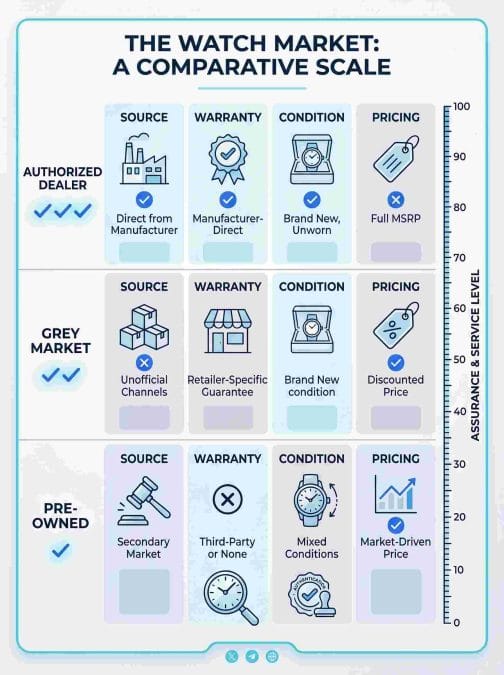
Like Chrono24, Bob’s Watches, Watchfinder. Offer access to high-tier models at lower prices.
✅ Full sets (box + papers) keep 85%+ value; AI authentication exceeds 99.5% confidence.
❌ Verify serial numbers, service history, condition grade
By mid-2026, EU Digital Product Passports will need scannable IDs via NFC or QR code, reducing fraud.
The European Union plans to launch a Digital Product Passport regulation. This will create scannable product IDs for luxury items. However, the timelines and specific rules for watches are still being worked out.
For first-time buyers, ADs are safest. For value, pre-owned wins; if you can verify authenticity.
Lug-to-lug distance is the best predictor of comfort and proportion. Case diameter alone is misleading.
Three measurements matter:
Example: A 40mm watch with 50mm lug-to-lug wears larger than a 42mm watch with 47mm lugs.
Try watches in person when possible. For online orders, cut a cardboard strip to the listed lug-to-lug length. Tape it to your wrist to test fit.
ECI Jewelers calls lug-to-lug “the secret spec that really matters.”
If this is your only watch, choose versatility over niche features. Fratello Watches advises: “Choose the one style you think you’ll wear most.”
Best all-around models share four traits:
Top picks:
These work with jeans, suits, and weekend gear; no need to switch watches.
Three specs decide if a luxury watch fits a buyer: movement type, material quality, and water resistance rating.
3 movement types power entry-level luxury watches: automatic, quartz, and manual-wind.
Automatic: a weighted rotor winds the mainspring through wrist movement. No battery. Worn 8 to 10 hours daily, it stays wound. Left unworn for 38 to 80 hours, it stops. The second hand sweeps continuously at 28,800 vph. Standard metal hairsprings can be magnetized by smartphones and laptops. This leads to a loss of accuracy, resulting in a delay of 30 to 60 seconds each day. Silicon hairspring models, such as the Longines L888.5 and Oris Calibre 400, do not get magnetized. They resist magnetization completely.
Quartz: a battery sends current through a quartz crystal oscillating at 32,768 vibrations per second. The seconds hand ticks once per second. Standard luxury quartz accuracy: ±15 seconds per month. Grand Seiko 9F: ±10 seconds per year. Longines V.H.P.: ±5 seconds per year. No magnetization risk. Battery replacement every 2 to 4 years costs $50 to $150. The Cartier Tank Must SolarBeat requires no battery change for 16 years.
Manual-wind: mechanical calibre with no rotor. Crown winding for 30 to 60 seconds each morning tensions the mainspring. The absence of a rotor reduces case thickness by 1.5 to 3mm, producing watches measuring 8 to 10mm total. Left unworn for 42 to 80 hours, it stops. Entry-level options include the Grand Seiko SBGW231. It has a 72-hour reserve. Another choice is the Hamilton Khaki Mechanical. This watch offers an 80-hour reserve. Both are under 11mm thick.

In-house movements matter in 3 specific scenarios at entry level. They are irrelevant in the majority of purchase decisions.
An in-house movement is engineered and manufactured by the brand. Outsourced movements come from ETA or Sellita, both supplying many brands industry-wide.
Where in-house matters:
Where in-house is irrelevant: The ETA 2824 and Sellita SW200 are among the most reliable movements ever produced. Any qualified watchmaker services them without proprietary tools. The Longines HydroConquest L888.5 outperforms many in-house movements priced twice as high. It excels in accuracy and magnetic resistance.
At $500 to $3,000, outsourced movements are standard and fully acceptable. In-house origin starts to show its value above $3,000. It offers longer service intervals and better resale value.
COSC and METAS are the 2 independent bodies that verify movement accuracy. Both test externally, not by the brand itself.
COSC tests uncased movements across 15 days in 5 positions and 3 temperatures. Accuracy standard: -4/+6 seconds per day. Passing watches display “Chronometer” on the dial. Adds approximately $200 to $500 to retail price. Brands: Tudor, Longines, Breitling, Rolex.
METAS tests the fully assembled watch. Includes all COSC tests plus 8 more tests over 10 days. Accuracy standard: 0/+5 seconds per day. Magnetic resistance: 15,000 gauss. Only Omega offers METAS at entry level.
Three specs make entry-level luxury watches different from fashion watches explained in men’s watches guide. They are crystal type, steel grade, and water resistance.
Sapphire crystal is standard on every watch above $500 in this guide. Mineral crystal belongs to fashion watches.

Grand Seiko, Omega, and Longines apply double-sided AR coating. TAG Heuer and Tudor apply single-sided AR coating. The Omega Speedmaster Professional uses hesalite (acrylic) crystal as a deliberate heritage specification. It scratches easily but resists shattering.
316L is the standard that 95% of luxury watch brands use. This includes Tudor, Omega, TAG Heuer, Longines, Oris, and Cartier. Rolex exclusively uses 904L. Both resist corrosion from saltwater, sweat, and daily chemical exposure. The difference produces no visible or functional outcome under normal daily wear.
2 more case materials appear at entry level:
Water resistance ratings are static laboratory results. They do not represent safe depths for real-world use.
| Rating | What It Actually Allows |
| 30m / 3ATM | Splashes and rain only. No swimming |
| 50m / 5ATM | Brief water contact. No swimming |
| 100m / 10ATM | Swimming and snorkeling |
| 200m / 20ATM | Recreational scuba diving |
| 300m / 30ATM | Professional diving |

The practical minimum for daily wear is 100m. A 30m-rated watch submerged in a pool risks immediate water ingress.
4 factors reduce real-world water resistance beyond the dial rating:
Lug width determines long-term strap compatibility. A 20mm lug width has significantly more aftermarket options than 19mm or 21mm. Common lug widths: 18mm on the Cartier Tank, 20mm on the Tudor Black Bay 58 and Omega Seamaster, 22mm on the Breitling Superocean.
A watch that doesn’t fit well gets ignored, no matter its quality, brand, or cost.
A 2021 WatchPro survey showed that 34% of pre-owned watch sellers reported wrist fit as their main reason for reselling a new watch. This often happened within 12 months.

Case diameter, lug-to-lug distance, and case thickness together determine how a watch fits on the wrist.
Case diameter is the width of the watch face in millimeters. It is the most prominently listed measurement in watch listings. It is also the least reliable single predictor of actual fit.
Lug-to-lug distance is the measurement from the tip of the upper lugs to the tip of the lower lugs. It measures the physical span of the watch across the wrist. When lug-to-lug exceeds wrist width, the lugs overhang the wrist edge. Overhang causes discomfort during wrist flexion, visual disproportionality, and accelerated strap wear. Revolution Watch says lug-to-lug is “the true measurement to keep in mind. It’s much more useful than the traditional case width.”
Case thickness determines how the watch sits off the wrist and whether it clears a shirt cuff. Under 10mm slides under any dress shirt cuff. 10mm to 13mm fits most cuffs. Above 13mm requires loose cuffs or rolled sleeves.
A properly fitted watch allows 1 finger to slide underneath the band.
Lug width determines strap compatibility. Common lug widths: 18mm on the Cartier Tank Must, 20mm on the Tudor Black Bay 58 and Omega Seamaster 300M, 22mm on the Breitling Superocean. A 20mm lug width provides the widest aftermarket strap selection.
A 40mm watch with a 48mm lug-to-lug fits smaller than a 38mm watch with a 51mm lug-to-lug. Diameter alone cannot predict this difference.
Tim Mosso from WatchBox shares a simple fit formula: subtract 5mm from your wrist width. This gives you the most comfortable lug-to-lug measurement. A 55mm-wide wrist accommodates watches up to 50mm lug-to-lug.
2 watches illustrate this directly:
The 3mm diameter difference understates the actual fit difference. The 2.5mm lug-to-lug gap and 1.3mm thickness create a different wearing experience. ECI Jewelers confirms lug-to-lug is “the secret spec that really matters for fit.”
Wrist circumference determines the appropriate lug-to-lug range. Diameter is the aesthetic choice within that range.
Measure wrist circumference with a flexible tape below the wrist bone. Measuring above or below this point changes the reading by up to 5mm.

The max lug-to-lug column is the binding constraint. The diameter column is the aesthetic preference within it.
The dominant sizing trend of 2025 to 2026 favors 36mm to 39mm cases. This reverses the 44mm to 46mm oversized era of 2005 to 2015.
3 measurable signals confirm the trend:
36mm to 39mm cases fit the largest proportion of wrist sizes. They transition between casual and formal settings without visual incongruity. The Black Bay 58 at $3,800 to $4,300 retails below the Black Bay 41 at $4,100 to $4,600. The smaller reference delivers better proportions and a lower entry cost.
For wrists under 6.5 inches (16.5 cm), the best fit is in the 34mm to 38mm range. Look for a lug-to-lug length under 47mm.

Many 36mm to 38mm models marketed as men’s watches wear proportionally on wrists of 6 to 6.75 inches. The Tudor Black Bay 36, Rolex Oyster Perpetual 36mm, Cartier Santos Medium (35.1mm), and Omega Seamaster Aqua Terra (38mm) all fit anyone. They come in unisex sizes. They share similar movements and water resistance too. The “men’s” designation reflects historical marketing convention only.
5 methods allow accurate fit assessment for online purchases without handling the watch in person.
1. Wrist width calculation. Measure wrist width in millimeters using calipers or a ruler. Subtract 5mm to find the most comfortable lug-to-lug. Tim Mosso of WatchBox confirms this as the most reliable pre-purchase fit calculation.
2. Cardboard template. Cut a cardboard strip to the exact lug-to-lug measurement from the manufacturer’s spec sheet. Place it on the wrist horizontally. If it extends past wrist edge, the watch overhangs.
3. Reference watch comparison. Measure the lug-to-lug of a watch already owned that fits comfortably. Use that figure as the upper limit. A lug-to-lug difference of 3mm or less produces a nearly identical wearing experience.
4. Wrist shot research. Check forums like WatchUSeek and Reddit’s r/Watches for wrist shots. They often include wrist sizes. YouTube channels including Teddy Baldassarre and Fratello Watches include wrist measurements in reviews. Match reviewer wrist size to yours for the most accurate visual reference.
5. Authorized dealer try-on. Try a same-brand reference of similar dimensions at a local authorized dealer before committing online. Tim Mosso advises: “Try before you buy. Never buy a watch without wearing it.”
Wrist circumference fluctuates 3 to 10mm between morning and evening. Bracelets with micro-adjustment accommodate this without a watchmaker visit. The Tudor T-fit clasp provides 8mm of tool-free adjustment. The 2026 Longines Hydro Conquest H-link bracelet includes a redesigned micro-adjustment clasp.
The top entry level luxury watches are in four price ranges from $500 to $10,000. Each tier gives better movement quality, finishing, and resale value.
A 2023 Deloitte report reveals that 58% of buyers want to spend less than $1,650. This means most first-time buyers fall in the $1,000–$3,000 range.
Three solid choices cost less than $1,000. They provide Swiss or Japanese craftsmanship that beats fashion watches.
This tier delivers:
It does not deliver:
Value peaks here. You get COSC certification, ceramic bezels, silicon hairsprings, and 72-hour power reserves.
Upgrades from sub-$1,000 tier:
In-house movements, strong brand equity, and high resale define this tier. Pre-owned Omega and Breitling enter here.
Pre-owned access at this price:
New retail purchases lose 20–35% immediately. Pre-owned with boxes and papers is the smarter strategy.
Box and papers matter most here:
| Documentation | Resale Impact |
| Complete set (box + papers + warranty card) | Full value |
| Watch + papers only | 5–10% reduction |
| Watch only | 15–25% reduction |
Smart buying principles:
An entry-level luxury watch for women has 4 key attributes: a Swiss or Japanese movement, a scratch-resistant sapphire crystal, a surgical-grade steel case, and a manufacturer-authorized service network. Men’s models differ mainly in case size, dial proportion, and bracelet width.
The 2026 market for these watches ranges from $395 to $7,400. The best value falls between $800 and $5,500. This is where movement quality, brand heritage, and wearable sizing come together.
A note on sizing: The “boyfriend watch” trend has expanded the options for women. Many models from 36mm to 38mm, like the Tudor Black Bay 36, fit well on wrists that measure 5.5 to 6.5 inches (14cm to 16.5cm).
This price tier offers watches with great features. They have automatic movements and sturdy construction. This provides a real luxury experience.

Active lifestyles, water sports
This range offers better brand recognition and stylish designs from top Swiss watchmakers.
| Model | Key Specs | Price (2026) | Best For |
| Longines DolceVita | Swiss quartz, rectangular case, elegant | $1,100–$2,200 | Classic dress watch, smaller wrists |
| TAG Heuer Aquaracer 30mm | Quartz, 200m water resistance, ceramic bezel | $1,800–$2,650 | Sport diving, bold style |
| Tudor Royal 28mm–38mm | Automatic, integrated bracelet, versatile | ~$2,500 | All-purpose style from a top brand |
| Oris Star Edition 35mm | Automatic, slim vintage design, sapphire | ~$1,800 | Vintage aesthetic from a respected brand |
Vintage aesthetic from a respected brands:
This tier features iconic models. They have in-house movements, top-notch specs, and a rich brand heritage.
| Model | Key Specs | Price (2026) | Best For |
| Grand Seiko SBGX359 | Hyper-accurate quartz, Zaratsu polish | $3,200 | Unmatched finishing and accuracy |
| Cartier Tank Must | Solar-powered quartz or automatic, iconic | $3,350–$4,600+ | Timeless elegance, strong resale value |
| Tudor Black Bay 36 | In-house automatic, 200m water resistance | $3,800–$4,200 | A versatile “one-watch collection” |
| Omega Aqua Terra 34mm | METAS-certified, anti-magnetic, 150m WR | $6,400–$7,400 | Sport-dress versatility, top performance |
Sport-dress versatility, top performance
A watch’s fit is determined by its lug-to-lug measurement, not just its case diameter. This is the distance from the top strap horns to the bottom ones. A 36mm watch with short lugs often wears smaller than a 34mm watch with long lugs. Always check this measurement for an accurate sense of fit.
Adding diamonds to an entry-level watch raises the price by $1,000 to $3,000. However, it doesn’t enhance the watch’s technical quality or resale value. For the same price premium, a buyer can buy a watch from a higher tier with a superior movement. Non-set models offer stronger value retention.
To select the correct watch as a gift, verify 3 facts about the recipient:
For buyers without this information, 2 safe choices exist:
Of course. I rewrote the buying dilemmas section using the Semantic SEO framework. This makes the information clear, direct, and easy to understand.
Three key comparisons cause the most hesitation for first-time luxury watch buyers. This guide ends the debate by looking at each option. We’ll cover heritage, movement, finishing, resale value, and daily wearability.

Each comparison uses pricing and market data from 2026. Sources include Chrono24, WatchBox, and Bob’s Watches.
This is the most common comparison in the entry-level dive watch category. Both watches have in-house movements and diving heritage. They differ in size, technical specifications, and price.
| Factor | Tudor Black Bay 58 | Omega Seamaster Diver 300M |
| Case Size | 39mm | 42mm |
| Thickness | 11.9mm | 13.2mm |
| Movement | MT5402 (In-house, COSC) | Calibre 8800 (In-house, METAS) |
| Power Reserve | 70 hours | 55 hours |
| Water Resistance | 200m | 300m |
| Bezel Material | Aluminum | Ceramic |
| Magnetic Resistance | Standard | 15,000 gauss |
| Price (New, 2026) | $3,800–$4,375 | $5,500–$5,700 |
| Price (Pre-Owned) | $3,200–$4,000 | $4,200–$5,200 |
Heritage
Movement
Daily Wearability
Resale Value
The Verdict
This comparison pits a motorsport icon against a pilot’s watch. The Longines Spirit offers superior technical features for the price. The TAG Heuer Carrera offers stronger brand recognition and a distinct racing heritage.
| Factor | TAG Heuer Carrera | Longines Spirit |
| Movement | Calibre 5 (Sellita base) | Calibre L888.4 (In-house modified) |
| Certification | None | COSC Chronometer |
| Power Reserve | ~38 hours | 72 hours |
| Hairspring | Standard | Silicon |
| Price (New, 2026) | $2,800–$3,500 | $2,350–$2,700 |
Movement and Value
The Longines Spirit is the clear winner on technical merit. For $150 to $800 less than the Carrera, the Spirit provides:
Heritage
The Verdict
This choice shows a key debate in watch collecting. It’s about Swiss prestige and practicality versus Japanese artistry and finishing.
| Factor | Rolex Oyster Perpetual 36 | Grand Seiko SBGW299 |
| Movement | Automatic (Calibre 3230) | Manual-wind (Calibre 9S64) |
| Accuracy | -2/+2 sec/day | +5/-3 sec/day |
| Case Finishing | Brushed & polished 904L steel | Zaratsu distortion-free polish |
| Crown Type | Screw-down | Push-pull |
| AD Availability | Waitlists over 12 months | Generally available |
| Secondary Market | Trades above retail ($7.5k+) | Trades below retail (~$5k) |
| Price (AD, 2026) | $6,150–$6,550 | $5,400–$5,800 |
Finishing Quality vs. Practical Use
Investment Value vs. Accessibility
The Verdict
| If Your Priority Is… | The Best Watch Is… |
| Vintage dive aesthetics & smaller wrist size | Tudor Black Bay 58 |
| Modern looks & top-tier dive specs | Omega Seamaster Diver 300M |
| Best movement for the money & COSC accuracy | Longines Spirit |
| Motorsport heritage & brand recognition | TAG Heuer Carrera |
| Investment value & everyday practicality | Rolex Oyster Perpetual 36 |
| Hand-finished quality & immediate availability | Grand Seiko SBGW299 |
These watches wear differently in person. The best way to find the right model is to visit an authorized dealer. Try on each one to see which fits your wrist and style before you buy.
There are three primary channels to buy an entry-level luxury watch: authorized dealers (ADs), the grey market, and pre-owned platforms. Each channel offers a distinct trade-off between price, warranty, authenticity, and availability.
Pre-owned and grey market platforms have grown significantly among younger buyers. Chrono24 is the biggest online watch marketplace. It links many professional dealers and private sellers worldwide. You can find lower prices and quicker availability here. There are no waitlists like with authorized dealers.
Authorized dealers are retailers officially certified by brands like Rolex, Omega, and Tudor. They are the only official source for brand-new watches.
Buying from an AD is ideal for first-time buyers. It ensures authenticity, especially for items under $3,000 where a warranty matters. It’s also great for milestone gifts that need perfect provenance.
The grey market includes unofficial sellers. They offer genuine, new watches, but not through the brand’s authorized network. These are not counterfeit watches. They are real watches from authorized dealers. These come from extra inventory or international price gaps. Top platforms include Jomashop and Watchmaxx.
The grey market works for experienced buyers. They can check a seller’s reputation and are okay with skipping the manufacturer warranty. In return, they get a discount of 25% or more.
Pre-owned platforms are marketplaces for buying and selling used luxury watches. Trusted platforms like Chrono24, Bob’s Watches, and Watchfinder offer authentication services. They also provide buyer protection.
Buying pre-owned is a smart choice for several reasons. It’s great for buyers who want a watch that costs more than their budget. It’s also ideal for collectors looking for discontinued models. Plus, experienced buyers can easily assess a watch’s condition.
The true cost of a luxury watch is the purchase price plus an extra $1,000 to $3,000 in hidden expenses over 10 years. Most first-time buyers underestimate the total cost of luxury watch ownership. As ECI Jewelers warns, ‘Skipping service might feel like saving money. It isn’t. Neglect can turn a routine overhaul into a multi-thousand-dollar repair.
The retail price is just 55% to 70% of a watch’s total 10-year cost. This is due to three hidden expenses: servicing, insurance, and depreciation.
A mechanical watch has over 150 tiny parts, including gears, springs, and jewels, that are subject to wear. These parts need regular maintenance to prevent damage. As ECI Jewelers warns, “Neglect turns a routine $500 service into a $2,000 repair.”
For example, here is the breakdown for a Tudor Black Bay 58 priced at $4,000:
A mechanical watch needs a full service every 5 to 10 years. The cost varies from $195 to over $1,200 for each service. This depends on the brand and how complex the movement is.
| Brand Tier | Example Brands | Avg. Service Cost (5-10 yrs) |
| Gateway ($500–$1,000) | Tissot, Hamilton, Seiko | $195–$400 |
| Sweet Spot ($1,000–$3,000) | Longines, Oris, TAG Heuer | $380–$500 |
| Prestige ($3,000–$5,000) | Tudor, Grand Seiko | $400–$855 |
| Upper Entry ($5,000+) | Rolex, Omega | $800–$1,400 |
Recommended Service Intervals by Brand:
Specialized watch insurance is necessary for watches valued over $2,000 and costs 1% to 2% of the watch’s appraised value annually.
A standard homeowner’s policy typically limits jewelry coverage to $1,000–$2,000. BriteCo, Hodinkee Insurance, and Jewelers Mutual are dedicated watch insurers. They provide “agreed value” policies. If your watch is stolen, you get the full insured amount. There’s no deduction for depreciation.
Over 10 years, insurance adds $500 to $1,400 to the total cost of ownership. This fee keeps you safe from losing all your money because of theft, accidental damage, or things going missing.
Most entry-level luxury watches lose 20% to 40% of their value in the first year. However, Rolex models stand out. They often sell for more than their retail price. After the first year, the value of most watches stabilizes.
A complete “box and papers” set increases resale value by 12% to 25%. This set includes the original box, manual, warranty card, and receipt. On a $5,000 watch, missing this set can reduce your resale price by up to $1,250.
Buying a pre-owned watch allows you to skip the initial, steepest drop in value.
This table displays the true cost of owning four popular watches over ten years. It includes all expenses and possible resale value.
| Watch Example | Purchase Price | Services (10yr) | Insurance (10yr) | Total 10-Year Outlay | Estimated Resale | Net Cost of Ownership |
| Tissot PRX ($700) | $700 | $400 | $140 | $1,240 | $280–$420 | $820–$960 |
| Longines Spirit ($2,500) | $2,500 | $500 | $500 | $3,500 | $1,375–$1,750 | $1,750–$2,125 |
| Tudor BB58 ($4,000) | $4,000 | $800 | $800 | $5,600 | $3,000–$3,400 | $2,200–$2,600 |
| Rolex OP 36 ($6,500) | $6,500 | $1,200 | $1,300 | $9,000 | $5,500–$6,500+ | $2,500–$3,500 |
The watch with the best resale value usually has the lowest net cost of ownership, even if it costs more upfront. The Rolex may have the highest price, but it might cost only a bit more to own over 10 years than the Longines. This is because it holds its value so well.
First-time luxury watch buyers often make 8 identifiable mistakes that lead to regret. These mistakes are preventable with the right knowledge. Hodinkee notes that new buyers often rush their choices. They tend to follow trends and skip important research.
Here are the 8 mistakes and how to avoid them.
A common mistake is buying a watch because it’s popular on Instagram or TikTok. You should choose one that fits your wrist and lifestyle instead. Trends fade, and a watch that is popular today may trade at a 30% discount in two years.
The fit of a watch is determined by its lug-to-lug measurement, not its case diameter. Lug-to-lug is the distance from the top horn of the watch case to the bottom one. If the lugs hang over the sides of your wrist, the watch is too big.
| Wrist Circumference | Max Lug-to-Lug |
| Under 6″ (15cm) | Under 44mm |
| 6″ to 6.5″ (15.2cm – 16.5cm) | 44mm–48mm |
| 7″ and Over (17.8cm+) | 48mm–52mm |
A “30m” water resistance rating does not mean you can take the watch 30 meters deep. It means the watch can only handle light splashes. Any intentional submersion, like swimming or showering, can damage the watch and void the warranty.
| Rating | Safe Activities | Not Safe |
| 30m | Light splashes, hand washing | Swimming, showering |
| 50m | Showering, brief submersion | Swimming laps |
| 100m | Swimming, snorkeling | Scuba diving |
| 200m | Recreational scuba diving | Saturation diving |
Quartz movements are not inferior to automatic movements; they are different. They offer superior accuracy and lower maintenance costs.
| Factor | Quartz Movement | Automatic Movement |
| Accuracy | ±15 seconds per month | ±15 seconds per day |
| Maintenance | Battery change every 2–5 years | Full service every 5–10 years |
| Service Cost | Minimal | $200–$1,200 |
When you buy pre-owned, you might get a counterfeit or a “Frankenwatch”; a watch made from real parts that don’t match. These watches have a significantly lower value.
Most luxury watches, except for some Rolex models, are not good financial investments. Most will depreciate 20% to 40% after purchase.
| Brand/Model | Expected Depreciation (3 Years) |
| Tissot, Hamilton, Seiko | 40–60% |
| Longines, Oris, TAG Heuer | 30–45% |
| Tudor Black Bay | 15–25% |
| Rolex Oyster Perpetual | 0% (Often appreciates) |
The original box, warranty card, and manuals are known as “box and papers.” Discarding them can reduce a watch’s resale value by 10% to 25%. On a $5,000 watch, that is a loss of up to $1,250.
The sticker price is only part of the cost. Over 10 years, servicing and insurance will add 15% to 40% to the initial purchase price.
| Watch | Purchase Price | 10-Year Total Cost |
| Longines Spirit | $2,500 | ~$3,255 |
| Tudor Black Bay 58 | $4,150 | ~$5,323 |
| Rolex OP 36 | $6,500 | ~$8,475 |
Choosing the right entry-level luxury watch means looking at key specs, not trends. A smart buy involves looking at the total cost of ownership. It’s also crucial to pick the right movement for your lifestyle. Make sure to check the wrist fit using lug-to-lug measurements, not the case diameter. A great watch, whether a Swiss automatic or a Japanese quartz, should be comfortable to wear every day. It should show true craftsmanship and provide lasting value.
Ready to make a smart purchase? Once you find the ideal watch, check out our guide on 10 Classy Mens Accessories. They’ll elevate your whole look.
Tissot is in the attainable luxury tier. It’s not true luxury, but it’s a credible Swiss watchmaker founded in 1853. Its watches feature Swiss Made movements, sapphire crystal, and stainless steel. These meet established Swiss quality standards. Tissot gives better craftsmanship and durability for buyers under $1,000. This is true compared to any fashion watch at that price.
Yes. The Rolex Oyster Perpetual is an excellent first luxury watch thanks to its timeless design, in-house movement, and strong resale value. It works well for both casual and formal wear.
Yes, but set realistic expectations. Brands like Tissot, Hamilton, and Seiko Presage offer quality Swiss or Japanese movements. They feature sapphire crystal and solid stainless steel, all under $1,000. You won’t get a fully in-house movement or luxury at this price. However, you will receive a reliable watch from a brand with real watchmaking heritage.
Neither is universally better; the right choice depends on your priorities. Automatic movements have great craftsmanship and appeal for collectors. However, they need a full service every five to eight years. Quartz movements are more accurate, virtually maintenance-free, and often priced lower. For everyday practicality, quartz is underrated. For long-term collector satisfaction, automatic wins.
Entry-level luxury ranges from $500 to $10,000. This includes brands like Tissot, Longines, Tudor, and Omega. Mid-tier luxury ranges from $10,000 to $15,000. It includes more complex models from Omega, IWC, and Jaeger-LeCoultre. At this level, in-house movements become standard. You also see better finishing and significantly stronger resale value.
Yes. Entry-level luxury watches are a smart buy. They appeal to those who value craftsmanship. These watches have brand history and last longer than fast fashion. The pre-owned market has expanded, offering higher-tier models at more accessible prices. The move to neo-vintage styles and simple designs helps classic looks in this segment.
Buying from authorized dealers is the safest option. They give you a full manufacturer warranty, guaranteed authenticity, and reliable after-sales support. The grey market can offer genuine watches at lower prices, usually 15 to 30 percent less than retail. However, it does not provide a manufacturer warranty. First-time buyers who aren’t familiar with authentication should choose authorized dealers. Experienced buyers can find good deals in the grey market if they verify authenticity.


